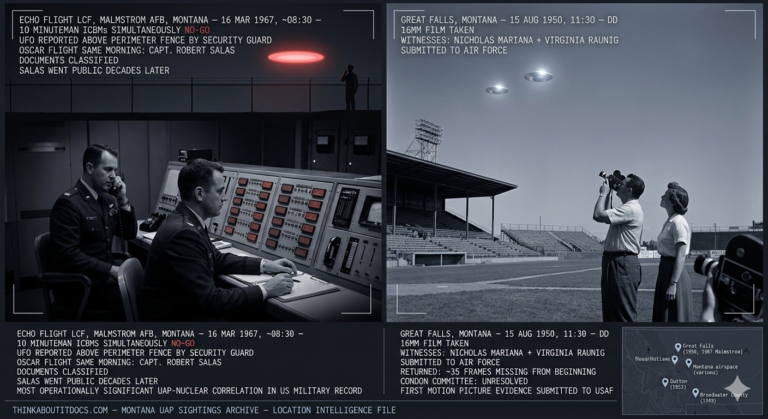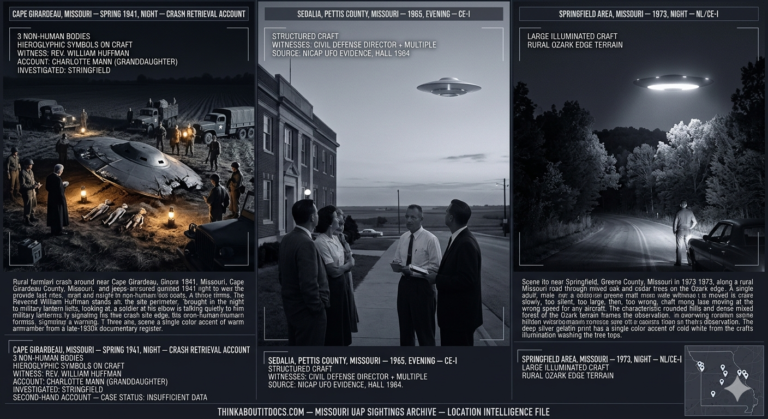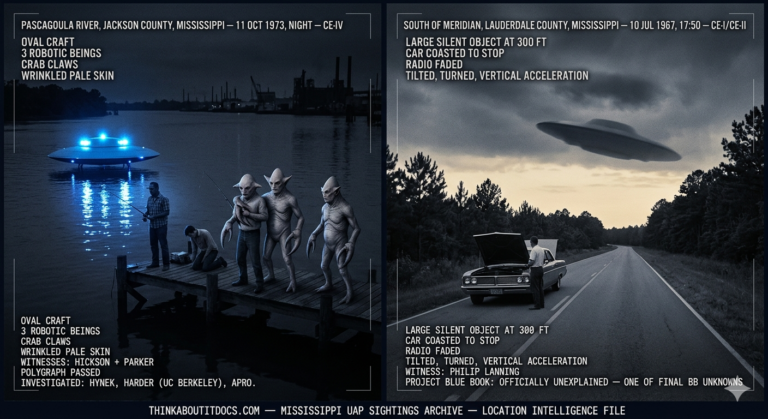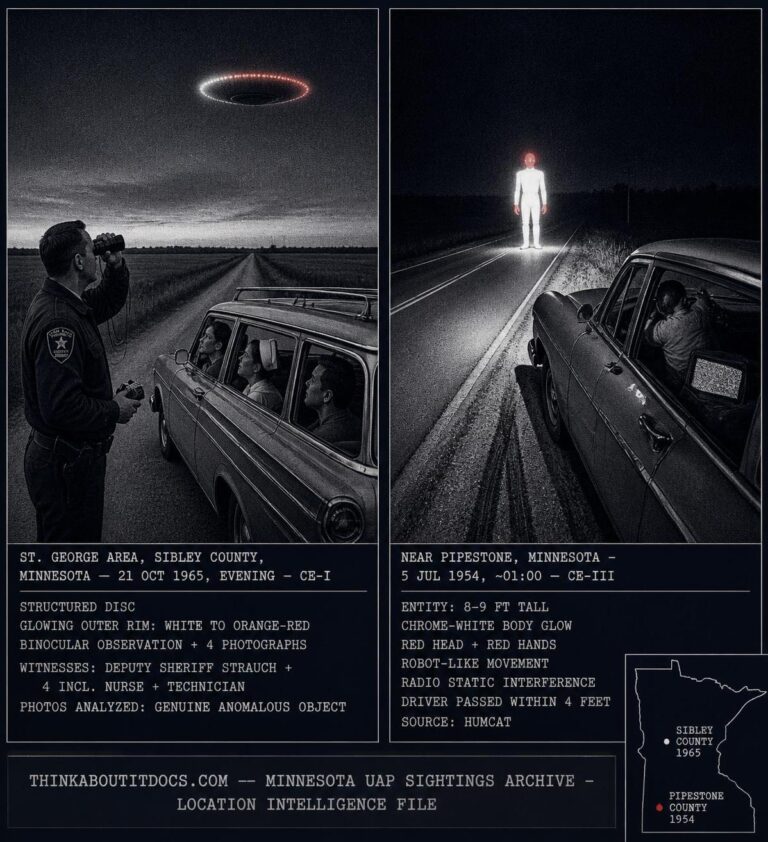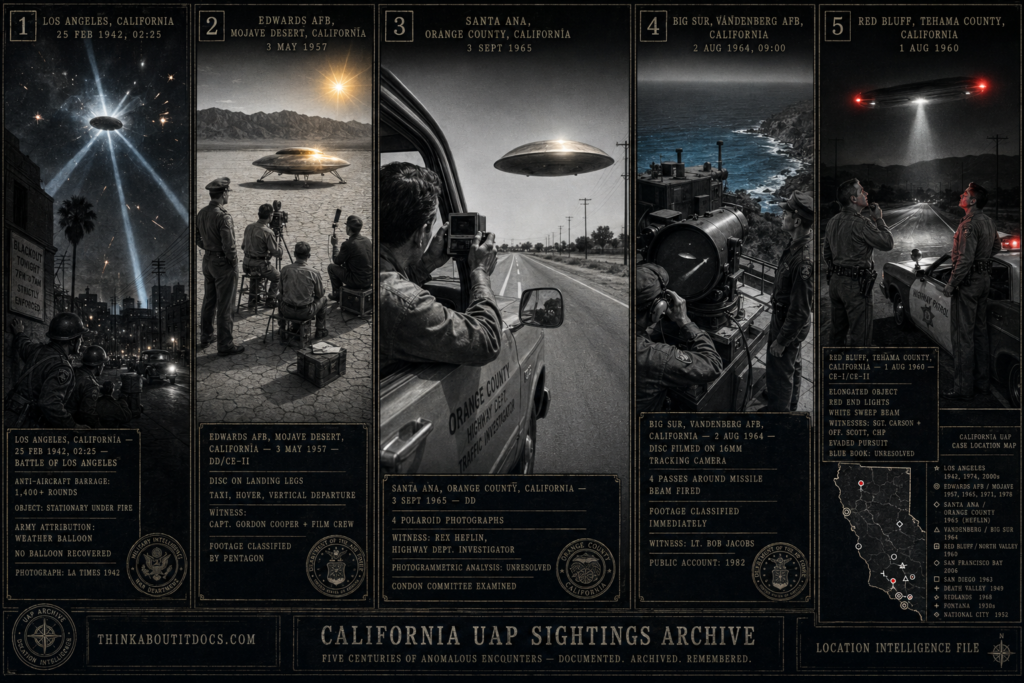
California UAP archive: Battle of Los Angeles February 1942 (1,400+ anti-aircraft rounds, object stationary under fire), Edwards AFB Gordon Cooper disc landing May 1957 (footage classified), Rex Heflin four-photograph sequence September 1965 (photogrammetric analysis unresolved), Big Sur Vandenberg classified disc filming August 1964 (Lt. Bob Jacobs), and Red Bluff CHP officers CE-I August 1960. 70+ documented cases 1896–2024.
California UFO|UAP|ENTITY Sightings Archive
California reports more UAP sightings than any other state in the country, and not by a small margin: roughly double the nearest competitor, per National UFO Reporting Center data compiled across multiple independent analyses. The reasons are geographic, demographic, and military simultaneously. The state’s roughly 840 miles of Pacific coastline run parallel to some of the most restricted and heavily instrumented military airspace in the country. Its desert and coastal regions, from the Mojave to the Central Coast, host Edwards Air Force Base, China Lake Naval Weapons Center, Fort Irwin, and Vandenberg Air Force Base. Its population of roughly 40 million generates more observers per square mile across more varied terrain than any other state. And its clear, largely arid skies, particularly over the coastal ranges and high desert, provide favorable conditions for aerial observation across most of the year.
The archive’s pre-modern California record opens in 1896 with the first documented aerial-light observations along the Pacific coast, including the Sacramento “Mystic Flying Light” and an “Apparition Wandering Through the Atmosphere,” before jumping to February 1942’s Battle of Los Angeles, in which anti-aircraft batteries fired more than 1,400 rounds at unidentified aerial targets over the city during a wartime blackout. The immediate official reactions were mixed and, notably, did not settle on a weather balloon explanation the next morning: Secretary of the Navy Frank Knox publicly called it a “false alarm” attributable to war nerves, while some Army officials initially raised the possibility of unidentified, possibly enemy-flown aircraft. A specific weather-balloon explanation emerged only later, first from the U.S. Coast Artillery Association’s 1949 documentation and definitively from a 1983 U.S. Office of Air Force History review, which attributed the incident to “war nerves” triggered by a stray meteorological balloon and worsened by flares and shell bursts from adjoining batteries. The widely reproduced Los Angeles Times photograph of searchlights converging on a disc-like shape, republished worldwide and still the most recognizable image associated with the incident, was heavily retouched before publication, a standard 1940s newsprint practice to boost contrast; the original, unretouched negative shows only faint, indistinct light and none of the crisp disc silhouette that made the published version so iconic. This detail is well documented but frequently omitted from popular retellings of the case.
The state’s post-1947 record is anchored in its military installations, though the strength of the evidence varies considerably from case to case, and this archive presents each accordingly rather than treating them as a uniform body of confirmed fact. On May 3, 1957, near Edwards Air Force Base, ground camera crews photographed an unusual aerial object; astronaut Gordon Cooper, then an Air Force captain stationed at the base, reviewed the resulting film afterward but was not, according to the fuller documented record, a firsthand witness to any landing, taxiing, or vertical departure himself, a detail sometimes lost in popularized retellings of the case. NICAP director Jack Acuff stated in 1976 that Cooper described the object to him as consistent with a weather balloon. The case remains catalogued in this archive as Insufficient Data rather than confirmed. In 1964, at a remote tracking site near Big Sur associated with Vandenberg AFB missile testing, Air Force officer Bob Jacobs filmed an anomaly during an Atlas missile test that he has long described as an unidentified craft interacting with the warhead package; project engineer Kingston George later published a detailed, technically specific rebuttal in Skeptical Inquirer, arguing the footage instead showed malfunctioning decoy reentry vehicles and launch-tube debris, classified for conventional national-security reasons unrelated to any craft. Neither account has been independently verified against the original film, which has never resurfaced, and this archive documents the case as a genuine, unresolved dispute between two named, credentialed participants rather than a settled account of anomalous footage. In 1965, Rex Heflin, an Orange County highway maintenance worker, photographed a disc-shaped object from the roadside using a Polaroid camera in four sequential exposures; those photographs have been subjected to more photogrammetric and optical analysis, by JPL’s Robert Nathan and later MUFON’s Jeffrey Sainio, than nearly any other UAP photographs on record, with neither analysis finding evidence of a simple hoax, though the case remains single-witness. A separately reported 1971 crash-and-recovery claim near Edwards AFB rests on a single anonymous, hypnotically-influenced account sourced through a compiler with a documented pattern of unverified contributions elsewhere in this archive, and is catalogued as Insufficient Data on markedly weaker evidentiary footing than the other Edwards-area cases; it should not be read as comparable in strength to the 1957 or 1965 incidents.
California’s documented cases in this archive span from 1896 to the present, cover every geographic zone from the redwood coast to the Sonoran Desert, and carry a photographic and military-adjacent case density unmatched by any other state archive in this collection. Readers should note that “documented” here means a surviving, sourced record of the claim, not a confirmed extraterrestrial or otherwise anomalous event; case status (Unexplained, Insufficient Data, or Explained) is assigned individually to each entry based on the evidence available for that specific case.
- 1896: An Apparition Wandering Through The Atmosphere – Article
- 1896: Saw The Mystic Flying Light
- 1930?: Fontana Sighting
- 1941: Three Naval Craft Sent Out To Hunt Plane Base
- 1941: City’s Black-Out Called Success
- 1942: Battle Of Los Angeles
- 1949: Death Valley California UFO Crash
- 1950: Above Van Nuys and San Fernando — Airliner Near-Miss
- 1952: 4 foot alien spotted near Oakdale California
- 1952: Aliens and Abduction in Redding, California
- 1953: Edwards Air Force Base California Crash
- 1952: Engineer observes object over National City, California
- 1952: George Adamski’s Blythe California Sightings
- 1952: Humanoid Spotted in June Lake, California
- 1952: Palomar Gardens, California Sighting
- 1952: Scientist Reports Sighting Disc
- 1952: Sighting and Contact in Bakersfield, California
- 1952: Strange Couple in Burbank California
- 1953: Round, metallic object near Livermore
- 1954: Muroc AFB, California
- 1955: Glendale, California Sighting
- 1957: Astronaut Gordon Cooper Witnesses UFO Landing at Edwards AFB
- 1957: Lake Isabella UFO Photograph Still a Mystery – Article
- 1956: San Bernardino, California
- 1960: Red Bluff Incident
- 1963: San Diego, California Abduction
- 1963: Disc-shaped UFO, seen by police officers and others
- 1964: Alien Encounter in Cisco County
- 1964: Strange-looking object over homes, Sunnyvale, California
- 1964: Big Sur UFO Incident: The Classified Filming at Vandenberg AFB
- 1965: Edwards AFB visited by UFOs – The Incident
- 1965: Rex Heflin UFO Photographs
- 1965: Sid Padrick Contact Case
- 1968: Redlands Sighting
- 1971: Abductee Involved in UFO Crash near Edwards AFB
- 1972: Man finds gold ‘nugget’ after seeing bright light
- 1972: Pasadena, California Helicopter Crew Encounter UFO
- 1974: Ronald Reagan UFO Sighting
- 1976: Several witnesses view oval shaped object
- 1976: Silent cigar-shaped object over Yuba City
- 1977: 3 boys frightened by creatures from a landed UFO
- 1978: Police Officer Suffers Burns from a UFO
- 1978: USAF witness 3 large craft in Mojave desert
- 1978: Veteran Pilot Encounters UFO With Portholes
- 1979: Large UFO flies low over couple’s home
- 1979: Twenty Nine Palms California Encounter
- 1981: Low-flying UFO sighted over Los Angeles
- 1985: Abduction in CA.
- 1985: Flying ‘ball of fire’ seen by 3 children camping in backyard in Redwood Valley, CA
- 2000: Randsburg, California Sighting
- 2000: Formation of three black triangle craft hovering over Los Angeles
- 2000: Something was in my home..
- 2000: Three black triangles hovering over Los Angeles
- 2003: Three Huntington Police Officers See Flying Object
- 2004: Triangular craft flying low over Interstate 5
- 2005: Glowing metallic UFO seen twice over Fresno
- 2005: Two large black triangles move over San Francisco, CA
- 2006: Metallic disk observed over San Francisco Bay, California
- 2006: Roseville & Rocklin, California Sighting
- 2007: Anza Borrego State Park, California Encounter
- 2007: Redondo Beach, California Sighting
- 2008: Granada Hills, California Abduction
- 2008: Sacramento California Sighting
- 2008: Large V-Shaped UFO Seen over California
- 2008: Unknown Object Crashed near Needles, California
- 2011: Silent UFO shines spotlight on witness
- 2013: Grey Sighting in California
- 2013: Hilltop Park, Signal Hill CA Sighting
- 2014: MacArthur Park, Los Angeles California Sighting
- 2014: La Puente ( San Gabriel Valley), California Sighting
- 2017: Santa Rosa, California Sighting
- 1946: Palomar Gardens — The Night the Contactee Movement Began
- 1947: The Pilot Hill Triangular Fire
- 1949: George Adamski’s Palomar Sighting
- 1950: The Mojave Desert Crash Claim
- 1950: The June 24th Multi-State Fireball — Nevada, California, Utah & Arizona
- 1951: The March Field Intercept — Southern California
- 1953: Round Metallic Object Near Livermore, California
- 1953: The Los Angeles Attorney’s Office Visitors
- 1953: The Thompson Gun Camera Pursuit — Near Blythe, California
- 1953: The Tujunga Canyon Contacts — Sarah Shaw & Jan Whitley
- 1953: The Brush Creek, California Sightings — March & May
- 1953: The Brush Creek Water Carrier — June 20, 1953
- 1953: George Van Tassel’s Giant Rock Contact — Solgando
- 1953: “Adam and Vega” — Twentynine Palms, California
- 1954: The Eisenhower Edwards AFB Alien Summit Legend — Examined
- 1954: The Desert Center, California Encounter — Carl Anderson
- 1954: The March Field, California Encounter — A Thrown Fireball
- 1947: The Muroc Double Sighting: Two Groups, One Object
- 1956: Van Nuys and Panorama City, California: The July Venusian Contact Cluster
- 1956: El Toro Marine Corps Air Station, California: Eight Hours on the Scope
- 1950: Alameda Flying Ice Cream Cone UFO
- 1950: Hamilton Field, California — Five Passes Over the Beacon
- 1951: A twin-tailed white cylinder hovers beside McClellan Air Force Base
- 1951: Two Air Force Airmen Watch Six Orange Lights Fly Over Claremont, California
- 1951: Six F-86 Jets Chase a Silver Object Over Long Beach and March AFB, California
- 1951: Two Forest Lookouts North of Mojave, California Signal a Blue-Green Disc That Approaches Within a Dozen Feet
- 1952: A B-29 Radar Observer and Navigator Track a Target Crossing the Scope at 2,000 Knots West of Point Conception
Executive Summary
The Military Corridor and the Photographic Record — California’s Dual Archive
California’s UAP record is organized around two parallel threads running from the 1940s to the present that rarely intersect: the military installation corridor and the civilian photographic record. The military thread, the 1942 Battle of Los Angeles, 1950s Van Nuys radar-visual reports, the 1957 Edwards AFB Gordon Cooper film-review case, the 1964 Big Sur/Vandenberg disputed filming, the 1965 Edwards AFB “Incident,” the uncorroborated 1971 Edwards crash claim, and the 1978 USAF Mojave three-airmen sighting, produces a series of institutional responses that are themselves analytically significant, though of uneven evidentiary weight. The 1942 anti-aircraft barrage is the most visible: the Army fired over 1,400 rounds at unidentified targets over Los Angeles during a wartime blackout, and a specific weather-balloon explanation was only formally reached decades later, in 1949 and again in 1983, not the following morning as popular accounts sometimes claim. The 1964 Big Sur footage remains genuinely disputed between the original witness and the project’s own engineer, not simply “classified and later revealed.” The 1957 Cooper case is more accurately described as a reviewed-film incident than a personally witnessed landing. In each case, the institutional response, whether suppression, reclassification, a delayed and contested explanation, or a still-unresolved technical dispute between named participants, is worth documenting independently of the original claim, since it forms its own layer of the historical record regardless of what was ultimately seen.
The civilian photographic thread, the 1965 Rex Heflin Polaroids, the 1957 Lake Isabella photograph, the 1952 National City engineer’s disc, and multiple later images from the 1970s through the 2000s, produces a photographic archive that is collectively among the most extensively analyzed state-level UAP photographic records in the country. California is not simply the state that reports the most UAP sightings. It is the state where the military and civilian evidence records intersect most densely, and where the gap between what a case’s surviving documentation actually supports and what popular retellings often claim is, in several of its best-known cases, considerably wider than commonly assumed. This archive aims to document that gap honestly, case by case, rather than smooth it over.