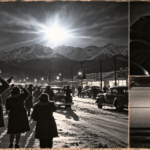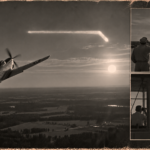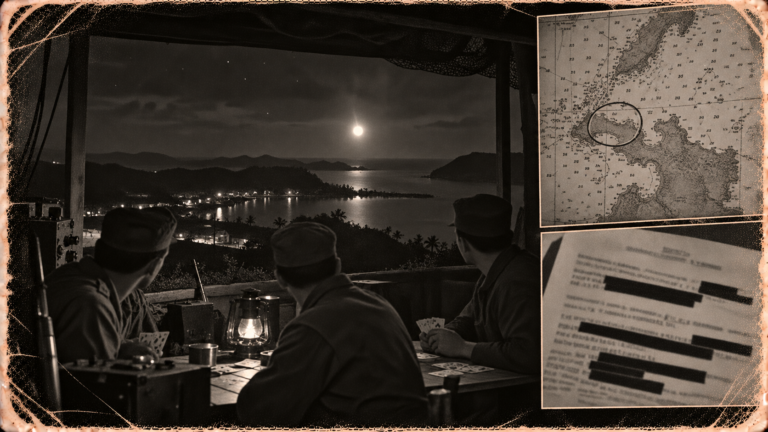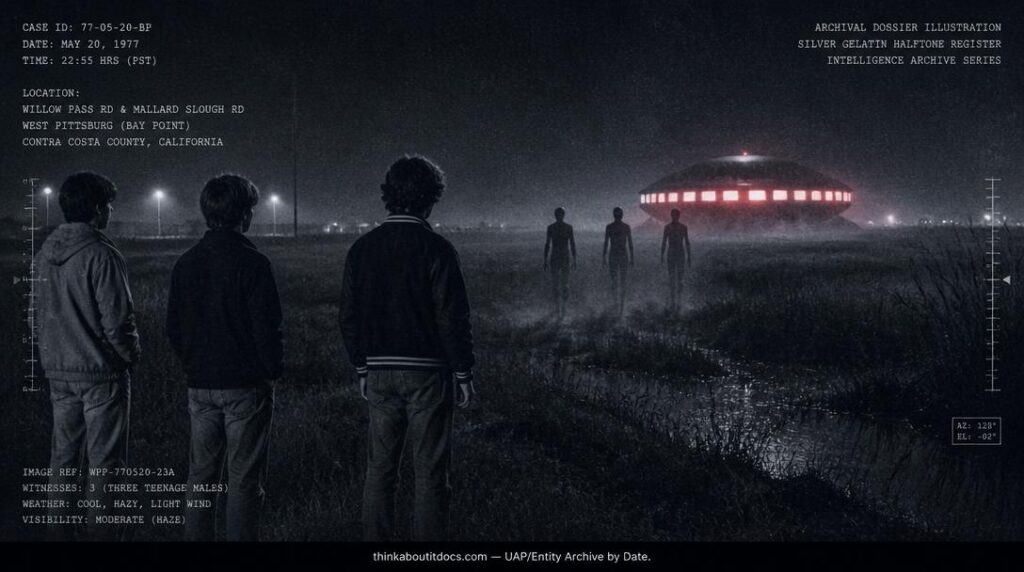
Archival rendering of the May 20, 1977 West Pittsburg, California encounter reported by three 14-year-old boys, once labeled a "credible" Close Encounter of the Third Kind by CUFOS.
THINK ABOUTIT UFO|ENTITY ENCOUNTER REPORT
1977: Three Boys Frightened by Creatures From a Landed UFO, West Pittsburg
On the night of May 20, 1977, three 14-year-old boys in a marshy field near West Pittsburg, California, said they watched a cluster of red lights land nearby, then fled in terror when three dark, faceless figures approached them, walking stiffly and, in one boy’s description, seeming linked together. The case became internationally known after the Center for UFO Studies, directed by J. Allen Hynek, named it one of only three cases that year meeting its threshold for a credible Close Encounter of the Third Kind. The investigators who actually worked the case, however, were considerably more divided than that label suggests, and their own conclusions are worth reading in full.
Date: May 20, 1977
Sighting Time: Shortly before 11:00 p.m.
Day/Night: Night
Location: A grassy field north of Willow Pass Road near Mallard Slough Road, between the Santa Fe Railroad tracks and the marsh edge of Suisun Bay, West Pittsburg, Contra Costa County, California (renamed Bay Point in 1993)
Urban or Rural: Urban/semi-rural edge (unincorporated community adjoining marshland)
No. of Entity(s): 3
Entity Type: Humanoid, described inconsistently across the three witnesses as smoke-like, black, faceless figures, or gray, robot-like figures with a vaguely human shape
Entity Description: Estimated 5 feet 6 inches to 6 feet tall; described by one witness as smoke-like, black, and faceless, uncertain whether they had arms or heads or wore clothing; described by a second witness as wearing what looked like long garments over their heads, black, walking slowly as if linked together; described by a third witness as gray, human-shaped but eyeless, walking with a stiff, robotic gait; all three witnesses described the figures as surrounded by or emerging through what appeared to be smoke or steam vapor
Hynek Classification: CE-III — Close Encounter of the Third Kind. Close observation of animate beings associated with a landed object.
Duration: Undocumented precisely
No. of Object(s): 1
Description of the Object(s): Initially described as a cluster of bright red lights joined together, with a blue light moving quickly among them; the boys said the lights covered a distance of more than three miles in about five seconds before returning and landing nearby; descriptions of the landed object varied among the three witnesses but generally agreed on a row of square, window-like lights with one larger than the rest; none of the boys described it as a classic “flying saucer,” with descriptions ranging from “round but flat” to a comparison with a flying building
Shape of Object(s): Disc (per site field data); witness descriptions varied and did not consistently describe a saucer shape
Size of Object(s): Undocumented
Color of Object(s): Bright red lights with one blue light in flight; blinking lights reflecting off the object’s sides once landed
Distance to Object(s): The three entities were observed at an estimated 50 to 150 feet from the boys
Height & Speed: The lights were reported traveling more than three miles in approximately five seconds before returning to land
Number of Witnesses: 3 named witnesses, all 14 years old at the time: Lennie Young, George Ferrera, and Patrick Morrison
Special Features/Characteristics: All three boys were interviewed separately by police and investigators and gave consistent accounts; Contra Costa County Deputy Sheriff Douglas Pendleton reported the boys appeared genuinely frightened, one visibly shaking, showed no signs of drinking or drug use, and volunteered to take a polygraph test; psychologist and NASA researcher Richard Haines investigated on behalf of the Center for UFO Studies and found the level of consistent detail across separately-told accounts significant, but found no independent corroborating witness, no radar contact reported that night by nearby Oakland, San Francisco, or Travis Air Force Base towers, and no physical evidence (ground marks, scorching, or magnetometer-detected magnetic anomalies) at the site when he surveyed it roughly a month later; Haines explicitly raised the possibility of a hoax or psychological/illusory explanation and ultimately concluded the existing evidence did not warrant further investigation; James A. Harder of the Aerial Phenomena Research Organization separately investigated and found no recoverable physical evidence beyond the boys’ own accounts; Allan Hendry, editor of the International UFO Reporter, characterized it as a genuine “50-50” case and confirmed no pilot or radar UFO reports from the area’s airport towers that night; an attempt to interview one of the boys under hypnosis was unsuccessful, as he was found not to be a good hypnosis subject
Case Status: Insufficient Data — despite the widely repeated “credible Close Encounter of the Third Kind” label, the investigators who directly worked the case (Haines, Harder, and Hendry) each independently concluded there was no physical evidence, no independent corroboration, and, in Haines’s own words, insufficient basis to pursue further investigation; the “credible” designation reflected the internal consistency and apparent sincerity of the boys’ separately-told accounts rather than independent physical or corroborating verification
Source: Fred Garretson, “Eastbay close encounter: Contra Costa UFO rates ‘credible third kind’ label,” Oakland Tribune, April 2, 1978; investigations by Richard Haines (Center for UFO Studies), James A. Harder (Aerial Phenomena Research Organization), and Allan Hendry (International UFO Reporter)
Related Cases: None documented
Detailed Report
Shortly before 11:00 p.m. on May 20, 1977, three 14-year-old boys, Lennie Young, George Ferrera, and Patrick Morrison, were in a grassy field near the intersection of Willow Pass Road and Mallard Slough Road in West Pittsburg, an unincorporated Contra Costa County community that would later rename itself Bay Point. The field lay between the Santa Fe Railroad tracks and the marshy edge of Suisun Bay, near a landmark locally known as the Pump House, a fortress-like water pumping structure that served as an informal teenage gathering spot. The boys were reportedly deciding whether to hitchhike to nearby Shore Acres or head to the Pump House when the sighting began.
According to the account they later gave investigators, the boys saw a cluster of bright red lights joined together, accompanied by a quickly moving blue light. The lights reportedly covered a distance of more than three miles in about five seconds before returning and settling to the ground nearby. Descriptions of the landed object varied somewhat between the three witnesses, though all recalled a row of square, window-like lights along its side with one larger than the others. None of the boys likened it to a classic flying saucer; Young described it as round but flat, Ferrera compared it to a flying building, and Morrison recalled blinking lights reflecting off its surface.
The boys then reported seeing three figures emerge from the darkness between themselves and the object, at an estimated distance of 50 to 150 feet, visible only by the light of two nearby street lamps and a liquor store sign. Young described the figures as smoke-like and black, with no discernible face, and said he could not tell whether they had arms or heads, comparing his familiarity with how people look walking in darkness at night to his certainty that these were not people. Morrison described them as black, slow-moving, and seemingly linked together, as though wearing long coverings over their heads. Ferrera described gray, vaguely human-shaped figures with no visible eyes, walking with a stiff, mechanical gait. All three said the figures appeared to be surrounded by or emerging through a haze of smoke or steam.
The boys fled to Morrison’s home, reporting that the figures appeared to follow at a distance for part of their retreat. Morrison’s mother called the sheriff’s office. Deputy Douglas Pendleton, who responded, found the boys’ accounts consistent with one another and the boys visibly frightened, one shaking badly; he noted no signs of alcohol or drug use, and the boys offered to take a polygraph examination.
The case was subsequently investigated by Richard Haines, a psychologist employed by a government space agency who pursued UFO investigation as a personal avocation and had by that time conducted several thousand such inquiries, largely involving pilot sightings. Haines found the level of consistent, independently-corroborated detail across the boys’ separately conducted interviews noteworthy, and confirmed the weather that night was clear, ruling out the boys mistaking their own shadows for the figures. He determined no American aircraft carried the light configuration the boys described. However, a magnetometer survey and physical inspection of the reported landing site, conducted roughly a month after the event, found no scorched grass, ground marks, or magnetic anomalies. Haines also noted the absence of any independent adult or expert witness, and that no radar or pilot UFO reports were logged that night. He explicitly raised the possibility of a hoax or a psychologically influenced account, noting the boys were out late in an unfamiliar, dark location, and concluded that the evidence available did not, in his assessment, warrant further investigation. A separate attempt to explore one boy’s memory under hypnosis was abandoned when he proved a poor hypnosis subject.
James A. Harder, a University of California, Berkeley engineering professor serving as director of research for the Aerial Phenomena Research Organization, separately investigated and likewise found no physical evidence beyond what the boys themselves had already described. Allan Hendry, editor of the International UFO Reporter, called it a genuine toss-up case and confirmed, through direct contact with airport tower supervisors at Oakland, San Francisco, and Travis Air Force Base, that no UFO reports had been logged by pilots or on radar that night, and that two local aerial advertising firms had not been flying at the time.
RESEARCHER’S NOTES
West Pittsburg — 1977 and the Gap Between “Credible” and “Confirmed”
- The “credible Close Encounter” label describes narrative consistency, not physical verification. CUFOS’s designation of this as one of the year’s few credible CE-III cases reflected the boys’ separately-told, internally consistent, and apparently sincere accounts, not any independent corroboration, radar contact, or physical trace evidence, all of which the investigating team explicitly found absent. Readers encountering this case’s “credible” reputation should understand precisely what that label was, and was not, based on.
- The lead investigator’s own conclusion was that further investigation was not warranted. Richard Haines, the CUFOS-affiliated investigator most closely associated with the case, explicitly raised the possibility of a hoax or psychological explanation and concluded the evidence did not justify pursuing the case further. This is a materially different position than the “credible encounter” framing that has followed the case in later popular retellings, and this archive presents Haines’s own stated conclusion directly rather than letting the more dramatic media label stand in for it.
- Three independent professional investigators, three converging negative findings on physical evidence. Haines, Harder, and Hendry approached the case from different organizational affiliations and methodologies, yet each independently confirmed the absence of physical evidence, radar corroboration, or independent adult witnesses. Convergent negative findings from separate investigators carry real weight, just as convergent positive findings would.
- Witness consistency remains a genuinely notable feature, whatever the ultimate explanation. Three teenage boys, interviewed separately by both law enforcement and investigators, gave detailed and substantially consistent accounts, showed clear and observed physical signs of fear, and volunteered for polygraph testing. This level of behavioral and narrative consistency is a real data point, even though it does not, on its own, establish what actually happened in that field.
- Entity descriptions were not fully consistent with one another. While the boys’ overall narrative held together, their specific descriptions of the entities varied meaningfully, from smoke-like and featureless to robed and linked together to gray and robotic. This kind of variation across independently interviewed witnesses to the same brief, frightening event is common in eyewitness testimony generally and should be weighed as such, rather than treated as either confirming or undermining the account on its own.
Three teenage boys told a consistent, frightened story to police and to some of the most experienced UFO investigators of the era, and passed the psychological credibility test those investigators applied. None of those same investigators found a shred of physical evidence to go with it, and the one most directly responsible for the case concluded, in his own words, that it did not warrant pursuing further. The label “credible Close Encounter” has outlived that more careful, more divided verdict. Both belong in the record.
“This is a 50-50 case if there ever was one.” — Allan Hendry, editor, International UFO Reporter