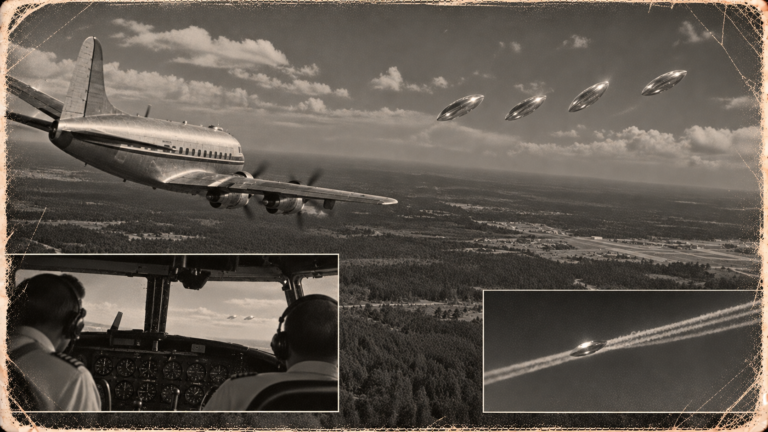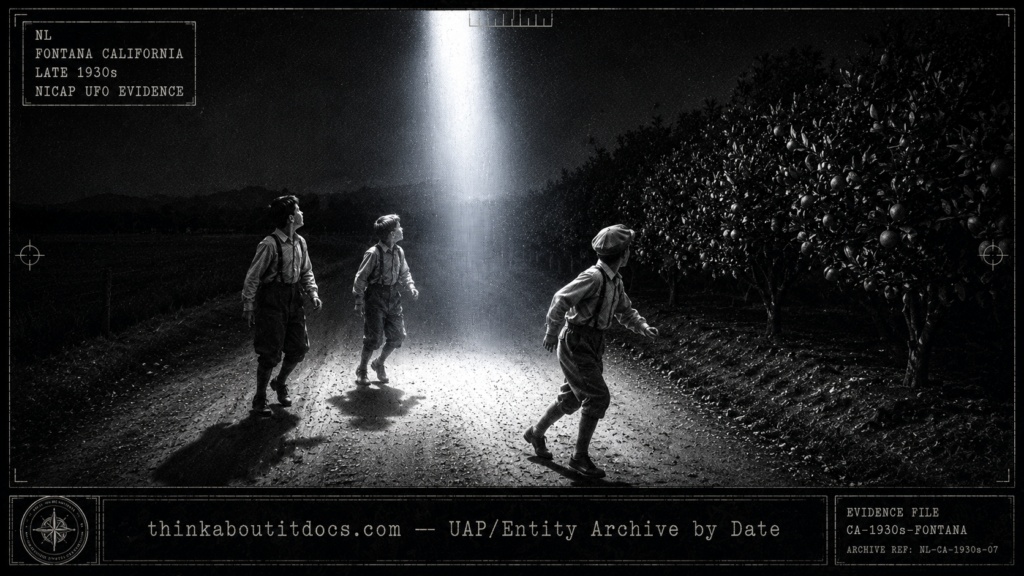
Fontana, California, late 1930s — three young witnesses walking home from the local movie theatre are suddenly illuminated by a bright shaft of light from above and break for the cover of a nearby orange grove. No sound. No shape. No source identified. Source: NICAP, UFO Evidence. Case Status: Insufficient Data. thinkaboutitdocs.com.
THINK ABOUTIT UFO | UAP SIGHTING REPORT
1930?: Fontana Sighting
Somewhere in the late 1930s, on a rural road outside Fontana, California, three boys walking home from the local movie theatre were abruptly stopped by light. Not a lamp, not a passing vehicle — a very bright shaft of light descending from above, sudden enough and strange enough that all three broke from the road and ran for the cover of a nearby orange grove. The source overhead was never identified. No sound was reported. No shape was recorded. What the NICAP record preserves is only the irreducible core of the encounter: an unidentified aerial light source, three witnesses in motion, and the instinctive human response to something that did not belong in the sky above a California citrus road at night.
Date: Late 1930s (exact year unknown)
Sighting Time: Unknown — night
Day/Night: Night
Location: Fontana, California, USA
Urban or Rural: Rural
No. of Entity(‘s): None reported
Entity Type: N/A
Entity Description: N/A
Hynek Classification: NL — Nocturnal Light (point or extended luminous source observed at night)
Duration: Not recorded
No. of Object(s): 1
Description of the Object(s): A very bright shaft of light descending from above onto the witnesses; no structural form described
Shape of Object(s): Not determined — light shaft only
Size of Object(s): Not recorded
Color of Object(s): Bright white
Distance to Object(s): Not recorded — light reached ground level
Height & Speed: Not recorded
Number of Witnesses: 3 (three young boys)
Special Features/Characteristics: Sudden onset; bright enough to alarm three witnesses into immediate flight toward cover; no sound reported; no source object described
Case Status: Insufficient Data
Source: NICAP, UFO Evidence
Summary/Description: Three young boys returning from the local movie theatre on a rural road near Fontana, California were suddenly illuminated from above by a very bright shaft of light. All three fled to a nearby orange grove for cover. No further details recorded. Date uncertain — reported as late 1930s.
Related Cases: 1935 Palestine, Texas (NICAP, UFO Evidence — stationary shaft of light) | 1934 Guipúzcoa, Spain (Valentine Williams — luminous aerial object over road)
DETAILED REPORT
The Fontana, California nocturnal light event of the late 1930s is one of the briefest entries in the NICAP pre-modern archive, but brevity here is not a disqualifier. The NICAP UFO Evidence compendium, the source for this case, is a primary credentialed compilation and among the most rigorously assembled pre-modern UAP records available. Its inclusion of the Fontana case means the event cleared NICAP’s minimum threshold for documentation — three witnesses, an unambiguous aerial light source, and a behavioral response consistent with genuine alarm.
The geographic and temporal context is worth holding. Fontana in the late 1930s was a rural community in San Bernardino County, California, not yet industrialized — the Kaiser Steel plant that would transform it did not open until 1942. The surrounding terrain was largely citrus groves and open agricultural land, making artificial light sources easily identifiable and unusual aerial illumination genuinely anomalous. Three boys walking home from the movies on a rural road at night had no competing light sources to confuse them. What struck them from above was bright enough and sudden enough to produce an immediate, unanimous flight response — all three broke for the nearest cover without apparent hesitation.
The case records no sound and no shape. The light is described as coming from above, not from the horizon, which rules out vehicle headlights, distant structures, or atmospheric reflection of ground sources. The NICAP categorization as NL (Nocturnal Light) is technically correct given the available data, though the directed shaft behavior — light reaching the witnesses from above — is more consistent with an active aerial source than with passive luminous phenomena such as ball lightning or atmospheric optical effects, which do not typically produce directed downward beams.
What the record cannot provide is the one thing that would elevate this case: a description of what was producing the light. The witnesses were boys, at night, suddenly illuminated on a road far from home. They ran. That response is the record’s honest final word on the event — and it is, in its way, as informative as any technical description. Something overhead was bright enough, unexpected enough, and sufficiently inexplicable that three children did not stay to find out what it was.
RESEARCHER’S NOTES
The Shaft in the Grove — Fontana California, Late 1930s and the NL Threshold Problem
- Source and Evidentiary Weight: The NICAP UFO Evidence compendium is a primary credentialed source — the product of the National Investigations Committee on Aerial Phenomena under Major Donald Keyhoe, the most rigorous civilian UAP research organization of the pre-modern and early modern era. Its inclusion of a case with minimal detail is significant precisely because NICAP was not known for padding its records. That the record is sparse is a property of the original report, not of editorial carelessness.
- NL Classification and the Directed Beam Question: Hynek’s NL category covers point or extended luminous sources at night without structural detail sufficient for DD or CE classification. The Fontana case formally qualifies. However, the detail that the light came from above and illuminated the witnesses suggests directed emission rather than ambient luminosity. Ball lightning, St. Elmo’s fire, and atmospheric optical phenomena do not typically produce a directed downward shaft bright enough to trigger immediate flight in three observers. The NL classification is accurate given available data but should be understood as a ceiling imposed by the evidence, not a conclusion about source type.
- Pattern Context — Pre-Modern California Aerial Light Reports: The Fontana case sits within a thin but consistent pattern of pre-modern California aerial light events, alongside the 1904 USS Supply sighting and the 1896–1897 mystery airship wave. In the late 1930s, California’s rural inland valleys — pre-industrial, low ambient light, clear desert-adjacent skies — were among the most favorable observing environments in the continental US.
- Date Uncertainty and Archive Integrity: The report is dated “late 1930s” with no year specified, placing it alongside several other NICAP pre-modern cases where witnesses reported events decades after they occurred and could not fix the year precisely. The page title “1930?” reflects honest uncertainty. The case should be cross-referenced with the 1938 Fontana repeated-visitation account (NUFORC), which describes the same general area and a similar initiating shaft of light followed by sustained entity contact — whether these are connected events or coincidental geography is unresolvable with available data.
The Fontana nocturnal light incident of the late 1930s is the archive at its most stripped-down: three witnesses, one source, one response, no resolution. The NICAP record preserves it without embellishment because there was nothing to embellish. A bright shaft of light came from above a rural California road at night, three boys ran for the orange grove, and whatever produced the light departed without identification. The case status is Insufficient Data — not because the witnesses were unreliable, but because the encounter ended before anything more could be known. In the pre-modern record, that is often the most honest outcome available.