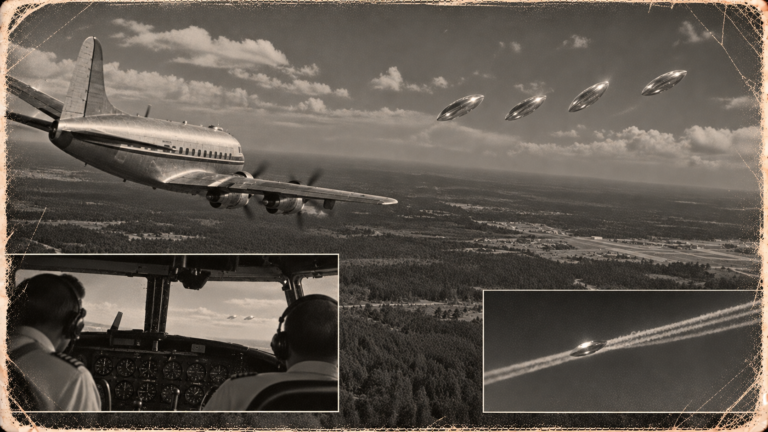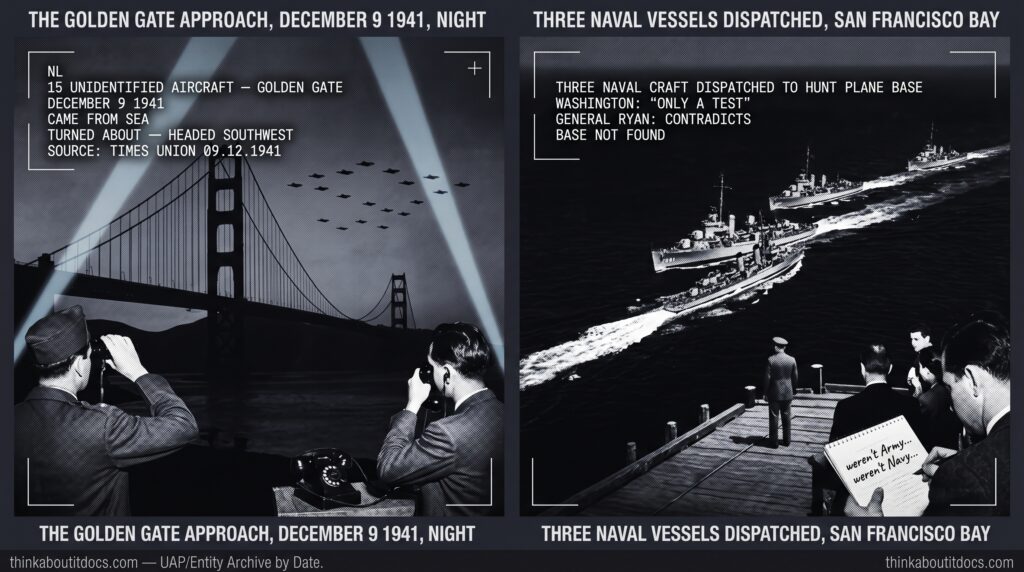
San Francisco, December 9, 1941 — two days after Pearl Harbor, a large number of unidentified aircraft approach from the Pacific, reach the Golden Gate, turn about, and head southwest. General Ryan of the Western Defense Command: "They weren't Army planes, they weren't Navy planes, and you can be sure they weren't civilian planes." The 12th Naval District confirms 15 unidentified planes off the Golden Gate — "This is not a test." Three Naval vessels dispatched to find their base. Sixty Army trucks rush anti-aircraft guns to Marine Boulevard. Washington claims the alarms were only tests. No aircraft identified. No base found. Source: Times Union, December 9, 1941. Case Status: Unexplained. thinkaboutitdocs.com.
THINK ABOUTIT UFO | UAP SIGHTING REPORT
1941: Three Naval Craft Sent Out To Hunt Plane Base
On the evening of December 9, 1941 — two days after the Japanese attack on Pearl Harbor, the day the United States and Great Britain formally declared war on Japan — a large number of unidentified aircraft approached San Francisco from the sea, reached the Golden Gate, turned about, and headed southwest. General Ryan of the Western Defense Command was asked whether he thought they were Japanese bombers. His answer has not been improved upon in eighty years: “Well, they weren’t Army planes, they weren’t Navy planes, and you can be sure they weren’t civilian planes.” An hour and fifty minutes after the first alarm sounded, the 12th Naval District Headquarters at San Francisco announced that 15 unidentified planes were reported somewhere off the Golden Gate. A Navy spokesman told a waiting city: “This is not a test.” Three Naval vessels were dispatched to sea to find where the planes had come from. Sixty Army trucks rushed anti-aircraft guns to the water’s edge along Marine Boulevard during the blackout. Washington said it was only a test. San Francisco knew it was not.
Date: December 9, 1941
Sighting Time: Evening — alarm sounded; 15 unidentified planes announced by 12th Naval District approximately 1 hour 50 minutes after first alarm
Day/Night: Night
Location: San Francisco, California — Golden Gate area; Marine Boulevard waterfront; offshore Pacific
Urban or Rural: Urban and coastal — Golden Gate approach, San Francisco Bay area
No. of Entity(‘s): None reported
Entity Type: N/A
Entity Description: N/A
Hynek Classification: NL — Nocturnal Light / unidentified aerial objects tracked at night. Note: Page lists DD (Daylight Disc) — this is incorrect. The event occurred at night. NL is the correct classification for multiple unidentified aerial objects tracked without structural detail at night. Recommend updating.
Duration: At least 1 hour 50 minutes from first alarm to 12th Naval District announcement; total duration unknown as article continues on page 2 (unavailable)
No. of Object(s): Large number — General Ryan stated “a large number”; 12th Naval District confirmed 15 unidentified planes reported off the Golden Gate
Description of the Object(s): Unidentified aircraft. Came from the sea. Reached the Golden Gate. Turned about and headed southwest. Not Army, not Navy, not civilian — per General Ryan. No visual description of the objects recorded. 15 confirmed off the Golden Gate per 12th Naval District.
Shape of Object(s): Unknown — aircraft designation used; no structural description
Size of Object(s): Unknown
Color of Object(s): Unknown
Distance to Object(s): Golden Gate and offshore — exact distance not recorded
Height & Speed: Not recorded
Number of Witnesses: Military personnel (Western Defense Command, 12th Naval District, anti-aircraft crews, Naval vessel crews); civilian residents of San Francisco; General Ryan (Western Defense Command)
Special Features/Characteristics: Contemporaneous primary newspaper documentation (Times Union, December 9, 1941); General Ryan’s explicit tripartite exclusion — not Army, not Navy, not civilian; 15 unidentified planes confirmed by 12th Naval District; 3 Naval vessels dispatched to find the planes’ base; 60 Army trucks rushed anti-aircraft guns to Marine Boulevard waterfront; Navy spokesman explicitly stated “This is not a test”; Washington authorities subsequently claimed the alarms were tests — directly contradicting the on-site military command’s statements; one day before the December 10 Los Angeles blackout; precedes the February 25 1942 Battle of Los Angeles by 77 days; article continues on page 2 column 1 — that section is unavailable
Case Status: Unexplained — no official identification of the aircraft was made; Washington’s “test” designation contradicted by the on-site commanding general
Source: The Times Union, December 9, 1941 — “Three Naval Craft Sent Out To Hunt Plane Base”
Summary/Description: On the night of December 9, 1941, a large number of unidentified aircraft approached San Francisco from the sea, reached the Golden Gate, turned about, and headed southwest. General Ryan of the Western Defense Command confirmed they were not Army, Navy, or civilian aircraft. The 12th Naval District confirmed 15 unidentified planes off the Golden Gate. Three Naval vessels were dispatched to locate their base. Anti-aircraft crews and 60 Army trucks rushed to the waterfront. Washington subsequently claimed the alarms were only tests. General Ryan’s on-site statements directly contradict this.
Related Cases: December 10, 1941 — Los Angeles blackout (same event series, next day, LA Times) | February 25, 1942 — Battle of Los Angeles | December 9, 1941 — New York City false alarm
DETAILED REPORT
The December 9, 1941 San Francisco event is one of the most analytically significant early WWII UAP cases in the American record, and its source — the Times Union dated December 9, 1941 — is primary contemporaneous newspaper documentation. The case is distinguished by two elements that set it apart from the broader December 1941 West Coast alarm wave: the on-record statement of the commanding general, and the tripartite exclusion he applied to the aircraft.
General Ryan’s statement — “Well, they weren’t Army planes, they weren’t Navy planes, and you can be sure they weren’t civilian planes” — is the key analytical anchor. In December 1941, those three categories exhausted the universe of known aircraft. A general officer of the Western Defense Command, speaking publicly about a live aerial alarm two days after Pearl Harbor, was not hedging. He knew what Army planes looked like on radar and visually. He knew what Navy planes looked like. He knew what the civilian air traffic registry contained. He eliminated all three. What was left was something he could not categorize.
The operational response was proportional to a genuine threat. Three Naval vessels were dispatched to sea to find where the aircraft had come from — not to verify whether the alarm was real, but to locate an assumed base of operations. Sixty Army trucks rushed anti-aircraft guns to Marine Boulevard. The 12th Naval District issued a formal announcement that 15 unidentified planes were off the Golden Gate. The Navy spokesman’s statement — “This is not a test” — was the highest-level official confirmation available from the on-site command.
Washington’s subsequent claim that both alarms were tests directly contradicts every on-the-ground statement. The Times Union’s article captures this contradiction explicitly: “Official sources on the coast and in Washington were not in entire agreement on whether the whole performance was a series of surprise tests or terrible truth.” This is a contemporaneous newspaper documenting an official cover-story conflict in real time — the same pattern that would recur seven weeks later in the Battle of Los Angeles, when the Navy declared a false alarm and the War Department said 15 aircraft had been over the city.
The behavioral signature of the aircraft is the event’s other analytically significant element. They came from the sea. They reached the Golden Gate — the entrance to San Francisco Bay, one of the most significant military installations on the Pacific Coast. They turned about. They headed southwest — back out to sea. This is not the profile of a Japanese attack run, which would have continued inland toward the naval installations. It is not the profile of a reconnaissance mission, which would not have turned back at the most significant observation point available. It is the profile of something approaching, assessing, and departing — a pattern consistent with the aerial behavior documented in multiple pre-modern and wartime UAP cases.
RESEARCHER’S NOTES
General Ryan’s Exclusion — December 9 1941 and the Three-Category Problem
- Source Chain Assessment: The Times Union is a legitimate American regional newspaper. Its December 9, 1941 report is contemporaneous documentation of a live military event, quoting named officials (General Ryan, 12th Naval District spokesman) with specific operational details. This is primary contemporaneous press documentation of the highest available tier for this era — equivalent to the Charleston Enterprise-Courier April 5 1941 article and the Los Angeles Times December 11 1941 article. The article’s continuation on page 2 column 1 is unavailable; the page 2 content may contain additional identifying information or official resolution. Locating the full article in the Times Union archive is the single most productive research step available for this case.
- The Washington Contradiction: The explicit conflict between Washington’s “test” designation and General Ryan’s on-site statements is a documented institutional cover-story pattern. In December 1941, two days after Pearl Harbor, Washington had overwhelming reasons to suppress evidence of aerial activity over San Francisco that it could not explain — acknowledging unidentified aircraft over the Golden Gate would have caused mass panic on the West Coast and undermined public confidence in the military’s ability to defend the mainland. The “test” explanation served that institutional purpose. General Ryan’s public statement, made before Washington’s position was established, is the unguarded military assessment on record.
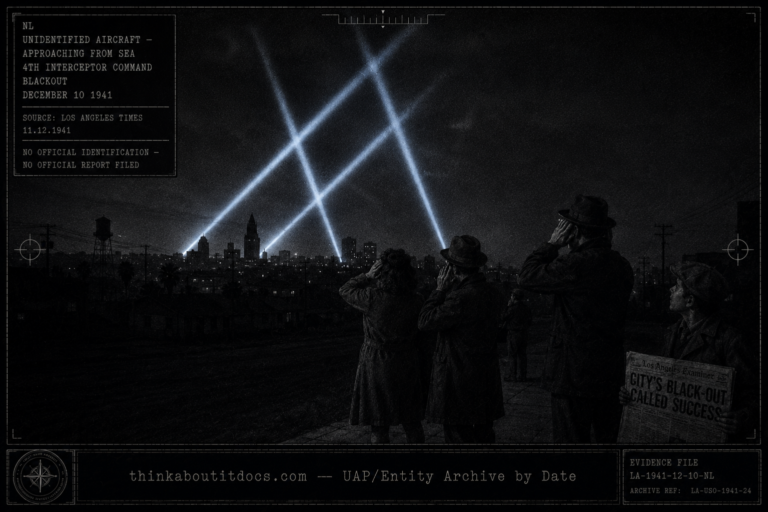
- The Approach-and-Turn Behavioral Profile: The aircraft came from the sea, reached the Golden Gate, turned, and headed southwest. This behavioral sequence — approach to a significant point followed by reversal and departure — appears in the December 10 Los Angeles blackout (unidentified aircraft approaching from the sea, no interception, blackout lifted after the objects departed), the February 25 1942 Battle of Los Angeles (object tracked, approached, eventually departed), and multiple pre-modern maritime UAP cases in the archive. It is structurally distinct from known Japanese military aircraft behavior in December 1941 and from any documented test aircraft profile.
- The Three-Case December 1941 Cluster: The December 9 San Francisco event, the December 10 Los Angeles blackout, and the broader December West Coast alarm wave form a coherent three-event cluster in the first week of American involvement in WWII. All three involve unidentified aircraft from the sea. None produced an official identification. Washington’s “test” designation for the San Francisco event was contradicted on the record by the commanding general. The Los Angeles blackout produced no official report at all. Together, these events establish that the wartime West Coast UAP pattern began not in February 1942 but on December 9, 1941 — two days after Pearl Harbor.
Three Naval vessels went to sea on the night of December 9, 1941 to find where the planes had come from. They did not find a base. General Ryan had already told the press what the aircraft were not: not Army, not Navy, not civilian. The 12th Naval District said 15 of them were off the Golden Gate and that this was not a test. Washington said it was a test. The Times Union printed both positions on the same day. The planes headed southwest, back out to the Pacific, and were not identified. The naval vessels returned. One day later, Los Angeles blacked out over more unidentified aircraft from the sea. Seventy-seven days after that, the Battle of Los Angeles. The pattern that ended with 1,400 anti-aircraft rounds fired at an unidentified object over a major American city began here, at the Golden Gate, on December 9, 1941. Case Status: Unexplained.
Three Naval Craft Sent Out To Hunt Plane Base
2nd part unavailable