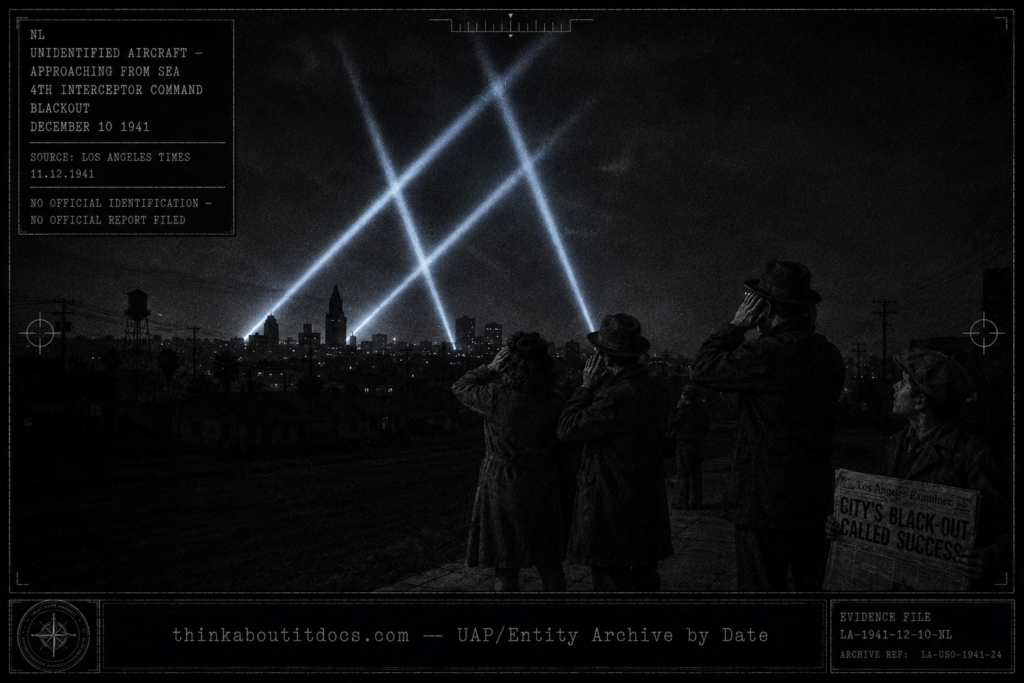
Los Angeles, December 10, 1941 — four days after Pearl Harbor, the Army's 4th Interceptor Command orders a blackout across the region from Bakersfield to San Diego after the statewide teletype system signals unidentified aircraft approaching from the sea at 7:35 PM. Fort MacArthur goes to alert. Aircraft are scrambled. Searchlights deploy 25 miles from the waterfront. Listening posts at the beach and harbor detect no motor sounds. The blackout lifts at 11:03 PM. No aircraft are identified. No official report is ever filed. The first wartime UAP-triggered blackout over the American mainland. Source: Los Angeles Times, December 11, 1941. Case Status: Insufficient Data. thinkaboutitdocs.com.
THINK ABOUTIT UFO SIGHTINGS REPORT
1941: City’s Black-Out Called Success
Four days after Pearl Harbor, on the evening of December 10, 1941, a yellow signal indicating the approach of enemy air raiders was flashed on the statewide police teletype at 7:35 PM. Police said the signal indicated the presence of unidentified airplanes approaching Los Angeles from the sea — but explicitly noted it did not necessarily mean they were enemy. By shortly after 8 o’clock, the Army’s 4th Interceptor Command had ordered a gigantic blackout covering the area from Bakersfield south to San Diego and eastward to Boulder City and Las Vegas, Nevada. Anti-aircraft and machine gunners scrambled to their weapons at Fort MacArthur. The Interceptor Command’s spokesman told a waiting city: “There are planes over the south of Los Angeles that are unidentified. The area will be blacked out until we can identify them.”
When asked whether Army planes had been sent aloft to contact the aircraft, the spokesman said: “You can assume there have been.” Thousands of Angelenos listening for the sound of motors in the blacked-out city heard nothing. Searchlights flashed in the higher portions of Los Angeles, 25 miles from the waterfront. The blackout continued until 11:03 PM. No official identification of the aircraft was ever made. The Los Angeles Times reported it the following morning — December 11, 1941 — under the headline “City’s Black-out Called Success.” It was the first documented wartime military blackout over the American mainland triggered by unidentified aircraft. No subsequent report identified what was in the sky.
Date: December 10, 1941 (evening); reported in the Los Angeles Times, December 11, 1941
Sighting Time: 7:35 p.m. (yellow signal flashed on statewide teletype); blackout ordered shortly after 8:00 p.m.; blackout lifted 11:03 p.m.
Day/Night: Night
Location: South of Los Angeles, California, USA; unidentified aircraft reported approaching from the sea; searchlights visible 25 miles from the waterfront; blackout zone covered from Bakersfield south to San Diego, east to Boulder City and Las Vegas, Nevada
Urban or Rural: Urban and regional; citywide blackout across the entire Southern California region
No. of Entity(s): Not Applicable
Entity Type: Not Applicable
Entity Description: Not Applicable
Hynek Classification: NL — Nocturnal Light, used here as the closest available category with a significant caveat: no witness at any point directly observed a light source or object in the sky. The incident consists of a teletype warning signal, a military blackout and searchlight response, and an absence of confirmed sound or sight of aircraft. This is closer to a documented military alert event than a classic witnessed sighting, and the classification above should be read as provisional rather than a confirmed NL case.
Duration: Blackout in effect from shortly after 8:00 p.m. to 11:03 p.m., approximately 3 hours. Duration of the alleged aerial presence itself is undocumented.
No. of Object(s): Unknown; described only as “planes” (plural), reported as unidentified airplanes approaching Los Angeles from the sea
Description of the Object(s): Unidentified aircraft reported approaching from the sea, detected via the statewide military teletype warning system. No visual description of any object was recorded by any source located for this entry. Army searchlights were deployed and Army aircraft were reportedly scrambled to investigate.
Shape of Object(s): Undocumented
Size of Object(s): Undocumented
Color of Object(s): Undocumented
Distance to Object(s): Reported approaching from the sea; searchlights active 25 miles from the waterfront; statewide yellow signal triggered at 7:35 p.m.
Height & Speed: Undocumented
Number of Witnesses: Thousands of civilian Angelenos (listening for sound, not visually observing anything confirmed); military personnel at Fort MacArthur; 4th Interceptor Command personnel; Army aircraft crews reportedly scrambled to investigate
Special Features/Characteristics: First documented wartime military blackout over the American mainland triggered by unidentified aircraft; occurred four days after the Pearl Harbor attack; a yellow signal (the standard enemy-approach indicator) was activated on the statewide police teletype; the 4th Interceptor Command explicitly stated this was not a practice blackout; an Army spokesman confirmed the aircraft were unidentified and that intercept aircraft had been scrambled; no sound of motors or gunfire could be verified by listening posts at the beach or harbor despite the scale of the response; no official identification of the aircraft was ever made; the event precedes the February 25, 1942 Battle of Los Angeles by 76 days
Case Status: Insufficient Data — no official identification was ever made, and no witness directly observed a visual object
Source: Los Angeles Times, December 11, 1941, “City’s Black-out Called Success: Southland Plunged Into Darkness as Army Reports Presence of Unidentified Aircraft; Searchlights Seen and Gunfire Reported”
Summary/Description: On the evening of December 10, 1941, four days after the Japanese attack on Pearl Harbor, the Army’s 4th Interceptor Command ordered a regional blackout across Southern California after the statewide teletype system issued a yellow signal for unidentified aircraft approaching Los Angeles from the sea. Anti-aircraft crews scrambled at Fort MacArthur. Army intercept aircraft were reportedly scrambled. Searchlights were deployed 25 miles from the waterfront. No motor sounds were detected by listening posts at the beach or harbor. No visual identification of any aircraft was made. The blackout was lifted at 11:03 p.m. No official report identifying the aircraft was ever filed. The Los Angeles Times reported the event the following morning. It stands as the first wartime military blackout over the American mainland triggered by an unidentified aerial contact.
Related Cases: February 25, 1942 — Battle of Los Angeles | December 8, 1941 — San Francisco radar contacts off the coast
Detailed Report
The December 10, 1941 Los Angeles blackout is among the earliest documented instances of a wartime military response to unidentified aircraft over the American mainland, and its source — the front page of the Los Angeles Times dated December 11, 1941 — is primary, contemporaneous newspaper documentation. No official report identifying what the aircraft were has ever surfaced. The event precedes the Battle of Los Angeles by 76 days and establishes that the pattern of unidentified aerial activity over Southern California, and the military’s difficulty identifying or intercepting it, began not in February 1942 but in the first week of American involvement in the Second World War.
The timing is the event’s most significant contextual element. Pearl Harbor was attacked on December 7, 1941. The United States formally declared war on Japan on December 8. The Los Angeles blackout occurred on December 10, the same day Germany and Italy declared war on the United States, completing America’s entry into the global conflict. The entire West Coast was on maximum alert, anticipating a possible follow-up attack. In this environment, the activation of the statewide yellow signal on the police teletype at 7:35 p.m. carried immediate and unambiguous military significance. The 4th Interceptor Command’s public statement was explicit that this was not a drill.
The aircraft’s origin was never established. The 4th Interceptor Command’s spokesman described them only as unidentified planes over south Los Angeles — not Japanese, not enemy, not friendly. The signal indicated an approach from the sea. Army aircraft were reportedly scrambled to investigate. Listening posts at the beach and harbor could not detect the sound of motors or gunfire. Aircraft approaching a major city from the sea in 1941 would typically have been audible to positions specifically staffed to detect them, which makes the absence of confirmed sound a notable feature of the case rather than a routine detail.
Searchlights were deployed 25 miles from the waterfront, suggesting a directional response to something the military believed to be aloft, though the source material does not describe what, if anything, the lights illuminated. The blackout was lifted at 11:03 p.m., and the 4th Interceptor Command characterized it as a success. No subsequent press release, military report, or after-action document identifying the aircraft has been located in the sources reviewed for this entry. The event does not appear prominently in standard World War II West Coast defense histories, which tend to focus on the December 8 radar contacts and the February 1942 Battle of Los Angeles; this December 10 event falls between those two better-known incidents.
RESEARCHER’S NOTES
The First Blackout — December 10, 1941 and the Missing Official Record
- Strong contemporaneous source, unusual classification problem. A front-page Los Angeles Times article dated the day after the event is primary contemporaneous newspaper documentation, quoting named institutions (4th Interceptor Command, Fort MacArthur, the statewide police teletype system) and specific operational detail (the 7:35 p.m. signal, the 8:00 p.m. blackout order, the 11:03 p.m. lift, the 25-mile searchlight position). But the source-quality strength does not resolve a separate problem: no witness in the record directly saw a light or object. This is why the Hynek field above is marked provisional — the case is better described as a documented military alert response than a classic witnessed sighting.
- The absence of an official identification report is the case’s most significant feature. No publicly available official report identifying the December 10 aircraft has been located, despite the scale and significance of the response. Possible explanations include that the aircraft were identified as friendly and the finding was simply never publicized, that they were identified as hostile and the matter was classified, that the event was genuinely unresolved amid the chaos of the war’s first week, or that a report exists in archives not yet publicly released. The record does not currently support choosing among these.
- The listening-post silence is the case’s central tension. Beach and harbor listening posts, specifically staffed to detect approaching aircraft by sound, reported nothing, even as the military response escalated to a full regional blackout and scrambled interceptors. This gap between the scale of the official response and the absence of any confirmed sensory detection is unresolved in the available sources.
- Read alongside the Battle of Los Angeles, not in isolation. The February 25, 1942 Battle of Los Angeles, 76 days later, involved the same city, the same 4th Interceptor Command, and the same basic pattern: an unidentified aerial contact from the sea met with a large military response and no confirmed identification. That later event has received substantial research attention; this earlier one has received comparatively little, despite establishing much the same operational pattern first.
On the evening of December 10, 1941, the day America went to war with Germany and Italy, four days after Pearl Harbor, something reportedly approached Los Angeles from the sea and triggered one of the largest regional military blackouts in American history to that date. The 4th Interceptor Command scrambled aircraft to investigate. Searchlights swept the higher portions of the city, 25 miles from the waterfront. Listening posts at the beach and harbor heard nothing. The blackout lasted until 11:03 p.m. No official report ever identified what, if anything, was in the sky. The Los Angeles Times printed the account on page one the next morning and called the blackout a success. It stands as the first entry in the Southern California wartime UAP record, and it remains without resolution.
“There are planes over the south of Los Angeles that are unidentified.”
— 4th Interceptor Command spokesman, December 10, 1941

Los Angeles Times December 11th, 1941
 Southland Plunged Into Darkness as Army Reports Presence of Unidentified Aircraft; Searchlights seen and gunfire reported
A gigantic black-out, covering the area from Bakersfield south to San Diego and eastward to Boulder City and Las Vegas, Nev., went into effect shortly after 8 o’clock last night on orders from the Army Fourth Interceptor Command. It continued until 11:03 p.m.
As Los Angeles went dark amongst considerable confusion and uncertainty, The Interceptor Command announced, “this is not a practice black-out.”
A yellow signal, indicating the approach of enemy air raiders, was flashed on the statewide teletype at 7:35 p.m.. Police said the signal indicated the presence of unidentified airplanes approaching Los Angeles from the sea but did not necessarily mean they were enemy.
FORT GUNNERS SCRAMBLE TO POSTS
Anti-aircraft and machine gunners scrambled to their weapons at Ft. Mac Arthur, which was promptly placed on alert basis.
Reports that the sound of gun fire could be heard could not be verified from listening posts at the beach or at the harbor.
Definite indication that the Interceptor Command meant business by calling for the black-out was contained in a statement from a spokesman who said:
“There are planes over the south of Los Angeles that are unidentified. The area will be blacked out until we can identify them.”
PLANES SENT UP TO INVESTIGATE
When asked if Army planes had been sent aloft to contact these aircraft the spokesman said: “You can assume there have been.”
Thousands of Angelenos, listening for straining ears for sounds of aircraft, were unable to distinguish sounds of motors, however.
A few minutes after the black-out was ordered, the flashing of what appeared to be Army searchlights was visible in the higher portions of Los Angeles, 25 miles from the water front.
Headquarters of the Fourth Interceptor Command, calling the blackout a success, said they a had a report that unidentified planes were in the vicinity of Los Angeles.
remainder of article unavailable