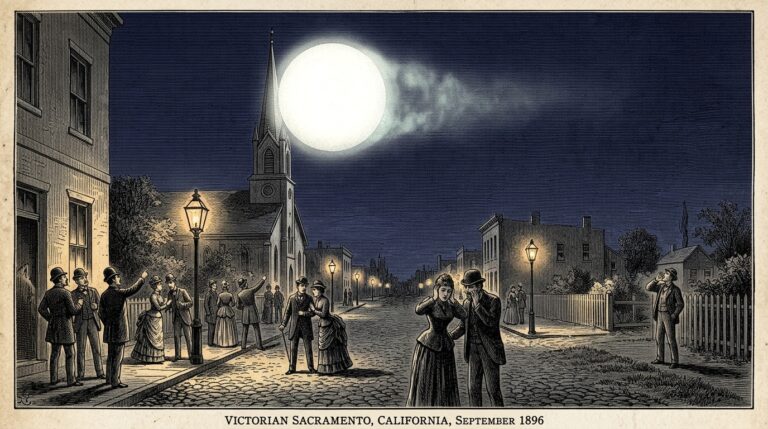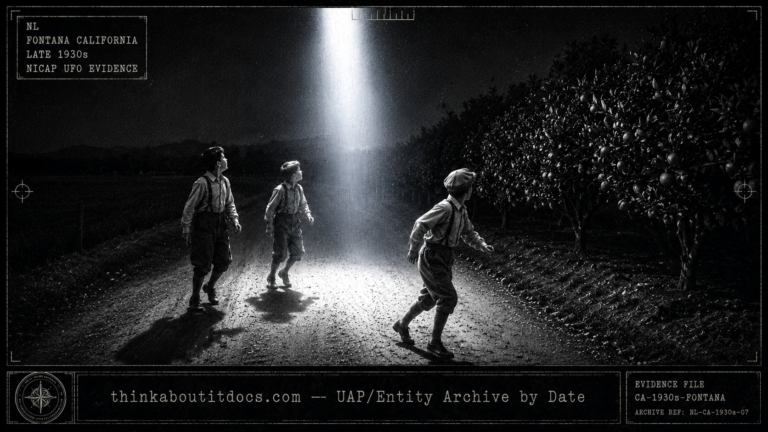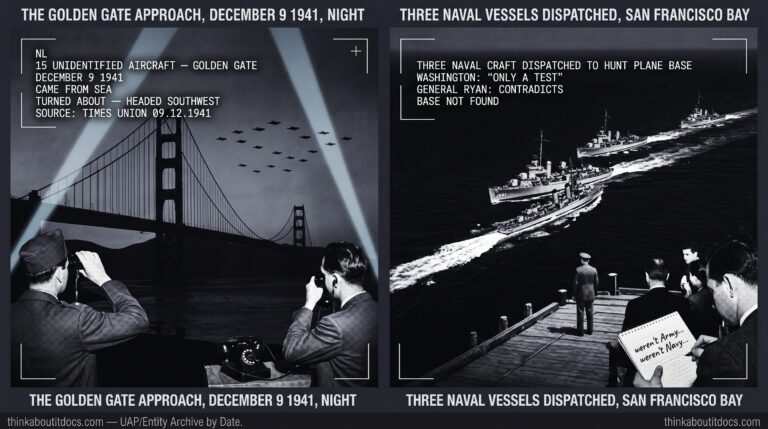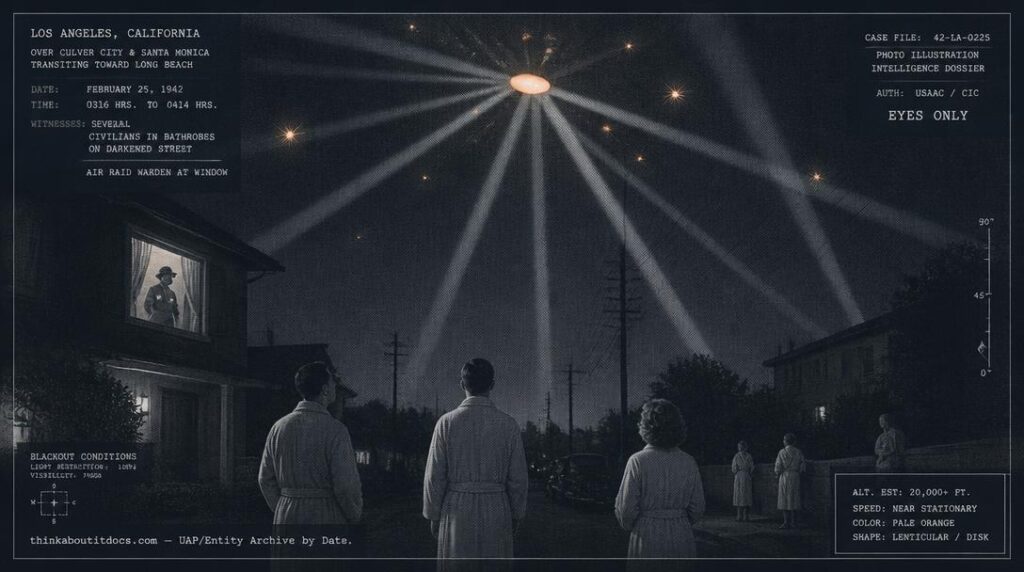
Archival rendering of the February 25, 1942 Battle of Los Angeles, in which a large unidentified object held in searchlight beams withstood over an hour of anti-aircraft fire.
THINK ABOUTIT UFO SIGHTINGS REPORT
1942: Battle Of Los Angeles
At 2:25 in the morning on February 25, 1942, the air raid sirens of Los Angeles screamed across a city of more than a million people. The 4th Interceptor Command ordered a blackout from the coast to the Mexican border and inland to the San Joaquin Valley. Within an hour, the guns of the 37th Coast Artillery Brigade were firing. They would fire 1,430 rounds of 12.8-pound high-explosive anti-aircraft shells before they stopped. They were firing at something that hung nearly stationary over Culver City and Santa Monica — something locked in the convergent beams of dozens of Army searchlights, visible to hundreds of thousands of residents in the blacked-out city below as a large luminous object described by eyewitness Air Raid Warden Katie as “huge,” “lovely pale orange,” and “the most beautiful thing you’ve ever seen.”
Shell bursts detonated on and adjacent to it. Many observers described what appeared to be direct hits. The object moved at a leisurely pace — 20 miles in 30 minutes, from Santa Monica to Long Beach — apparently oblivious to the barrage. It was never shot down. No wreckage was found. No enemy aircraft were identified. No bombs were dropped. Six people died — four from heart attacks and traffic accidents caused by the chaos, two from other causes. The United States Navy Secretary declared it a false alarm and jittery nerves. The Army’s Western Defense Command issued two statements insisting the aircraft were real and unidentified. The object that 1,430 rounds could not bring down moved leisurely off over Long Beach and disappeared. No official explanation has ever been confirmed.
Date: February 25, 1942
Sighting Time: 2:25 a.m. (blackout ordered); 3:16 a.m. (firing commenced); 4:14 a.m. (firing ceased); 7:21 a.m. (blackout lifted)
Day/Night: Night
Location: Los Angeles, California — Culver City, Santa Monica, Inglewood, Southwest Los Angeles, Long Beach; blackout zone from the coast to the Mexican border, inland to the San Joaquin Valley
Urban or Rural: Urban, major American metropolitan area
No. of Entity(s): Not Applicable
Entity Type: Not Applicable
Entity Description: Not Applicable
Hynek Classification: NL — Nocturnal Light. A luminous object observed at night without structural detail sufficient for a DD classification. Note: multiple eyewitnesses, including Air Raid Warden Katie at close range, described a large object with enough apparent detail that CE-I (a witness within roughly 500 feet) is arguably defensible, but no source establishes proximity that close with confidence; NL is used as the more conservative classification.
Duration: Blackout in effect 2:25 a.m. to 7:21 a.m. (approximately 5 hours); active anti-aircraft engagement 3:16 a.m. to 4:14 a.m. (58 minutes of firing); the object’s observed transit from Santa Monica to Long Beach took approximately 30 minutes
No. of Object(s): At least 1 primary large object; Army spokesmen initially cited a range of “1 to 50 planes,” later scaled down as eyewitness consensus converged on one primary large unidentified object
Description of the Object(s): A large luminous object, nearly stationary, hovering over Culver City and Santa Monica before moving slowly toward Long Beach. Described by Air Raid Warden Katie as huge, enormous, and moving very slowly, barely at all. Described in the Los Angeles Times’ Marvin Miles sidebar as caught in the center of searchlight beams “like the hub of a bicycle wheel surrounded by gleaming spokes.” Experienced dirigible specialists doubted it was a Japanese blimp, citing no known Japanese helium source. The object appeared undamaged by the barrage. The Army’s official statement said only that the aircraft “have not been identified.”
Shape of Object(s): A large round or disc-like form is suggested by the searchlight convergence pattern and by Katie’s description; some street-level observers described it as blimp-like
Size of Object(s): Described in Fate Magazine (Paul T. Collins, July 1987) as big enough to “dwarf an apartment house”; Katie described it as enormous and big
Color of Object(s): “Lovely pale orange,” per Katie’s close-range account; the anti-aircraft shell bursts themselves are separately described as orange in the Los Angeles Times sidebar
Distance to Object(s): Very close to Katie’s home near Santa Monica, close enough that she described seeing it perfectly; exact distance from ground level is not recorded in available sources
Height & Speed: Moved approximately 20 miles in 30 minutes (Santa Monica to Long Beach); nearly stationary for extended periods; altitude not precisely recorded, and some anti-aircraft shells reportedly fell short, exploding halfway up their climb
Number of Witnesses: Hundreds of thousands of civilians across the Los Angeles area; 12,000 Air Raid Wardens on duty; anti-aircraft crews of the 37th Coast Artillery Brigade; military personnel; journalists including Marvin Miles of the Los Angeles Times
Special Features/Characteristics: 1,430 rounds of anti-aircraft ammunition fired with no confirmed effect; multiple observers described what appeared to be direct hits with no resulting damage; the object continued its leisurely pace throughout the barrage; the Army and Navy issued directly contradictory official statements within hours of each other; the Los Angeles Times demanded a public explanation in its own front-page editorial; the Long Beach Independent alleged censorship; Army interceptor aircraft sat ready on runways for roughly 51 minutes before firing began but were never ordered up; six deaths were attributed to the event; the event followed a February 23, 1942 Japanese submarine attack on the Ellwood oil field near Santa Barbara by roughly 36 hours
Case Status: Unexplained
Source: Los Angeles Times, February 26, 1942 (front-page article and Marvin Miles sidebar); Fate Magazine, Paul T. Collins, “World War II UFO Scare,” July 1987; eyewitness testimony of “Katie,” an Air Raid Warden, as collected and published by researcher Jeff Rense; Army Western Defense Command official statements; U.S. Navy Secretary Frank Knox’s public statement
Summary/Description: In the early morning hours of February 25, 1942, a large unidentified luminous object moving slowly over Los Angeles from Santa Monica to Long Beach was engaged by the 37th Coast Artillery Brigade, which fired 1,430 rounds of anti-aircraft ammunition over 58 minutes with no confirmed effect. Hundreds of thousands of civilians witnessed the event. The Army confirmed unidentified aircraft were present; the Navy declared it a false alarm. No aircraft was identified, shot down, or found. Six people died. The event has never received an official explanation.
Related Cases: December 10, 1941 — Los Angeles Blackout | December 8–9, 1941 — San Francisco Golden Gate Contacts
Detailed Report
The Battle of Los Angeles is among the most massively witnessed and institutionally documented pre-modern UAP events in American history, and it is the last of three unidentified aerial incidents over the Southern California coast documented on this archive across the preceding three months. What makes it extraordinary is not only what was reported — though an object that 1,430 anti-aircraft rounds apparently could not damage is extraordinary by any standard — but the institutional response: two directly contradictory official statements issued within hours of each other, a press corps demanding public accountability, and interceptor aircraft that were never ordered into the air.
The timeline begins before the firing. The 4th Interceptor Command ordered the blackout at 2:25 a.m. after reports of unidentified craft over the coastline. The anti-aircraft batteries did not open fire until 3:16 a.m., 51 minutes later. During that interval, Army interceptor aircraft sat warming up on the runways, waiting for orders that never came. Secretary of War Henry Stimson later suggested it might have been prudent to send planes up to identify the intruder before firing on it. No planes were sent; the guns opened instead.
The convergence of dozens of searchlight beams on a single point in the sky, captured in the now-famous Los Angeles Times photograph, establishes that trained military operators had a target. Searchlights are aimed and coordinated, not deployed randomly, and the photograph shows beams converging in a pattern consistent with a large, slow-moving object at medium altitude.
The eyewitness quality for this event is unusually strong for the period. Air Raid Warden Katie was a trained wartime civil defense volunteer in position to observe, not a casual bystander. Her description — huge, enormous, pale orange, hovering nearly over her house — is internally consistent with the searchlight photograph and with the reported transit timeline. The Marvin Miles Los Angeles Times sidebar, written in real time by a professional journalist on the ground, describes the object moving slowly in the convergent beams “like the hub of a bicycle wheel,” continuously illuminated, with shell bursts detonating around it without bringing it down.
The institutional contradiction was immediate and documented on the newspaper’s own front page. The Army’s Western Defense Command issued two statements confirming the presence of unidentified aircraft. The Navy Secretary issued a statement declaring a false alarm and jittery nerves. The Times editorial demanded to know whose nerves were jittery, the public’s or the Army’s. The Long Beach Independent went further and alleged censorship. This pattern — on-site military command confirming a real event, Washington characterizing it as a false alarm — mirrors the pattern documented in this archive’s entry on the December 1941 Los Angeles blackout and the earlier San Francisco Golden Gate contacts.
RESEARCHER’S NOTES
The Object That 1,430 Rounds Could Not Touch — The Battle of Los Angeles in the West Coast UAP Series
- Source chain assessment. The Los Angeles Times’ February 26, 1942 front-page and sidebar articles are primary, contemporaneous press documentation of the highest tier. The Army Western Defense Command’s official statements and Secretary Knox’s contradictory statement are both primary institutional documentation. The Marvin Miles sidebar is a professional journalist’s real-time eyewitness account. Katie’s testimony, while not formally documented at the time, was collected and published by researcher Jeff Rense and is internally consistent with the contemporaneous press and official record. The Fate Magazine account by Paul T. Collins (July 1987) synthesizes multiple contemporaneous sources with additional research. This source chain is among the strongest of any pre-modern California UAP event in the archive.
- Two source-text discrepancies flagged, not silently corrected. The reproduced Los Angeles Times excerpt below refers at one point to the “14th Interceptor Command.” Every other contemporaneous and modern source, including the same article’s own earlier reference and the official wire statement issued at the time, identifies the responsible unit as the 4th Interceptor Command; “14th” is very likely a scanning or transcription error in this reproduction and is presented here as originally transcribed, flagged rather than silently altered. Separately, the reproduced Fate Magazine excerpt states firing began “at 3:36,” while the Los Angeles Times’ own contemporaneous account and the consistent modern historical record place the first shots at 3:16 a.m.; the field data above uses 3:16 as the better-supported time, with the Fate Magazine figure flagged here as a likely transcription discrepancy in that source rather than corrected within the quoted excerpt.
- The indestructibility question. The most analytically significant element of this case is not the object’s size or appearance but its apparent immunity to over an hour of high-explosive anti-aircraft fire. A Los Angeles Herald Express staffer, quoted in the Fate Magazine account, said he was certain many shells hit the object directly and was amazed it was not shot down. Whether this reflects a conventional object at an altitude where shell bursts appeared closer than they were, or something genuinely unaffected by the barrage, cannot be established from the available sources. It remains the case’s strongest and least resolved analytical thread.
- The intercept-aircraft gap. The 51-minute interval between the blackout order (2:25 a.m.) and the first shots fired (3:16 a.m.), during which Army interceptor aircraft sat ready on the runways without launch orders, is one of the more unusual operational details in the West Coast’s wartime defense record. Gen. Mark Clark later attributed the gap to the absence of a confirmed mass attack. Whether command-level uncertainty about the nature of the contact played a role cannot be established from the available record, but the pattern fits the broader institutional ambiguity documented across this and the related December 1941 cases.
- Part of a documented West Coast series, not an isolated incident. This event follows the San Francisco Golden Gate contacts and the December 10, 1941 Los Angeles blackout, both separately documented on this archive. All three involve unidentified aircraft reported from the Pacific, all three produced contradictory or subsequently walked-back official statements, and none produced a confirmed identification. Read together, the three events span roughly 77 days and form a connected pattern rather than three unrelated incidents.
On February 25, 1942, the United States Army fired 1,430 rounds of anti-aircraft ammunition at something over Los Angeles that would not come down. The searchlights held it in their beams for half an hour. Hundreds of thousands of people watched. Six people died from the chaos. The Army said it was real and unidentified. The Navy said it was a false alarm. The object moved from Santa Monica to Long Beach at a leisurely pace, apparently indifferent to the barrage, and disappeared over the Pacific. The Los Angeles Times demanded a public explanation on its front page. No official explanation has ever been confirmed. What hung in the searchlight beams over Los Angeles that February morning — pale orange, enormous, barely moving, apparently impervious to the guns of the 37th Coast Artillery — has not been identified in over eighty years.
“It was just hovering there in the sky and hardly moving at all.” — Air Raid Warden Katie, describing the object over Santa Monica, February 25, 1942

1942 ‘Battle Of Los Angeles’: The Most Incredible Mass Sighting Of All?
Wednesday, February 25, 1942
In February, 1942, Katie was a young, beautiful, and highly-successful interior decorator and artist who worked with many of Hollywood’s most glamorous celebrities and film industry luminaries. She lived on the west side of Los Angeles, not far from Santa Monica. With the outbreak of the war with Japan and the rising fear of a Japanese air attack, or even invasion of the West Coast, thousands of residents volunteered for wartime duties on the home front. Katie volunteered to become an Air Raid Warden as did 12,000 other residents in the sprawling city of Los Angeles and surrounding communities.
In the early morning hours of February 25th, Katie’s phone rang. It was the Air Raid supervisor in her district notifying her of an alert and asking if she had seen the object in the sky very close to her home. She immediately walked to a window and looked up. “It was huge! It was just enormous! And it was practically right over my house. I had never seen anything like it in my life!” she said. “It was just hovering there in the sky and hardly moving at all.” With the city blacked out, Katie, and hundreds of thousands of others, were able to see the eerie visitor with spectacular clarity. “It was a lovely pale orange and about the most beautiful thing you’ve ever seen. I could see it perfectly because it was very close. It was big!”
The U.S. Army anti-aircraft searchlights by this time had the object completely covered. “They sent fighter planes up (the Army denied any of its fighters were in action) and I watched them in groups approach it and then turn away. There were shooting at it but it didn’t seem to matter.” Katie is insistent about the use of planes in the attack on the object. The planes were apparently called off after several minutes and then the ground cannon opened up. “It was like the Fourth of July but much louder. They were firing like crazy but they couldn’t touch it.” The attack on the object lasted over half an hour before the visitor eventually disappeared from sight. Many eyewitnesses talked of numerous “direct hits” on the big craft but no damage was seen done to it. “I’ll never forget what a magnificent sight it was. Just marvelous. And what a gorgeous color!”, said Katie.
The ONLY description in the LA Times of the UFO, and a sense of the energy and emotion of that night, was found in this small sidebar article written by Times staff writer the day after the event:
Chilly Throng Watches Shells Bursting In Sky By Marvin Miles
Explosions stabbing the darkness like tiny bursting stars… Searchlight beams poking long crisscross fingers across the night sky…Yells of wardens and the whistles of police and deputy sheriffs…The brief on-and-off flick of lights, telephone calls, snatches of conversation: ‘Get the dirty…’ That was Los Angeles under the rumble of gunfire yesterday.
RESIDENTS AWAKENED
Sleepy householders awoke to the dull thud of explosions… “Thunder? Can’t be!” Then: “Air Raid! Come here quick! Look over there…those searchlights. They’ve got something…they are blasting in with anti-aircraft!” Father, mother, children all gathered on the front porch, congregated in small clusters in the blacked out streets — against orders. Babies cried, dogs barked, doors slammed. But the object in the sky slowly moved on, caught in the center of the lights like the hub of a bicycle wheel surrounded by gleaming spokes.
SPECULATION RIFE
Speculation fell like rain. “It’s a whole squadron.” “No, it’s a blimp. It must be because it’s moving so slowly.” “I hear planes.” “No you don’t. That’s a truck up the street.” “Where are the planes then?” “Dunno. They must be up there though.” “Wonder why they picked such a clear night for a raid?” “They’re probably from a carrier.” “Naw, I’ll bet they are from a secret air base down south somewhere.” Still the firing continued. Like lethal firecrackers, the anti-aircraft rounds blasted above, below, seemingly right on the target fixed in the tenacious beams. Other shots fell short, exploding halfway up the long climb. Tracers sparked upward like roman candles. Metal fell. It fell in chunks, large and small; not enemy metal, but the whistling fragments of bursting ack-ack shells. The menacing thud and clank on streets and roof tops drove many spectators to shelter.
WARDENS DO GOOD JOB
Wardens were on the job, doing a good job of it. “Turn off your lights, please. Pull over to the curb and stop. Don’t use your telephone. Take shelter. Take shelter.” On every street brief glares of hooded flashlights cut the darkness, warning creeping drivers to stop. Police watched at main intersections. Sirens wailed enroute to and from blackout accidents. There came lulls in the firing. The search lights went out. (To allow the fighter planes to attack?). Angelinos breathed deeply and said, “I guess it’s all over.” But before they could tell their neighbors good night, the guns were blasting again, sighting up the long blue beams of the lights.
WATCHERS SHIVER
The fire seemed to burst in rings all around the target. But the eager watchers, shivering in the early morning cold, weren’t rewarded by the sight of a falling plane. Nor were there any bombs dropped. “Maybe it’s just a test,” someone remarked. “Test, hell!” was the answer. “You don’t throw that much metal in the air unless you’re fixing on knocking something down.” Still the firing continued, muttering angrily off toward the west like a distant thunderstorm. The targeted object inched along high, flanked by the cherry red explosions. And the householders shivered in their robes, their faces set, watching the awesome scene.
The following are excerpts from the primary front page story of the LA Times on February 26th. Note that there is not a SINGLE description of the object even though is was clearly locked in the focus of dozens of searchlights for well over half an hour and seen by hundreds of thousands of people:
 Army Says Alarm Real Roaring Guns Mark Blackout
Identity of Aircraft Veiled in Mystery; No Bombs Dropped and No Enemy Craft Hit; Civilians Reports Seeing Planes and Balloon
Overshadowing a nation-wide maelstrom of rumors and conflicting reports, the Army’s Western Defense Command insisted that Los Angeles’ early morning blackout and anti-aircraft action were the result of unidentified aircraft sighted over the beach area. In two official statements, issued while Secretary of the Navy Knox in Washington was attributing the activity to a false alarm and “jittery nerves,” the command in San Francisco confirmed and reconfirmed the presence over the Southland of unidentified planes. Relayed by the Southern California sector office in Pasadena, the second statement read: “The aircraft which caused the blackout in the Los Angeles area for several hours this a.m. have not been identified.” Insistence from official quarters that the alarm was real came as hundreds of thousands of citizens who heard and saw the activity spread countless varying stories of the episode. The spectacular anti-aircraft barrage came after the [4th, transcribed in the original scan as “14th”] Interceptor Command ordered the blackout when strange craft were reported over the coastline. Powerful searchlights from countless stations stabbed the sky with brilliant probing fingers while anti-aircraft batteries dotted the heavens with beautiful, if sinister, orange bursts of shrapnel.
City Blacked Out For Hours
The city was blacked out from 2:25 to 7:21 am after an earlier yellow alert at 7:18 pm was called off at 10:23 pm. The blackout was in effect from here to the Mexican border and inland to the San Joaquin Valley. No bombs were dropped and no airplanes shot down and, miraculously in terms of the tons of missiles hurled aloft, only two persons were reported wounded by falling shell fragments. Countless thousands of Southland residents, many of whom were late to work because of the traffic tie-up during the blackout, rubbed their eyes sleepily yesterday and agreed that regardless of the question of how “real” the air raid alarm may have been, it was “a great show” and “well worth losing a few hours’ sleep.” The blackout was not without its casualties, however. A State Guardsman died of a heart attack while driving an ammunition truck, heart failure also accounted for the death of an air raid warden on duty, a woman was killed in a car-truck collision in Arcadia, and a Long Beach policeman was killed in a traffic crash enroute to duty. Much of the firing appeared to come from the vicinity of aircraft plants along the coastal area of Santa Monica, Inglewood, Southwest Los Angeles, and Long Beach.
In its front page editorial, the Times said: “In view of the considerable public excitement and confusion caused by yesterday morning’s supposed enemy air raid over this area and its spectacular official accompaniments, it seems to The Times that more specific public information should be forthcoming from government sources on the subject, if only to clarify their own conflicting statements about it.”
“According to the Associated Press, Secretary Knox intimated that reports of enemy air activity in the Pacific Coastal Region might be due largely to ‘jittery nerves.’ Whose nerves, Mr. Knox? The public’s or the Army’s?”
The following is an excerpt of an article appearing in Fate Magazine. Our special thanks to Bill Oliver of UFO*BC for transcribing and bringing it to our attention.
WORLD WAR II UFO SCARE By Paul T. Collins Fate Magazine July, 1987
On Wednesday, February 25, 1942, as war raged in Europe and Asia, at least a million Southern Californians awoke to the scream of air-raid sirens as Los Angeles County cities blacked out at 2:25 AM. Many dozed off again while 12,000 air raid wardens reported faithfully to their posts, most of them expecting nothing more than a dress rehearsal for a possible future event – an invasion of the United States by Japan. At 3:36 [most sources, including this site’s own field data above and the contemporaneous LA Times account, place the first shots at 3:16 AM; this discrepancy is flagged rather than silently corrected], however, they were shocked and their slumbering families rudely roused again, this time by sounds unfamiliar to most Americans outside the military services.
The roar of the 37th Coast Artillery Brigade’s antiaircraft batteries jolted them out of bed and before they could get to the windows the flashing 12.8 pound shells were detonating with a heavy, ominous boomp – boomp – boomp and the steel was already raining down. All radio stations had been ordered off the air at 3:08. But the news was being written with fingers of light three miles high on a clear star-studded blackboard 30 miles long.
The firing continued intermittently until 4:14. Unexploded shells destroyed pavement, homes and public buildings, three persons were killed and three died of heart attacks directly attributable to the one hour barrage. Several persons were injured by shrapnel. A dairy herd was hit but only a few cows were casualties.
The blackout was lifted and sirens screamed all clear at 7:21. The shooting stopped but the shouting had hardly begun. Military men who never flinched at the roar of rifles now shook at the prospect of facing the press. While they probably could not be blamed for what had happened, they did have some reason for distress. The thing they had been shooting at could not be identified.
Caught by the searchlights and captured in photographs, was an object big enough to dwarf an apartment house. Experienced lighter-than-air (dirigible) specialists doubted it could be a Japanese blimp because the Japanese had no known source of helium, and hydrogen was much too dangerous to use under combat conditions.
Whatever it was, it was a sitting duck for the guns of the 37th. Photographs showed shells bursting all around it. A Los Angeles Herald Express staffer said he was sure many shells hit it directly. He was amazed it had not been shot down.
The object that triggered the air raid alarm had drawn 1430 rounds of ammunition from the coast artillery, to no effect. When it moved at all, the object had proceeded at a leisurely pace over the coastal cities between Santa Monica and Long Beach, taking about 30 minutes of actual flight time to move 20 miles; then it disappeared from view.
You can well imagine with what chagrin public information officers answered press queries. The Pasadena Office of the Southern California Sector of the Army Western Defense Command simply announced that no enemy aircraft had been identified; no craft was shot down; no bombs were dropped; none of our interceptors left the ground to pursue the intruder.
Soon thereafter US Navy Secretary Frank Knox announced that no planes had been sighted. The coastal firing had been triggered, he said, by a false alarm and jittery nerves. He also suggested that some war industries along the coast might have to be moved inland to points invulnerable to attacks from enemy submarines and carrier-based planes.
The press responded with scathing editorials, many on page one, calling attention to the loss of life and denouncing the use of the coast artillery to fire at phantoms. The Los Angeles Times demanded a full explanation from Washington. The Long Beach Telegram complained that government officials who all along had wanted to move the industries were manipulating the affair for propaganda purposes. And the Long Beach Independent charged: “There is a mysterious reticence about the whole affair and it appears some form of censorship is trying to halt discussion of the matter. Although it was red-hot news not one national radio commentator gave it more than passing mention. This is the kind of reticence that is making the American people gravely suspect the motives and the competence of those whom they have charged with the conduct of the war.”
The Independent had good reason to question the competence of some of the personnel responsible for our coastal defense operations as well as the integrity and motives of our highest government officials. Only 36 hours before the Long Beach air raid, a gigantic Japanese submarine had surfaced close to shore 12 miles north of Santa Barbara and in 25 minutes of unchallenged firing lobbed 25 five-inch shells at the petroleum refinery in the Ellwood oil field. The Fourth Interceptor Command, although aware of the sub’s attack, ordered a blackout from Ventura to Goleta but sent no planes out to sink it. Not one shot was fired at the sub.
After the Ellwood incident had alerted all the West Coast defense posts to possible repeat attacks, these units were sensitive to anticipated invasion attempts. By Wednesday morning in the Los Angeles area they were ready to open fire on a boy’s kite if it in any way resembled a plane or a balloon. Secretary of War Henry Stimson praised the 37th Cost Artillery for this attitude. It is better to be a little too alert than not alert enough, he said. At the same time he delicately suggested that it might have been a good idea to send some of our planes up to identify the invading aircraft before shooting at them.
Planes of the Fourth Interceptor Command were, in fact, warming up on the runways waiting for orders to go up and interview the unknown intruders. Why, everybody was asking, were they not ordered to go into action during the 51-minute period between the first air-raid alert at 2:25 AM and the first artillery firing at 3:16?
Against this background of embarrassing indecision and confusion, Army Western Defense Command obviously had to say something fast. Spokesmen told reporters that from one to 50 planes had been sighted, thus giving themselves ample latitude in which to adjust future stories to fit whatever propaganda requirements might arise in the next few days.
When eyewitness reports from thousands searching the skies with binoculars under the bright lights of the coast artillery verified the presence of one enormous, unidentifiable, indestructible object – but not the presence of large numbers of planes – the press releases were gradually scaled downward. A week later Gen. Mark Clark acknowledged that army listening posts had detected what they thought were five light planes approaching the coast on the night of the air raid. No interceptors, he said, had been sent out to engage them because there had been no mass attack.
Believing an aerial bombardment was in progress, some people thought they saw formations of warplanes, dogfights between enemy craft and our fighter planes and other things that they assumed were evidence of such an attack. Obviously there were no dogfights because none of our interceptors were in the air. Tracer bullets were fired from military ground stations and some people mistook the fire pattern made by these projectiles for aerial combat. Other observers reported lighted objects which were variously described as red-and-white flares in groups of three red and three white, fired alternately, or chainlike strings of red lights looking something like an illuminated kite.
People suggested that some of these lights were caused by Japanese-Americans signaling approaching Japanese aircraft with flares to guide them to selected targets, but because no bombs were dropped, the theory was quickly abandoned. In any case, such charges fitted in perfectly with a hysterical press campaign to round up all citizens of Japanese descent and put them in concentration camps.
During the week of the Japanese submarine attack on the Ellwood oil field and the air raid on Los Angeles County, the press took full advantage of the made-to-order situation. Arrests of suspects were quickly made and the FBI was called in, but the Long Beach Press Telegram stated all investigations indicated nobody was signaling the enemy from the ground.
Santa Barbara’s Ellwood Oil Field Submarine Attack
Just a few days before the “Battle of LA” a Japanese submarine had surfaced at night and fired its deck gun into the Ellwood oil field located 12 miles northwest of Santa Barbara. The LA Times:
“From Santa Barbara, area of the submarine attack Monday night, District Attorney Percy Heckendorf said he would appeal to Lt. Gen. John L. DeWitt, commanding officer of the Western Defense Command, to make Santa Barbara County a restricted area for enemy nationals and American-born Japanese as well. “There is convincing proof,” Heckendorf asserted, “that there were shore signals flashed to the enemy.” Heckendorf said the people will hold Gen. DeWitt responsible if he failed to act. Army ordinance officers, meanwhile, were studying more than 200 pounds of shell fragments from missiles fired by the submarine, which caused only $500 damage in the Ellwood oil field near Santa Barbara.”
It is said by some locals that the skipper or one of the officers on the Japanese sub had worked in the Ellwood oil field some years prior to the outbreak of the war. The story claims that the man had been mistreated by some of his co-workers during that time, had returned to Japan before the war began, and had then subsequently helped lead the submarine back to the area to make it’s attack.
then subsequently helped lead the submarine back to the area to make it’s attack.