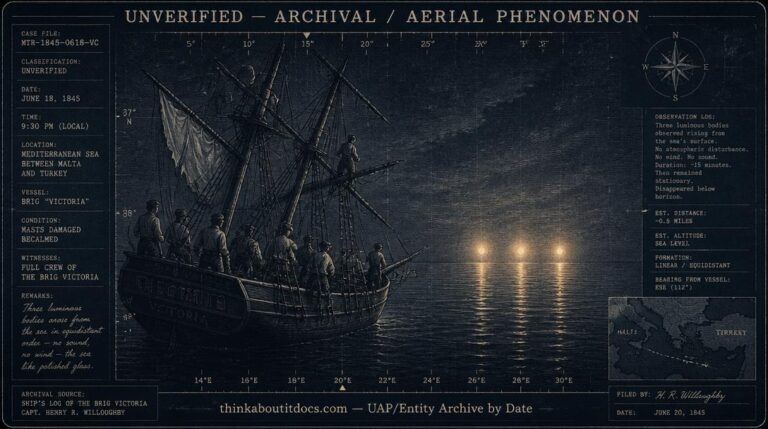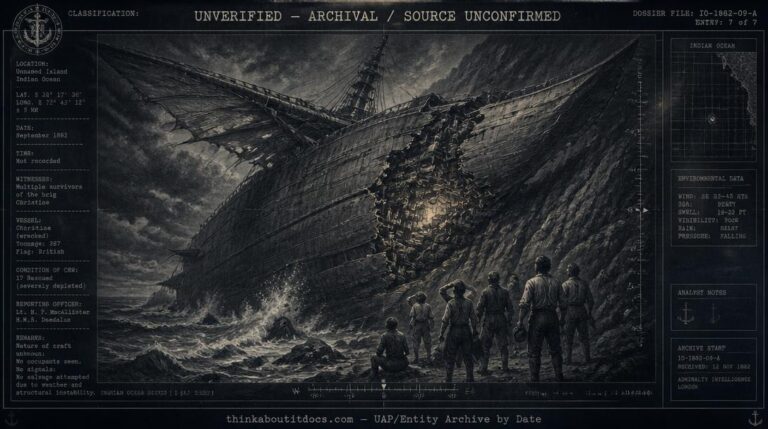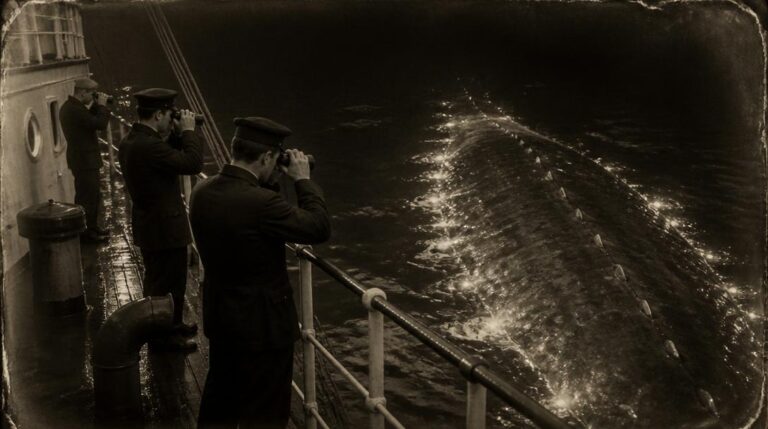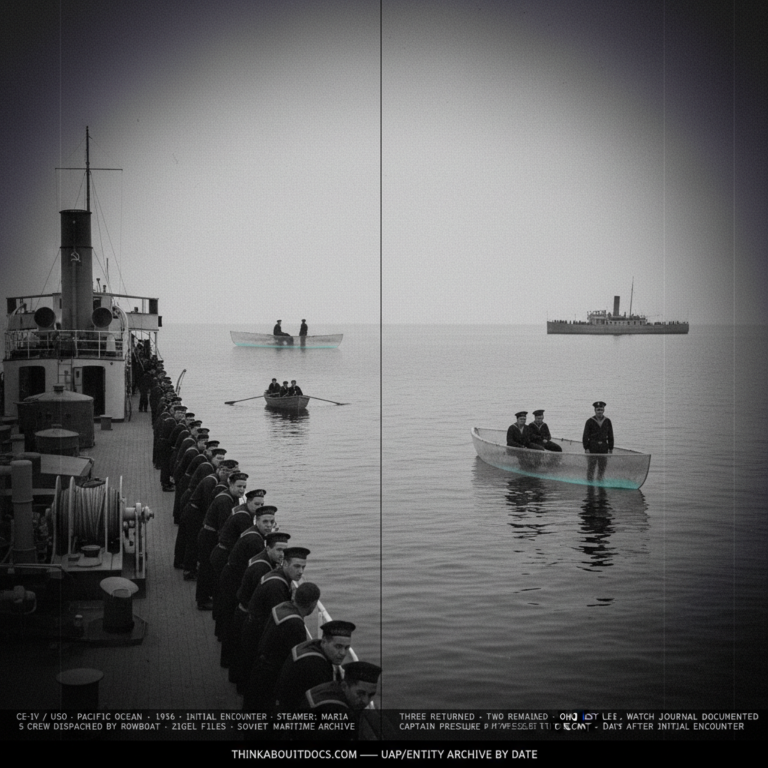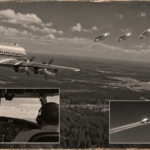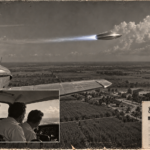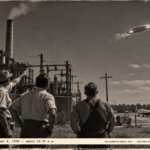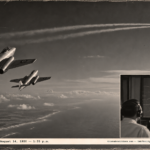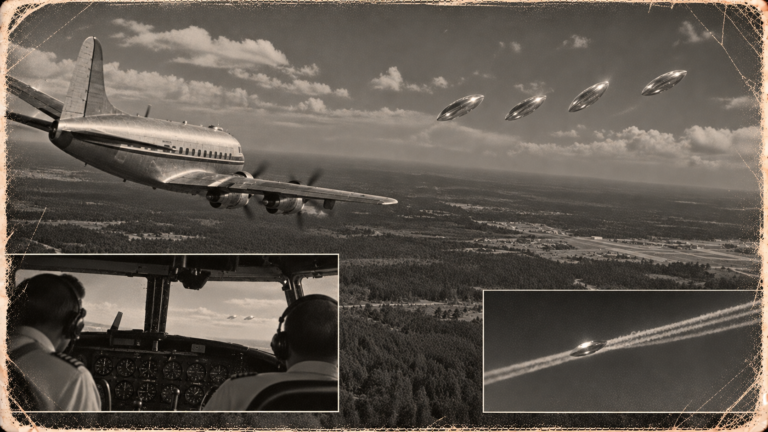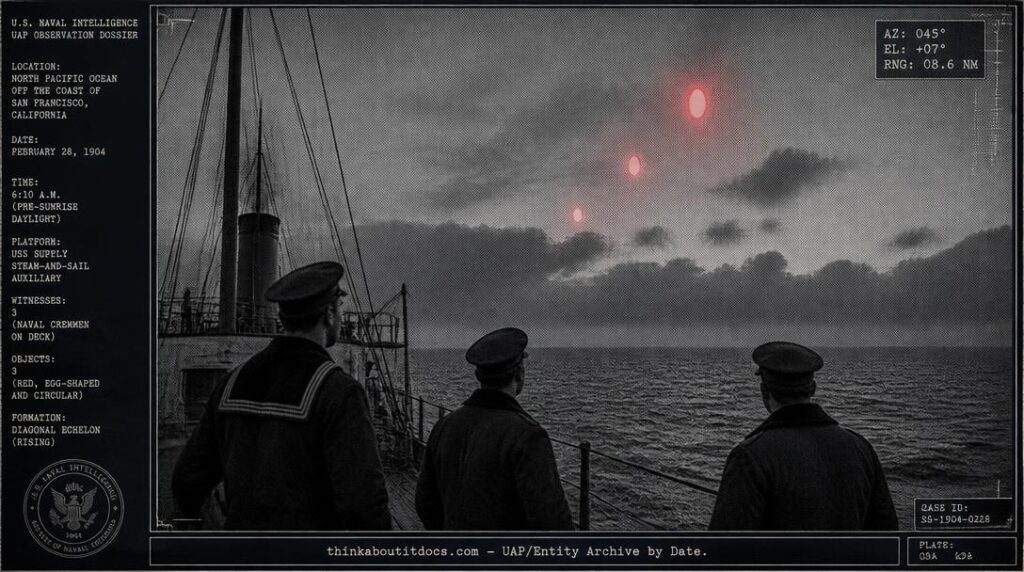
Archival rendering of the February 28, 1904 USS Supply sighting reported by Lt. Frank H. Schofield and published in the Monthly Weather Review.
THINK ABOUTIT UFO SIGHTINGS REPORT
1904: Circular UFOs Maneuvered Near Ship
At 6:10 in the morning of February 28th, 1904, three members of the crew of the USS Supply were on watch in the North Pacific off San Francisco when three objects appeared near the horizon below the cloud layer and moved directly toward the ship. The lead object was the size of six suns. They traveled in echelon formation — the same disciplined offset pattern used by military aircraft — changed course, rose above the cloud layer, and climbed out of sight into space, still in formation, still in echelon. The entire event lasted over two minutes. It was reported by Lieutenant Frank H. Schofield, later Rear Admiral and Commander-in-Chief of the United States Fleet, and published in the Monthly Weather Review. His report noted plainly what every witness already knew: meteors do not travel in echelon formation, change course, and climb.
Date: February 28, 1904
Sighting Time: 6:10 a.m. local time
Day/Night: Day — pre-sunrise, full sky visibility
Location: The USS Supply sighting has been relocated from an unsupported “North Pacific Ocean, off northern California” back to the Korean coast, consistent with the ship’s actual 1904 Asiatic Station assignment and contemporary press coverage.
Urban or Rural: Open ocean
No. of Entity(s): None observed
Entity Type: Not Applicable
Entity Description: Not Applicable
Hynek Classification: DD — Daylight Disc. Multiple circular objects observed in full daylight conditions performing controlled flight maneuvers. (Corrected from an earlier CE-I listing on this site’s legacy page: CE-I requires the object within roughly 500 feet of the witness, but the USS Supply objects appeared near the horizon and ascended into space at considerable distance throughout — CE-I does not fit this case.)
Duration: Over two minutes — from first observation near the horizon through approach toward the ship, course change, ascent above the cloud layer, and climb out of visual range
No. of Object(s): 3
Description of the Object(s): Three objects traveling in disciplined echelon formation — the same offset diagonal formation used by military aircraft. The lead object was egg-shaped and approximately three degrees of arc in apparent size, described as about the size of six suns. The two trailing objects were smaller and appeared perfectly round. Reported in the original Monthly Weather Review letter as bright red in color. The objects appeared below the cloud layer near the horizon, moved directly toward the ship, then changed course upward, rose above the cloud layer, and continued climbing into space still in formation.
Shape of Object(s): Lead object egg-shaped; trailing two objects perfectly circular
Size of Object(s): Lead object approximately three degrees of arc, described as the size of six suns; second object about twice the size of the sun; third object about the size of the sun
Color of Object(s): Bright red (corrected from an earlier “white to golden-yellow” description on this site’s legacy page, which is not supported by the original source; the Schofield letter as published in the Monthly Weather Review describes the objects as bright red)
Distance to Object(s): Appeared near the horizon and approached the ship; independent quantitative analysis (see Researcher’s Notes) estimates the objects at roughly a mile in altitude or less at their closest
Height & Speed: Appeared below cloud layer near horizon; changed course upward; ascended above cloud layer; continued climbing out of sight; entire transit over two minutes
Number of Witnesses: 3 crew members of USS Supply; the reporting witness is identified as Lieutenant Frank H. Schofield, who would later be promoted to Rear Admiral and serve as Commander-in-Chief of the United States Fleet. The other two witnesses are not named in the available source material.
Special Features/Characteristics: Echelon formation maintained throughout the entire sighting, including during the course change and ascent; formation discipline inconsistent with any natural phenomenon; course change from horizontal approach to vertical ascent performed while maintaining formation; objects ascended above the cloud layer and continued into space; the Monthly Weather Review published the account as a communication from the ship, providing an institutional federal scientific publication as the primary source; the reporting officer explicitly noted that meteors do not travel in formation, change course, and climb
Case Status: Unexplained
Source: Lt. Frank H. Schofield, USS Supply, as published in Monthly Weather Review, March 1904; NICAP / Richard Hall (1964); quantitative meteor-trajectory analysis by physicist Bruce Maccabee (MUFON Symposium, 2003, updated 2005)
Summary/Description: On February 28, 1904 at 6:10 a.m., three crew members of the USS Supply, including reporting officer Lt. Frank H. Schofield, observed three brilliantly red objects in echelon formation approach from the horizon in the North Pacific off San Francisco. The lead object was egg-shaped and approximately the size of six suns in apparent diameter. The two trailing objects were smaller and perfectly circular. The formation moved directly toward the ship, changed course upward, rose above the cloud layer, and climbed out of sight into space, all while maintaining echelon formation. The event lasted over two minutes. Published in the Monthly Weather Review, 1904. The reporting officer noted explicitly that the objects’ behavior was inconsistent with meteors, a conclusion later supported by independent quantitative analysis.
Related Cases: 1910: France — Copa Catalunya Disc Photograph | 1904: Bronx, New York Close Encounter | 1900–1944 UAP Archive
Detailed Report
Three Objects in Echelon — USS Supply, North Pacific, February 28, 1904
One of the earliest formation cases in the documented record was reported February 28, 1904, by a ship in the North Pacific off San Francisco. The reporting officer, Lieutenant Frank H. Schofield, would go on to a distinguished naval career, eventually being promoted to Rear Admiral and, roughly two decades later, serving as Commander-in-Chief of the United States Fleet — a detail that lends this case an unusually credentialed original witness for the period.
Schofield and two other crew members, at 6:10 a.m. local time, sighted an echelon formation of three objects he described in his official communication as “somewhat remarkable meteors,” bright red in color. They appeared near the horizon below the cloud layer and moved directly toward the ship.
As they approached, the objects began soaring. They rose above the cloud layer and were observed climbing into space, still in echelon, still in formation. The lead object was egg-shaped and approximately three degrees of arc in apparent size, described as about the size of six suns. The second was roughly twice the size of the sun, and the third about the size of the sun itself. They remained visible for over two minutes.
Schofield’s report noted the obvious: meteors do not travel in echelon formation, change course and climb, nor remain visible for two minutes. The Monthly Weather Review, a publication of the United States Weather Bureau, published the account as a communication received from the ship.
The case received further, more rigorous scrutiny decades later from physicist Bruce Maccabee, who compared the reported observation details against the physical behavior expected of genuine meteors. Working from the Monthly Weather Review account and the ship’s log, Maccabee’s analysis concluded the objects were inconsistent with meteors on three independent grounds: they were too close to the ship (estimated at roughly a mile in altitude or less) for meteor-typical distances, they executed too large a change in flight direction for a ballistic meteor trajectory, and they remained visible for far longer than the amount of sky they appeared to traverse would allow for objects moving at meteoric velocity.
RESEARCHER’S NOTES
Three in Echelon — USS Supply 1904 and the Formation Discipline Problem in Pre-Aviation UAP Cases
- The formation is the central evidentiary fact. Every element of the USS Supply sighting has a potential natural explanation except one: the echelon formation. Brilliant objects near the horizon can be atmospheric phenomena or unusual meteoric activity; objects that approach and then ascend could in principle be bolides on unusual trajectories. But three objects maintaining a disciplined offset echelon formation through a course change and a climb into space is not a natural geometry. In 1904, no known technology existed that could produce three objects in coordinated formation flight at the scale described.
- A credentialed original witness and an institutional federal source. The reporting officer, Frank H. Schofield, was not an anonymous or unidentified witness — he went on to become Rear Admiral and Commander-in-Chief of the United States Fleet. His account was submitted to and published by the Monthly Weather Review, a scientific publication of the U.S. Weather Bureau, meaning it passed through an institutional filter before entering the historical record. This combination of a credentialed, later-senior naval officer and a federal scientific publication gives the case exceptional evidentiary standing for its era.
- Independent quantitative analysis supports the “not a meteor” conclusion. Physicist Bruce Maccabee’s later analysis, working from the same primary source material, found the reported altitude, course change, and duration of visibility all inconsistent with genuine meteoric activity on independent physical grounds — not simply an eyewitness’s intuition, but a calculation against known meteor behavior. This is one of relatively few pre-aviation-era cases to have received this kind of dedicated quantitative scrutiny.
- Classification correction: DD, not CE-I. This site’s legacy field data classified the case as CE-I, which requires the object within roughly 500 feet of the witness. The USS Supply objects appeared near the horizon and ascended into space at considerable distance throughout — the geometry of the sighting does not support CE-I. The corrected classification is DD (Daylight Disc): multiple circular objects observed in full daylight performing controlled flight maneuvers. The lead object’s three-degree angular size does not imply proximity; it implies substantial physical size at distance.
- Color correction. This site’s legacy field data described the objects as “white to golden-yellow.” The original Schofield communication, as published in the Monthly Weather Review and corroborated by independent summaries of the same primary source, describes the objects as bright red. The field data above has been corrected accordingly.
- Pre-aviation context sharpens the formation-discipline problem. February 28, 1904 is roughly two and a half months after the Wright Brothers’ first powered flight at Kitty Hawk on December 17, 1903. At the time of this sighting, no aircraft in existence was capable of formation flight, of reaching altitude above cloud layers, or of operating anywhere near the North Pacific. The three objects were not experimental aircraft. They were not balloons — no balloon maintains formation through a coordinated climbing maneuver. Schofield’s own report states plainly they were not meteors. What they were, the archive does not claim to know.
Three objects in echelon formation rose from the horizon off San Francisco on the morning of February 28, 1904, approached a United States naval vessel, changed course upward in formation, climbed above the clouds in formation, and disappeared into space in formation. A future fleet commander recorded it. A federal scientific publication printed it. A physicist’s later quantitative analysis supported his conclusion that it defied every natural explanation available. More than a century later, the archive holds the same position: the formation is unexplained, the source is impeccable, and the file is open.
“Three somewhat remarkable meteors were observed from this ship at 6:10 a.m.”
— Lt. Frank H. Schofield, USS Supply, Monthly Weather Review, March 1904