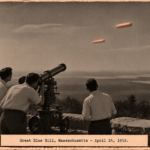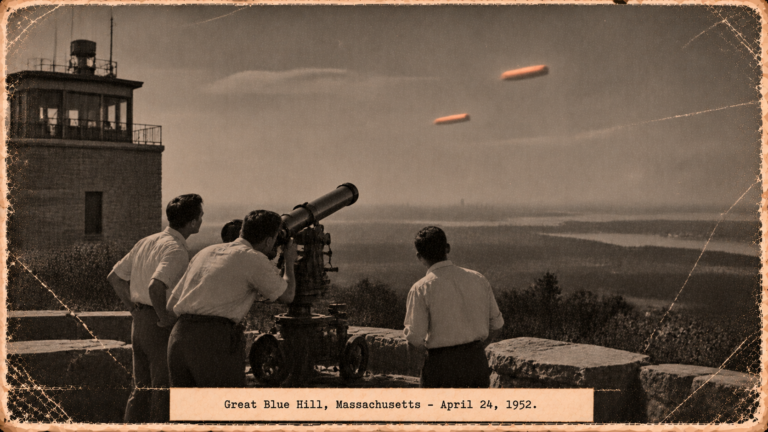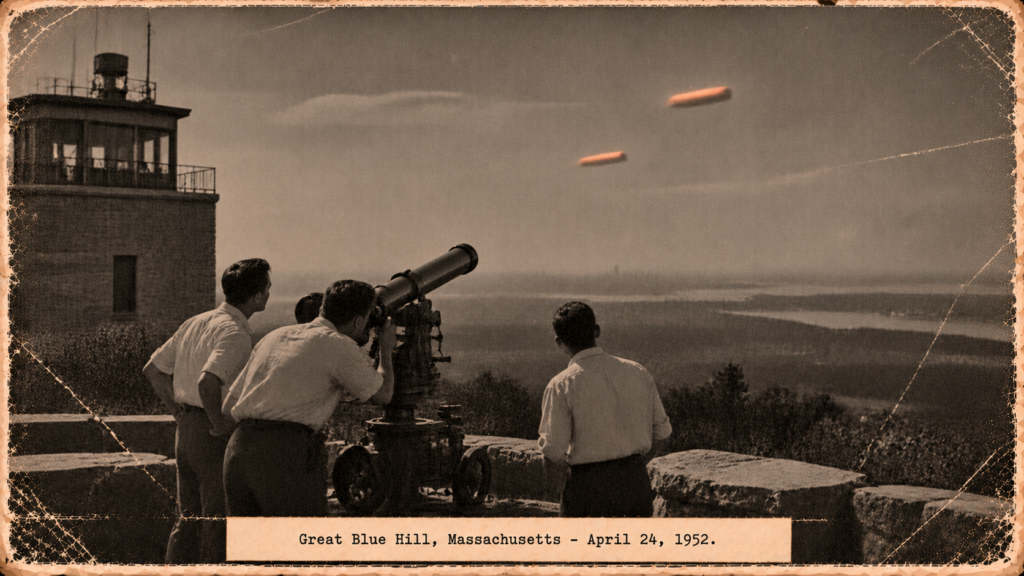
Two wobbling orange objects over Great Blue Hill, April 24, 1952.
THINK ABOUTIT UFO|UAP SIGHTINGS REPORT
1952: Radar Engineers on Great Blue Hill Track Two Wobbling, Dull-Orange Objects Through a Battery Commander’s Telescope
At about 2:30 p.m. on April 24, 1952, two electronics workers of the Air Force Cambridge Research Center’s Radar Systems Laboratory and an MIT electrical engineering student were practicing aircraft tracking with a Battery Commander’s telescope on the Air Force observation platform at the summit of Great Blue Hill, Milton, Massachusetts, when one of them saw an object about two miles to the northwest rise rapidly in a wobbling motion from about 1,500 feet.
A second, identical object appeared after it had climbed about 400 feet. The two flat, dull reddish-orange objects, 10 to 20 feet across, undulated in a swooping motion, flew four to six miles toward the northeast and then climbed again and disappeared, with no trail, exhaust or sound. All three men said they were not birds, kites or paper and did not look like any aircraft they knew. Project Blue Book lists this Great Blue Hill, Massachusetts UFO case as Unidentified.
Date: April 24, 1952
Sighting Time: About 2:30 p.m. EST (1430); one witness gives 1445
Day/Night: Day; clear, sun behind high overcast in the opposite quadrant
Location: Top of the Air Force observation tower, Great Blue Hill, Milton, Massachusetts (elevation 785 feet)
Urban or Rural: Hilltop, suburban area near Boston
No. of Entity’s: Not Applicable
Entity Type: Not Applicable
Entity Description: Not Applicable
Hynek Classification: DD (Daylight Disc)
Duration: 1.5 to 2 minutes
No. of Object(s): 2
Description of the Object(s): Flat, thin, dull reddish-orange objects with a lip around the outer edges, no corners, shaped like “ovals pulled in at the waist” (diamond to oval to one witness), undulating in a wobbling, swooping motion
Shape/Size/Color of Object(s): Square-like, oval or diamond depending on the witness; 10 to 20 feet across and not more than 3 feet thick; dark orange or red, brick orange; no aerodynamic features
Distance to Object(s): First seen about 2 miles to the northwest; visibility about 70 miles
Height & Speed: Climbed from about 1,000–1,500 feet to about 2,000 feet; the witnesses estimated 150, 200 and 240 mph; they flew about 4 to 6 miles from northwest toward the northeast
Number of Witnesses: 3 (two electronics workers and an MIT student; names blacked out)
Special Features/Characteristics: Tracked through a 6-power Battery Commander’s telescope; no trail, exhaust or sound; the radar on the tower was inoperative
Case Status: Blue Book: Unidentified
Source: Air Force OSI report ID-051 24-0-250 (April 24, 1952 sighting; interviews of April 29, 1952); routing and record sheet; Project Blue Book record card; Blue Book April list; Berliner; FUFOR Index; Loren Gross, UFOs: A History
Summary/Description: Three radar-laboratory workers on Great Blue Hill tracked two flat orange objects wobbling upward and away for about two minutes through a telescope. None could match them to birds, kites, paper or aircraft.
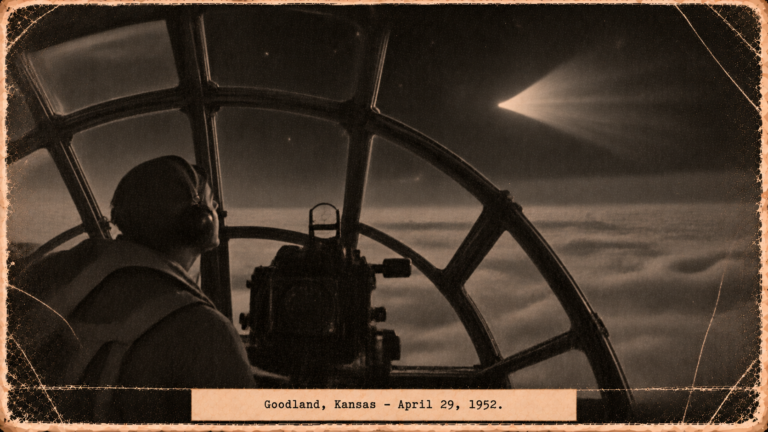
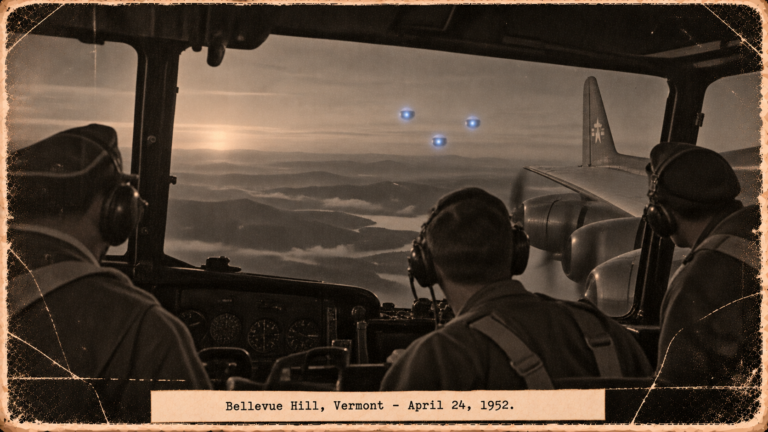
Related Cases: Bellevue Hill C-124 crew (April 24, 1952); Goodland B-29 fan-shaped light (April 29, 1952); April 1952 archive
Detailed Report
The Air Force OSI report (ID-051 24-0-250), subject “Reporting of Information on Unconventional Aircraft (Great Blue Hill, Milton, Massachusetts, 24 April 1952),” synopsizes that on April 28, 1952, three USAF civilian employees assigned to the Radar Systems Laboratory, Electronics Research Division, Air Force Cambridge Research Center at 230 Albany Street, Cambridge, reported to Captain James R. Locke, the Air Provost Marshal, that they had observed two unidentified airborne objects between 1430 and 1445 hours on April 24, 1952. The report says no activity or condition developed that accounts for the sighting.
Each witness was interviewed on April 29 by an OSI special agent. The first, an electronics scientist who for about a year and a half had been tracking aircraft with a Battery Commander’s telescope and radar, described two flat, flexible, square-like objects of about 10 feet in their greatest dimension and undetermined thickness, dark orange or red, with no aerodynamic features, producing no sound and leaving no trail or exhaust. They moved with a wobbly, undulating motion for four to six miles in about a minute and a half, in a rapid ascent from about 1,500 to 2,000 feet, then an unsteady horizontal path, then another ascent at an undetermined angle. He did not notice there were two objects until the first had nearly completed its initial ascent.
The second witness, an electronics technician who had tracked aircraft since July 1951, described very thin objects 10 to 15 feet across at their widest point, with a lip around the outer edges and a dull reddish-orange color. No corners were visible and they looked like “ovals pulled in at the waist.” They consistently undulated with a wobbling, swooping motion, first on a perpendicular course, then along a horizontal plane, and then in a second but angular rise of about 15 degrees at approximately 240 mph. There was no trail or exhaust and no sound. They grew smaller and smaller and became invisible. He said he did not believe the undulating and swooping motion could cause their propulsion.
The third witness, an MIT electrical engineering senior working as a cooperative employee at the laboratory as an aircraft observer since February 4, 1952, described two objects of definite diamond to oval shape and flat surface, brick orange and dull, with a greatest dimension of about 20 feet and not more than 3 feet thick. They continuously undulated like the conventional portrayal of a “flying carpet.” He saw them undulating side by side for about 20 seconds, then rise perpendicularly about 500 feet, level off and cover an angle of 62 to 65 degrees, about three miles, and then climb at an angle to about 2,000 feet. Just before he last saw them they stopped and undulated without progressing. He put the speed at about 200 mph and the time at about 1445 for not more than two minutes.
All three observed through a 6-power Battery Commander’s telescope (“Telescope B. C. M65”), a standard U.S. Army elbow-type instrument on a mounted unit with hand wheels. The observer stood on top of the observation platform at the summit of Great Blue Hill, 785 feet above sea level. Each stated definitely that the objects were not kites, birds, large pieces of paper or any aircraft known to him. One said the radar on the tower was inoperative and that his description was not influenced by anything he had read on unknown objects. The weather was clear with visibility estimated at 70 miles in the quadrant where the objects were sighted; the sun was hidden behind high overcast in the opposite quadrant, and the Blue Hills weather station reported random winds at 4 mph.
The Project Blue Book record card lists two electronic engineers as source, 1.5 minutes, two objects, dark red and flat square, “wobbly” flight and a climb to level flight to climb, and notes the B.C. scope is fairly high powered. The conclusion is Unknown. The OSI chief’s routing sheet transmitted the spot intelligence report to the Directorate of Intelligence and said the Director would be kept advised of further developments.
RESEARCHER’S NOTES
Three Accounts, Three Shapes and One Motion
- Three Descriptions. The witnesses disagree on shape (square-like, ovals pulled in at the waist, diamond to oval), size (10, 10–15 and 20 feet) and speed (150, 200 and 240 mph) but agree on color, the wobbling or undulating motion and the climb-level-climb path.
- Instrumented Observers. All three were using an Army instrument in routine tracking practice. The file records that each tried and failed to match the objects with any known thing.
- Radar. The tower radar was inoperative at the time, so there is no radar record to compare.
- Time. Two accounts give about 1430 and the third about 1445; the report and card use 1430.
Great Blue Hill is rare among the April cases: three trained observers tracking with a telescope, interviewed separately by OSI within five days, agreeing on the motion and disagreeing, naturally, on the detail. None of them could name what they had watched.
«Ovals pulled in at the waist.»
— Witness statement, Air Force OSI report ID-051 24-0-250, Great Blue Hill, Milton, Massachusetts, April 24, 1952