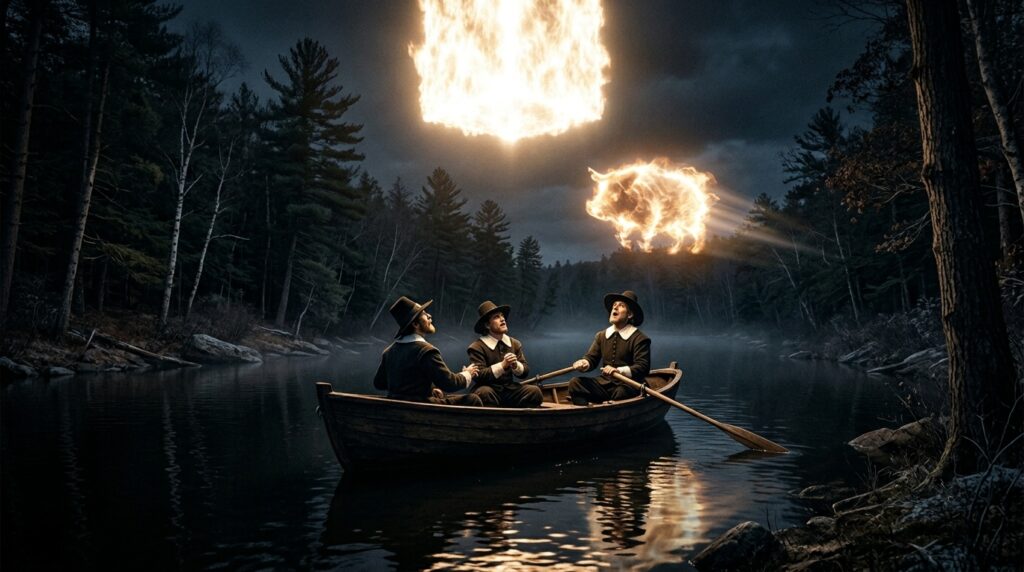
March 1638 or 1639 — Muddy River, Charlton, Massachusetts Bay Colony. James Everell — described by Governor John Winthrop as a sober discreet man — watched a three-yard-square luminous mass flame up, contract into a swine-shape, and race between his location and Charlton for two to three hours. When it was gone, the boat had been carried one mile against the tide. America's first formally documented UAP.
THINK ABOUTIT UFO|UAP SIGHTING REPORT
1638 or 1639: Charlton, Massachusetts Sighting
One evening in March of 1638 or 1639 — the colonial records disagree on the exact year — James Everell, a sober discreet man of good reputation and considerable standing in the Massachusetts Bay Colony, was crossing the Muddy River in a small boat with two companions when a great light appeared in the sky above the water. It flamed up as it hovered, appearing to measure three yards square. Then it contracted into the figure of a swine and moved swift as an arrow in the direction of Charlton. For two to three hours it did this — hovering and flaming up, contracting and racing away, returning, repeating — in full view of three credible Puritan witnesses on the water below. When the light finally disappeared, the men stood up and found themselves one mile upstream from where they should have been — carried against the tide back to their starting point by an unknown force while they had been watching the sky. Governor John Winthrop — a trained historian who had been chronicling the Massachusetts Bay Colony since its founding in 1630 — considered this event important enough to record twice in his journal, devoting two separate index entries to it. James Everell, the man who watched a three-yard-square light contract into the shape of a swine and race across the Massachusetts night, was not a frontier eccentric. He was a respected church member, a successful tradesman, and one of the most credible witnesses in the earliest American UAP record.
Date: March 1638 or 1639 — exact year uncertain; Governor Winthrop recorded both dates
Sighting Time: Evening — after dark
Day/Night: Night
Location: Muddy River near Charlton (Charlestown), Massachusetts Bay Colony — the river between Boston and Charlestown
Urban or Rural: Rural frontier — the Massachusetts Bay Colony was eight years old at the time of the sighting
Hynek Classification: NL — Nocturnal Light; luminous aerial object observed at night with extended duration, shape transformation, and physical effect on witnesses; the physical displacement of the boat and the two to three hour duration place this case at the CE-II boundary
Duration: Two to three hours
No. of Object(s): 1
Description of Object(s): A great luminous mass that appeared in the sky above the Muddy River. When hovering and motionless it flamed up and appeared to measure three yards square — approximately nine feet per side. When moving it contracted into the shape of a swine and moved with arrow-like speed toward Charlton. It repeated this cycle — flame up and hover, contract and race away, return — for two to three hours.
Shape of Object(s): Variable — three yards square when hovering; contracted to swine-shape when moving
Size of Object(s): Three yards square — approximately nine feet per side when at full expansion
Color of Object(s): Luminous — described as a great light; flaming up when at maximum size
Distance to Object(s): Above the river — close enough to observe shape transformation in detail
Height & Speed: Aerial — hovering above the water; moved swift as an arrow when in contracted form
Number of Witnesses: 3 — James Everell and two companions; Governor Winthrop also notes that diverse other credible persons saw the same light afterward about the same place
Special Features / Characteristics: Shape transformation — object changed from a three-yard-square flaming mass to a contracted swine-shaped form and back repeatedly; physical effect on witnesses — the boat was carried one mile against the tide to the starting point during the observation period; the witnesses were unaware of the displacement until the light had gone; possible missing time element — two to three hours of observation with unexplained physical displacement; Governor Winthrop’s personal credibility assessment of James Everell — described as a sober discreet man of reputation, activity and good estate; Winthrop devoted two separate index entries to the event indicating he considered it significant; additional witnesses confirmed afterward; the swine shape is analytically noted as the closest familiar animal form available to a 17th century leather dresser for describing a contracted aerial object
Case Status: Unexplained
Source: Governor John Winthrop, The History of New England from 1630 to 1649 (Boston: Little, Brown and Company, 1853), pp. 349–350
Summary/Description: In March 1638 or 1639, James Everell and two companions observed a great luminous mass above the Muddy River near Charlton, Massachusetts for two to three hours. The object alternately expanded to three yards square while hovering and contracted into a swine-shaped form while racing toward Charlton, repeating this cycle repeatedly. When the object disappeared the men discovered their boat had been carried one mile against the tide to their starting point by an unknown force. Documented by Governor John Winthrop in his personal journal — one of the most credible and precisely documented early American UAP accounts in the historical record.
Related Cases: January 18, 1644 CE Boston Bay Colony Man-Shaped Lights | 1660 CE New England Spear-Shaped Light | North American Colonial UAP Archive
DETAILED REPORT:
The Massachusetts Bay Colony is eight years old. Governor John Winthrop, who arrived in 1630 with one thousand English emigrants to build a Puritan commonwealth in the New World, has been keeping a meticulous journal of the colony’s development. He is a trained historian and a man of considerable personal discipline — his journal is not a collection of gossip or speculation but a carefully considered record of events he believes posterity will want to understand.
In March of 1638 or 1639 — his own dating is uncertain between the two — James Everell boards a small boat on the Muddy River with two companions. Everell is a leather dresser — a skilled tradesman who works with animal hides, tanning them and producing leather goods. He is, in Winthrop’s personal assessment, a sober discreet man of good reputation, activity, and good estate — one of the more established members of the young colony, a church member of eight years’ standing, a man whose word carries weight.
They have been moving downstream for approximately a mile when the sky changes.
A great luminous mass appears above the river. Not a distant light on the horizon — above the river, in the sky above the water they are moving through. It hovers. As it hovers it flames up — intensifies — and at its maximum luminosity it appears to measure three yards square. Nine feet across on each side, flaming and hovering above a small boat carrying three Massachusetts colonists in the dark.
Then it changes.
It contracts. The three-yard-square flaming mass pulls itself together into a smaller, more defined shape — the shape, Everell says, of a swine. And in that contracted swine-shape it moves swift as an arrow toward Charlton.
Then it comes back.
And it flames up again.
And contracts again.
And races toward Charlton again.
For two to three hours, James Everell and his two companions watch this cycle repeat — the object expanding into its flaming square form when hovering, contracting into its arrow-swift swine-form when moving, never permanently departing, always returning to the same position above the river. The consistency of the return is one of the most analytically significant features of the account. This is not a random aerial phenomenon moving through. It is a repeating pattern — a cycle of presence and movement centered on a specific location above the Muddy River.
After two to three hours, the light vanishes.
The three men stand up in the boat and look around. They are one mile from where they should be. They have been carried — against the tide, back to their starting point — without being aware of the movement. Whatever moved the boat did it silently and without the men’s perception during the period they were watching the sky. They were downstream when the light appeared. They are back at their starting point when it is gone.
Governor Winthrop’s response to Everell’s account is analytically revealing. He does not dismiss it. He records it twice — once in the text of his journal and twice more in his index, devoting two separate entries to this single event. He evaluates the witness personally and in writing — not just noting that Everell was present but explicitly vouching for his credibility, sobriety, and social standing. He notes that other credible persons saw the same light afterward, in the same location. He speculates in a footnote about possible explanations — demonic influences, ghost lights, will-o-the-wisps — and appears unsatisfied by all of them. This is a historian’s response to an event he cannot explain but will not ignore.
The swine comparison has attracted analytical attention across the four centuries since Winthrop recorded it. James Everell was a leather dresser — a man whose professional life was organized around the bodies of domestic animals, primarily pigs and cattle. When he searched for the closest shape his experience could offer for a contracted aerial object with an indistinct lower form, he chose swine. The observation is sometimes noted as possibly describing struts, landing gear, or an irregular bottom surface on an aerial object whose upper portion contracted into a defined mass when moving. Whatever Everell saw, he described it in the most precise language his experience made available to him, and Governor Winthrop considered that description worth preserving for posterity.
RESEARCHER’S NOTES:
The Muddy River Light — Shape Transformation, Impossible Displacement, and America’s First Governor-Documented UAP
- Governor Winthrop as Primary Source: John Winthrop’s documentation of the Everell sighting is the gold standard of early American historical evidence. Winthrop was not a credulous recorder of colonial folklore — he was a trained lawyer, a careful historian, and the founder and governor of what became one of the most institutionally significant colonies in American history. His personal vouching for Everell’s credibility, his two-index treatment of the event, and his honest acknowledgment that he could not satisfactorily explain it are the marks of a careful mind taking an anomalous observation seriously.
- The Shape Transformation Pattern: The object’s documented cycle of expanding into a three-yard-square flaming mass when stationary and contracting into a swine-shaped fast-moving form when in transit is one of the earliest documented shape-transformation UAP accounts in the American record. Shape transformation — specifically the change from a larger hovering form to a smaller faster-moving form — appears consistently across the modern UAP record and has been noted in multiple government-adjacent UAP investigation reports. The 1638 Muddy River object was doing in colonial Massachusetts what modern trans-medium craft are described as doing in declassified US Navy encounters.
- The Boat Displacement as Physical Evidence: The discovery that the boat had been carried one mile against the tide to the starting point during the observation period is the most physically significant element of the case. This is not a subjective experience or a perceptual anomaly. It is a physical displacement of a material object — a boat with three occupants — against the direction of tidal current, over a measurable distance, during a specific time window. The witnesses were unaware of the movement until they noticed their location. Whatever moved the boat did so without their perception, which argues for a force acting on the vessel from outside the awareness of the men aboard.
- Duration Eliminates Natural Explanations: Winthrop himself noted that the two to three hour duration rules out meteors. The 1638 date is 150 years before the first balloon flights. The shape transformation eliminates conventional astronomical objects. The physical effect on the boat eliminates purely visual phenomena. Every conventional explanation available to the 17th century or the 21st has been systematically eliminated by the documented characteristics of the Muddy River event — which is precisely why Governor Winthrop devoted two index entries to it and why the archive holds it as America’s first formally documented UAP case.
James Everell was a sober discreet man and Governor Winthrop said so twice. On a March evening in 1638 or 1639 — the year remains uncertain — Everell and two companions watched a three-yard-square flaming light contract into a swine-shape and race across the Massachusetts night for two to three hours from a small boat on the Muddy River. When it was gone they were a mile upstream from where they should have been, carried against the tide by something they had not felt moving. Winthrop wrote it down. His journal has been in continuous scholarly circulation since 1853. The Muddy River light has not been explained in nearly four centuries and the archive does not expect that to change. Whatever flamed up over the Muddy River in colonial Massachusetts, it arrived before the United States did, and it left without explaining itself to the most careful recorder in the New World.