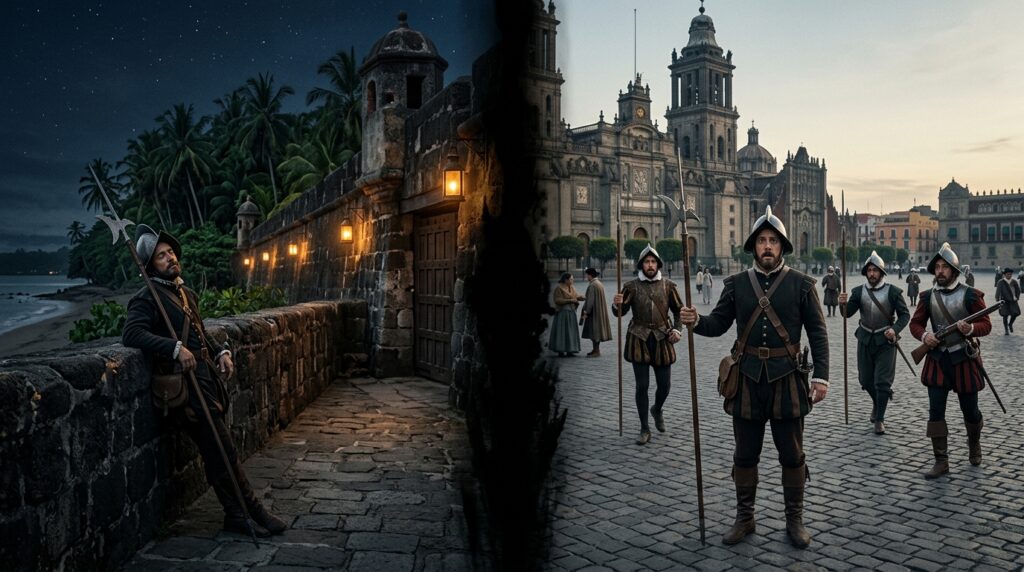
October 24–25, 1593 — Manila, Philippines to Mexico City, Mexico. Palace guard Gil Pérez closed his eyes against a wall in Manila and opened them in the Plaza Mayor of Mexico City — 9,000 miles away. His knowledge of Governor Dasmariñas' assassination was confirmed two months later by a galleon from Manila. Documented by historian Antonio de Morga in 1609.
THINK ABOUTIT TELEPORTATION REPORT
1593: Gil Pérez’s 9,000 mile Instant Trip
On the morning of October 25, 1593, the Captain of the Guard at the Viceroy’s palace in Mexico City noticed a soldier standing at his post in the wrong uniform. The man was calm, professional, and clearly knew how to perform guard duty. He was also wearing the uniform of the palace guards from Manila, Philippines — 9,000 miles away across the Pacific Ocean. When questioned, the soldier gave his name as Gil Pérez. He explained, as matter-of-factly as a man could explain such a thing, that he had been standing guard at the Governor’s palace in Manila the previous evening, leaned against a wall to rest for a moment, closed his eyes — and opened them here. He also told his questioners something they had no way of verifying: the Governor of Manila, Gómez Pérez Dasmariñas, had been assassinated by Chinese mutineers the night before. The Mexican authorities threw him in prison. Two months later a galleon arrived from Manila. Every word Gil Pérez had said was confirmed — including details no one in Mexico City could have known. The first and most thoroughly documented case of instantaneous human teleportation in the historical record was recorded not in fringe literature but in the official chronicle of a Spanish colonial historian in 1609.
Date : October 24–25, 1593
Sighting Time : Evening October 24 — discovered morning October 25
Day/Night : Evening / Early morning
Location : Manila, Philippines (origin) → Mexico City, Mexico (arrival) — approximately 9,000 miles / 14,500 km
Urban or Rural : Urban — Governor’s palace Manila; Plaza Mayor Mexico City
Hynek Classification : CE-IV — anomalous physical transport of a human being across an impossible distance; direct physical evidence and multiple independent confirmation
Duration : Instantaneous — from leaning against a wall in Manila to standing in Mexico City’s Plaza Mayor
Number of Witnesses : Multiple — Captain of the Guard, Viceroy Velasco, Spanish Inquisition authorities, galleon passengers, Manila officer who confirmed Gil Pérez’s identity and disappearance
Special Features/Characteristics : Gil Pérez retained full consciousness and physical integrity; he was wearing his correct Manila palace guard uniform; he carried a different type of musket than used in Mexico; he provided advance knowledge of Governor Dasmariñas’ assassination confirmed two months later by galleon; a Manila military officer arriving on the galleon recognized Pérez as the guard who had specifically gone missing on October 24; the Viceroy personally examined him and found his account credible; the Spanish Inquisition investigated and ultimately released him; he was returned to Manila on the galleon
Case Status: Unexplained
Source : Antonio de Morga, Sucesos de las Islas Filipinas (1609); José Rizal annotations; Father Gaspar de San Agustín, Conquista de las Islas Filipinas (1698)
Summary/Description : On the evening of October 24, 1593, Spanish palace guard Gil Pérez was on duty at the Governor’s palace in Manila, Philippines. He leaned against a wall and when he opened his eyes found himself standing in Mexico City’s Plaza Mayor — 9,000 miles away. He was arrested, questioned by Viceroy Velasco, held by the Inquisition, and consistently maintained his account. Two months later a galleon from Manila confirmed every detail he had provided including the date of the Governor’s assassination. A Manila military officer on the galleon confirmed Pérez had disappeared from his post on October 24. He was returned to Manila. The event was recorded in 1609 by colonial historian Antonio de Morga — one of the most thoroughly documented cases of apparent instantaneous human teleportation in the historical record.
Related Cases: 1593 Manila October 24 archive entry | 1572 Hans Buchmann Abduction — Romerswil Switzerland | Anomalous Human Transport Archive
Detailed Report
October 1593. Manila, Philippines. The Spanish colonial capital is in turmoil.
The seventh Governor-General of the Philippines, Gómez Pérez Dasmariñas, has been assassinated. He was leading a naval expedition to capture the fort of Ternate in the Molucca Islands when Chinese galley rowers — conscripted, underfed, and regularly flogged — mutinied aboard his flagship La Capitana. Dasmariñas and most of his Spanish guards were killed. The colony is without its leader. A successor has not been named. The palace guards maintain their posts.
Gil Pérez is one of them.
By the accounts that survive, Pérez was an ordinary soldier — a member of the palace guard in Manila, a man who had given no indication throughout his service of anything unusual. On the evening of October 24, 1593, he was fulfilling his duty at the Governor’s palace. Tired, he leaned against a wall and closed his eyes for a moment.
When he opened them he was not in Manila.
He was standing in the Plaza Mayor of Mexico City — the main square of New Spain’s colonial capital — approximately 9,000 miles across the Pacific Ocean from where he had been standing seconds before. His uniform was the same. His weapons were with him, though observers in Mexico City noted he carried a different type of musket than those used there. He was physically intact and fully conscious.
Not knowing what else to do, he continued performing guard duty.
The Captain of the Guard noticed him immediately — a soldier in the wrong uniform standing at a post. When questioned, Pérez gave his account: he was Gil Pérez, a palace guard from Manila, Philippines. He did not know how he had arrived in Mexico City. He had been in Manila the night before. He reported that Governor Gómez Pérez Dasmariñas had been assassinated by Chinese mutineers.
The Mexican authorities were skeptical in the manner of men confronted with something they cannot explain. At best, they reasoned, he was a deserter who had traveled by some unknown route. At worst, he was involved in diabolism. He was arrested. Viceroy Luis de Velasco personally examined him. By multiple accounts Pérez was calm, assured, and consistent — answering every question with the straightforward conviction of a man telling the truth about something he himself could not understand. The Viceroy found him credible but did not know what to do with him. He was handed to the Spanish Inquisition in Santo Domingo.
Two months passed.
Then a galleon arrived at Acapulco from Manila laden with goods and news from the East.
Everything Gil Pérez had said was confirmed.
Governor Gómez Pérez Dasmariñas had indeed been assassinated by Chinese mutineers. The date matched. The details of the expedition, the mutiny, the death — all confirmed precisely as Pérez had described them to the Viceroy weeks before the galleon could have carried the news. And among the galleon’s passengers was a Spanish military officer from Manila who recognized Gil Pérez on sight — and confirmed that Pérez had been serving as a palace guard in Manila and had specifically gone missing on October 24, 1593, the very day he had appeared in Mexico City.
The Inquisition released him. Viceroy Velasco recalled him to Mexico City. He was returned to Manila on the departing galleon.
The case was recorded in 1609 by Antonio de Morga — a distinguished Spanish lawyer, colonial official, and historian whose Sucesos de las Islas Filipinas is considered one of the most authoritative primary sources on Spanish colonial Philippines. De Morga was not a sensationalist. He was a trained legal mind producing an official historical record. He included the Gil Pérez account because the evidence for it was, by colonial Spanish legal standards, compelling enough to warrant documentation.
José Rizal, the Philippine national hero and physician-scholar, later annotated de Morga’s work and addressed the Pérez case directly. Father Gaspar de San Agustín included it in his 1698 Conquista de las Islas Filipinas. The case has two independent primary source documentation chains separated by nearly a century — both drawing on the same underlying event whose core facts were confirmed by official examination, multiple witnesses, and documentary corroboration.
RESEARCHER’S NOTES: The Manila Teleportation — A Soldier, A Galleon, and the Evidence That Would Not Go Away
- The Corroboration Structure: The Gil Pérez case is unique in the anomalous transport record because it has a built-in verification mechanism that operated independently of the witness. Pérez did not merely claim to have come from Manila — he provided specific, verifiable intelligence about a recent event in Manila that no one in Mexico City could have known. When the galleon confirmed those details two months later, it simultaneously confirmed that Pérez’s account of his origin was truthful. The corroboration was not provided by Pérez — it arrived on a ship.
- The Military Officer Identification: The Manila military officer aboard the galleon who recognized Gil Pérez and confirmed his identity as a guard who had gone missing on October 24 provides the most forensically significant element of the case. This was not a general confirmation that a man named Pérez had existed in Manila — it was a specific identification of the exact person, at the exact post, on the exact date of his disappearance. The officer was as surprised to find Pérez in Mexico City as the Viceroy had been.
- The Inquisition’s Response: The Spanish Inquisition’s handling of the case is analytically significant. The Inquisition’s institutional reflex was to prosecute cases of supernatural agency — demonic pacts, witchcraft, and diabolism. That they investigated and ultimately released Pérez rather than prosecuting him suggests their examination found insufficient evidence of supernatural contract or willing participation. He was not a willing traveler. He was a man who leaned against a wall and found himself somewhere else.
- Primary Source Documentation: The 1609 de Morga documentation is the gold standard of historical evidence for the pre-modern era. Antonio de Morga was a trained lawyer and official colonial historian writing within sixteen years of the event, drawing on official colonial records and testimony. His inclusion of the Pérez case in a formal history of the Philippines was a deliberate editorial decision — he considered it documented fact worth preserving in the permanent record of the colony.
Gil Pérez leaned against a wall in Manila on the evening of October 24, 1593, and opened his eyes in Mexico City. He had no explanation for what happened to him, no memory of the transit, no awareness of the journey. He did what a soldier does — he continued his duty. The evidence that confirmed his account arrived on a galleon two months later, carried by a ship that had no knowledge of what it was confirming. Antonio de Morga recorded it in 1609. José Rizal annotated it in 1890. The archive holds it now. Whatever moved Gil Pérez 9,000 miles in the time it takes to close and open your eyes did not leave a mechanism, a craft, or an explanation. It left only a confused soldier in the wrong uniform standing in the Plaza Mayor of Mexico City, faithfully performing a duty he had been told to perform — in front of the wrong palace, on the wrong side of the world.