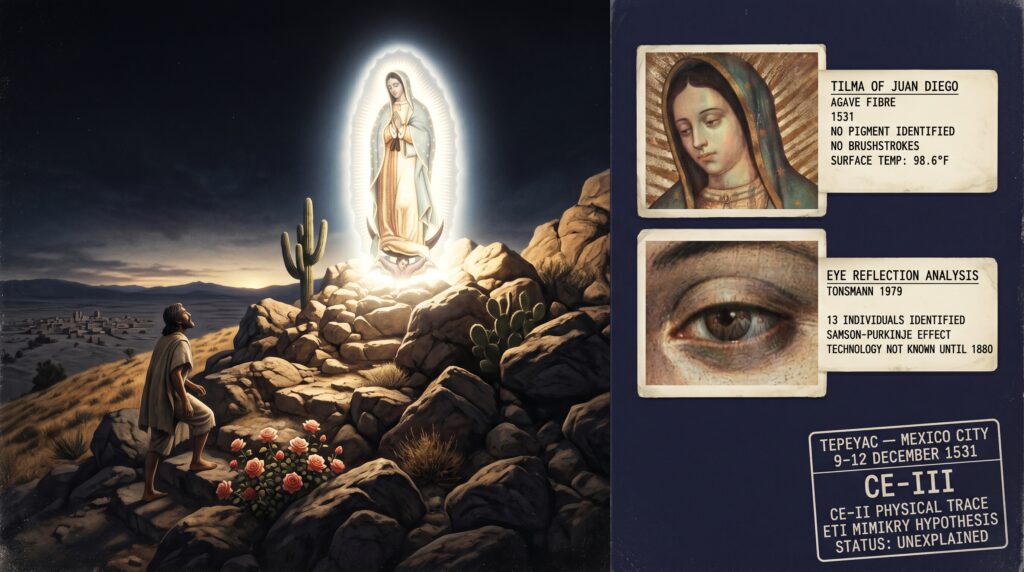
Tepeyac, Mexico, December 9–12, 1531 — Juan Diego encountered a luminous figure who produced an image on his agave tilma with no paint, no brushstrokes, and no identifiable pigment. The figure's eyes contain photographic reflections of the witnesses present using an optical mechanism not understood by science until 1880. Source: Johannes Fiebag Ph.D.; Philip Callahan NASA/CARA 1981; Jose Aste Tonsmann 1979; Richard Kuhn 1936. Case status: Unexplained.
THINK ABOUTIT UFO|UAP|ENTITY SIGHTINGS REPORT
1531: THE GUADALUPE EVENT — TEPEYAC, MEXICO
On December 9th, 1531, Juan Diego — a 57-year-old Aztec convert to Christianity — was walking to Mass before sunrise when a brilliant light and unearthly music stopped him at the base of Tepeyac Hill outside Mexico City. A radiant woman appeared and sent him to the bishop with a request to build a sanctuary. The bishop asked for a sign. What he received three days later, when Juan Diego opened his tilma in front of multiple witnesses, has not been explained in the five centuries since. The image that appeared on the rough agave-fibre cloak had no brushstrokes, no pigment of any known origin, no preparatory sketch, and no protective coating — yet it survived 115 years of open exposure to candle smoke, incense, touch, and humidity without deteriorating. In 1931, a photographer discovered that something was reflected in the eyes of the figure. In 1979, infrared analysis confirmed the eyes held a photographic-quality image of the room and the witnesses at the moment the tilma was opened — recorded in a technology that did not exist in 1531 and was not fully understood until satellite image enhancement in the late 20th century. The image maintains a consistent surface temperature of 98.6 degrees Fahrenheit. Dr. Johannes Fiebag’s analysis proposes the only rational framework that accounts for all documented phenomena simultaneously: an orchestrated technological operation by an advanced non-human intelligence presenting itself in culturally legible form. The archive holds that framework alongside the object — the tilma — which has outlasted every explanation offered for it.
Date: December 9–12, 1531 — series of four apparition events; primary physical artifact event December 12, 1531
Sighting Time: Pre-dawn — Juan Diego’s first encounter began before sunrise on December 9th; final tilma event occurred during a morning audience
Day/Night: Pre-dawn and day
Location: Tepeyac Hill and its surroundings, outside Mexico City — now the Basilica of Our Lady of Guadalupe, Gustavo A. Madero borough, Mexico City, Mexico
Urban or Rural: Rural — Tepeyac was a small hillock on the outskirts of the Aztec capital
No. of Entity(‘s): 1
Entity Type: Luminous humanoid female figure — self-identified as the perfect holy Virgin Mary; interpreted by Dr. Johannes Fiebag and Jacques Vallee as a holographic or technological projection by an advanced non-human intelligence presenting in culturally appropriate form consistent with the Mimikry Hypothesis
Entity Description: A noble lady standing on the hilltop. Her garment shined like the sun. The stone on which her feet stood sparkled with beams. Her glow gleamed like jewels. She produced unearthly music before she was seen. She communicated verbally with Juan Diego in his native Nahuatl. She identified herself as the perfect holy Virgin Mary. She demonstrated methodical, systematic, and time-constrained operational behavior throughout — requiring preparation time for the sign, inspecting and arranging the flowers herself, issuing precise conditional instructions about when the tilma could be opened, and timing the image’s appearance for a specific moment with specific witnesses present. She was not visible to the bishop or others in the room during the tilma opening — yet her full image was recorded in the eyes of the figure on the tilma at the moment of the event. Surrounding her was described as an oval nimbus of light.
Hynek Classification: CE-III (Close Encounter III) — repeated close observation of and verbal communication with an animate non-human luminous figure associated with an anomalous light source; physical artifact produced; technological operation implied by the orchestrated sequence of events. Note: the physical artifact — the tilma — elevates this case to CE-II physical trace status simultaneously. The archive applies both designations.
Duration: Four separate apparitions from December 9th through December 12th, 1531; the tilma artifact has persisted for 495 years
No. of Object(s): 1 primary — the tilma itself as the physical artifact; secondary phenomena include the luminous oval nimbus surrounding the figure and the unearthly music that preceded the first apparition
Description of the Object(s): The tilma of Juan Diego — a rough agave-fibre upper garment approximately 170 cm in length bearing a 142 cm colorful figure of a woman. No pigment of animal, plant, or mineral origin identified in scientific analysis. No brushstrokes. No preparatory sketch. No protective varnish. Image produced in a single step. Colors exhibit iridescence — shifting brightness depending on viewing angle, a property no known 1531 or subsequent paint technology can reproduce. Infrared transparency of the pink pigment is anomalous — most pink pigments are opaque to infrared light; this one is not. The figure maintains a consistent surface temperature of 98.6 degrees Fahrenheit. The tilma has not deteriorated in 495 years despite being displayed without glass for its first 115 years in a humid chapel with candle smoke, incense, and direct physical contact by millions of visitors.
Shape of Object(s): Rectangular garment — the tilma artifact
Size of Object(s): Approximately 170 cm length; figure 142 cm
Color of Object(s): Full color — primarily rose, blue-green mantle, gold stars; colors retain brightness after 495 years; original colors distinguished from later painted additions by infrared analysis
Distance to Object(s): Direct contact — Juan Diego carried the tilma; the bishop and multiple named witnesses were in the room at the moment of image appearance
Height & Speed: The luminous figure appeared at the top of Tepeyac Hill; the oval nimbus of light was observed surrounding her; no flight or movement of the figure recorded beyond her stationary appearances at the hilltop
Number of Witnesses: Juan Diego (primary visionary); Bishop Juan de Zumárraga and multiple named church officials and indigenous witnesses present at the tilma opening on December 12, 1531; at least 13 identifiable persons recorded in the eye reflections of the tilma figure by digital analysis; 20 million annual pilgrims subsequently; the tilma itself as a physical permanent witness
Special Features/Characteristics: The tilma image was produced without paint, brushwork, or any identifiable physical medium — the creation mechanism is unknown; the eyes of the figure on the tilma contain photographic-quality reflections of the room and witnesses at the moment of the tilma opening, including the Samson-Purkinje triple reflection effect that was not scientifically understood until 1880 and could not have been reproduced artificially in 1531; the image was identified in 1929 by photographer Alfonso Gonzales, confirmed in 1951 by illustrator Carlos Salinas, and fully analyzed by oculist Rafael Chavoignet, optician Charles Wahlig, NASA consultant Philip Callahan, and engineer Jose Aste Tonsmann using satellite-grade image enhancement; Nobel Prize-winning chemist Richard Kuhn confirmed in 1936 that no known colorant — animal, plant, mineral, or synthetic — is present in the image; 1964 Kodak analysis determined the image has the character of a photograph; the figure maintains human body temperature of 98.6°F; the operational sequence of the apparitions — requiring preparation time, physical inspection of the flowers, conditional instructions about the tilma opening, and precise timing — is incompatible with spontaneous miraculous action and consistent with a coordinated technological operation
Case Status: Unexplained — the physical artifact exists and has been subjected to rigorous scientific analysis across five centuries; no known natural, artistic, or technological process of 1531 or any subsequent era accounts for all documented properties simultaneously
Source: Nican Mopohua — Antonio Valeriano, translated 1649 from elder Spanish texts into Nahuatl; Francis Johnston, 1981; Dr. Philip Callahan, The Tilma Under Infrared Radiation, CARA, 1981; Richard Kuhn, University of Heidelberg, 1936; Jose Aste Tonsmann, Cornell University / digital eye analysis, 1979–1986; Charles Wahlig, optician analysis, 1962; Johannes Fiebag, Ph.D., The Guadalupe Event, 1997, edited and transcribed by Katharina Wilson
Summary/Description: Between December 9th and 12th, 1531, Juan Diego — an Aztec convert — encountered a luminous female figure at Tepeyac Hill outside Mexico City across four separate apparitions. On December 12th, in the presence of Bishop Juan de Zumárraga and multiple witnesses, he opened his tilma to reveal an image of the figure that appeared instantaneously without brushstrokes, paint, or any identifiable medium. Five centuries of scientific analysis — including Nobel Prize chemistry, NASA infrared photography, Kodak photographic analysis, and satellite-grade eye-reflection imaging — have failed to identify the creation mechanism. The image has not deteriorated. It maintains human body temperature. Its eyes contain photographic reflections of the witnesses present at the moment of its creation, recorded using an optical precision that was not scientifically understood until 350 years after the event. Dr. Johannes Fiebag proposes the event is best understood as a coordinated technological operation by an advanced non-human intelligence — the Mimikry Hypothesis — presenting in culturally legible form. Case status: Unexplained.
Related Cases: 1917: The Fatima Event — Cova de Iria, Portugal | 1531–1917: Marian Apparition Cases as UAP Pattern Archive | Jacques Vallee, Passport to Magonia — Apparition/UAP Framework
Detailed Report
The Guadalupe Event — Tepeyac, Mexico, December 1531 Source: Johannes Fiebag, Ph.D., The Guadalupe Event, ©1997, edited and transcribed by Katharina Wilson Additional sources: Nican Mopohua (Antonio Valeriano, 1649); Francis Johnston (1981); Dr. Philip Callahan, CARA (1981); Richard Kuhn (1936); Jose Aste Tonsmann (1979–1986); Charles Wahlig (1962)
The original report of the Guadalupe apparitions was written by Aztec nobleman Antonio Valeriano, translated in 1649 from elder Spanish texts into the Nahuatl dialect and titled the Nican Mopohua — the oldest existing text of the event, the original Spanish reports having been lost.
Before sunrise on December 9th, 1531, Juan Diego, a 57-year-old Aztec convert to Christianity, was walking from his village of Tolpetlac to the town of Tlatelolco nine miles away. As he passed the base of Tepeyac Hill he became aware of unearthly music coming from the hilltop. He looked up. The singing stopped. A voice called his name. He climbed the hill and saw a noble lady standing there. Her garment shone like the sun. The stone on which her feet stood sparkled with beams. The glow of her gleamed like jewels. She named herself the perfect holy Virgin Mary and requested that a sanctuary be built at Tepeyac. She designated Juan Diego as her chosen messenger to the bishop of Mexico City.
Juan Diego went to Bishop Juan de Zumárraga. The bishop listened but did not believe him and sent him away. Juan Diego returned to Tepeyac, reported his failure, and asked to be replaced by a more credible messenger. The figure replied that it was absolutely necessary that he go personally. He returned to the bishop a second time. The bishop asked for a sign.
The figure responded with precise operational instructions: return tomorrow and a sign will be prepared. The preparation requirement — the figure needed time to arrange the sign — is analytically significant. An omnipotent divine miracle requires no preparation time. A technological operation does.
On December 12th, Juan Diego was sent to the top of Tepeyac to collect flowers. In deep winter, on a hillock where normally only rough rocks, prickly pears, and mesquite were found, beautiful Castilian roses were blooming. The figure inspected and arranged them in his tilma herself — checking the sample and the arrangement with her own hands. She issued a strict conditional instruction: do not open the tilma for anyone except the bishop. The condition is operationally specific — a miraculous image independent of physical conditions requires no such instruction. A photographic or projection-based process sensitive to premature light exposure does.
Juan Diego was admitted to the bishop’s audience. In the presence of Zumárraga and multiple named church officials and indigenous witnesses, he opened the tilma. The flowers fell to the floor. On the fabric was a 142 cm figure of the woman — appearing instantaneously, in full color, before everyone present. The bishop and all witnesses fell to their knees.
The Tilma — Five Centuries of Scientific Investigation
The physical artifact that resulted from the Guadalupe event has been subjected to rigorous scientific analysis for over 250 years. The consistent finding across every analysis is that no known creation process accounts for what is on the cloth.
In 1936, Nobel Prize laureate Richard Kuhn of the University of Heidelberg examined fiber samples and confirmed that no pigment of animal, plant, or mineral origin is present in the image. Synthetic colors were excluded because they did not exist for another 300 years after 1531.
A 1946 microscopic analysis and a 1954 examination by Mexican physicist Francisco Ribera confirmed there are no brushstrokes and no evidence of painting technique. The image is not a painting.
In 1964, two photo experts from Kodak analyzed the image and determined it definitively has the character of a photograph.
In 1979, biophysicist Dr. Philip Callahan — a NASA consultant at the University of Florida — conducted a three-hour infrared study. His findings: no preparatory sketch, no brushwork, no corrections, no ground coat, no protective varnish. The pink pigment transmits infrared light — anomalous, since most pink pigments do not. The colors exhibit iridescence — shifting brightness at different viewing angles — a property that cannot be reproduced by hand. The image was produced in a single step. The tilma had not cracked, flaked, or decayed in 450 years despite 115 years of unprotected exposure.
In 1981, Callahan measured the surface temperature of the tilma figure: a consistent 98.6 degrees Fahrenheit — human body temperature — with no external heat source.
Beginning in 1929, a series of investigators discovered that the eyes of the figure on the tilma contain reflected images. Alfonso Gonzales first noticed in 1929 that the eyes reflected a human face — the church suppressed the finding for 22 years. In 1951 illustrator Carlos Salinas examined an enlargement and found the image of a bearded man in the right pupil. An archdiocesan committee in 1955 confirmed the discovery and identified the face as likely Juan Diego. Oculist Rafael Chavoignet confirmed the distortion of the reflection is identical to what a normal human eye would produce. Optician Charles Wahlig in 1962 found three reflected faces and reconstructed the geometric configuration of the witnesses in the room at the moment of the image’s appearance.
In 1979, Cornell University engineer Jose Aste Tonsmann amplified the pupils by 2,500 times using satellite-grade digital image processing technology. He identified at least 13 individuals reflected in both eyes — the same people in both eyes, in different proportions as would occur in a real human eye. The reflections include Juan Diego, Bishop Zumárraga, an interpreter, an indigenous slave, and other witnesses present in the room. The Samson-Purkinje triple reflection effect — in which light reflects in both the cornea and the lens producing double or triple images — is present in the tilma eyes. This effect was not scientifically described until Helmholtz in 1880, 349 years after the image was created. It could not have been artificially reproduced in 1531 and would be extraordinarily difficult to reproduce even today.
Fiebag’s Analysis — The Mimikry Hypothesis
Dr. Johannes Fiebag identifies three elements of the Guadalupe event that are incompatible with a spontaneous divine miracle and consistent with a coordinated technological operation:
First, temporal preparation: the figure could not produce the sign immediately — she needed until the following day. An omnipotent God requires no preparation time.
Second, operational organisation: the figure physically inspected and arranged the flowers herself, checking both sample completeness and arrangement. A miracle does not require quality control.
Third, conditional instruction: the tilma was not to be opened before reaching the bishop. This condition is meaningless for a divinely-produced spontaneous image. It is essential for a photographic process sensitive to premature light exposure.
Fiebag proposes that the figure of the Virgin Mary was a holographic or advanced technological projection — the Mimikry Hypothesis — in which an extraterrestrial or advanced non-human intelligence presents itself in a form adapted to the cultural, religious, and psychological framework of its chosen contact. The tilma functioned simultaneously as photographic medium, lens, and object — capturing an image of the projected figure at the precise moment the tilma was opened before the designated witnesses, including reflections of those witnesses in the figure’s eyes that are invisible to the naked eye and were not understood for 350 years.
RESEARCHER’S NOTES
The Image Not Made by Hands — Tepeyac 1531 and the Physical Artifact as Archive Evidence
- The Tilma as the Strongest Physical Evidence in the Pre-Modern Archive: The archive holds many cases without physical evidence and notes that absence as a limitation. The Guadalupe case is categorically different: the physical artifact exists, is accessible, has been examined by credentialed scientists across five centuries, and continues to resist explanation. Nobel Prize chemistry, NASA-affiliated biophysics, Kodak photographic analysis, and satellite-grade digital imaging have all been applied to the same object and have all reached the same conclusion — the creation mechanism is unknown. A physical artifact that has survived 495 years of scientific scrutiny without a satisfactory conventional explanation is the highest-grade evidence the pre-modern archive contains.
- The Eye Reflections as Technological Signature: The Samson-Purkinje triple reflection effect in the eyes of the tilma figure is the single most analytically significant detail in the Guadalupe record — and the most underreported. This optical phenomenon, in which light reflecting off both the cornea and the lens produces multiple layered reflections visible in the eye, was not described in scientific literature until Hermann von Helmholtz in 1880. It could not have been known to any artist in 1531. It cannot be produced by conventional painting. It appears in both eyes of the tilma figure with the correct geometric distortion of a real human eye reflecting a real scene. Tonsmann’s identification of at least 13 individuals in the eye reflections — using the same digital enhancement technology developed for satellite imagery — means the tilma recorded a photographic-quality image of the witnesses in the room at a precision invisible to the naked eye, using an optical mechanism not understood by science for another 349 years. Whatever created the image on the tilma understood the Samson-Purkinje effect in 1531.
- The Operational Sequence as the Fiebag Evidentiary Core: The three preparation requirements Fiebag identifies — time to prepare the sign, physical inspection and arrangement of the flowers, and the conditional instruction not to open the tilma prematurely — are each individually inconsistent with the classical theological concept of an omnipotent divine miracle. Taken together they describe something different: an operation with physical constraints, quality control requirements, and sensitivity to premature exposure. Fiebag’s interpretation that the tilma functioned as a photographic medium — with the flowers as the chemical emulsion, the opening before the designated witnesses as the exposure event, and the projected figure as the photographed subject — accounts for all three preparation requirements simultaneously. No alternative explanation accounts for all three.
- The Mimikry Hypothesis in the Broader Archive Context: Jacques Vallee’s Passport to Magonia and Fiebag’s Mimikry Hypothesis both argue that the Guadalupe apparition belongs to the same phenomenon as documented UAP cases across centuries — not because the technology is identical but because the operational pattern is: an unknown intelligence presents itself in the culturally expected and maximally credible form available to its chosen contact, communicates a specific request, provides a verifiable physical sign, and disappears. The archive notes that this pattern appears in 1531 Tepeyac, in 1917 Fatima, in multiple 1897 Mystery Airship Wave crew-contact cases, and in numerous 20th-century CE-III cases worldwide. The form changes to match the cultural context. The operational structure does not.
In 1531 an Aztec man opened a rough agave cloak in front of a Spanish bishop and a figure appeared on it that was not painted, is not deteriorating, maintains the temperature of a living human body, and contains in its microscopic eyes an optically perfect recording of the moment the cloak was opened — including reflections that follow physical laws not known to science for another 349 years. The Catholic Church calls it a miracle. Science calls it unexplained. The archive calls it the strongest physical evidence in the pre-modern record and holds it here — not under the heading of theology, and not under the heading of folklore, but under the heading of an artifact that has not been explained and demands to be.