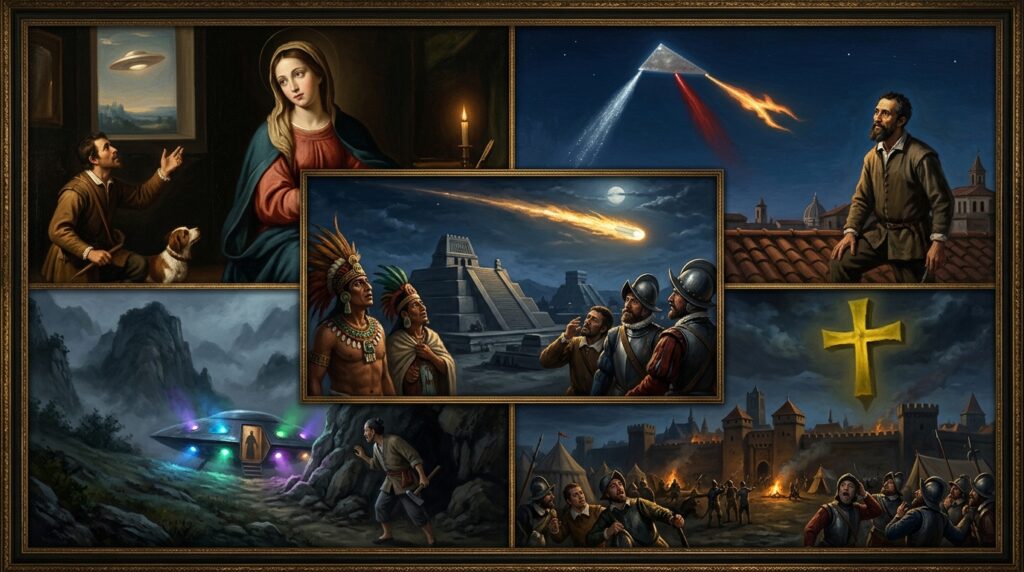
1500–1549 CE — The Renaissance era produced some of history's most precisely documented UAP encounters. Michelangelo observed a triangular three-tailed light over Rome, a Chinese mason was abducted for over a year, Spanish conquistadors logged luminous objects in official expedition reports, and Renaissance painters preserved disc-shaped objects in religious art across Italy.
Sighting by Date:
1500 – 1549 UFO|UAP & ENTITY Sightings Archive
Michelangelo’s Triangular Light, Grijalva’s Log & the Ivan the Terrible Claim Fact-Checked
The first half of the 16th century CE was the age of the Renaissance — Leonardo da Vinci, Michelangelo, Copernicus, and the Protestant Reformation. It was also, by the documentary record, a richly documented period for anomalous aerial phenomena across Europe, Mexico, and China. A Spanish conquistador recorded a luminous object trailing his ships for three hours off the Mexican coast. German broadsheets preserved detailed, illustrated accounts of terrifying sky apparitions over Westrie and Franconia. Michelangelo reportedly observed and attempted to paint a triangular, three-tailed light over Rome.
This page also required more source verification than most in the archive. One entry — an alleged “metallic implant” found in the skull of Ivan the Terrible — does not survive scrutiny and is corrected in place below rather than repeated. Another draws on a discredited contactee-era author. Both are flagged directly rather than silently dropped, consistent with the archive’s standing editorial practice.
Date: c. 1500 (probable duplicate of the “Madonna with Saint Giovannino” entry in the 1400–1499 archive — see Researcher’s Notes)
Location: Florence, Italy — Palazzo Vecchio
Time: Not recorded
Summary: Cited in ufological literature for a disc-shaped object above the Virgin’s shoulder, with a man and dog depicted looking up at it, and a dark figure beside them variously interpreted as a demon, dwarf, or non-human entity. Mainstream art history attributes the disc to conventional glory-cloud or halo iconography rather than a depiction of craft. This is very likely the same painting documented as “The Madonna with Saint Giovannino” in the 1400–1499 archive, attributed there to the school of Filippo Lippi or Domenico Ghirlandaio.
Source: Palazzo Vecchio collection, Florence; artist unknown, attributed to the Lippi school
Date: 1500
Location: Lucerne, Switzerland
Time: Not recorded
Summary: A single fireball was observed.
Source: Gillieron, UFO-DOC
Date: 1501
Location: Between Urbino and Gubbio, central Italy
Summary: Carlo Pedretti, a Leonardo da Vinci specialist at the University of California, cites the Florentine physician Antonio Benivieni (1443–1502), who studied pathological phenomena, describing “a horrible appearance in the stormy sky” between Urbino and Gubbio in 1501 that reportedly caused a number of miscarriages — an event Pedretti characterizes as “what we today call the appearance of a UFO.”
Source: Antonio Benivieni, De Abditis Nonnullis ac Mirandis Morborum et Sanationum Causis, ed. G. Weber (Florence: Leo S. Olschki, 1994), p. 190; Carlo Pedretti, La Nazione, July 28, 1979
Date: 1502 (part of the documented pre-conquest “omens” tradition recorded in later Aztec/Spanish sources — see the related 1509 entry below and Researcher’s Notes)
Location: Tenochtitlan, Mexico
Time: Not recorded
Summary: A sighting or anomalous event associated with the Aztec capital. [Full report]
Source: ThinkAboutIt Docs linked report
Date: 1503
Location: Germany
Time: Not recorded
Summary: Multiple luminous objects were reported over southern German cities, recorded in German chronicles as extraordinary heavenly signs.
Source: Referenced in Lycosthenes, Prodigiorum ac Ostentorum Chronicon
Date: September 29, 1504
Location: Tirano, Valtellina, Italy
Summary: A man named Mario Omodei reported being surrounded by a dazzling light while in his garden at dawn, hearing a voice call his name, and finding himself lifted and carried to a nearby landholding. There, a figure he took to be the Virgin Mary, appearing as a 14-year-old girl, instructed him to publicize her wish for a temple. The temple was completed in 1513 and consecrated in 1528.
Source: Marino Gamba, Apparizioni Mariane nel Corso di Due Millenni (Udine: Ediz. Il Segno, 1999); Simone Cabasso, Miracoli della Madonna di Tirano (Vicenza, 1601)
Date: 1509 (part of the same pre-conquest omens tradition as the 1502 entry above — see Researcher’s Notes)
Location: Aztec Empire, Mexico
Summary: The gatekeepers of the Tezcatlipoca temple reportedly informed Emperor Moctezuma of a thick, luminous white smoke observed overnight, bright enough to resemble approaching daylight — one of several recorded “omens” preceding the Spanish conquest.
Source: Michel Bougard, La Chronique des OVNI (Delarge, 1977), pp. 77–78
Date: March 19, 1509
Location: Villefranche-de-Rouergue, France
Summary: A man named Collonges, whose cart became stuck crossing a river, prayed and reportedly saw a being in blinding light from the east, accompanied by twelve figures he took to be the Virgin Mary and the Apostles. They stepped across thirteen local crossing-stones and vanished; Collonges found his cart freed. An episcopal investigation led to the founding of the Chapel of the Thirteen Stones in 1510.
Source: Gilles Bernard and Guy Cavagnac, Villefranche-du-Rouergue, Histoire et Génie du Lieu (Privat, 1991), p. 82; Yves Chiron, Enquête sur les Apparitions de la Vierge (Perrin, 1995), pp. 65–66
Date: 1510
Location: St. Anne, Prostyń, Poland
Time: Not recorded
Summary: A sighting or anomalous event associated with St. Anne in Prostyń. [Full report]
Source: ThinkAboutIt Docs linked report
Date: 1513
Location: Rome, Italy
Summary: Sculptor Michelangelo Buonarroti (1475–1564) reportedly observed a triangular light with three differently colored tails on a calm night, later attempting to paint it (the painting has not survived). Benedictine chronicler Benedetto Luschino, in Vulnera Diligentis, describes it as star-like with one silvery tail, one red, and one fiery and forked.
Source: Giovanni Papini, La Vita di Michelangelo nella Vita del Suo Tempo (Milan: Garzanti, 1949), pp. 198–200
Date: 1515
Location: Belgium
Time: Not recorded
Summary: A single meteor-like object was observed.
Source: SOBEPS
Date: 1516
Location: Ozarks Region, North America
Time: Not recorded
Summary: “Mr. Bad Thing” — an entity encounter in the Ozarks region predating European settlement of the area. [Full report]
Source: ThinkAboutIt Docs linked report
Date: 1517
Location: Western Moldavia
Time: Not recorded
Summary: A sighting or anomalous event associated with Western Moldavia. [Full report]
Source: ThinkAboutIt Docs linked report
Date: April 1517 or 1518
Location: Coatzacoalcos, Mexico
Summary: Spanish conquistador Juan de Grijalva (c. 1489–1527) recorded in his official expedition report a star appearing above his ship after sunset that moved away, emitting continuous rays until positioned above a village, leaving a trail visible for three hours — read by the expedition as a divine sign favoring settlement of the land.
Source: “Itinerario de la Armada del Rey Católico a la Isla de Yucatán,” in Joaquín García Icazbalceta, ed., Colección de Documentos para la Historia de México, Vol. 1 (Mexico: Librería de J.M. Andrade, 1858), p. 302
Date: April 1519
Location: China
Note — poor source translation: fragmentary translation, retained pending improvement.
Summary: A Ming Dynasty record from the reign of the Zhengde Emperor describes a meteor-like light moving slowly westward before dividing.
Source: Wuzong Shilu (“Veritable Records of Emperor Wuzong”), Ming Dynasty chronicles
Date: 1520
Location: Erfurt, Germany
Summary: Two burning “suns” were observed; a great burning beam reportedly landed, took off again, and became circular in shape.
Source: Jacques Vallée, Anatomy of a Phenomenon (Chicago: Henry Regnery, 1965)
Date: 1520
Location: Hereford, England
Summary: Lycosthenes records “a colossal beam of fire” seen in the sky, approaching the earth and burning objects with its heat before ascending and changing shape into a circle of fire.
Source: Lycosthenes, Prodigiorum ac Ostentorum Chronicon, p. 527
Date: 1521
Location: Cuenca, Spain
Summary: Dr. Eugenio Torralba reported contact with an entity called “Zekiel,” who he claimed taught him esoteric knowledge and physically transported him to Rome — a story famous enough that Cervantes referenced it in Don Quixote. Torralba became personal physician to the widowed Queen Leonor of Portugal in 1525, but was arrested by the Inquisition in 1528, tortured, and sentenced to prison in 1531 for his dealings with the entity, though he maintained he had never broken with Catholic faith. He was later released and permitted to resume practice on condition of no further contact with Zekiel.
Source: Marcelino Menéndez y Pelayo, Historia de los Heterodoxos Españoles (Madrid: La Editorial Católica, 1978)
Date: 1523
Location: Yugiu, Jiangsu, China
Time: Not recorded
Summary: A sighting or anomalous event associated with Yugiu. [Full report]
Source: ThinkAboutIt Docs linked report
Date: August–October 1523
Location: Guilin, Guangxi, China
Time: Each night
Summary: Residents reportedly saw, each night, a “star” measuring over ten arm-spans, hanging in the sky surrounded by white vapor, rectangular like a sword, moving slowly north to south.
Source: Shi Bo, La Chine et les Extraterrestres (Paris: Mercure de France, 1983), p. 44
Date: 1526
Location: Rome, Italy
Time: Not recorded
Summary: An alleged abduction event associated with Rome. [Full report]
Source: ThinkAboutIt Docs linked report
Date: October 12, 1527
Location: France
Summary: Numerous witnesses across the country reportedly saw an unexplained cigar- or egg-shaped flying object.
Source: Jacques Vallée, Anatomy of a Phenomenon (Chicago: Henry Regnery, 1965)
Date: 1528
Location: Utrecht, Holland
Time: Daytime
Summary: During the siege of Utrecht, Lycosthenes records a yellowish, cross-shaped sign of “terrible aspect” appearing over the town — read by defenders as an omen of doom and by besieging Burgundian forces as a sign of impending victory, since the cross resembled the Burgundian symbol.
Source: Lycosthenes, Prodigiorum ac Ostentorum Chronicon, p. 536
Date: 1528
Location: Cangshan, China
Note — poor source translation: the surviving text is badly garbled and does not resolve into coherent English. Retained for completeness pending a better source.
Summary: A record citing lost Dali chronicles describes a bright “guest star” observed by large crowds over several days in May 1528, said to have descended near Cangshan; a mason reportedly encountered a crushed, house-sized object with colored light and non-human figures, was captured and released unharmed, and returned home over a year later with no memory of the intervening time and unexplained marks on his body.
Source: “Copying Old Book Dali Lost,” citing Jiajing-era records, Ming Dynasty
Date: 1528
Location: Westrie, France/Western Germany border region
Time: Not recorded
Summary: An extremely alarming blood-red aerial object was reportedly seen for an hour and fifteen minutes, described as excessively long, blood-colored, bearing the image of a bent arm holding a great sword with three stars near its tip, flanked by weapons and hideous bearded faces. Some observers reportedly died of panic; others fell ill.

Source: Ambroise Paré; Pierre Boaistuau, Histoires Prodigieuses; Peter Creutzer broadsheet (1527); Michel Bougard, La Chronique des OVNI (Delarge, 1977), pp. 79–80
Date: October 9, 1528 (probable duplicate of the entry above — see Researcher’s Notes)
Location: Westrie, Northern Germany
Time: Not recorded
Summary: Ambroise Paré, via Pierre Boaistuau’s Histoires Prodigieuses, describes the same blood-red “comet” over Westrie in near-identical detail — sword-bearing arm, three stars, flanking weapons and bearded faces, and the hour-and-a-quarter duration. Paré and later authors drew from the same 1527 Peter Creutzer broadsheet as the entry above, making this very likely a second citation of one underlying account rather than an independent event.

Source: Peter Creutzer broadsheet (1527), via Ambroise Paré and subsequent authors
Date: 1529
Location: Erfurt, Germany
Time: Not recorded
Summary: Two burning suns were reportedly seen; a great “burning beam” landed suddenly, then took off and became circular in shape — closely matching the 1520 Erfurt entry above, possibly a duplicate or a recurrence at the same location.
Source: Not cited in original compilation
Date: 1529–1555
Location: Sibiu, Romania
Time: Not recorded
Summary: The Sibiu municipal archive documents the genuine, historically verified rocketry experiments of Transylvanian-Saxon military engineer Conrad Haas — including multi-stage rocket designs, a rocket-powered “flying house,” and delta-wing stabilization concepts developed between 1529 and 1555. This is a documented early rocketry pioneer, not a UFO account; it is included here because it is frequently cited in ufological literature alongside genuine sighting reports.
Source: Conrad Haas manuscript, Sibiu municipal archive; John Ferguson, Everything About Flying Saucers (Ottawa: Leméac, 1972), pp. 26–27
Date: c. 1530s–1540s
Note — fabricated claim, corrected: no genuine forensic examination of Ivan the Terrible’s remains has ever reported a metallic implant or any object resembling an electronic component. Ivan IV’s tomb was opened and examined by Soviet anthropologist Mikhail Gerasimov in 1963, and again by researchers in the 2020s using modern facial-reconstruction techniques; both examinations are well documented and describe reduced mobility in his final years and elevated mercury levels in his remains (likely from period medical treatments), with no mention of any implant. Electronic chips did not exist prior to the 20th century in any form that could be embedded in a 16th-century skull. This entry is corrected in place rather than removed.
Location: Moscow, Russia
Time: Not recorded
Summary: A ufological compilation claims an apparent abduction event occurred in Moscow during the reign of Ivan IV, citing a “metallic implant… resembling an electronic chip” allegedly found in his skull and linked to his documented episodes of extreme behavior. No such finding appears in any published forensic examination of Ivan IV’s remains.
Source: Philip Mantle and Paul Stonehill, UFO-USSR (claim not corroborated by genuine forensic literature on Ivan IV’s remains)
Date: December 9, 1531
Location: Tepeyac Hill, near Mexico City
Time: Dawn
Summary: Juan Diego, an indigenous convert, reported encountering a luminous apparition at Tepeyac Hill over several days, identifying herself and requesting a church be built there. On December 12, roses reportedly bloomed out of season at her instruction, and when Juan Diego opened his cloak (tilma) to present them to the bishop, an image of the figure was found on the fabric — an image subsequent examinations have found contains no detectable paint, dye, or brushwork at the fiber surface.
Source: Nican Mopohua (1545), earliest Nahuatl account; multiple ecclesiastical and scientific investigations. [Full report]
Date: 1532
Location: Lyon, France
Time: Not recorded
Summary: A luminous, shield- or disc-shaped object was observed moving across the sky over Lyon by multiple witnesses.
Source: Referenced in Michel Bougard, La Chronique des OVNI, supplementary records
Date: August 1533
Location: Peru
Summary: Inca chronicler Garcilaso de la Vega records that a greenish-black “comet” — narrower than a man’s body, longer than a pike, seen repeatedly at night — deepened Tupac Huallpa’s fear of death, since a similar object had reportedly been seen before his father Huayna Cápac’s death. Huallpa was executed August 29, 1533.
Source: Inca Garcilaso de la Vega, Historia General del Perú (1617), Book I, Ch. XXXIV
Date: 1534
Location: Not recorded — likely Spain or Rome
Summary: An early Jesuit tradition holds that when Ignatius of Loyola founded the Society of Jesus in 1534, an assassin threatening him reportedly fled when an angel descended and confronted him.
Source: Early Jesuit chronicle sources
Date: 1535
Location: Amsterdam, Holland
Time: Not recorded
Summary: Multiple witnesses reportedly observed a formation of luminous, vessel-shaped objects moving above the city — a “phantom fleet” account referenced in later compilations of 16th-century aerial phenomena.
Source: Referenced in multiple 16th-century Dutch chronicle compilations
Date: April 20, 1535
Location: Stockholm, Sweden (with a reported simultaneous sighting at Weimar, Germany)
Summary: Seven “suns” reportedly circled the city, observed for five minutes by a witness named Petri Olaus.
Source: UFO Nachrichten
Date: May 31, 1536
Location: Monte Stella, Brescia, Lombardy, Italy
Summary: A deaf-mute shepherd, Antonio de’ Antoni, reported a light more intense than the sun, within which the Virgin appeared holding Jesus, requesting a temple be built at the site. The site was later consecrated by Pope Paul III, with construction completed in 1539.
Source: Marino Gamba, Apparizioni Mariane nel Corso di Due Millenni (Udine: Ediz. Il Segno, 1999)
Date: 1537 (probable related record to the 1540 Florence entry below — see Researcher’s Notes)
Location: Florence, Italy
Summary: Benvenuto Cellini’s memoir describes returning on horseback from Rome when companions cried out at “a great thing” seen over Florence — a great object of fire, twinkling and emitting enormous splendor.
Source: Benvenuto Cellini, Vita (1558–1566), Book I, Sec. 89
Date: January 16, 1538
Location: Franconia, Thuringia, Germany
Summary: Scholar Simon Goulart records a “star of marvelous magnitude” descending gradually between Bamberg and the Thuringian Forest, becoming a great white circle from which whirlwinds and fireballs emerged, melting spear tips, iron, and horse fittings without harming people or buildings.
Source: Simon Goulart, Trésors d’Histoires Admirables et Mémorables de Notre Temps (1600), pp. 53–54; Jobus Fincelius, Wunderzeichen (Jena: Rodinger, 1556); Lycosthenes, op. cit., p. 563
Date: 1538
Location: Bruges, Belgium
Time: Not recorded
Summary: A tapestry titled “Triomphe du Soleil,” woven in Bruges in 1538 and now held at the Bavarian National Museum, is cited in ufological literature for several disc-shaped objects in its sky background — a claim best assessed against standard period tapestry conventions for depicting celestial bodies.

Source: Not cited in original compilation
Date: 1540
Location: Chile
Time: Not recorded
Summary: A sighting or anomalous event associated with the Spanish conquest of South America. [Full report]
Source: ThinkAboutIt Docs linked report
Date: 1540 (probable duplicate or a second retelling of the 1537 entry above — see Researcher’s Notes)
Location: Florence, Italy
Time: Night
Summary: Benvenuto Cellini’s memoir again describes an ascent at night when he and companions exclaimed at “a thing above the city” — a great flaming bar-like object that sparkled and diffused splendor, closely matching the 1537 entry’s description.
Source: Benvenuto Cellini, Vita
Date: November 26, 1540
Location: Region of Kallipolis (Gallipoli)
Time: Not recorded
Summary: A star-like appearance was recorded on the dark side of the sky, per later observers cataloguing historical sightings at Worms, Hesse.
Source: Hess (1911), historical sighting catalog
Date: 1543
Note — fringe source flagged: George Hunt Williamson (1926–1986) was a contactee-era author associated with the 1950s George Adamski circle, whose claims of channeled extraterrestrial communication and speculative “solar civilization” theories are not accepted within mainstream astronomy or ufology as reliable sourcing. This entry’s claims about comets surviving passage through the solar corona are presented here as a documented fringe claim, not as an established astronomical account.
Location: Solar corona (astronomical observation, not a terrestrial sighting)
Time: Not recorded
Summary: Williamson claimed a comet passed closer to the sun in 1543 than any other recorded case (with a repeat event claimed for 1882), surviving corona temperatures he described as around one million degrees without disintegrating — presented by Williamson as evidence of anomalous physics.
Source: George Hunt Williamson, Other Languages, Other Natures
Date: May 14, 1544
Location: Nay, Béarn, France
Summary: A “spear of fire” reportedly appeared on Pentecost, falling at 3:00 p.m. into a building with a frightful uproar, leaving nothing of the structure remaining.
Source: Pierre Boaistuau, Histoires Prodigieuses (1560), vol. II, p. 148
Date: 1546
Location: Carranza, near La Spezia, Italy
Summary: Chronicler Antonio Cesena records farmers reporting “a strange disk, changing from yellow to red, with red fireballs shining beneath it,” seen periodically near Passo del Bocco. Cesena interpreted the sighting as a portent of Count Luigi Fieschi’s death later that year.
Source: Antonio Cesena, Relatione dell’Origine e Successi della Terra di Varese (1558), copy held at the Biblioteca della Società Economica di Chiavari (ms. Z VI 29)
Date: April 24, 1547
Location: Halberstadt, Saxony, Germany
Summary: A black, ball-shaped object was reportedly seen emerging from the middle of the moon and flying rapidly northward.
Source: Simon Goulart, Trésors des Histoires Admirables et Mémorables de Notre Temps (1600); Jobus Fincelius, Wunderzeichen (Jena: Rodinger, 1556); Lycosthenes, op. cit., p. 595
Date: November 13, 1547
Location: Rome, Italy
Time: 3:00 p.m.
Summary: A rod and cross reportedly appeared in a clear, calm sky, with a bird-like shape above them, visible over three days. Recorded in a German broadsheet held in the Johann Jakob Wick collection, Zurich Zentralbibliothek.
Source: Jobus Fincelius, Wunderzeichen (Jena: Rodinger, 1556); Erschreckliche Unerhörte Warhafftige Gesichten… (Strasbourg: Jakob Frölich, 1547)
Date: December 15, 1547
Location: Hamburg, Germany
Summary: Sailors reportedly saw at midnight a glistening globe, fiery like the sun, rolling toward the north, its heat forcing passengers to take cover for fear their vessels would ignite.
Source: Simon Goulart, Trésors d’Histoires Admirables et Mémorables de Notre Temps (1600); Fincelius, op. cit.; Lycosthenes, op. cit., p. 595
Date: June 28 and July 26, 1548
Location: Oettingen, Bavaria, Germany
Summary: A witness reported the sky darkening as the sun’s disc was obscured, followed by roughly twenty flying “vehicles” moving over houses low enough to be seen clearly, accompanied by red flames, on two separate dates.
Source: Bruno Weber, Wunderzeichen und Winkelmaker, 1543–1586 (Zurich/Dietikon: Urs Graf Verlag, 1972), p. 93
RESEARCHER’S NOTES
The Renaissance Witnesses — and Two Claims That Don’t Hold Up
- Ivan the Terrible “implant” corrected: this is the most significant correction on this page. No genuine forensic or archaeological examination of Ivan IV’s remains — including the well-documented 1963 Gerasimov exhumation and subsequent 21st-century reconstructions — reports any implant. The claim is retained, clearly labeled as unsubstantiated, rather than presented as physical evidence.
- George Hunt Williamson flagged as a fringe source: Williamson was a 1950s contactee-movement author, not an astronomer; his solar-corona claims are documented here as his claim, not as accepted science.
- Palazzo Vecchio painting cross-referenced: the c. 1500 Madonna entry here is very likely the same “Madonna with Saint Giovannino” documented in the 1400–1499 archive.
- Moctezuma-era omens noted as related: the 1502 Tenochtitlan and 1509 Aztec Empire entries both belong to the documented tradition of pre-conquest “omens” recorded in later Nahuatl and Spanish sources — related but distinct accounts, not merged.
- Probable duplicates flagged: the two Westrie “blood-red comet” entries (1528, October 9 1528) and the two Benvenuto Cellini Florence entries (1537, 1540) closely match each other in detail and likely represent double citation of the same underlying accounts.
The strongest material on this page remains its named, institutionally documented witnesses — Cellini’s memoir, Michelangelo’s biographer, the Vatican-adjacent broadsheets, and Grijalva’s official expedition log — sources with clear provenance, distinct from the two flagged claims above.
“On this day, in the evening, we witnessed a big miracle… there appeared a star above the ship after sunset, and it moved away, emitting rays of light continuously until it was above the town… and it left a trace in the air that lasted for three long hours.”
Juan de Grijalva, official expedition log, Coatzacoalcos, Mexico, April 1517/1518