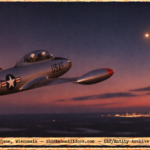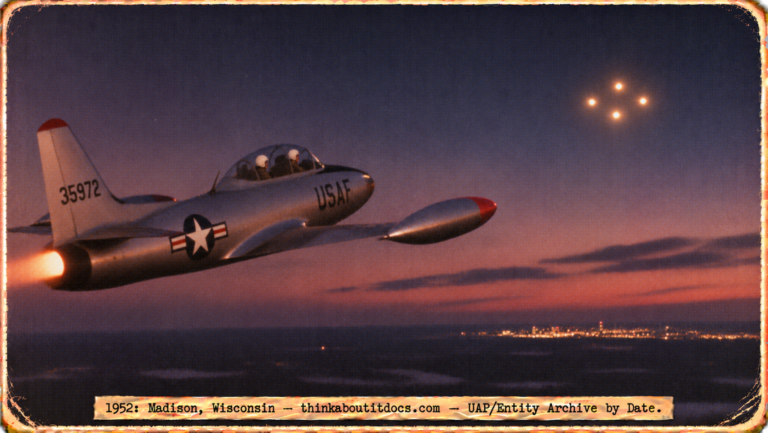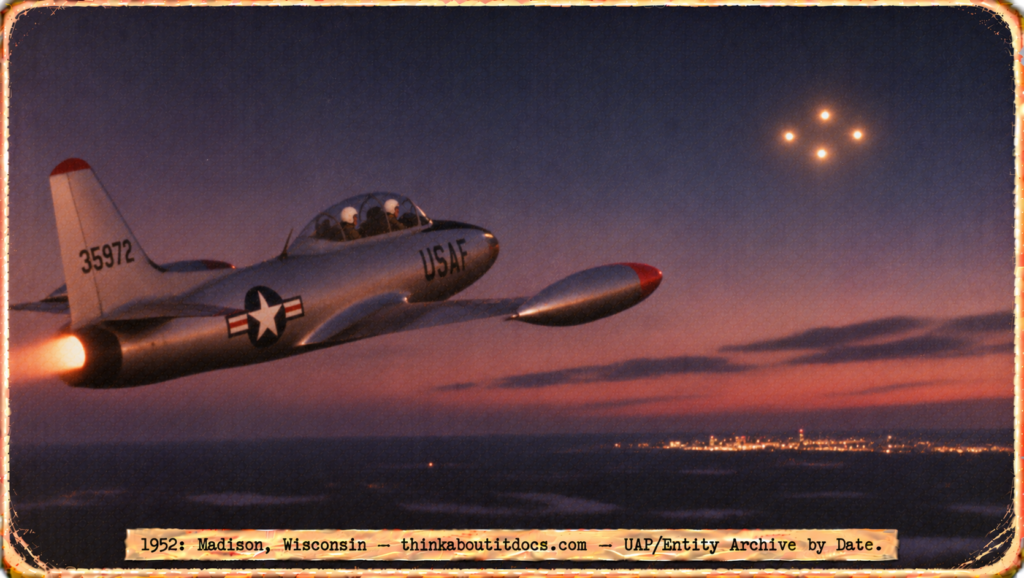
Near Madison, Wisconsin, December 9, 1952: the diamond formation pursuit.
THINK ABOUTIT UFO|UAP SIGHTINGS REPORT
1952: Near Madison, Wisconsin
The T-33’s Pursuit of a Diamond Formation (BBU 2267)
On the evening of December 9, 1952, two USAF pilots flying a T-33 jet trainer spotted four bright lights in diamond formation and gave chase, overtaking them near Janesville, Wisconsin. A ground radar site tracked the pursuing jet perfectly — and never once picked up the objects it was chasing. The lights crossed directly in front of the glow of downtown Milwaukee without ever resolving into a silhouette, and the pilots broke off only when their fuel ran low. It stands as Blue Book Unknown 2267.
Date: December 9, 1952
Sighting Time: 5:45–5:55 p.m.
Day/Night: Night (dusk/early evening)
Location: About 10 miles south of Madison, Wisconsin, pursued east through Janesville toward Racine
Urban or Rural: Rural to suburban, passing near the Milwaukee metropolitan area
No. of Entity(‘s): None
Entity Type: Not applicable
Entity Description: Not applicable
Hynek Classification: NL (Nocturnal Light) with an attempted radar-visual pursuit; no structure was ever resolved and radar never acquired the objects
Duration: About 10 minutes
No. of Object(s): 4
Description of the Object(s): Four bright lights holding a diamond formation in level flight, with no silhouette or structure visible even when passing directly in front of the lit Milwaukee skyline
Shape of Object(s): Not resolved; formation shape only (diamond)
Size of Object(s): Not recorded
Color of Object(s): Bright (specific color not recorded)
Distance to Object(s): The T-33 closed to overtaking distance near Janesville, Wisconsin
Height & Speed: The objects were first seen heading southwest at roughly 400 mph and 8,000 ft; the T-33 pursued at 450 mph and overtook them near Janesville before the lights continued east
Number of Witnesses: 2 (USAF Capt. Bridges and 1st Lt. Johnson, aboard the T-33) plus the 755th AC&W radar site “Soapberry,” which detected the pursuing jet but not the objects
Special Features/Characteristics: Four lights holding a precise diamond formation; a ground radar site that tracked the chasing T-33 in real time yet never acquired the formation itself; the objects crossing directly in front of the lit Milwaukee skyline with no silhouette resolving against that backdrop; the pursuit ended only by the T-33’s fuel limits, not by losing visual contact
Case Status: Unexplained — catalogued as Blue Book Unknown 2267
Source: Berliner; cf. Hynek-CUFOS re-evaluation; Jan Aldrich
Summary/Description: On December 9, 1952, USAF Capt. Bridges and 1st Lt. Johnson, flying a T-33 jet trainer about 10 miles south of Madison, Wisconsin, saw four bright lights in diamond formation heading southwest at roughly 400 mph and 8,000 ft. They pursued at 450 mph, overtaking the objects near Janesville, then radioed the 755th AC&W radar site “Soapberry,” which could detect only their own aircraft, not the objects. The lights continued east, crossing in front of the Milwaukee skyline without ever showing a silhouette, and the T-33 broke off the chase near Racine only due to low fuel. The encounter lasted about ten minutes and is catalogued as Blue Book Unknown 2267.
Related Cases: December 1952 archive | the Ladd AFB, Alaska F-94 encounter, December 8, 1952 (BBU 2266)
DETAILED REPORT
USAF Capt. Bridges and 1st Lt. Johnson were flying a T-33 jet trainer about ten miles south of Madison, Wisconsin, at around 5:45 p.m. on December 9, 1952, when they spotted four bright lights arranged in a precise diamond formation, flying level and heading southwest at an estimated 400 mph and 8,000 feet — a speed and altitude well within the performance of conventional aircraft, but a formation shape and light pattern that caught the crew’s attention.
The pilots gave chase, pushing their own aircraft to roughly 450 mph, and succeeded in overtaking the formation near Janesville, Wisconsin. As they closed the distance, Bridges radioed ground control, reaching the 755th Aircraft Control and Warning radar site known by the call sign “Soapberry.” The site’s operators confirmed they had the T-33 itself clearly on their scope — but despite the pursuing jet being close enough to visually track the formation, “Soapberry” never once picked up the four lights on radar.
The chase continued east, carrying the formation and its pursuer across the sky directly in front of the lit skyline of Milwaukee. Even silhouetted against that bright urban backdrop — exactly the kind of contrast that would normally reveal a solid object’s outline — no structure or shape ever resolved around the four lights. The T-33 crew kept the chase going until fuel considerations forced them to break off the pursuit near Racine, at which point the objects were still in sight, not lost through any failure of visual contact.
The case was catalogued as Blue Book Unknown number 2267 and has been cited by Don Berliner, cross-referenced in a Hynek/CUFOS re-evaluation, and compiled by Jan Aldrich. The combination of a successful visual pursuit, a radar site’s confirmed inability to detect the targets despite tracking the chasing aircraft perfectly, and the lack of any resolved silhouette against city lights distinguishes this case from an ordinary formation-light misidentification.
RESEARCHER’S NOTES
A Radar Site That Saw the Chaser But Not the Chased
- Classification and the radar null result: NL fits the basic visual description — no structure ever resolved — but the case’s real evidentiary interest is the radar-visual mismatch: “Soapberry” demonstrably could track a real aircraft (the T-33) at the same time and place it failed entirely to acquire the four lights, which argues against a simple radar-sensitivity or siting explanation for the miss.
- The Milwaukee skyline test: A formation of four aircraft, balloons, or any solid flying object passing in front of a brightly lit city at night would ordinarily show up as a dark silhouette against that light. That none did here is one of the more concrete negative details in the case — it rules out certain mundane explanations more cleanly than most NL reports can.
- Two trained pilots, sustained pursuit: This was not a brief glimpse: the T-33 crew held visual contact through an active pursuit covering tens of miles and roughly ten minutes, exchanging radio communication with ground control throughout. That duration and engagement level gives the account more weight than a fleeting roadside sighting.
- Breaking off was a fuel decision, not a loss of contact: The pursuit ended because the T-33 was running low on fuel, with the formation still visible — the encounter was not resolved by the object simply disappearing from view, which leaves its ultimate fate and origin as open as its identity.
A T-33 crew chased four formation lights for ten minutes, overtook them, and stayed in radio contact with a ground radar site that tracked their own jet perfectly while never once detecting the objects — which then crossed in front of a lit city skyline without ever showing a shape. Catalogued as Blue Book Unknown 2267, it stands as Unexplained.
“The 755th AC&W radar site could detect only the T-33, not the objects… no silhouette was visible even when the objects passed in front of the Milwaukee city lights.”
— Case summary, near Madison, Wisconsin, December 9, 1952 (Blue Book Unknown 2267)