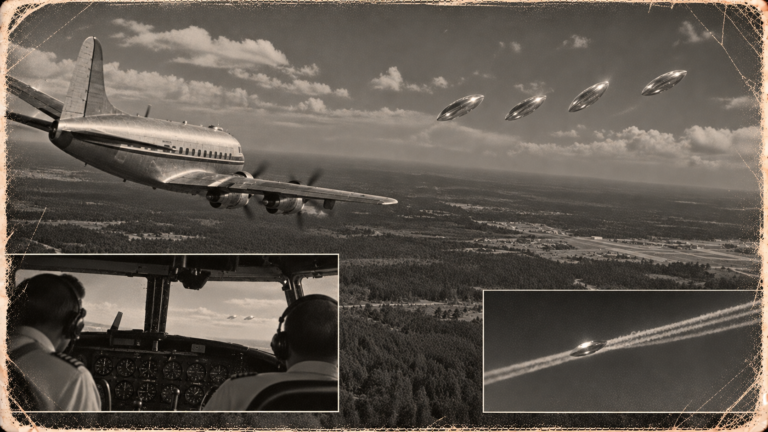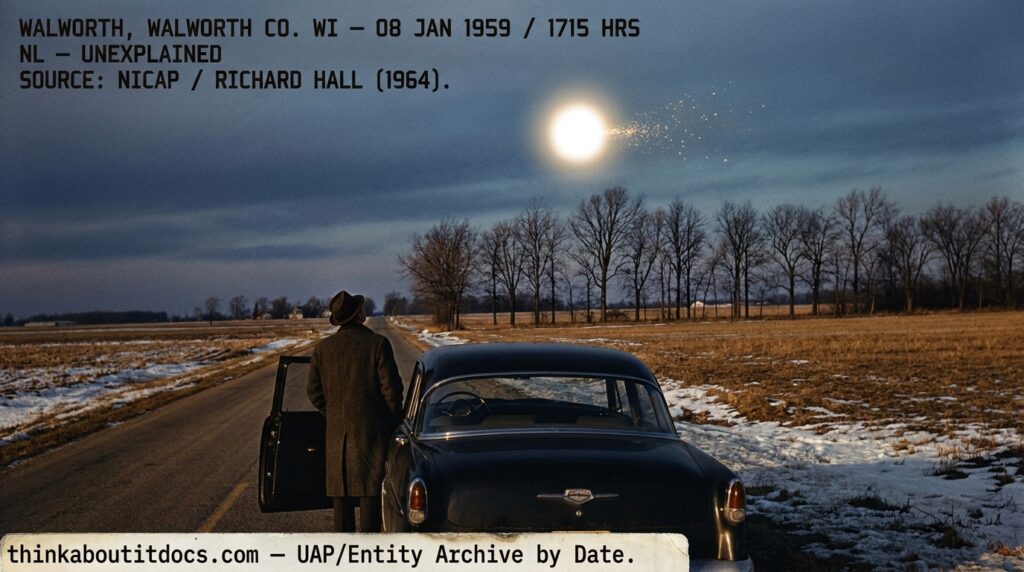
Near Walworth, Walworth County, Wisconsin, January 8, 1959, 5:15 P.M. — Former USAF flight controller Gordon Higgins observes a brilliant white round object descend slowly, then depart horizontally at tremendous speed trailing sparks and shifting from white to orange. Source: NICAP / Richard Hall, The UFO Evidence (1964).
THINK ABOUTIT UFO|UAP SIGHTING REPORT
1959: UFO descends, then speeds away near Walworth, Walworth County, Wisconsin
On January 8, 1959, draftsman Gordon Higgins — a former USAF control tower operator and flight controller with two years of military aviation experience — watched a brilliant white round object descend slowly through the dusk sky east of Walworth, Wisconsin, then accelerate horizontally at tremendous speed, trailing sparks and shifting from white to orange before vanishing in seconds. The entire event lasted roughly fifteen seconds, but the witness who observed it had spent two years tracking aircraft for the United States Air Force and knew what conventional traffic looked like — and this was not conventional traffic.
The sighting was reported to and documented by NICAP, the National Investigations Committee on Aerial Phenomena, and published by Richard Hall in 1964. Though brief, the case’s value lies almost entirely in the witness: a trained military aviation observer whose professional background in flight control and tower operations placed him in a narrow category of civilians whose observational credibility the Air Force itself would have difficulty dismissing.
Date: January 8, 1959
Sighting Time: 5:15 P.M.
Day/Night: Dusk (sunset in Walworth County, Wisconsin in early January occurs at approximately 4:40–4:50 P.M.; by 5:15 P.M. the sky would be in late civil twilight or early night)
Location: Near Walworth, Walworth County, Wisconsin, United States
Urban or Rural: Rural
No. of Entity(‘s): None reported
Entity Type: Not Applicable
Entity Description: Not Applicable
Hynek Classification: NL (Nocturnal Light) Point or extended luminous source observed at night
Duration: Approximately 15 seconds (descent phase); total event slightly longer including horizontal departure
No. of Object(s): 1
Description of the Object(s): Round, self-luminous object; brilliant white during descent, color-shifted to orange during high-speed horizontal departure; emitted a trail of sparks as it accelerated
Shape of Object(s): Round
Size of Object(s): Not estimated by the witness
Color of Object(s): Brilliant white (descent); orange (departure); trailing sparks
Distance to Object(s): Not estimated by the witness
Height & Speed: Object descended slowly from elevated position (approximately 15 seconds to reach lower altitude), then departed horizontally at “tremendous speed” — witness stopped his automobile to observe
Number of Witnesses: 1 — Gordon Higgins, draftsman, former USAF control tower operator and flight controller (2 years military aviation experience)
Special Features/Characteristics: Slow controlled descent followed by explosive horizontal acceleration; color shift from white to orange during departure; trail of sparks emitted during acceleration; object appeared to either go out of sight, disappear, or disintegrate after departure; witness diagram provided to NICAP showing positions 1 (initial sighting) and 2 (end of descent) and departure trajectory
Case Status: Unexplained
Source: NICAP; Richard Hall, The UFO Evidence (1964)
Summary/Description: Gordon Higgins, a former USAF control tower operator and flight controller, observed a brilliant white round object descend slowly near Walworth, Wisconsin at 5:15 P.M. on January 8, 1959. After approximately 15 seconds of controlled descent, the object accelerated horizontally at tremendous speed, emitting a trail of sparks and shifting color from white to orange before vanishing. Higgins stopped his automobile to observe and later provided a diagram to NICAP documenting the object’s positions and trajectory.
Related Cases: 1961 Eagle River Wisconsin CE-III (Joe Simonton) | 1974 Frederic Wisconsin CE-III (William Bosak)
Full Report
On the evening of January 8, 1959, Gordon Higgins was driving east near the rural community of Walworth in Walworth County, Wisconsin. Higgins worked as a draftsman but brought an unusual qualification to civilian life: two years of service as a United States Air Force control tower operator and flight controller, a role that required continuous visual tracking of aircraft under all lighting and weather conditions.
At 5:15 P.M. — well past sunset for early January in southern Wisconsin, placing the sky in late civil twilight or early darkness — Higgins sighted a round, brilliant white glowing object in the sky ahead. The object was descending slowly. He brought his automobile to a stop to observe it more carefully.
Over a period of approximately fifteen seconds, the object descended from an elevated position (designated Position No. 1 in the witness diagram later provided to NICAP) to a lower altitude (Position No. 2). During the descent, the object maintained its brilliant white glow and moved in a controlled manner, with no erratic motion or tumbling. It then departed horizontally at what Higgins described as “tremendous speed,” emitting a trail of sparks. During the acceleration, the object’s color shifted from the original brilliant white to orange. It then appeared to either go out of sight, disappear, or disintegrate — the witness could not determine which.
Higgins reported the sighting to the National Investigations Committee on Aerial Phenomena (NICAP), providing a diagram showing the positions and trajectory of the object. The case was published by Richard Hall in The UFO Evidence (1964), NICAP’s comprehensive catalog of UFO reports, which specifically noted Higgins’s military aviation background as a factor in the case’s credibility assessment.
No sound was reported. No additional witnesses have been documented. No physical traces were observed. The object did not interact with the witness’s vehicle. The sighting’s evidentiary value rests primarily on the brevity of the event, the clarity of the witness’s observation, and the professional qualifications of the observer.
Researcher’s Notes
The Flight Controller’s Fifteen Seconds — Walworth 1959 and the Weight of Trained Observation
- Witness Credibility — Military Aviation Training: The central evidentiary weight of the Walworth 1959 case rests not on the event itself — which was brief and left no physical traces — but on who observed it. Gordon Higgins’s two years as a USAF control tower operator and flight controller represent a specific and verifiable professional skill set: sustained visual identification of aircraft at varying altitudes, distances, and lighting conditions. Flight controllers are trained to distinguish aircraft types, assess speed and trajectory, and identify anomalous behavior in the traffic pattern. When a witness with this background stops his car, observes an object for fifteen seconds, and reports that its behavior did not match any known aircraft profile, the observation carries a calibration that untrained civilian sightings do not.
- Classification Assessment: The NL (Nocturnal Light) classification is correct for this sighting. Although the existing page header describes the time as “Dusk,” the sighting occurred at 5:15 P.M. on January 8 in southern Wisconsin, where sunset falls at approximately 4:40–4:50 P.M. in early January. By 5:15, the sky would be in late civil twilight at best, and the object was described as a self-luminous glowing source — not a metallic reflective body illuminated by ambient sunlight. The object’s behavior (slow controlled descent followed by explosive horizontal departure with sparks) argues against a meteor, which would follow a ballistic trajectory without the observed pause-and-accelerate profile. A fireball breaking apart could produce sparks and a color shift, but fireballs do not descend slowly for fifteen seconds, stop, and then depart horizontally.
- Behavioral Profile — Controlled Descent and Explosive Departure: The two-phase behavior profile described by Higgins — slow controlled descent followed by instantaneous horizontal acceleration — is one of the most frequently reported kinematic signatures in the UFO literature. The pattern appears across hundreds of cases from the late 1940s onward and defies conventional aerodynamic explanation because it implies the ability to transition from near-hover to extreme velocity without a visible acceleration curve. The trail of sparks and the white-to-orange color shift during departure may indicate propulsive or atmospheric interaction effects, though they also overlap with the visual signature of certain pyrotechnic or re-entry phenomena. The fifteen-second controlled descent phase is the discriminating factor: no known natural or conventional phenomenon descends slowly under apparent control, pauses, and then departs horizontally.
- Source Chain — NICAP and Richard Hall: The case is documented through NICAP and published in Richard Hall’s The UFO Evidence (1964), which remains one of the most carefully vetted UFO case compilations ever produced. Hall’s inclusion criteria were rigorous; the catalog was prepared specifically for Congressional review and prioritized cases with credentialed witnesses and clear observational detail. The Walworth case’s inclusion — despite its brevity — reflects NICAP’s assessment that Higgins’s military aviation background elevated the report above the threshold for anonymous or untrained civilian sightings. No Blue Book case file has been located for this specific event.
Fifteen seconds is not much time. But for a man who spent two years in a control tower tracking aircraft across the sky, fifteen seconds is long enough to see what he saw, know what it was not, and produce a diagram that said more than most witnesses manage in fifteen minutes. The Walworth case will never anchor a research program, but as a data point — a trained military observer, a controlled descent, an explosive departure, documented by one of the most rigorous civilian UFO organizations in American history — it holds its ground in the archive.
Media