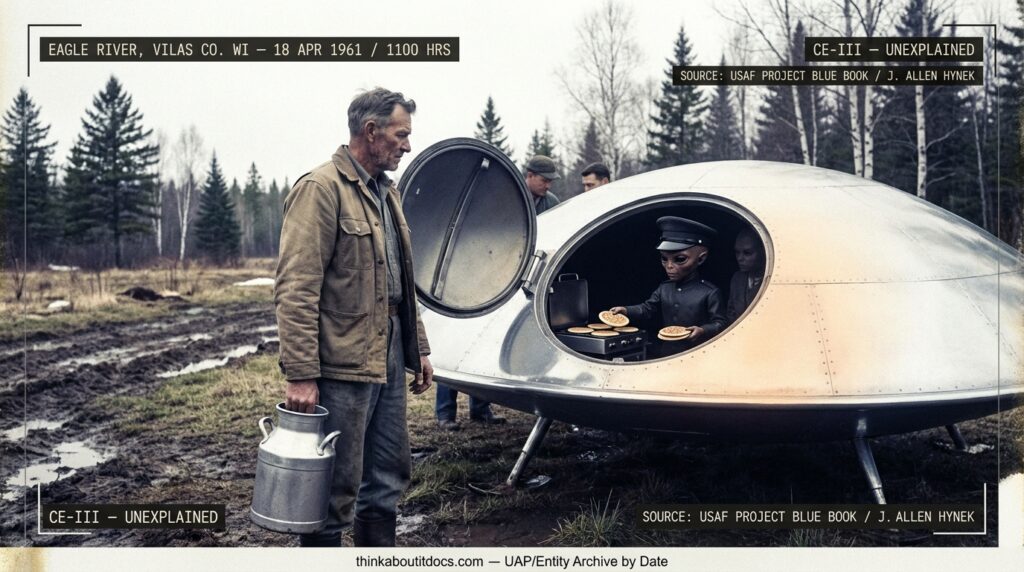
Eagle River, Vilas County, Wisconsin, April 18, 1961 — Chicken farmer Joe Simonton exchanges a jug of water for four small perforated pancakes with one of three humanoid occupants inside a chrome disc-shaped craft landed on his farm. The pancakes were analyzed by Northwestern University; the Air Force assessed the case as Unexplained. Source: USAF Project Blue Book; J. Allen Hynek.
THINK ABOUTIT UFO|UAP|ENTITY ENCOUNTER REPORT
1961: Eagle River Close Encounter
On April 18, 1961, chicken farmer and part-time plumber Joe Simonton heard a sound like knobby tires on wet pavement, walked into his yard near Eagle River, Wisconsin, and watched a silver disc-shaped craft descend vertically and land on his property. A hatch opened, three dark-skinned humanoids in black knit uniforms appeared, one handed him a silvery jug and indicated they wanted water, and in exchange for filling it from his basement pump, the entities gave Simonton four small perforated pancakes from a flameless griddle inside the craft. The saucer lifted off, tilted forty-five degrees, and vanished to the south in two seconds — leaving Simonton holding breakfast from another world.
The encounter survived one of the most rigorous institutional evaluations ever applied to a close encounter report. J. Allen Hynek investigated personally for the U.S. Air Force. A Northwestern University food technology committee analyzed the pancakes and found them to be composed of flour, sugar, and grease — terrestrial ingredients in a form unlike any known commercial product. The Air Force’s official Project Blue Book assessment: Unexplained. The case remains the only incident in the Blue Book files in which a physical artifact was recovered from an alleged occupant interaction and the institutional conclusion was something other than a dismissal.
Date: April 18, 1961
Sighting Time: 11:00 A.M.
Day/Night: Day
Location: Eagle River, Vilas County, Wisconsin, United States
Urban or Rural: Rural — chicken farm outside Eagle River
No. of Entity(‘s): 3
Entity Type: Humanoid
Entity Description: Three dark-skinned males, each approximately 5 feet tall and 125 pounds, appearing 25–30 years old, clean-shaven, described by Simonton as “Italian-looking.” Wearing dark blue or black knit uniforms with turtleneck tops and helmet-like caps. One entity (apparent leader) had narrow red trim on his trousers. Entities did not speak in the witness’s presence; communication appeared to occur through gesture or ESP. One entity saluted Simonton by touching his forehead in a gesture of thanks.
Hynek Classification: CE-III (Close Encounter III) Close observation with animate beings associated with the object
Duration: Several minutes (time not precisely recorded)
No. of Object(s): 1
Description of the Object(s): Disc-shaped craft with smooth exterior, landed vertically. Interior described as dull black with the appearance of wrought iron, including three “extremely beautiful” instrument panels in the same flat black finish. Flameless cooking appliance (griddle) visible inside. On one edge, exhaust pipes of 6–7 inches diameter. Craft was made of a material “brighter than chrome.” The entities carried a silvery jug with two handles, approximately one foot tall, heavier than aluminum but lighter than steel, made of the same material as the craft.
Shape of Object(s): Disc
Size of Object(s): 12 feet in height, 30 feet in diameter
Color of Object(s): Silver, “brighter than chrome”
Distance to Object(s): Direct contact — witness approached craft, braced against hull to return water jug
Height & Speed: Craft rose approximately 20 feet vertically, tilted to 45-degree angle, and departed to the south; disappeared from view in approximately 2 seconds; departure wake tossed tops of nearby pine trees
Number of Witnesses: 1 — Joe Simonton, chicken farmer, plumber, and part-time auctioneer, approximately 55–60 years old
Special Features/Characteristics: Physical artifact recovered — four small pancakes (approximately 3 inches diameter, perforated with small holes) given to witness by entities; pancake laboratory analysis by Northwestern University food technology committee (composed of flour, sugar, and grease; rumored to contain wheat of an unknown type); flameless cooking appliance inside craft; silvery jug of unknown material exchanged for water; departure blast tossed pine tree tops; sound on arrival described as knobby tires on wet pavement; Air Force Project Blue Book assessment: Unexplained
Case Status: Unexplained
Source: Jay Rath; J. Allen Hynek (personal investigation for USAF Project Blue Book); NICAP; Vilas County News-Review (April 27, 1961); Associated Press; Northwestern University food technology analysis; Vilas County Judge Frank Carter
Summary/Description: Chicken farmer Joe Simonton observed a silver disc land on his Eagle River farm, exchanged a jug of water with three humanoid occupants, and received four small pancakes from a flameless griddle inside the craft. J. Allen Hynek investigated for the Air Force. A Northwestern University committee analyzed the pancakes and found terrestrial ingredients. Project Blue Book assessed the case as Unexplained — the only occupant interaction case in the Blue Book files to receive that assessment with a recovered physical artifact.
Related Cases: 1959 Walworth Wisconsin NL (Gordon Higgins) | 1974 Frederic Wisconsin CE-III (William Bosak) | 1975 Mellen Wisconsin CE-II (Baker Family Landing)
Full Report
In 1961, Joe Simonton was a plumber, auctioneer, and — annually, for the Eagle River Chamber of Commerce — Santa Claus. He lived on a chicken farm outside Eagle River in Vilas County, Wisconsin, a rural community in the state’s Northwoods. He reported his age variously as 55 or 60, depending on the interviewer.
At approximately 11:00 A.M. on April 18, Simonton was having a late breakfast when he heard a sound he described as resembling a jet being throttled back — “like the sound of knobby tires on wet pavement.” He went into the yard and saw a silver disc-shaped craft descend vertically from the sky and hover over his farm. The object was approximately twelve feet in height and thirty feet in diameter, “brighter than chrome,” with exhaust pipes six or seven inches in diameter visible on one edge.
The craft landed and a hatch opened. Inside, Simonton could see three dark-skinned males, each approximately five feet tall and weighing about 125 pounds. They appeared to be between twenty-five and thirty years old, were clean-shaven, and wore dark blue or black knit uniforms with turtleneck tops and helmet-like caps. Simonton described them as “Italian-looking.”
The entities did not speak in Simonton’s presence, but one held a silvery jug with two handles — approximately one foot tall, heavier than aluminum but lighter than steel, made of what appeared to be the same material as the craft. Simonton described it as “a beautiful thing, a Thermos jug-like bottle quite unlike any jug I have ever seen here.” Through what Simonton interpreted as ESP or gestures, he understood that the entities wanted water. He took the jug, went into his basement, filled it from his water pump, returned to the craft, and handed it back — bracing himself against the hull and stretching upward to reach the occupant.
Looking into the craft’s interior, Simonton observed a space finished entirely in dull black with the appearance of wrought iron, including three “extremely beautiful” instrument panels in the same flat black finish. One of the entities was operating a flameless cooking appliance — a griddle on which he was preparing small pancakes. The contrast between the dark interior and the brilliant chrome exterior fascinated Simonton, who later said he “would love to have a room painted in the same way.”
In return for the water, one of the entities — the only one with narrow red trim on his trousers — presented Simonton with four of the pancakes, hot from the griddle. Each was roughly three inches in diameter and perforated with small holes. The entity touched his own forehead in what appeared to be a salute of thanks. Simonton saluted back.
The entity then connected a line or belt to a hook in his clothing and the hatch closed. The craft rose approximately twenty feet, tilted to a forty-five-degree angle, and departed to the south. Its wake produced a blast of air strong enough to toss the tops of nearby pine trees. The craft disappeared from view in approximately two seconds.
Simonton ate one of the pancakes. “It tasted like cardboard,” he told the Associated Press. He gave the remaining two pancakes to Vilas County Judge Frank Carter, a local UFO enthusiast who called the entities “saucernauts” and said he believed Simonton’s account because he could not think of any way the farmer might profit from a hoax. Judge Carter sent the pancakes to NICAP, the National Investigations Committee on Aerial Phenomena, for analysis. NICAP declined to examine them, a decision that frustrated Carter’s plans to hold a public seminar on the incident.
By this point, Simonton said he was “irked by reporters making fun of the situation and laughing.”
The Air Force dispatched its civilian UFO consultant, astronomer J. Allen Hynek of Northwestern University, to investigate. Hynek — who at this stage of his career maintained a publicly skeptical posture toward UFO reports but would later become convinced of their reality and found his own investigative organization — conducted on-site interviews with Simonton and arranged for laboratory analysis of one of the pancakes by a Northwestern University food technology committee. The analysis determined that the pancake was composed of flour, sugar, and grease. A persistent rumor held that the wheat in the pancakes was of an “unknown type,” though the specifics of this claim have not been confirmed in the published laboratory results.
The official Air Force Project Blue Book assessment of the Eagle River case: Unexplained. The Blue Book file noted that “the only serious flaw in the story is the disappearance of the craft in ‘two seconds.’ The rest of the story did not contain any outrages to physical concepts.” The report stated that Simonton “answered questions directly, did not contradict himself, insisted on the facts being exactly as stated, and refused to accept embellishments or modifications.” The Air Force investigators concluded that Simonton could not be considered a hoaxer and appeared to be sincere in his account.
Hynek’s own assessment was similarly measured. He told an interviewer that the case would have to be classified as unexplained, and that Simonton “obviously was not perpetrating a hoax.”
Researcher’s Notes
The Alien Pancakes — Eagle River 1961 and the Problem of the Absurd Artifact
- The Institutional Assessment: The Eagle River case occupies a singular position in the Project Blue Book archive: it is the only occupant-interaction case to be assessed as “Unexplained” in which a physical artifact was recovered and subjected to laboratory analysis. The Blue Book investigators noted that Simonton did not contradict himself, refused embellishments, and insisted on reporting the facts exactly as he experienced them. Hynek’s independent assessment — that Simonton “obviously was not perpetrating a hoax” — represents a rare convergence between the Air Force’s institutional evaluation and its civilian consultant’s personal judgment. The case’s formal status as Unexplained has not been revised in subsequent Air Force reviews.
- The Pancake Problem — Absurdity as Evidence: The Eagle River case confronts the researcher with a difficulty that no amount of forensic analysis can resolve: the events described are simultaneously too absurd to credit and too well-documented to dismiss. Pancakes from a flying saucer, cooked on a flameless griddle by “Italian-looking” entities in turtleneck uniforms, given in exchange for a jug of basement water — the narrative reads like a children’s story until one notes that the man telling it was assessed as sincere by J. Allen Hynek, found non-deceptive by Project Blue Book, and confirmed as a credible citizen by local officials including a county judge. Jacques Vallée has argued that the absurdity itself may be significant — that CE-III accounts frequently contain elements that appear designed to undermine their own credibility, producing a “signal” that is difficult to process through conventional frameworks. Whether one interprets this as a feature of the phenomenon, a failure of human perception under stress, or evidence that something genuinely inexplicable happened on Joe Simonton’s chicken farm, the absurdity is documented fact, not folklore embellishment.
- Laboratory Analysis and the Missing Wheat Question: The Northwestern University food technology committee’s analysis found the pancake to consist of flour, sugar, and grease — terrestrial ingredients in a form that matched no known commercial product. The persistent rumor that the wheat was of an “unknown type” has circulated in the UFO literature since the 1960s but has not been confirmed in published laboratory reports. If confirmed, it would represent the single most significant forensic finding in the case; if unconfirmed, it illustrates how an unverified detail can acquire the weight of established fact through decades of repetition. The existing lab analysis, while confirming terrestrial ingredients, did not identify the pancake as any known manufactured food product — a finding that is modest but genuine.
- The Witness Profile and the Folkloristic Thread: Joe Simonton was not a ufologist, not an attention-seeker, and not a figure who stood to gain from his report. He was a plumber, auctioneer, and chicken farmer who played Santa Claus for his local Chamber of Commerce — a profile that makes fabrication difficult to motivate. His subsequent regret at having spoken publicly, and his irritation at being ridiculed, are consistent with a witness who reported what he experienced and was punished for it by the machinery of media mockery. The case also intersects with a deep folkloric thread: the offering of food by non-human entities, and the exchange of hospitality between humans and otherworldly visitors, appears in Celtic fairy lore, Scandinavian huldufolk traditions, and multiple Indigenous oral histories. Whether this parallel reflects a genuine continuity between the UFO phenomenon and older contact traditions or merely a coincidence of narrative structure remains one of the most productive open questions in the comparative literature.
Joe Simonton ate one of the alien pancakes and said it tasted like cardboard. He gave two away and kept the fourth. The Air Force said the case was unexplained. Hynek said the man was not a hoaxer. A county judge said he believed him. The pancakes were real, composed of flour and sugar and grease, cooked on a flameless griddle inside a chrome flying saucer by three short dark men in turtlenecks. None of this makes sense, and none of it has been explained, and the file remains open — the only artifact-recovery occupant case in Project Blue Book history to be classified as anything other than a dismissal. Whatever else the Eagle River incident proves, it proves that the most carefully investigated cases are not always the most comfortable ones.
Full Report
 Sketch of the UFO, based on a drawing supplied by Joe Simonton. (credit: FSR)
 Two photographs of Joe Simonton with one of the “alien pancakes”. (source of first photo: Vilas County News-Review, April 27, 1961)