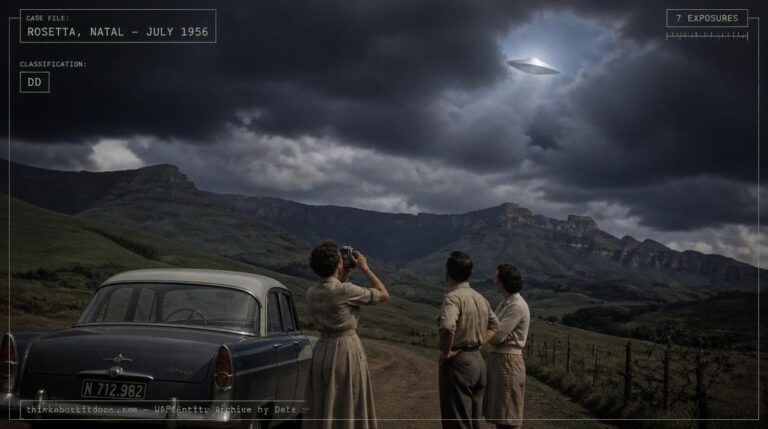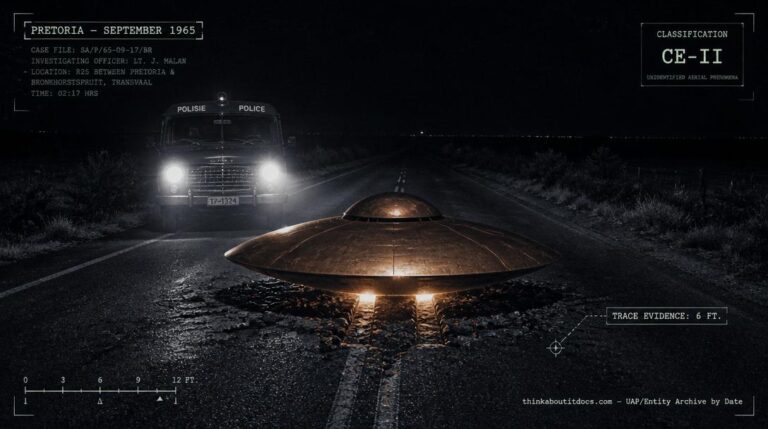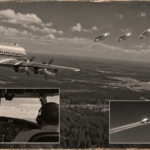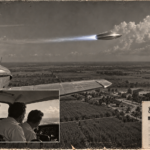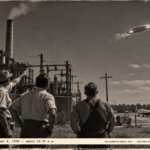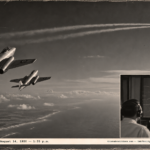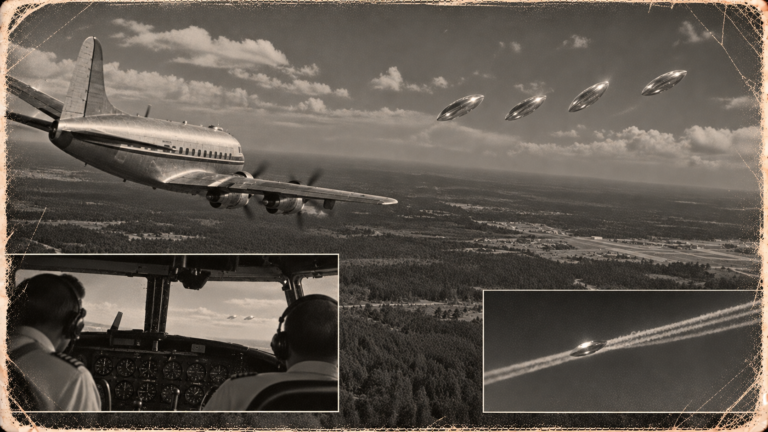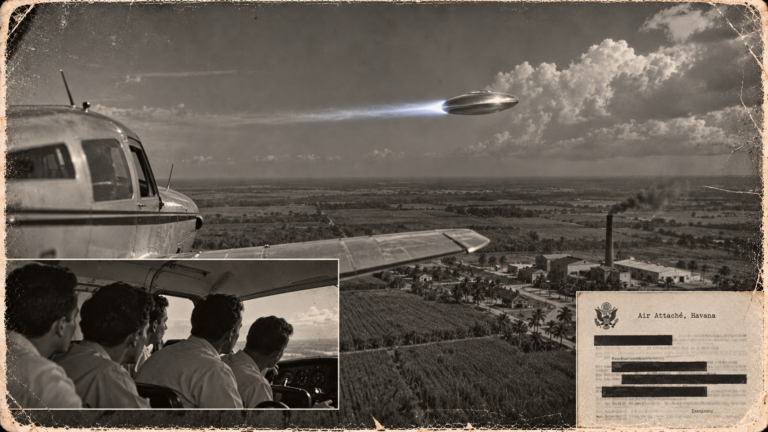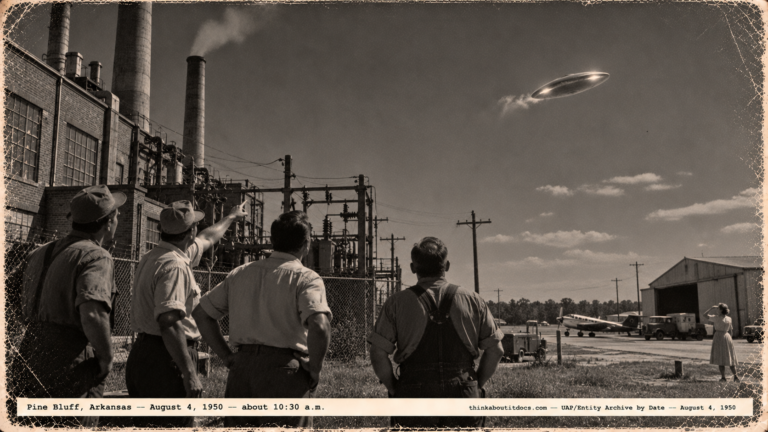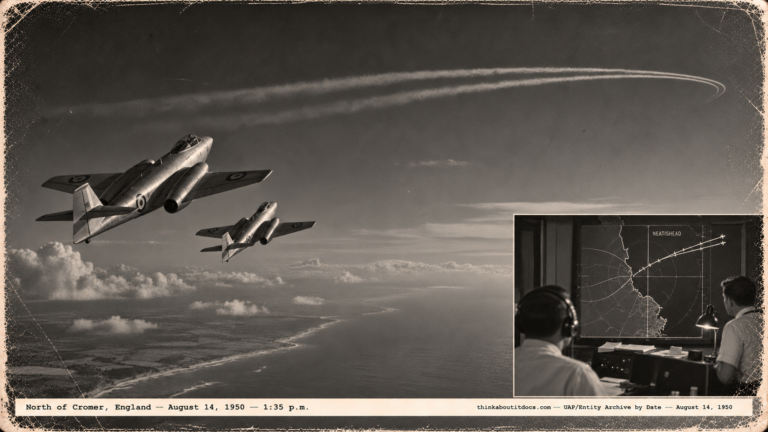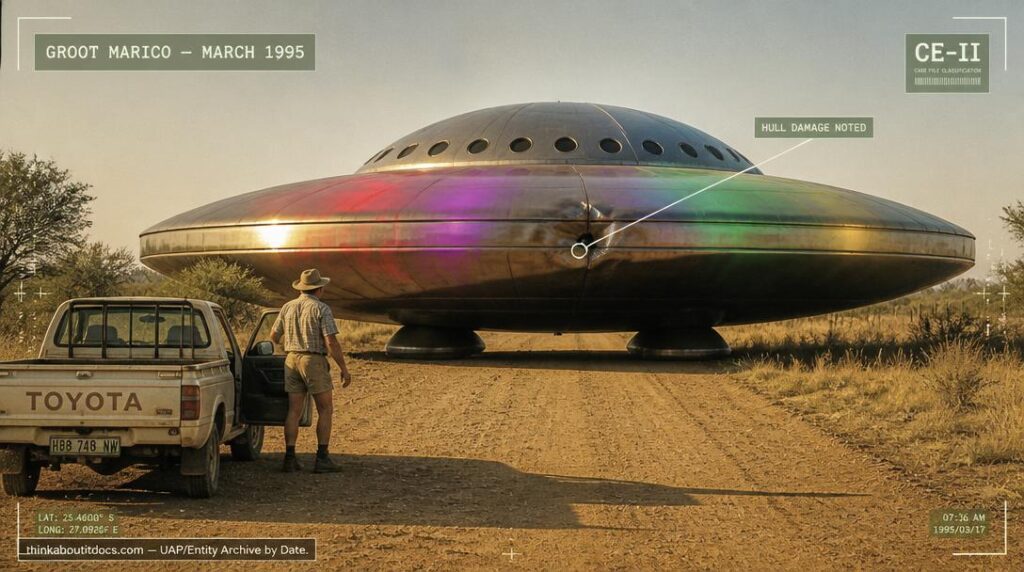
Dossier reconstruction of the damaged disc-shaped craft reported by farmer Jan Pienaar near Groot Marico, South Africa, March 30, 1995.
THINK ABOUTIT UFO|UAP ENCOUNTER REPORT
1995: Groot Marico UFO Landing | Damaged Disc Case Archive
Just after 8:30 on the morning of Thursday, March 30, 1995, farmer Jan Pienaar came around a bend on a remote dirt road between Coligny and Brakspruit, in South Africa’s Groot Marico district, and found his truck’s engine dead — and a huge, dented, disc-shaped craft resting across the entire width of the road ahead of him, glowing red, violet, green, and yellow along its stainless-steel-like hull. For three or four minutes, he stood frozen beside his truck, unable to take a single step, before the object shot upward and vanished. He would later theorize the damaged craft had stopped to make repairs — and that his own arrival had scared it off before the job was finished.
Reported days later in Rapport, a major Afrikaans Sunday newspaper, the case comes with an unusual complication worth clearing up: the original field data for this page describes a “humanoid entity” at the scene, but Pienaar’s own account describes an ordinary man on a bicycle, and Pienaar himself said plainly he saw no beings at all — only the craft. This entry treats that figure as a second human witness, not an alien occupant, and reclassifies the case accordingly.
Date: March 30, 1995
Sighting Time: Approximately 8:30 AM
Day/Night: Day — Morning
Location: A remote road between Coligny and Brakspruit, Groot Marico district — referred to in the source as “Transvaal,” a province formally subdivided the previous year into North West Province (where this area actually lies) and others. See Researcher’s Notes.
Urban or Rural: Rural
No. of Entity(‘s): 0 — corrected from “1 Humanoid.” The figure described was an ordinary man seen shielding his face and later riding away on a bicycle; the witness explicitly stated he saw no beings, only the craft. See Researcher’s Notes.
Entity Type: Not applicable — no entity is credibly described in the source; see Researcher’s Notes
Entity Description: Not applicable. A second person — described as an older man who shielded his face and rode off on a bicycle — was present at the scene as an apparent human bystander, not a claimed alien entity
Hynek Classification: CE-II (Close Encounter II) — corrected from CE-I. With no entity present and documented physical trace evidence (scorched ground, odor, vehicle ignition interference) at close range, this case fits Hynek’s physical-effects category rather than observation alone. See Researcher’s Notes.
Duration: 3–4 minutes
No. of Object(s): 1 craft
Description of the Object(s): A saucer-shaped craft resting on three landing pods, described by the witness as shaped like two inverted soup plates with a pudding bowl on top; its upper section appeared to have seven windows or portholes; a distinctly visible hole or dent, a little less than 2 feet across, was noticeable along a seam near the edge of the hull
Shape of Object(s): Disc
Size of Object(s): Approximately 8–9 meters high (given in the source as “24–36 feet,” though the more precise conversion is closer to 26–30 feet); spanned the entire width of the road
Color of Object(s): Translucent and lustrous, as though fabricated from a type of stainless steel; illuminated by a red-violet-green-yellow glow emanating from somewhere on or within the hull
Distance to Object(s): Approximately 80 meters (given in the source as “240 feet,” though the more precise conversion is closer to 262 feet)
Height & Speed: Landed/resting on three pods; on departure, rose vertically “like a helicopter” before accelerating away at very high speed; no numeric speed given
Number of Witnesses: Multiple — primary witness Jan Pienaar (45); a second man present at the roadside during the sighting itself; and farmer Chap Smit, who accompanied Pienaar back to the site about 30 minutes later and confirmed the physical aftermath, though he did not see the craft itself
Special Features/Characteristics: Landing; vehicle interference (Pienaar’s truck engine died on approach and restarted normally afterward); portholes/windows (approximately seven); physiological effects (witness immobilized, “as though a magnet held me,” for the full 3–4 minutes); physical trace (ground at the landing site was scorching hot to the touch when checked about 30 minutes later); smell/odor (a lingering, chloroform-like scent); the craft buzzed “like a gigantic electric beater”; police told Pienaar the object had reportedly been seen the previous night at various locations across the northern provinces
Case Status: Unexplained
Source: Rapport (Afrikaans Sunday newspaper, South Africa), April 2, 1995
Summary/Description: On the morning of March 30, 1995, farmer Jan Pienaar encountered a large, damaged, disc-shaped craft resting across a remote road in South Africa’s Groot Marico district. His truck’s engine died and he found himself unable to move for several minutes before the object departed at high speed. A second man present at the scene was an apparent human bystander, not a claimed entity. Roughly 30 minutes later, Pienaar and a fellow farmer found the landing site’s ground scorching hot with a lingering chloroform-like odor.
Related Cases: The source notes that the object had reportedly been seen the previous night at various locations across South Africa’s northern provinces, as part of a broader wave of sightings in the region that week. Not separately indexed in this archive.
Detailed Report
The case was reported in Rapport, a major Afrikaans-language Sunday newspaper, on April 2, 1995, describing an incident from the preceding Thursday morning, March 30. The witness was Jan Pienaar, a 45-year-old farmer from the Groot Marico district in what the newspaper still called “Transvaal” — despite that province having been formally split the year before, in 1994, into several new provinces, including North West Province, where Groot Marico, Coligny, and Brakspruit actually lie. The older name appears to have simply persisted in everyday and press usage.
Around 8:30 that morning, Pienaar came around a curve on a remote road between Coligny and Brakspruit and, in the same instant, noticed a man at the roadside shielding his face with his arm as though warding something off — and felt his truck’s engine die beneath him. Looking up, he found an enormous craft resting across the entire width of the road, roughly 80 meters ahead, standing on three landing pods and rising some 8 to 9 meters high. He described its shape as like two inverted soup plates with a pudding bowl set on top, its upper section showing what looked like seven windows or portholes. The whole structure was translucent and lustrous, as if made from a kind of stainless steel, lit by a shifting glow of red, violet, green, and yellow from somewhere on or within the hull. In that light, Pienaar could make out a dent along a seam near the edge, with a hole a little under two feet across — damage that later led him to speculate the craft had put down for repairs, and that his own arrival had startled it into leaving before the job was done.
Pienaar said he saw no beings anywhere near the craft — only the object itself, which buzzed like an enormous electric beater. Getting out of his truck, he found he couldn’t take another step, as though held in place by a magnet, and stood rooted to the spot for three or four minutes until the craft rose straight up like a helicopter, then shot away at tremendous speed. Once he’d recovered his composure and gotten back in the truck, the ignition started normally. He then thought to look for the man he’d seen at the roadside, curious what had become of him, and caught only a glimpse of coattails flapping as the man pedaled hurriedly away on a bicycle down the dusty road.
From a neighboring farm, Pienaar phoned the police, who told him the object had apparently been sighted the previous night at several locations across the northern provinces. About thirty minutes later, he drove back to the site with a fellow farmer, Chap Smit. The ground where the craft had rested was scorching hot to the touch, hot enough to burn a hand, and a strange, lingering odor — Pienaar likened it to chloroform — still hung in the air. Of the man on the bicycle, there was no further sign.
RESEARCHER’S NOTES
The Groot Marico Landing — South Africa 1995 and a Misidentified “Entity”
- Classification Correction — Entity Misidentification: The original field data lists “Entity Type: Humanoid” and counts “1 Humanoid” alongside the craft, but the source’s own narrative describes this figure in entirely ordinary human terms — a man shielding his face, later seen “peddl[ing] his bicycle down the dusty road” — and Pienaar states plainly, “I could not see any beings in the vicinity, only the strange ‘craft.'” This reads far more consistently as a second human bystander than a claimed non-human entity, and this entry does not classify it as one. Notably, the original ufoevidence.org catalog entry for this same case lists no occupant or entity-related feature either — only Landing, Vehicle Interference, Portholes/Windows, Physiological Effects, Physical Trace, and Smell/Odor.
- Classification Correction — Hynek Category: With no claimed entity present, and with documented physical trace evidence (scorched ground, unusual odor, vehicle ignition interference) at close range, this case fits Hynek’s CE-II far better than CE-I, which covers observation alone without physical effects. This entry reclassifies the case as CE-II.
- Corroboration: Pienaar was alone during the sighting itself, but returned roughly 30 minutes later with a second named farmer, Chap Smit, who confirmed the ground at the site was scorching hot and that a chloroform-like odor lingered in the air — independent, if delayed, corroboration of the physical aftermath, even though Smit did not see the craft.
- Geographic/Historical Note: The source refers to the region as “Transvaal,” a province formally subdivided the previous year, in 1994, into several new provinces, including North West Province, where Groot Marico, Coligny, and Brakspruit are actually located. The older name appears to have persisted colloquially in the press well after the administrative change.
- Minor Unit Conversions: The source’s own bracketed metric-to-imperial conversions are slightly inconsistent (80 meters is rendered as “240 feet,” closer to 262 feet; 8–9 meters is rendered as “24–36 feet,” closer to 26–30 feet). These are preserved here as given rather than silently corrected.
- Source Chain Assessment: The case was published in Rapport within days of the reported event, naming the primary witness by full name and age — stronger, more immediate sourcing than many single-witness cases in this archive, though no independent investigation beyond the newspaper account and Smit’s later corroboration is documented.
Stripped of a misread “entity” that appears nowhere in the witness’s own account, the Groot Marico case stands as a solid CE-II: a named farmer, a dead engine, a dented and glowing craft resting across the road, and — thirty minutes later — a second man confirming the ground itself was still scorching hot. It remains Unexplained not because every detail checks out perfectly, but because what can be checked, checks out.
“It was as though a magnet held me on the same spot.”