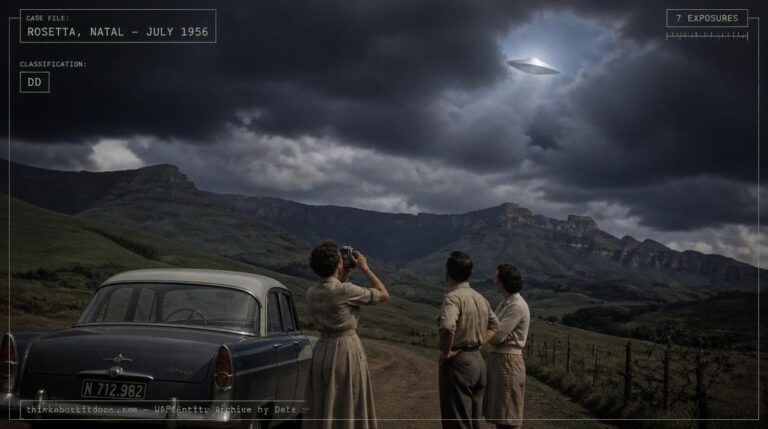
Dossier reconstruction of the UFO intercepted by Zimbabwe Air Force jets over Matabeleland South, July 22, 1985.
THINK ABOUTIT UFO|UAP|ENTITY ENCOUNTER REPORT
1985: Zimbabwe UFO | Air Force Jet Interception Case Archive
At a quarter to six in the evening on July 22, 1985, a shiny, cone-topped object streaked over western Zimbabwe in full view of dozens of witnesses — civilians, air traffic controllers, and, within minutes, two Zimbabwe Air Force Hawk jets scrambled from Thornhill Air Base. The fighters caught up to it at 7,000 feet. It answered by climbing to 70,000 feet in under a minute and vanishing on the horizon.
A year and a half later, with radar data, pilot testimony, and no explanation to show for it, Zimbabwe’s Air Commodore David Thorne told reporters plainly: “We have had to classify it as a UFO.” A more senior officer, Air Marshal Azim Daudpota, backed him publicly within weeks of the sighting. But NASA veteran and UFO skeptic James Oberg pushed back hard on how much any of that was really worth — and this entry keeps both sides on the record.
Date: July 22, 1985
Sighting Time: Approximately 5:45 PM
Day/Night: Sunset
Location: Matabeleland South, western Zimbabwe, near Bulawayo; intercepting jets launched from Thornhill Air Base
Urban or Rural: Undocumented in the original field; additional sourcing describes sightings across “urban areas of Matabeleland South”
Hynek Classification: RV (Radar/Visual) — object tracked on radar by air traffic control and confirmed visually by two intercepting fighter pilots
Duration: Undocumented precisely; the intercept and the object’s climb to 70,000 feet occurred within roughly a minute
No. of Object(s): 1
Description of the Object(s): A round object topped with a cone, described by intercepting pilots as incredibly shiny and reflecting the colors of the sunset; reported to emit its own light once it grew dark
Shape of Object(s): Round object topped with a cone
Size of Object(s): Undocumented
Color of Object(s): Shiny, reflecting the colors of the sunset; later reported to emit its own light after dark
Distance to Object(s): Undocumented precisely; intercepting jets closed to the object’s altitude of 7,000 feet
Height & Speed: Intercepted by fighter jets at 7,000 feet; climbed to approximately 70,000 feet in under a minute; separately estimated by Thorne as traveling at roughly twice the speed of sound
Number of Witnesses: Dozens, including pilots, air traffic controllers, and civilians on the ground
Special Features/Characteristics: Object was first tracked by air traffic controllers on radar, then visually confirmed by two intercepting Zimbabwe Air Force Hawk jets; its climb performance (7,000 to roughly 70,000 feet in under a minute) was far beyond the jets’ own capability to follow; Air Commodore David Thorne publicly stated the Air Force could not identify it and ruled out aircraft, weather balloon, or natural phenomenon; in a separate, unofficial letter to UFO researcher Timothy Good, Thorne went further, stating his Air Staff believed the object was extraterrestrial in origin; Air Marshal Azim Daudpota separately confirmed the sighting’s seriousness to The Times of London within two weeks of the event
Case Status: Unexplained
Source: Undocumented outlet in the original field; text matches a widely circulated account (see, e.g., sacred-texts.com, “Zimbabwe UFO”) quoting Air Commodore David Thorne and skeptic James Oberg, cross-referenced here with contemporary 1985 reporting from The Times of London and Zimbabwean press retrospectives
Summary/Description: On July 22, 1985, a shiny, cone-topped object was tracked by radar and visually confirmed over western Zimbabwe by air traffic controllers, civilians, and two intercepting Air Force Hawk jets, climbing from 7,000 to roughly 70,000 feet in under a minute before escaping. Zimbabwe’s Air Commodore David Thorne later stated the Air Force could not identify the object and had to classify it as a UFO; skeptic James Oberg questioned the evidential value of the sighting, citing limited regional radar coverage and known pilot perceptual biases.
Related Cases: The same broader 1985 Zimbabwe UFO wave includes a separate, unrelated report of a driver near Harare experiencing roughly ninety minutes of missing time in September 1985. That is a distinct incident, not part of this entry. Not separately indexed in this archive.
Detailed Report
At around a quarter to six in the evening on July 22, 1985, a rash of UFO sightings broke out across the urban areas of Matabeleland South, in western Zimbabwe. A shiny, round object topped with a cone was seen streaking across the sky by dozens of people — ordinary civilians as well as air traffic controllers, who picked it up on radar and watched it hover. Within minutes, two Hawk fighters from the Zimbabwe Air Force were scrambled from Thornhill Air Base to intercept it.
The jets closed on the object at an altitude of 7,000 feet. Rather than being caught, the object launched itself upward, reaching roughly 70,000 feet in under a minute — a climb rate far beyond what the intercepting Hawks could match. Unable to follow, the fighters returned to base, watching the object disappear at high speed along a horizontal path as it vanished from view. The pilots who got closest described it as incredibly shiny, reflecting the colors of the sunset; as darkness fell, witnesses reported that the object appeared to be emitting light of its own. Thorne’s own estimate placed its speed at roughly twice the speed of sound.
A year and a half later, with no conventional explanation found, Air Commodore David Thorne, Zimbabwe’s Director General of Operations, spoke on the record: “We have not been able to identify the object. We have had to classify it as a UFO.” He stood by the reliability of his pilots and ruled out an aircraft, weather balloon, or natural phenomenon as explanations. Separately, in an October 24, 1985 letter to British UFO researcher Timothy Good, Thorne went further still — explicitly framing it as a personal rather than official view — writing that his Air Staff “believe[d] implicitly that the unexplained UFOs are from some civilization beyond our planet.” Just weeks after the sighting itself, an even more senior officer, Air Marshal Azim Daudpota, told The Times of London: “This was no ordinary UFO. Scores of people saw it. It was no illusion, no deception, no imagination.”
Not every credentialed voice agreed the case amounted to much. James Oberg, a 22-year NASA space engineer and prolific writer on spaceflight and UFO phenomena, argued that “the evidential value of unresearchable sightings in Zimbabwe is zero, however sincere the witnesses,” pointing to the country’s limited capacity to track the kind of traffic — including foreign reconnaissance aircraft — that might account for such reports. He also cautioned that pilots, trained to treat ambiguous visual stimuli as potential threats, are not necessarily the most reliable UFO witnesses for that same reason: a trait that makes for a safer pilot doesn’t necessarily make for a more objective one.
This sighting was part of a wider wave of Zimbabwean UFO reports that year; a separate account from September 1985 describes a driver near Harare who reported losing roughly ninety minutes of time on a familiar road, an unrelated case not covered in this entry.
RESEARCHER’S NOTES
The Matabeleland Intercept — Zimbabwe 1985 and a Case With Two Named Officers
- Classification Notes: RV is correctly applied here — the object was tracked by radar via air traffic control and separately confirmed visually by two intercepting fighter pilots, matching Hynek’s definition of the category precisely.
- Source Chain Assessment: This case is unusually well-anchored for a broadly-dated “1985” archive entry — a specific date (July 22, 1985), a specific location (Matabeleland South, near Bulawayo, jets from Thornhill Air Base), and on-record statements from two named senior Zimbabwe Air Force officers, one of them (Air Marshal Daudpota) quoted in The Times of London within weeks of the event.
- Two Separate Thorne Statements: The “we have had to classify it as a UFO” quote used on this page comes from an account roughly a year and a half after the sighting. In a separate, October 24, 1985 letter to Timothy Good, Thorne went further, stating — explicitly as a personal rather than official view — that his Air Staff believed the object was extraterrestrial. These are two distinct statements made at different times and are not the same quote.
- Skeptical Counterpoint: James Oberg, a credentialed 22-year NASA space engineer and experienced spaceflight/UFO analyst, argued the sighting’s evidential value was limited by Zimbabwe’s regional radar/tracking infrastructure and by pilots’ documented tendency to interpret ambiguous stimuli as threats. This is preserved here as a serious, professional counterpoint rather than favoring either side of the case.
- Distinct From the “Missing Time” Case: The same broader 1985 Zimbabwe UFO wave includes a separate, unrelated account of a driver near Harare reportedly losing ninety minutes of time in September 1985. That is a distinct incident from the July 22 jet-interception case described here.
- Case Status Rationale: Filed as Unexplained given the specificity of the documented facts — date, location, named senior officers, radar-tracked altitude data — and Zimbabwe’s own Air Force declining, on the record, to identify the object, while Oberg’s skepticism about the broader evidential rigor of Zimbabwean sightings is preserved as a serious counterpoint rather than dismissed.
Few cases in this archive have two named senior Air Force officers on the record and a credentialed NASA engineer pushing back on all of it in the same breath. The Matabeleland intercept is filed as Unexplained not because the evidence is airtight, but because Zimbabwe’s own Air Force said, in public, that they couldn’t identify what their pilots chased that evening — and nothing since has changed that.
“We have had to classify it as a UFO.”