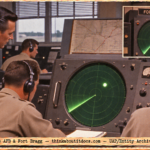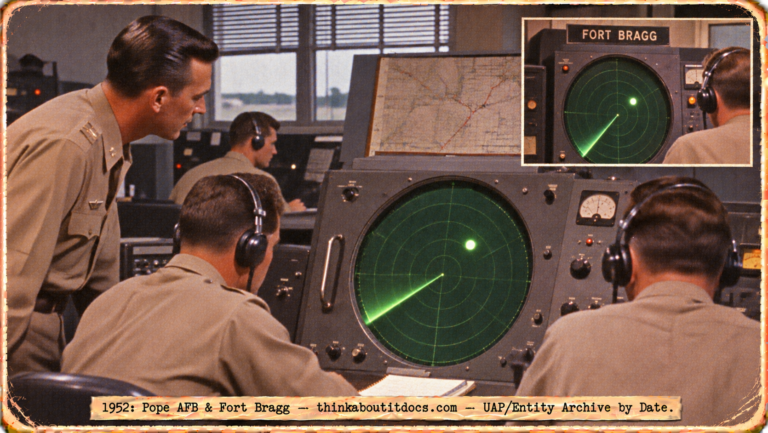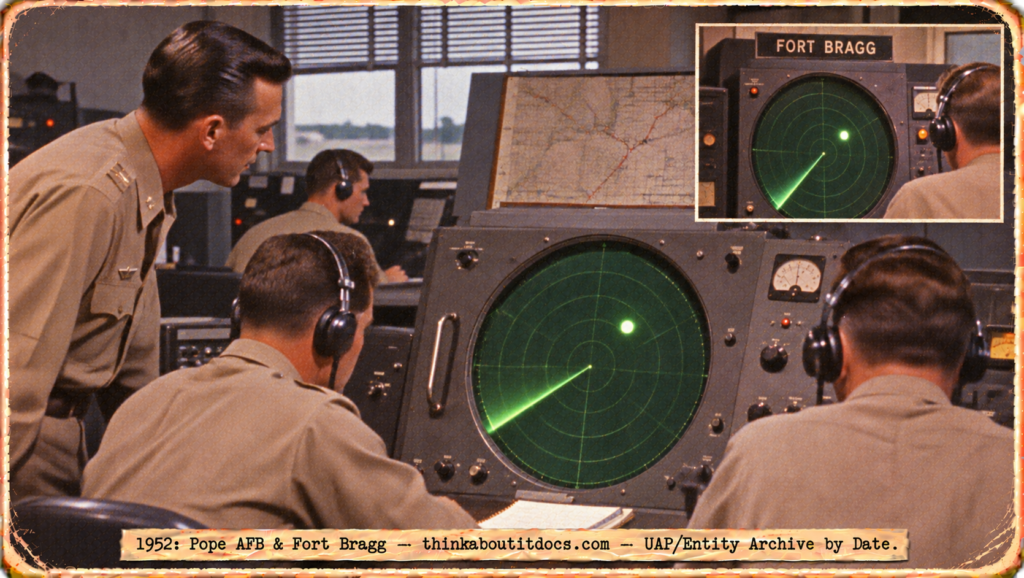
Pope AFB and Fort Bragg, December 10, 1952: the eight-hour dual-radar case.
THINK ABOUTIT UFO|UAP SIGHTINGS REPORT
1952: Pope AFB and Fort Bragg, an Eight-Hour Dual-Radar Confirmation
For nearly eight hours on December 10, 1952, a bright circular object sat on radar scopes at two separate installations in North and South Carolina at once. Pope Air Force Base’s own radar held the target from mid-morning to late afternoon; the search and height-finding radars of Fort Bragg’s 728th AC&W Squadron, operating independently miles away, confirmed the same target. An F-51 sent up to look saw nothing at all.
Date: December 10, 1952
Sighting Time: 9:20 a.m. to 5:15 p.m. EST
Day/Night: Day
Location: Pope Air Force Base, South Carolina, with cross-detection at Fort Bragg, North Carolina
Urban or Rural: Not applicable — radar/airborne detection
No. of Entity(‘s): None
Entity Type: Not applicable
Entity Description: Not applicable
Hynek Classification: RV (Radar-Visual) in the sense of dual independent radar confirmation, though no eyewitness description of the object survives beyond the radar presentation itself
Duration: Just under 8 hours
No. of Object(s): 1
Description of the Object(s): A bright circular return on a CPS/5D radar’s PPI scope, independently confirmed on the search and height-finding radars of the 728th AC&W Squadron at Fort Bragg
Shape of Object(s): Circular, as presented on the radar scope
Size of Object(s): Not recorded
Color of Object(s): Not applicable
Distance to Object(s): Not recorded
Height & Speed: Held at 8,000 ft altitude and 155° azimuth, showing only a slight circular movement over the nearly eight-hour observation period rather than sustained directional travel
Number of Witnesses: Radar operators at both Pope AFB and the Fort Bragg 728th AC&W Squadron, plus the pilot of the F-51 sent to investigate visually
Special Features/Characteristics: Independent confirmation by two separate radar installations operating different equipment at different locations; a near-stationary position held for nearly eight continuous hours, with only slight circular movement rather than ordinary aircraft transit; a visual intercept flight that found nothing despite the radar target persisting at the same reported position
Case Status: Unexplained
Source: McDonald list
Summary/Description: From 9:20 a.m. to 5:15 p.m. EST on December 10, 1952, a bright circular object was tracked on a CPS/5D radar’s PPI scope at Pope Air Force Base, South Carolina, at 155° azimuth and 8,000 ft altitude, showing only a slight circular movement. The target was independently confirmed on the search and height-finding radars of the 728th Aircraft Control and Warning Squadron at Fort Bragg, North Carolina. An F-51 sent to investigate visually saw nothing unusual. The case remains unexplained.
Related Cases: December 1952 archive | the Odessa–Hanford, Washington F-94 near-collision, December 10, 1952 (same date)
DETAILED REPORT
At 9:20 a.m. on December 10, 1952, radar operators at Pope Air Force Base, South Carolina, picked up a bright, circular return on their CPS/5D radar’s plan position indicator scope. The target sat at an azimuth of 155 degrees and an altitude of roughly 8,000 feet, and rather than moving off like a normal aircraft contact, it remained in essentially the same position for the remainder of the observation period, showing only a slight circular motion.
What distinguishes this case from a routine equipment glitch or atmospheric artifact is the independent cross-check. Miles away, the 728th Aircraft Control and Warning Squadron at Fort Bragg, North Carolina, operating its own search and height-finding radar systems, separately picked up and confirmed the same target. Two different installations, two different sets of operators, and at least two different radar system types were all reporting the same object at the same position — a far stronger basis for taking the contact seriously than any single scope’s reading could provide.
At some point during the long observation window, an F-51 fighter was dispatched to make a visual check of the reported position. The pilot saw nothing unusual in the sky where the radar insisted something was sitting. The radar target nonetheless continued to be tracked, with the full observation period running from 9:20 in the morning to 5:15 in the afternoon — just under eight hours.
The case is recorded in the McDonald list of radar and radar-visual UFO reports, and no conventional explanation — weather phenomenon, equipment malfunction at both sites simultaneously, or misidentified aircraft — is noted as having been confirmed for the sighting.
RESEARCHER’S NOTES
Nearly Eight Hours, Two Independent Radars, No Visual Confirmation
- Classification and its limits: RV typically implies a human eyewitness alongside a radar return. Here the only attempted visual check — the F-51 intercept — found nothing, so the case is better understood as a dual-radar confirmation case without a successful visual correlate, a distinction worth stating plainly rather than letting the RV label imply an eyewitness description that does not exist in the source material.
- Why the cross-detection matters more than the duration: An eight-hour stationary target on one scope alone could plausibly reflect an equipment or siting problem specific to that one radar installation. The same target appearing independently on Fort Bragg’s separate search and height-finding systems removes that explanation and is the single strongest piece of evidence in this case.
- The failed visual intercept cuts both ways: An F-51 finding nothing at the reported position could mean the object was never there in a conventional sense (supporting a radar-anomaly explanation), or that it was positioned, sized, or oriented in a way that made visual acquisition difficult despite a strong, stable radar return. The source material does not resolve which, and this entry does not resolve it either.
- Near-stationary behavior over a very long window: Eight hours is an unusually long persistence for a radar UFO case; most 1952 radar-visual reports run minutes, not most of a working day. That duration, combined with the dual confirmation, is what keeps this case in the record as a genuine radar mystery rather than a brief, easily dismissed blip.
Two separate radar installations, operating independently, tracked the same near-stationary circular target over Pope AFB and Fort Bragg for nearly eight hours, while a visual intercept found nothing in the sky. No conventional explanation accounts for the dual confirmation. It stands as Unexplained.
“The bright circular object was tracked on a CPS/5D radar’s PPI scope… it was independently confirmed on the search and height-finding radars of the 728th AC&W Squadron at Fort Bragg.”
— McDonald list, summarizing the Pope AFB/Fort Bragg radar case, December 10, 1952