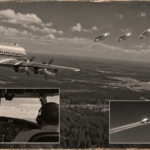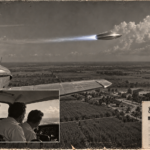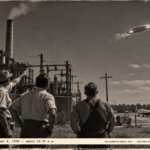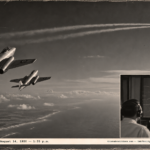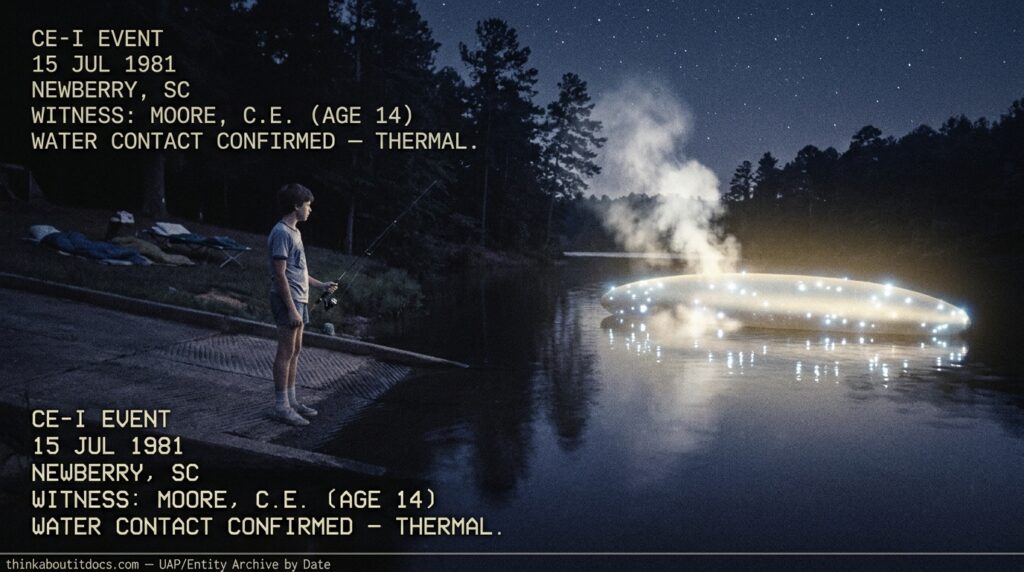
July 15, 1981 — A 30-foot glowing silver-white cigar-shaped object sits on the water surface near Newberry, South Carolina, as steam rises from the contact point. Fourteen-year-old Carl Moore observed the craft from less than 50 feet for approximately three minutes before it rose and shot vertically skyward.
THINK ABOUTIT UFO|UAP SIGHTING REPORT
1981: Cigar-shaped object seen landing on the water
On the night of July 15, 1981, fourteen-year-old Carl E. Moore was alone at a boat ramp near Newberry, South Carolina — his fishing companions asleep on their cots behind him — when a 30-foot glowing silver-white cigar-shaped object drifted slowly over the water at roughly 20 miles per hour, settled onto the surface close enough for him to watch steam rise from the contact point, sat motionless on the water for approximately three minutes, lifted to a hover one foot above the surface, and then shot vertically skyward at a speed the boy described as instantaneously exceeding 250 miles per hour. The object was less than 50 feet away. It was covered in small flickering whitish-blue lights. It had no windows, no doors, and no visible means of propulsion.
Investigated by John F. Schuessler and published in the MUFON Journal in December 1982, the Newberry water-landing is a rare and well-documented case of a UAP interacting directly with a body of water at close range, producing observable physical effects — the steam column — in the presence of a named witness who reported through a recognized investigative channel.
Date: July 15, 1981
Sighting Time: Approximately 10:30 p.m.
Day/Night: Night
Location: Near Newberry, South Carolina — boat ramp on an unspecified body of water
Urban or Rural: Rural — waterfront
No. of Entity(‘s): None observed
Entity Type: Not Applicable
Entity Description: Not Applicable
Hynek Classification: CE-I (Close Encounter of the First Kind) — Object observed at less than 50 feet distance with detailed structural features visible
Duration: Approximately 3 minutes (water contact phase); total observation somewhat longer including approach and departure
No. of Object(s): 1
Description of Object(s): 30-foot-long cigar-shaped object, glowing silver-white; surface covered with small whitish-blue lights that flickered continuously; no windows, doors, or visible propulsion features; featureless smooth exterior
Shape of Object(s): Cigar / Oblong
Size of Object(s): Approximately 30 feet long; larger than a standard automobile
Color of Object(s): Glowing silver-white body; small whitish-blue flickering lights covering the surface
Distance to Object(s): Less than 50 feet at closest approach (water landing phase)
Height & Speed: Approached at approximately 20–25 mph at low altitude over the water; settled onto water surface; hovered at 1 foot above surface after rising; departed vertically at extreme speed (witness estimated instantaneous acceleration to 250+ mph)
Number of Witnesses: 1 (Carl E. Moore, age 14; companions were asleep)
Special Features/Characteristics: Object made physical contact with the water surface, producing visible steam; covered in flickering whitish-blue lights; no windows, doors, or surface features; extreme vertical acceleration on departure; featureless exterior despite close-range observation; witness experienced emotional disturbance but maintained observation throughout
Case Status: Unexplained
Source: John F. Schuessler, MUFON Journal, December 1982; Waterufo.net; Project VISIT (Vehicle Internal Systems Investigative Team), Friendswood, Texas
Summary/Description: Carl E. Moore, 14, was fishing with friends near Newberry, South Carolina, when he observed a 30-foot glowing silver-white cigar-shaped object fly slowly over the water at 20–25 mph and settle onto the surface less than 50 feet from his position, producing visible steam. The object sat on the water for approximately 3 minutes, then rose to hover 1 foot above the surface before shooting vertically skyward at extreme speed. The craft was covered in small flickering whitish-blue lights and had no visible windows, doors, or propulsion features. Moore’s companions were asleep and did not witness the event.
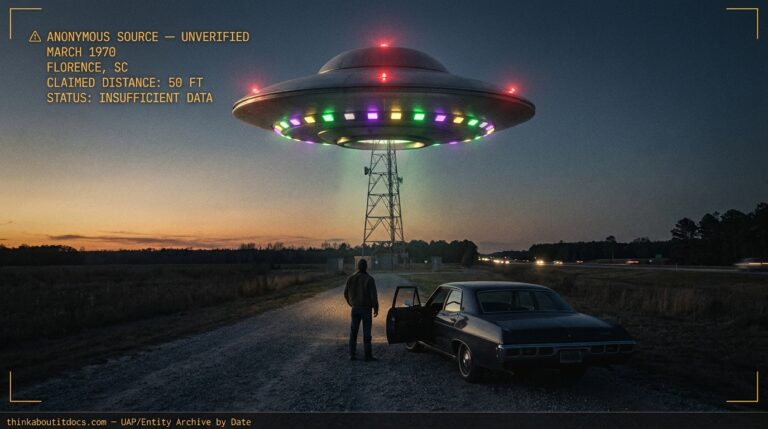
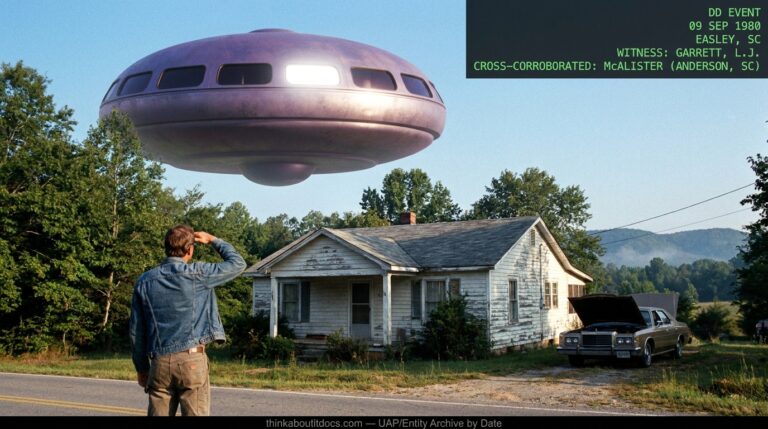
Related Cases: 1980 Easley, SC — Garrett Daylight Disc | 1970 Florence, SC — Disc Over TV Tower
Detailed Report
Carl E. Moore was fourteen years old in the summer of 1981. On the evening of July 15, he and friends had been fishing near Newberry, South Carolina, at an unspecified lake or reservoir accessible by boat ramp. The day’s fishing had been poor — only a few fish caught — and the group had retired to their cots to rest. Moore, however, decided to walk down to the boat ramp to check his trout lines. He was alone at the waterfront.
The weather was excellent: clear skies, temperature approximately 75 degrees Fahrenheit. It was approximately 10:30 p.m.
Moore observed a cigar-shaped object approaching over the water at low altitude. It was glowing silver-white and moving slowly — he estimated 20 to 25 miles per hour. The object was approximately 30 feet long, larger than a standard automobile. Its surface was covered with small whitish-blue lights that flickered continuously in an alternating pattern for the duration of the observation. The object had no visible windows, doors, seams, or propulsion apparatus — the exterior was smooth and featureless apart from the flickering lights.
The object slowly settled onto the surface of the water. Upon contact, steam rose visibly around the craft, indicating that the object’s surface temperature was significantly elevated — hot enough to cause immediate vaporization of the water at the contact interface. The object remained on the water surface for approximately three minutes.
After approximately three minutes, the object rose slightly and hovered at approximately one foot above the water surface. Then, without warning, it shot vertically skyward, rising straight up until it disappeared from sight. Moore described the acceleration as instantaneous, estimating that the object went from a stationary hover to more than 250 miles per hour in an instant. The departure was rapid enough that the object was out of visual range within seconds.
The flickering whitish-blue lights continued operating throughout the entire observation — during approach, water landing, hover, and vertical departure — and were the last visual feature visible as the object receded.
Moore described his emotional state during the encounter as “quite disturbed,” but stated that he was able to maintain composure and observe the entire event from beginning to end. His companions were asleep on their cots and did not witness the object. Moore did not immediately report the encounter, believing no one would credit his account. He later learned about Project VISIT (Vehicle Internal Systems Investigative Team), a Houston-area research group founded by John F. Schuessler, and submitted his report through that channel. Schuessler subsequently wrote up the case for the MUFON Journal, where it was published in December 1982.
Researcher’s Notes
The Newberry Water Landing — South Carolina 1981 and the Physics of Thermal Contact
- Classification Confirmation — CE-I with Physical Effects Implications: The CE-I classification is correct for the observational component — the object was within 50 feet of the witness with structural detail clearly resolved. However, the steam production upon water contact represents a physical effect (thermal energy transfer to the environment), which under strict Hynek taxonomy would suggest CE-II characteristics. Because the physical effect was observed at the water surface rather than on the witness or his immediate surroundings, and because no residual ground traces were examined, CE-I remains the more defensible classification. The thermal interaction is noted as a significant supplementary feature.
- Source Chain — Schuessler and Project VISIT: John F. Schuessler was one of the most credible investigators in the MUFON network during the 1980s. A NASA/contractor aerospace engineer by profession (he worked on the Space Shuttle program at McDonnell Douglas), Schuessler brought rigorous technical methodology to his UFO investigations and is best known for his extensive documentation of the 1980 Cash-Landrum incident. His involvement with the Moore case, published in the MUFON Journal, provides a reliable investigative chain. The report was filed through Project VISIT, Schuessler’s specialized research group focused on UFO propulsion and physical effects. While the case ultimately rests on a single teenage witness, the investigative handling is above average for the period.
- The Steam Column — Physical Evidence of Thermal Transfer: The most analytically significant detail in this case is the visible steam rising from the water surface upon the object’s landing. Steam production requires heating the water to or above its boiling point at the contact interface, which implies that the object’s lower surface was carrying significant thermal energy — at minimum 100°C (212°F) at the contact point, and likely considerably higher to produce visible steam rising to observable height. This thermal signature is consistent with a subset of UAP reports that describe heat effects — scorched ground, burned vegetation, witness burns (as in the Cash-Landrum case that Schuessler also investigated) — and suggests a propulsion or operational system that generates substantial waste heat or radiative energy on the craft’s underside.
- Pattern Context — Water-Interaction Cases: UAP-water interaction reports constitute a distinct subcategory in the global case literature, documented across lakes, rivers, coastal waters, and open ocean. Cases involving objects entering, exiting, or landing on water bodies span the full historical record, from the widely cited Shag Harbour incident (Nova Scotia, 1967) through numerous USO (Unidentified Submerged Object) reports in military and civilian maritime files. The Newberry case adds a thermal-contact detail that is uncommon even within this subcategory — most water-interaction reports describe objects entering or exiting the water without noted thermal effects. The steam column, if accurately reported, implies that this object was not engineered for aquatic operation (or was operating in a mode that produced surface heat), distinguishing it from accounts where objects appear to transition smoothly between aerial and underwater environments.
- Witness Age and Single-Witness Limitation: Carl Moore was fourteen at the time of the encounter, which introduces the standard considerations that apply to juvenile witnesses: heightened emotional reactivity, limited baseline experience with aerial phenomena, and the potential for creative embellishment. However, Moore’s account as documented by Schuessler is restrained and internally consistent, containing specific observational details (speed estimate, distance estimate, surface description, steam production, light behavior) without the narrative embroidery that often accompanies fabricated or exaggerated accounts. His delayed reporting — waiting until he learned of an appropriate investigative channel rather than seeking attention — is consistent with sincere testimony from a witness uncertain of reception. The fundamental limitation remains that he was alone; his sleeping companions provide neither corroboration nor contradiction.
 The Newberry water-landing case is a compact, well-investigated encounter that contributes a rare data point to the UAP-water interaction subcategory:
a named witness at close range observing a structured object making physical contact with a water surface, producing measurable thermal effects, and departing under extreme acceleration.
It is small in scope but specific in detail, and the investigative pedigree — Schuessler, MUFON Journal, Project VISIT — ensures that the account was handled by one of the more technically competent researchers of its era.