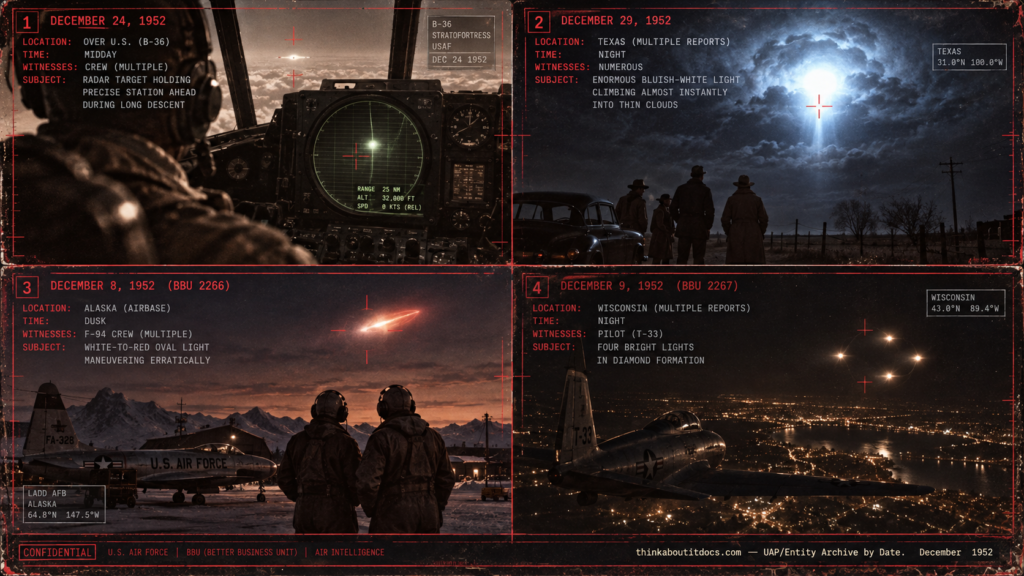
Four documented cases from December 1952.
1952: December 1st–15th
UFO|UAP & Entity Sightings Archive
December 1952 opens the final stretch of the year’s great UFO flap with a string of military radar and visual cases: a Laredo, Texas T-28 near-collision, an Air National Guard sighting of two spheres joined by a rod over Angoon, Alaska, and, before dawn on the 6th, a USAF B-29 crew over the Gulf of Mexico tracking fast-moving targets on three independent radar scopes while crewmen watched matching blue-white flashes from the waist blisters — one of the best-instrumented radar-visual cases of the entire wave.
An F-94 interceptor crew at Ladd AFB, Alaska chased an erratic climbing light; a T-33 crew near Madison, Wisconsin pursued four lights in diamond formation that a ground radar site could not detect at all; and on December 13 George Adamski returned to his telescope at Palomar Gardens for the film-plate session tied to his most scrutinized photograph. This page covers December 1st through 15th; see the companion page for December 16th–31st.
Date: December 4, 1952
Location: Colorado Springs, Colorado
Time: Not recorded
Summary: Unknown — no further detail survives in the sourced record.
Source: McDonald list
Date: December 4, 1952
Location: Congaree AFB, South Carolina
Time: 8:42 a.m. EST
Summary: An AN/MPS-5 radar detected an object roughly 100 miles NE of the base, traveling at an estimated 6,000 mph on a southern course. Per A/1C Clarence W. Ives, the object stopped for one minute, then reversed directly back along its original path. Duration about 5 minutes.
Source: Dan Wilson
Date: December 4, 1952 (Chop Clearance List Item #1)
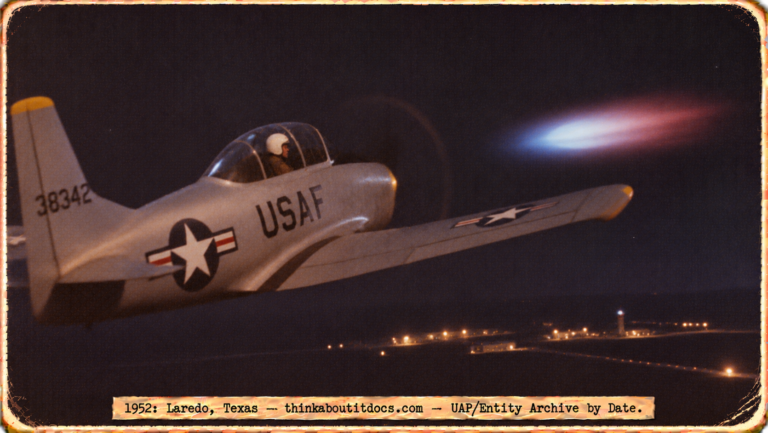
Location: Laredo, Texas
Time: 8:46–8:53 p.m.
Summary: USAF pilot Lt. Robert Arnold, flying a T-28 trainer at 6,000 ft, saw a bright bluish-white glowing object below him climb rapidly to his altitude, showing no navigation lights. As Arnold tightened his turn to track it, the object climbed to 9,000 ft in seconds, then dropped back to his level heading east, stopping and hovering about 6 miles SE of the base. When Arnold pursued, the object suddenly turned toward him on a collision course at high speed, wavering as if choosing which side to pass, before crossing his left wing at roughly 150 ft as a blurred reddish-bluish haze — all too fast for evasive action. Shaken, Arnold cut his running lights and spiraled down to 1,500 ft while keeping the object in view as it dove toward him again, then pulled up and climbed out of sight. Duration about 7 minutes. [Full Report]
Source: NARCAP
Date: December 5, 1952
Location: Lackland AFB, Texas
Time: 8:48 p.m.
Summary: A USAF T-28 pilot saw a blue light maneuver in a counterclockwise orbit, then climb away.
Source: Project 1947
Date: December 6, 1952
Location: Gulf of Mexico, about 100 miles south of the Louisiana coast
Time: About 0524–0535 local time
Summary: A USAF B-29 finishing a night training flight at 18,000 ft tracked successive groups of fast-moving targets on three independent radar scopes, computing speeds above 5,000 mph by stopwatch, while crewmen visually confirmed fast blue-white streaks at the called radar positions. In the final phase the small returns appeared to merge into one large return, which accelerated off the scopes at over 9,000 mph. The crew filed sworn statements; the case remains Unexplained. [Full Report]
Source: Project Blue Book case file; Jan Aldrich; NICAP/Weinstein catalog
Date: December 6, 1952
Location: Angoon, Alaska
Time: 9:15 a.m. AHST
Summary: An Air National Guard pilot saw two shiny spheres, connected by a solid rod, heading south.
Source: BB Status Report
Date: December 8, 1952 (BBU 2266)
Location: Ladd AFB, Alaska
Time: 8:16 p.m.
Summary: USAF pilot 1st Lt. D. Dickman and radar operator 1st Lt. T. Davies, in an F-94 jet interceptor (s/n 49-2522), saw a white oval light that turned red at higher altitude, flying straight and level on a 240° heading for 2 minutes before climbing at phenomenal speed on an erratic path. After they landed, the object could still be seen moving erratically without sound for 3 more minutes, then took up a 160° heading, gaining speed while descending and growing brighter red. Duration about 10 minutes.
Source: Berliner; cf. Hynek-CUFOS re-evaluation; Jan Aldrich
Date: December 8, 1952
Location: Chicago, Illinois
Time: Not recorded
Summary: An aircraft was paced by a row of unidentified lights (Thorpe/Plowe).
Source: UFOE, V
Date: December 9, 1952 (BBU 2267)
Location: About 10 miles south of Madison, Wisconsin
Time: 5:45–5:55 p.m.
Summary: USAF Capt. Bridges and 1st Lt. Johnson, flying a T-33 jet trainer, saw four bright lights in diamond formation heading southwest at roughly 400 mph and 8,000 ft. They pursued at 450 mph, overtaking the objects near Janesville, Wisconsin, then radioed the 755th AC&W radar site “Soapberry,” which could detect only the T-33, not the objects. The lights continued east and the T-33 followed until breaking off due to low fuel near Racine. No silhouette was visible even when the objects passed in front of the Milwaukee city lights. Duration about 10 minutes.
Source: Berliner; cf. Hynek-CUFOS re-evaluation; Jan Aldrich
Date: December 10, 1952
Location: Pope AFB, South Carolina (with cross-detection at Fort Bragg, North Carolina)
Time: 9:20 a.m. to 5:15 p.m. EST
Summary: A bright circular object was tracked on a CPS/5D radar’s PPI scope at 155° azimuth and 8,000 ft altitude, showing a slight circular movement; it was independently confirmed on the search and height-finding radars of the 728th AC&W Squadron at Fort Bragg. An F-51 sent to investigate visually saw nothing unusual.
Source: McDonald list
Date: December 10, 1952
Location: Hungnam, Korea
Time: Not recorded
Summary: A U.S. Navy pilot had a near-collision with an orange fireball.
Source: Weinstein; BB files
Date: December 10, 1952
Location: Between Odessa and Hanford, Washington
Time: 7:15–7:30 p.m. PST
Summary: An F-94 crew, flying at 26,000–27,000 ft, spotted and approached a light to identify it. The object appeared large, round, and white, with reddish light coming from two “windows,” and came at the F-94 on a collision course; the crew banked to avoid impact. Radar contact and lock-on were made multiple times on the aircraft’s ARC-33 radar. Duration about 15 minutes.
Source: Ruppelt p. 43; NARCAP
Date: December 13, 1952
Location: Palomar Gardens, near Mount Palomar, California
Time: Approximately 9:00 a.m.
Summary: George Adamski reported photographing a saucer-shaped craft three times as it approached to within 100 feet of his telescope. A porthole opened, a hand extended, and a film holder Adamski said his “spaceman friend” had carried off during the November 20 contact was dropped to the ground; developed, the plate showed blurred, unexplained symbols rather than the original exposure. This is also the date most associated with Adamski’s most examined photograph, independently identified by analysts as a modified chicken-egg incubator brooder. [Full Report]
Source: George Adamski & Desmond Leslie, Flying Saucers Have Landed (1953)
Date: December 14, 1952
Location: Charlottesville, Virginia
Time: 11:45 a.m. EST
Summary: An aeronautical engineer and former test pilot saw a light-orange, elliptical-shaped object hover, then move northeast at an estimated 1,000+ mph. The object gave off a discharge that changed brightness as it moved, apparently lofting debris into the air.
Source: Hynek-CUFOS re-evaluation; Jan Aldrich
Date: December 15–16, 1952 (Chop Clearance List Item #7)
Location: Goose Bay, Labrador, Canada
Time: 7:15 p.m.
Summary: Two Air Force crews got a momentary radar lock on an unidentified object after being vectored to the target by Ground Control Approach; visual contact was made by two aircraft, a T-33 and an F-94. One of the pilots reported having seen a similar object on November 26, 1952. This USAF Intelligence Report was item #7 on the official clearance list of sightings released to Maj. Donald Keyhoe by Air Force Press Desk officer Al Chop.
Source: Fran Ridge
Date: December 15, 1952
Location: Honshu, Japan (Early Warning Ground Radar Site #24)
Time: 8:54 p.m.
Summary: An AN/TPS-1C radar picked up a large, unidentified track estimated to represent more than one target, moving at roughly 1,320 mph. The target was visible on the first, second, and fourth antenna sweeps at 2 rpm.
Source: Dan Wilson; McDonald list
Date: December 15, 1952
Location: Greensboro (or Hartsville), South Carolina
Time: 9:15 a.m.
Summary: A USAF RF-80 pilot saw a bright, circular or spherical, silvery object losing and gaining altitude.
Source: Project 1947
EXECUTIVE SUMMARY
A Month of Radar Contacts Opens With the Gulf B-29
The first half of December 1952 is carried by three well-instrumented military cases. Before dawn on the 6th, a USAF B-29 crew over the Gulf of Mexico tracked fast-moving targets on three independent radar scopes while crewmen confirmed matching blue-white flashes visually — one of the strongest radar-visual files of the entire year’s flap. Two nights later an F-94 crew at Ladd AFB, Alaska chased an erratic, color-changing light (BBU 2266), and on the 9th a T-33 crew near Madison, Wisconsin pursued four lights in diamond formation that a ground radar site could track on the T-33 but never on the objects themselves (BBU 2267).
The period also carries two near-collision reports — Lt. Robert Arnold’s T-28 encounter at Laredo on the 4th and an F-94 crew’s head-on approach near Odessa, Washington on the 10th — and closes with George Adamski’s December 13 film-plate session at Palomar Gardens, the date most associated with his single most scrutinized photograph.
“The gun-laying radar was instrumented with a camera; the resulting film, though unclear, indicated the target’s presence and trackability.”
— Air Intelligence Information Report, on the period’s radar cases, December 1952