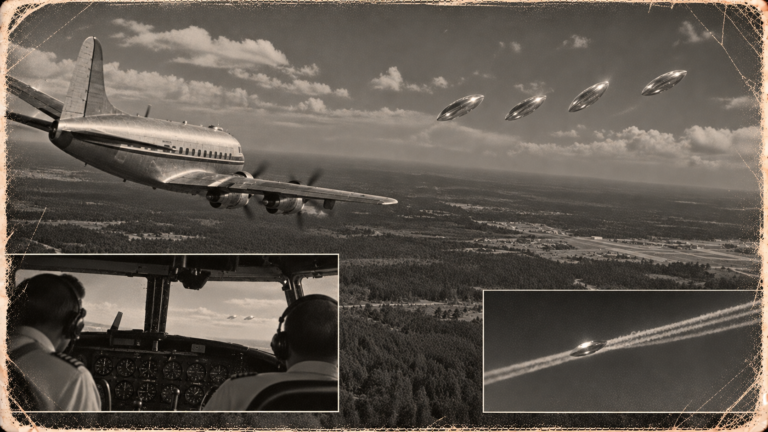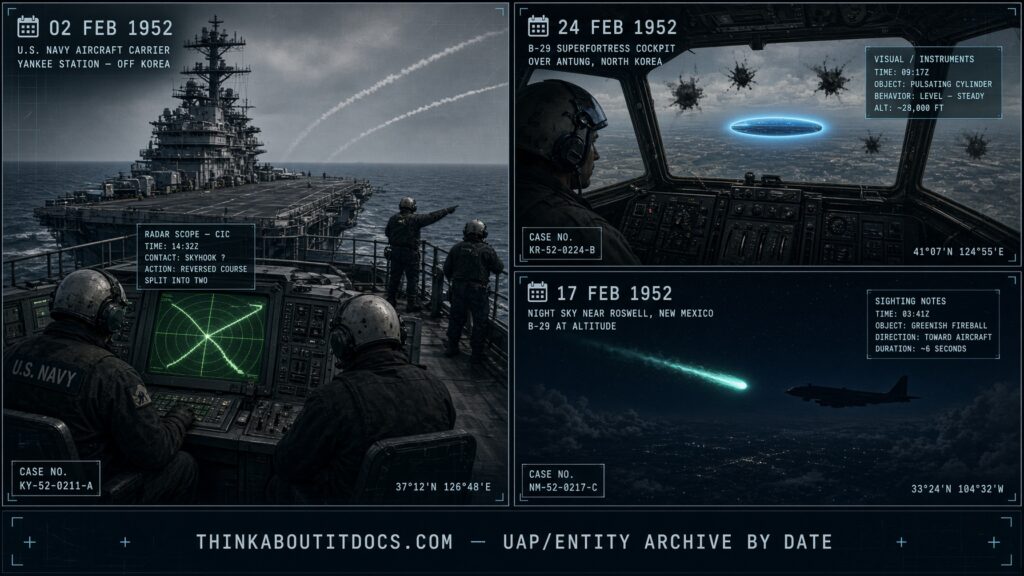
Three cases from February 1952, headlined by the USS Philippine Sea radar pursuit off the Korean coast.
1952: February UFO|UAP & Entity Sightings Archive
February 1952 is a dense, almost entirely military month, dominated by radar tracking cases across the Korean War theater and a dramatic carrier-based intercept in which a target reportedly accelerated from 600 to 1,800 mph while splitting into two separate radar returns. The month carries no entity encounters, but its sheer concentration of high-performance radar cases — several exceeding 4,000 mph — makes it one of the more consequential stretches in the lead-up to that summer’s Washington, D.C. UFO flap.
Date: February 1, 1952 (BBU)
Location: 10 miles west of Terre Haute, Indiana
Time: 9:30 p.m.
Summary: A military aircraft pilot saw a close group of moving lights changing color from blue to green to yellow.
Source: Project 1947; Blue Book files (attribution uncertain in the surviving record)
Date: February 2, 1952 (BBU)
Location: East of Pusan, South Korea
Time: 10:30 a.m. and 10:40 a.m.
Summary: Radar recorded an unidentified target at 767 mph; a second track ten minutes later, from position 35°30’N, 129°40’E, recorded a target at 1,257 mph.
Source: Jan Aldrich
Date: February 2, 1952 (BBU)
Location: East of South Korea, aboard USS Philippine Sea
Time: 7:35 p.m.
Summary: While the carrier held a southerly heading at 13 knots, radar picked up an approaching target from due north at 25 miles, which veered off in a wide left turn to the east — at which point visual observers spotted exhaust trails — then reversed course away from the ship, accelerating from roughly 600 mph to 1,800 mph at 52,000 feet altitude. The target then split into two separate returns, 5-12 miles apart, following a slightly zigzagging course due north until lost from radar at about 110 miles. Visual observers reported sighting three exhaust flames during the encounter.
Source: J. Allen Hynek, The UFO Report, pp. 126-128
Date: February 11, 1952 (BBU 1052)
Location: Pittsburgh, Pennsylvania
Time: 3:00 a.m.
Summary: USAF Capt. G. P. Arns and Maj. R. J. Gedson, flying a Beech AT-11 trainer, saw a yellow-orange, comet-shaped object pulsing flame for one to two seconds while flying straight and level.
Source: Berliner
Date: February 12, 1952 (BBU)
Location: Between Friendship Airfield and Baltimore, Maryland
Time: 9:30 p.m. and 10:00 p.m.
Summary: A USAF MATS C-47 pilot and copilot saw a bright, white object move slowly before speeding away; roughly a half hour later, they saw a similar object 10 miles south of Baltimore.
Source: Grudge/Blue Book report; FUFOR Index
Date: February 13, 1952 (BBU)
Location: Granite City, Illinois
Time: 10:30 p.m.
Summary: The 3903rd Radar Bomb Scoring Group observed an unusual radar return while attempting to score a bomb run, at first assuming the “target” was simply an aircraft pacing the bomber during its attack run; the target instead reached a speed of 1,090 mph.
Source: McDonald list; Blue Book Report 6
Date: February 16, 1952 (BBU)
Location: About 60 miles east of Pusan, Korea
Time: 2:40 p.m. and 3:50 p.m.
Summary: USMC GCI Squadron 3 at Yongil tracked an unidentified target at 4,320 knots (roughly 5,000 mph) on CPS-5 radar. A second track at 3:50 p.m., a few miles off the South Korean coast, showed a large target — radar-equivalent to 6-8 jet aircraft — traveling at 1,380 knots (roughly 1,600 mph) on a 170° heading, fading momentarily before continuing on a 120° heading until lost. A visual sighting of a contrail was reported in the direction of the radar track.
Source: Jan Aldrich; McDonald files; FUFOR Index; Dan Wilson
Date: February 17, 1952 (BBU)
Location: 25 miles southeast of Roswell, New Mexico
Time: 1:45 a.m. MST
Summary: A USAF B-29 crew saw a roughly three-foot, greenish-blue ball of fire flying straight toward them at 15,000 feet.
Source: Project 1947
Date: February 20, 1952
Location: Greenfield, Massachusetts
Time: Unknown
Summary: A Congregational minister saw three very bright, apparently spherical, silver objects traveling in a perfect V formation.
Source: Unknown
Date: February 20, 1952 (BBU)
Location: Mount Diablo, California
Time: 11:30 p.m.
Summary: USAF pilot Montgomery and the copilot of a B-25 bomber saw a bright yellow light on a collision course climb and accelerate.
Source: Project 1947; FUFOR Index
Date: February 24, 1952 (BBU 1061)
Location: Antung, North Korea
Time: 10:15 or 11:15 p.m.
Summary: A USAF 345th Bomber Squadron captain serving as B-29 navigator saw a bluish, cylindrical object roughly three times as long as it was wide, with a tail and rapid pulsations, come in high and fast, execute several turns, and level out beneath the B-29, which was at the time evading mild anti-aircraft fire.
Source: Berliner; FUFOR Index
Date: February 26, 1952
Location: New Albany, New York (CIRVIS report)
Time: Unknown
Summary: A UFO reported near an aircraft over New Albany was assessed at the time as probably a meteor.
Source: Unknown
Date: February 27, 1952 (BBU)
Location: Fort Stockton, Texas
Time: Unknown
Summary: A B-29 and ground radar were involved in an unidentified sighting; the original compiled record notes a date discrepancy suggesting this case may actually belong to March 26, 1952, which this archive has not yet reached — flagged here for cross-reference when that month is built.
Source: McDonald list; Blue Book Report 5
EXECUTIVE SUMMARY
A Radar-Dominated Month, Building Toward Summer
February 1952 offers no entity encounters and few visually dramatic accounts, but its concentration of high-speed radar cases — several independently tracking targets above 4,000 mph across Korea and the American Southwest — represents exactly the kind of accumulating institutional data that would culminate, five months later, in the well-known Washington, D.C. flap. The USS Philippine Sea case stands out as this month’s most fully documented single incident, appearing directly in J. Allen Hynek’s own published UFO report rather than a secondary compilation, and its target’s split into two separate radar returns mid-pursuit is a detail with few close parallels elsewhere in this archive.
Reversing course, the target accelerated from 600 to 1,800 mph at 52,000 feet, then split into two.
— Account of the February 2, 1952 USS Philippine Sea radar case, east of South Korea