Panama Canal Zone, November 25, 1952
THINK ABOUTIT UFO|UAP SIGHTINGS REPORT
1952: Panama Canal Zone, Five and a Half Hours on Radar
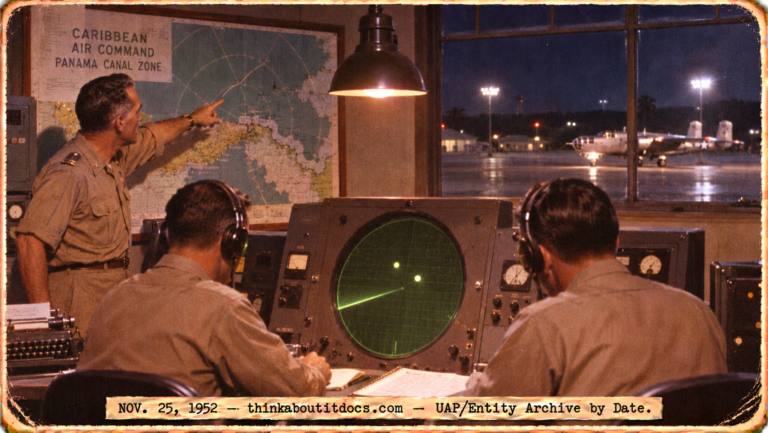
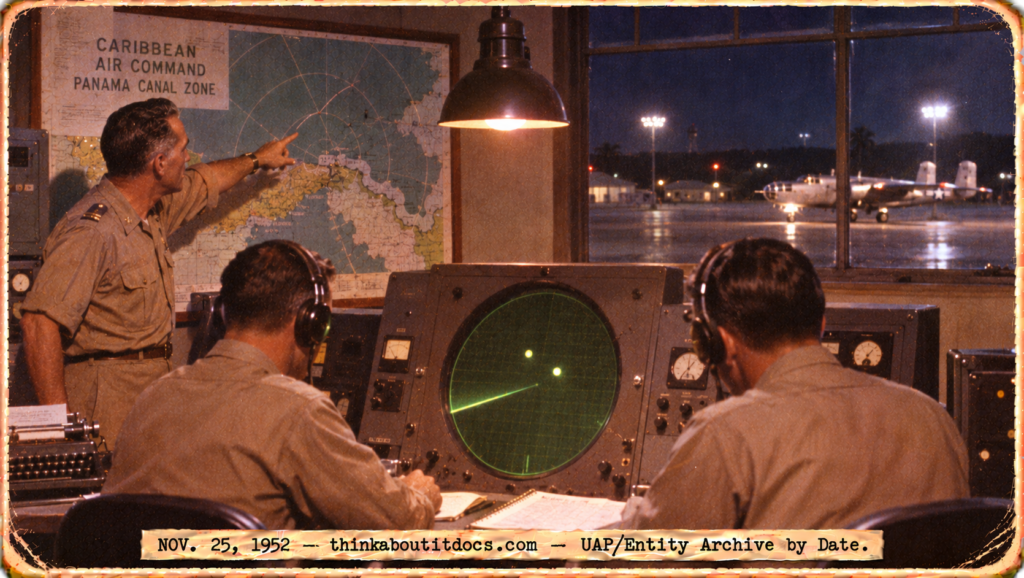
On the evening of November 25, 1952, gun-laying radar in the Panama Canal Zone picked up two objects at about 275 knots. The Caribbean Air Command went to a yellow alert, and over the next five and a half hours four U.S. aircraft were scrambled and made no contact.
Two visual sightings followed, both unconfirmed. The officer who prepared the report suggested radar calibration problems and communication delays may have sent the interceptors after each other, but said he knew of no object that could fly 275 knots for nearly six hours.
Date: November 25, 1952
Sighting Time: 6:06 p.m. to 11:47 p.m. (radar alert); an Air Force major’s visual at about 2339 local
Day/Night: Night
Location: Panama Canal Zone (Caribbean Air Command, Quarry Heights)
Urban or Rural: Military installations and canal area
No. of Entity(‘s): None reported
Entity Type: Not applicable
Entity Description: Not applicable
Hynek Classification: RV (Radar Visual), with the visual reports unconfirmed
Duration: About 5 hours 30 minutes
No. of Object(s): 2 (radar)
Shape of Object(s): Not described on radar; a visual report described an elongated yellow glow
Size of Object(s): Not recorded
Color of Object(s): Yellow glow (visual report)
Distance to Object(s): Not recorded
Height & Speed: About 1,000 to 28,000 feet; about 275 knots
Number of Witnesses: Radar operators and at least two visual reporters
Special Features/Characteristics: Yellow alert; four aircraft scrambled without contact; a fast elongated yellow glow at low altitude seen by an Air Force major at France Field; an Army anti-aircraft visual was identified as the interceptors
Case Status: Unexplained; the reporting officer raised radar calibration and communication delays
Source: NARA-PBB92-585; UFOE, VIII; Blue Book file (Caribbean Air Command cable)
Summary/Description: Gun-laying radar tracked two objects at about 275 knots over the Canal Zone for about five and a half hours on November 25, 1952, between 1,000 and 28,000 feet. Four aircraft were scrambled without contact. A visual report of a yellow glow was unconfirmed, and the preparing officer questioned the radar data.
Related Cases: Late-November radar cases on the November 16th–30th page
DETAILED REPORT
A Caribbean Air Command cable reported two objects on gun-laying radar over the Canal Zone at about 275 knots, at altitudes that ranged between roughly 1,000 and 28,000 feet. A yellow alert was declared.
Four U.S. aircraft were scrambled, among them two B-25s, a B-17 and a Navy PBM as read from the scan, and none made contact. Two visual sightings were reported but not confirmed. One, a high-speed elongated yellow glow at low altitude, was seen by an Air Force major at France Field at about 2339 local. An Army anti-aircraft source’s visual report was identified as the B-17 and the PBM.
The officer who prepared the report suggested that radar calibration and communication delays may have caused the interceptors to chase their own tail. He added that he knew of no object that could fly 275 knots and remain nearly six hours. The cable is partly garbled in the scan, so details are paraphrased here.
RESEARCHER’S NOTES
Panama 1952: A Radar Alert and the Aircraft That Found Nothing
- Units: The live listing gave 275 mph. The cable gives knots, about 316 mph.
- Aircraft count: The live listing said three bombers and a Navy plane. The file indicates four aircraft in total.
- The interceptor problem: The officer’s own suggestion, that the interceptors may have been tracking one another, is a real hazard in a crowded alert and may explain part of the pattern.
- What it leaves open: A target holding 275 knots for nearly six hours across a 27,000-foot altitude range does not match the cable’s own list of aircraft, and the officer says so.
The Panama Canal alert is a radar record with an honest internal debate: operators saw two targets, pilots saw nothing, and the author of the report could neither rule the radar out nor name an aircraft that fits.
“Radar contacts appeared firm, consistent, weather generally clear.”
— Caribbean Air Command cable, Panama Canal Zone, November 1952 (Blue Book file; OCR of a teletype)