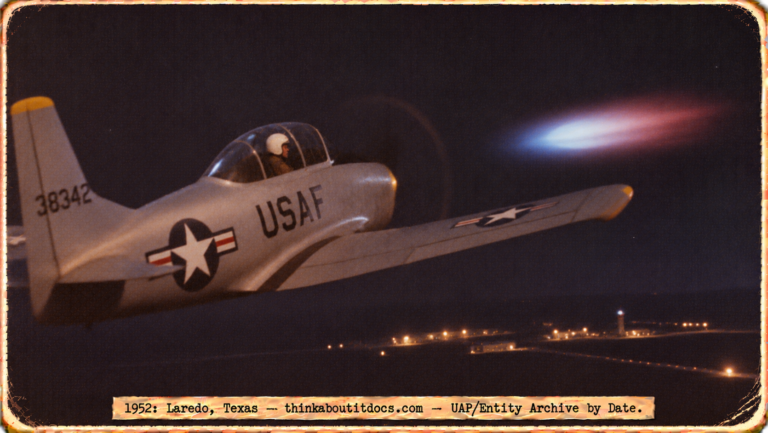
Laredo, Texas, December 4, 1952: Lt. Robert Arnold's near-collision.
THINK ABOUTIT UFO|UAP SIGHTINGS REPORT
1952: Laredo, Texas, Lt. Robert Arnold’s Collision-Course Encounter
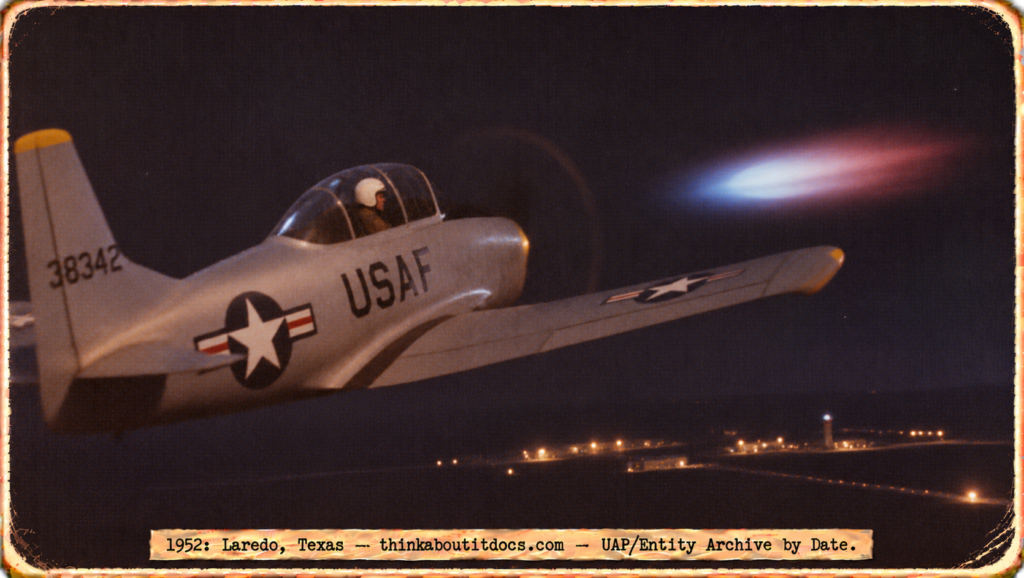
On the evening of December 4, 1952, USAF pilot Lt. Robert Arnold was flying a T-28 trainer near Laredo Air Force Base, Texas, when a glowing bluish-white object climbed out of nowhere to his own altitude, hovered, then turned and bore straight at his cockpit on a collision course. Arnold had no time to evade before the object crossed his wing in a blur. It remains one of the most immediate near-collision reports of the 1952 wave, filed item #1 on the official clearance list of sightings Air Force Press Desk officer Al Chop later released to Maj. Donald Keyhoe.
Date: December 4, 1952
Sighting Time: 8:46–8:53 p.m. (Chop Clearance List Item #1)
Day/Night: Night
Location: Over or near Laredo Air Force Base, Texas
Urban or Rural: Rural/airfield vicinity
No. of Entity(‘s): None
Entity Type: Not applicable
Entity Description: Not applicable
Hynek Classification: NL (Nocturnal Light) with a close-approach component; no entity or landing involved
Duration: About 7 minutes
No. of Object(s): 1
Description of the Object(s): A bright bluish-white glowing object, showing no navigation lights, that climbed rapidly, hovered, reversed course, and closed to a near-collision distance before crossing the aircraft’s wing as a blurred reddish-bluish haze
Shape of Object(s): Not resolved — seen only as a glowing light, too fast at closest approach to show a silhouette
Size of Object(s): Not recorded
Color of Object(s): Bright bluish-white; appeared reddish-bluish in the final high-speed pass
Distance to Object(s): Closed to an estimated 150 ft as it crossed Arnold’s left wing
Height & Speed: Arnold’s T-28 was at 6,000 ft; the object climbed from below him to 9,000 ft in seconds, then descended, hovered about 6 miles SE of the base, and crossed his wing at a speed too great for him to attempt evasive action
Number of Witnesses: 1 (Lt. Robert Arnold)
Special Features/Characteristics: No navigation lights; a rapid climb from below to match Arnold’s altitude; a stationary hover; a sudden turn onto a collision course with a visible wavering motion, as if choosing which side of the aircraft to pass; a near-miss crossing at an estimated 150 ft; Arnold cut his own running lights and dove to 1,500 ft, watching the object dive toward him again before it climbed out of sight
Case Status: Unexplained
Source: NARCAP; Air Force Press Desk Chop Clearance List, Item #1, released to Maj. Donald Keyhoe
Summary/Description: On December 4, 1952, Lt. Robert Arnold, flying a USAF T-28 trainer near Laredo AFB, Texas, watched a bright bluish-white object climb from below to his own 6,000 ft altitude, then climb further to 9,000 ft before descending to hover about 6 miles southeast of the base. When Arnold moved to track it, the object turned and accelerated directly at him on a collision course, crossing his left wing at an estimated 150 ft as a blurred haze, too fast for him to take evasive action. Shaken, Arnold cut his lights and dove to 1,500 ft, watching the object dive toward him again before it climbed away and vanished. The case was released as Item #1 on the official Air Force clearance list Al Chop gave Donald Keyhoe.
Related Cases: December 1952 archive | the Gulf of Mexico B-29 radar-visual case, December 6, 1952
DETAILED REPORT
Lt. Robert Arnold was flying a T-28 training aircraft at about 6,000 feet near Laredo Air Force Base on the evening of December 4, 1952, when he noticed a bright bluish-white light below him showing none of the red or green navigation lights any conventional aircraft would carry. The light climbed rapidly, closing the altitude gap to match his own, and Arnold banked to keep it in view. It continued to climb to an estimated 9,000 feet before reversing and descending back to his level, this time heading east, where it came to a stop and hovered roughly six miles southeast of the base.
When Arnold turned to pursue and get a closer look, the object reacted immediately: it turned toward his aircraft and accelerated on what Arnold described as a direct collision course, its path wavering slightly as though deciding which side of his T-28 to pass on. The closing speed left him no opportunity to maneuver. The object crossed his left wing at an estimated 150 feet, visible in that instant only as a blurred reddish-bluish haze — too fast to resolve into any shape or structure.
Rattled by how close the pass had been, Arnold switched off his own running lights and put the aircraft into a spiraling dive to about 1,500 feet, keeping the object in sight as best he could. It dove toward him a second time before pulling up sharply and climbing out of sight to the east. The whole encounter, from the first sighting to the object’s final departure, lasted about seven minutes.
The case entered the public record as Item #1 on a list of Air Force sightings that press desk officer Albert M. Chop released to Maj. Donald Keyhoe, part of a brief window in which the Air Force allowed a number of credible military reports to reach the public before tighter communications-security rules took hold. No radar confirmation is on record for the encounter, and Arnold remains its only witness.
RESEARCHER’S NOTES
A Near-Collision With No Second Witness
- Classification, why NL with a caveat: The object here is a nocturnal light by Hynek’s original definition — no shape or structure was ever resolved, day or night. But an ordinary NL case does not typically close to 150 feet on an apparent intercept course; the near-collision element is the reason this case has stayed in circulation for seven decades rather than being filed as a routine light sighting.
- Single witness, no corroboration: Arnold was alone in the aircraft, and no ground radar track or second aircraft sighting has been located for this encounter. The entire account rests on his own report, filed through official channels and preserved on the Chop clearance list rather than through a civilian or press source.
- The apparent intentionality of the maneuver: What makes this case stand out among the period’s many near-misses is the described behavior sequence — climb to match altitude, reverse, descend, hover, then turn and close on a collision course with a visible wavering motion. Whether that sequence reflects deliberate maneuvering, an optical/perceptual effect at high closing speed, or something else cannot be determined from a single witness account, and the archive does not resolve it either way.
- Institutional provenance: The case’s appearance as Item #1 on Chop’s clearance list gives it a documented chain of custody distinct from a press clipping or a later retelling: it was selected by Air Force personnel as a credible report worth releasing, at a moment when relatively few such sightings were being made public at all.
Lt. Robert Arnold’s account is a brief, visceral near-miss with no second witness and no instrument confirmation, but a documented place on the Air Force’s own released list of credible reports. It is preserved here as exactly that: a single pilot’s word, institutionally vetted enough to be released, resolved no further. It stands as Unexplained.
“The object suddenly turned toward him on a collision course at high speed, wavering as if choosing which side to pass, before crossing his left wing at roughly 150 feet as a blurred reddish-bluish haze.”
— NARCAP summary of Lt. Robert Arnold’s report, Laredo, Texas, December 4, 1952