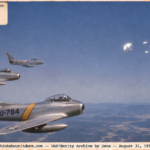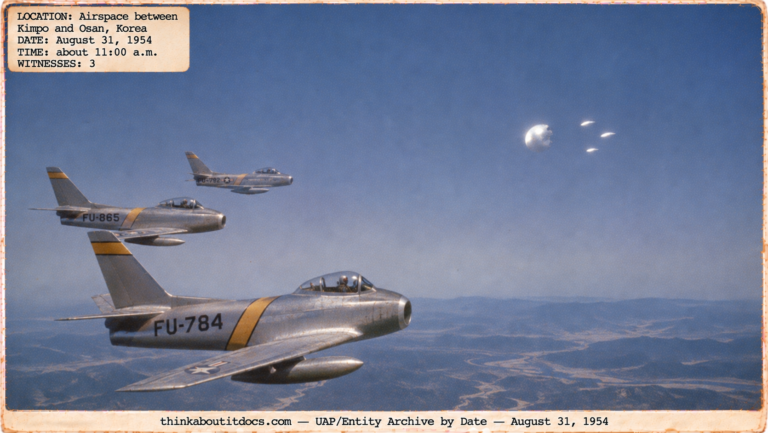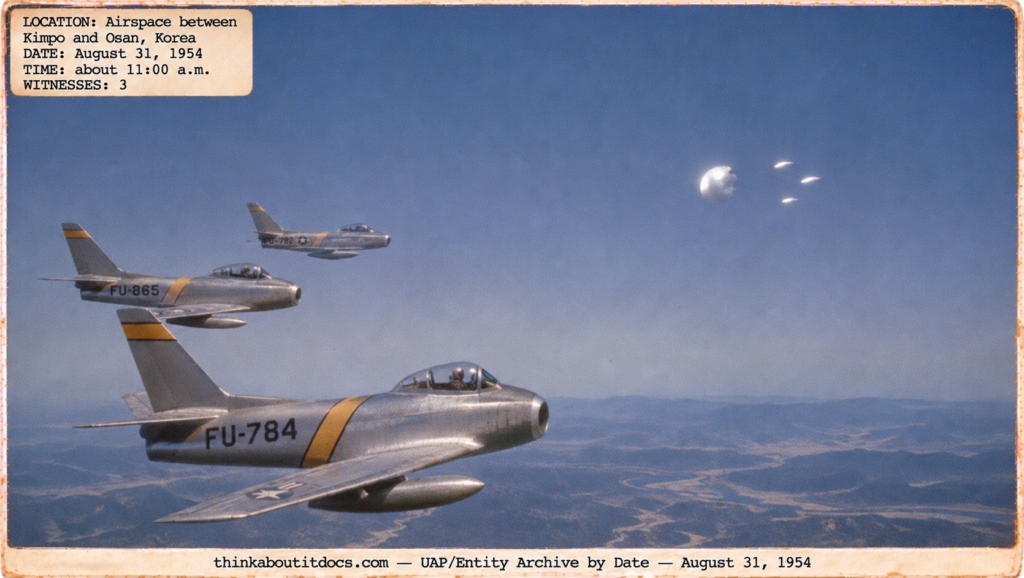
August 31, 1954: an F-86 flight watches a round object split in three over Korea.
THINK ABOUTIT UFO|UAP SIGHTINGS REPORT
1954: The Korea F-86 Flight — A Round Object That Split in Three
On the morning of August 31, 1954, three F-86 pilots of the Fourth Fighter Interceptor Group on a training flight from Kimpo toward Osan saw a large, round, shiny white object at about 70,000 ft. The flight orbited it at a five-mile radius for 20 minutes, and then, by the pilots’ account, it split into three. Blue Book concluded Probably Balloon, noting that only one of the three observers saw the split.
Date: August 31, 1954
Sighting Time: About 10:50-11:10 a.m. Korea time, zone uncertain (card: GMT 31/0150Z-0210Z)
Day/Night: Day
Location: Airspace between Kimpo (K-14) and Osan (K-55), Korea
Urban or Rural: Air (aerial sighting; not applicable)
No. of Entity(‘s): 0
Entity Type: Not Applicable
Entity Description: Not Applicable
Hynek Classification: DD (Daylight Disc)
Duration: 20-25 minutes
No. of Object(s): 1, reported as splitting into 3
Description of the Object(s): A large, round, shiny white object; about the size of a dime at arm’s length
Shape/Size/Color of Object(s): Round; about 30 ft across by the pilots’ triangulation; shiny white
Distance to Object(s): Flight orbited at a 5-mile radius
Height & Speed: About 70,000 ft by triangulation, with the F-86s at 42,000 ft; stationary for about 20 minutes, then two pieces climbed northwest at about 45 degrees and the third followed after about a minute and a half
Number of Witnesses: 3 (F-86 pilots of a Fourth Fighter Interceptor Group flight; a second flight saw only a bright illumination)
Special Features/Characteristics: Military air-visual; the object appeared to split in three; the GCI controller never got a fix and the position he gave was wrong; the K-14 weather station reported no balloons
Case Status: Probably explained: Blue Book concluded Probably Balloon
Source: Project Blue Book record card (Probably Balloon); Far East Air Forces teletypes JAPYC 32B and 45B, September 1954, forwarding report FGI 545-54
Summary/Description: Three F-86 pilots saw a large, round, shiny white object that held position about 20 minutes at an estimated 70,000 ft, then split into three. Blue Book concluded Probably Balloon.
Related Cases: None documented
Detailed Report
The Blue Book card records a military air-visual sighting at GMT 0150Z-0210Z on August 31, 1954, about 10:50-11:10 a.m. Korea time, of one to three objects on a northwest course, lasting 20-25 minutes. The conclusion box is Probably Balloon, with the comment: “Most likely balloon. Only one of 3 observers saw object split.”
The Far East Air Forces teletypes forward the Fourth Fighter Interceptor Group’s report. A flight of three F-86s, call sign “Shark,” was on a training mission from K-14 (Kimpo) toward K-55 (Osan) when the pilots saw a large, round, shiny white object. By triangulation they put it at about 70,000 ft, 30 ft across, while the aircraft flew at 42,000 ft; it appeared about the size of a dime at arm’s length. The flight orbited it at a five-mile radius while it stayed stationary for about 20 minutes.
The ground-control intercept controller, call sign “Badger,” never obtained a fix on the object, and the position he gave was wrong. The object then split into three: two climbed to the northwest at about 45 degrees, and the third followed after about a minute and a half. A second flight, “Bass,” saw only a bright illumination. The K-14 weather station reported no balloons in the area.
RESEARCHER’S NOTES
Korea — 1954 and an Object That Split Only for One Pilot
- The card’s reasoning: Blue Book’s comment turns on the fact that only one of the three observers saw the object split. The file does not say which pilot it was or whether the other two were interviewed
- The weather station: The K-14 weather station reported no balloons, which the file records without discussing. A high-altitude balloon release from another site is not ruled out by that report alone
- Estimates by triangulation: The 70,000 ft and 30 ft figures come from the pilots’ own triangulation from orbiting an object at a five-mile radius; the radar controller never got a fix to check them
- Case-file legibility: The case-file pages behind the teletypes are too dark to read, so no pilot names are used here and details beyond the card and teletypes are not included
The Korea case is a good example of a vivid pilot account that Blue Book reduced to Probably Balloon on the strength of one observation: only one pilot saw the split. The record leaves the weather-station report and the missing radar fix as open points.
“Most likely balloon. Only one of 3 observers saw object split.”
— Project Blue Book record card, Korea, August 31, 1954