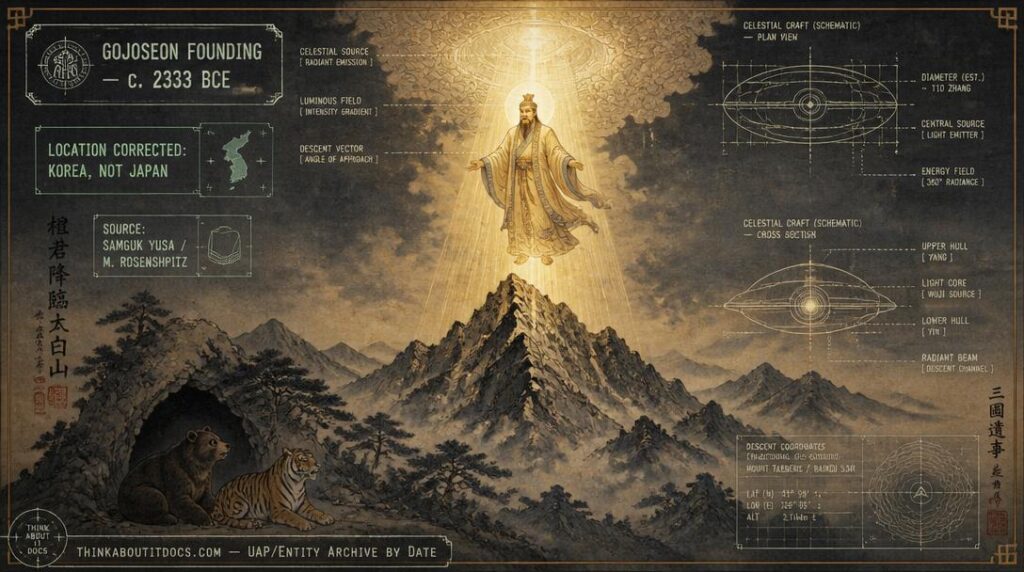
Dual-interpretation dossier illustration of Hwanung's descent to Mount Taebaek, combining traditional Korean mythological imagery with an ancient-astronaut reinterpretation.
THINK ABOUTIT UFO|UAP|ENTITY ENCOUNTER REPORT
Ancient Astronaut Reading of the Dangun Myth | Corrected Location: Korea
This entry describes Korea’s national founding myth — the story of Dangun Wanggeom, legendary founder of Gojoseon, Korea’s first kingdom, traditionally dated to 2333 BCE and recorded in the 13th-century Korean chronicle Samguk Yusa. The “divine man” who descends from the sky is Hwanung, son of the Lord of Heaven; his country, garbled here as “Peson,” is Joseon; “Tan-kun” is Dangun himself, whose name is traditionally translated “Sandalwood Ruler” or “Sandalwood King,” not “Sandalwood God.” This is one of the most culturally significant origin stories in Korean history, still marked today as National Foundation Day.

The source cited here, Mikhail Rosenshpitz’s “Space Visitors in Ancient Japan,” reinterprets Hwanung’s mythological descent as an extraterrestrial landing — the “monster that was emitting light” recast as a spacecraft. That reading is presented below fully and attributed clearly to Rosenshpitz. It is not adopted as fact, and it does not change what the underlying story actually is, where it comes from, or which country’s history it belongs to.
Date: 2357–2258 BCE, as given; the traditional founding date of Gojoseon in Korean historiography is 2333 BCE, which falls within this range
Sighting Time: Not applicable
Day/Night: Not specified in the source material
Location: Corrected from “Japan.” This is Korea’s founding myth: the descent of Hwanung to Mount Taebaek (later identified with Baekdu Mountain) and the founding of Gojoseon, with its legendary capital at Asadal, possibly near modern Pyongyang, on the Korean Peninsula.
Urban or Rural: Rural, consistent with a mountain/wilderness setting in the traditional account (Mount Taebaek/Baekdu)
No. of Entity(‘s): 1 (the “divine man”), corresponding to Hwanung in the source myth
Entity Type: In this page’s cited source (Rosenshpitz), implied to be an extraterrestrial visitor; in the underlying Korean myth, Hwanung is a heavenly/divine figure, son of Hwanin (the Lord of Heaven), central to Korean creation and founding tradition
Entity Description: Described in the source only as a “divine man” who descended from the sky and came to be called “the master”; in the traditional myth, Hwanung descended to Mount Taebaek accompanied by 3,000 followers and governed 360 areas of human affairs before his son Dangun founded Gojoseon
Hynek Classification: Listed as CE-I; as with other reinterpreted mythological texts in this archive, standard Hynek categories do not meaningfully apply to a foundational origin myth rather than a witnessed sighting. See Researcher’s Notes.
Duration: Not applicable
No. of Object(s): 1, per the source’s own framing (“a monster that was emitting light”)
Shape of Object(s): Described in the source only as “a monster that was emitting light,” used by the divine man to descend; reinterpreted by Rosenshpitz as a spacecraft. No shape or structural description survives beyond this phrase.
Size of Object(s): Not given
Color of Object(s): Described only as “emitting light”; no further color detail given
Distance to Object(s): Not given
Number of Witnesses: Not applicable — this is a foundational national origin myth, not an account with named individual observers
Special Features/Characteristics: The “divine man” was given the name Tan-kun (Dangun), traditionally translated “Sandalwood Ruler,” and his people/country is named in this source as “Peson,” almost certainly a garbled rendering of Joseon (Gojoseon), the kingdom Dangun is credited with founding. The people are said to have called him “the master.” The date range given (2357–2258 BCE) closely brackets the traditional Korean founding date of 2333 BCE. This entry could not confirm the exact identity of the cited chronicle name “Sey-to-ki”; the underlying myth is most authoritatively preserved in the 13th-century Korean text Samguk Yusa, with an additional early account in Jewang Ungi.
Case Status: Not applicable in the sense used elsewhere in this archive; see Researcher’s Notes
Source: Mikhail Rosenshpitz, “Space Visitors in Ancient Japan” [sic — see Researcher’s Notes], in “Unbelievable World” #8; underlying myth cross-referenced against the Korean chronicle Samguk Yusa (13th century) and Jewang Ungi
Summary/Description: According to Rosenshpitz’s account, drawing on an ancient manuscript, a “divine man” descended from the sky using “a monster that was emitting light,” was called “the master” by the people, received the name Tan-kun (“Sandalwood Ruler”), and founded a country called “Peson.” This is a garbled but recognizable retelling of the Korean Dangun myth — the founding of Gojoseon by Dangun, son of the heavenly figure Hwanung — misattributed in this source to Japan rather than Korea.
Related Cases: This archive’s Ezekiel’s Wheel entry is a comparable case of a modern ancient-astronaut reinterpretation applied to a foundational religious or mythological text. Not separately indexed here.
Detailed Report
The source cited for this page, Mikhail Rosenshpitz’s “Space Visitors in Ancient Japan,” describes a “divine man” who descended from the sky using “a monster that was emitting light,” during the reign of an “Emperor Ton-Yo,” in a year given as “Mon-Sham.” The people called him “the master,” and he came to be known as Tan-kun, or “Sandalwood God,” ruling over a country called “Peson.” The account is attributed to a narrator called “Tau-se,” drawing on an ancient manuscript referred to as “Sey-to-ki.”
Stripped of its garbled transliteration, this is a recognizable, if heavily distorted, retelling of Korea’s founding myth. The “divine man” corresponds to Hwanung, son of Hwanin, the Lord of Heaven, who in the traditional account descends to Mount Taebaek (later identified with Baekdu Mountain) accompanied by 3,000 followers, establishes a divine settlement, and governs 360 areas of human affairs — agriculture, justice, health, and weather among them. Hwanung later takes human form and marries Ungnyeo, a bear transformed into a woman through a trial of endurance; their son is Dangun Wanggeom, whose name combines dan (“sandalwood”) and gun (“ruler”), making “Sandalwood Ruler” or “Sandalwood King” the standard translation — not “Sandalwood God,” as this source renders it. Dangun is credited with founding Gojoseon, Korea’s first kingdom, traditionally dated to 2333 BCE, a date that falls squarely within the 2357–2258 BCE range given on this page. “Peson,” this source’s name for Dangun’s country, is almost certainly a garbled rendering of Joseon (or Gojoseon).
The myth’s oldest surviving written source is the Samguk Yusa, compiled in the 13th century by the Buddhist monk Il-yeon, with an early parallel account also appearing in the chronicle Jewang Ungi. This entry was unable to confirm what specific text Rosenshpitz’s cited “Sey-to-ki” refers to; it may be a further-garbled rendering of one of these titles, or a different secondary source entirely.
None of this diminishes the fact that the Dangun myth is a real, historically significant, and still-celebrated part of Korean national identity — not an obscure or invented tale. Gojoseon’s traditional 2333 BCE founding date was used as the basis of an official calendar era in Korea during the early 20th century and again from 1948 to 1961, and Dangun’s traditional birthday, October 3rd, remains a national holiday in South Korea (Gaecheonjeol, National Foundation Day) to this day. During the period of Japanese colonial rule over Korea (1910–1945), Dangun veneration also took on added significance for some Koreans as a symbol of national identity and eventual liberation — a historical irony worth naming, given that this source misattributes the myth to Japan rather than Korea.
Rosenshpitz’s own contribution is the ancient-astronaut reframing: presenting Hwanung’s mythological descent as the arrival of an extraterrestrial visitor in a light-emitting craft, rather than a theophany or symbolic account of divine kingship. That reading is presented here as his own interpretation, clearly attributed, and not adopted as this archive’s own conclusion.
RESEARCHER’S NOTES
A Korean Founding Myth Misfiled as Japanese
- Location Correction — This Is Korea, Not Japan: Every identifiable proper noun in this account maps onto the Korean Dangun/Gojoseon founding myth: “Tan-kun” is Dangun; “Peson” is Joseon/Gojoseon; the “divine man” is Hwanung; the traditional 2333 BCE founding date falls within the 2357–2258 BCE range given here. There is no comparable Japanese myth this account plausibly describes. This entry corrects the location from Japan to ancient Korea.
- A Mistranslation Worth Correcting: Dangun’s name is standardly translated “Sandalwood Ruler” or “Sandalwood King” (combining dan, “sandalwood,” and gun, “ruler”), not “Sandalwood God” as rendered in this source. This is a minor but meaningful distinction, since the myth itself distinguishes Dangun (a human ruler of divine descent) from Hwanung and Hwanin (the actual divine/heavenly figures in the story).
- Not a Standard Sighting Report: As with this archive’s Ezekiel’s Wheel entry, this page describes a foundational origin myth, not a witnessed, datable sighting. Hynek’s classification system and this archive’s usual evidentiary standards do not meaningfully apply, and the structured fields above are completed only where the source material allows.
- Unverified Chronicle Name: This entry could not confirm what specific text “Sey-to-ki” refers to. The Dangun myth’s most authoritative early source is the 13th-century Samguk Yusa, with an additional early account in Jewang Ungi; “Sey-to-ki” may be a garbled rendering of one of these, or of a different source entirely.
- Cultural Significance, Independent of Any UFO Reading: The Dangun myth is a genuinely significant part of Korean national identity, historically used as the basis of an official calendar era and still marked today as National Foundation Day. This significance exists entirely independent of, and long predates, any ancient-astronaut reinterpretation, and should not be reduced to or obscured by that framing.
- Case Status Rationale: As with other reinterpreted mythological entries in this archive, no independent, non-textual evidence exists to evaluate, and the underlying text is a work of national foundational literature with its own established meaning and interpretive tradition. “Case Status” as applied elsewhere in this archive does not meaningfully apply here.
Whatever one makes of Rosenshpitz’s spacecraft reading, the story underneath it belongs to Korea, not Japan, and it deserves to be labeled correctly regardless of how it’s interpreted. This entry corrects that misattribution, gives the ancient-astronaut reading its due as one writer’s specific claim, and gives equal or greater weight to the fact that this is, on its own terms, one of the oldest and most significant founding stories in East Asian history.
“A monster that was emitting light.”