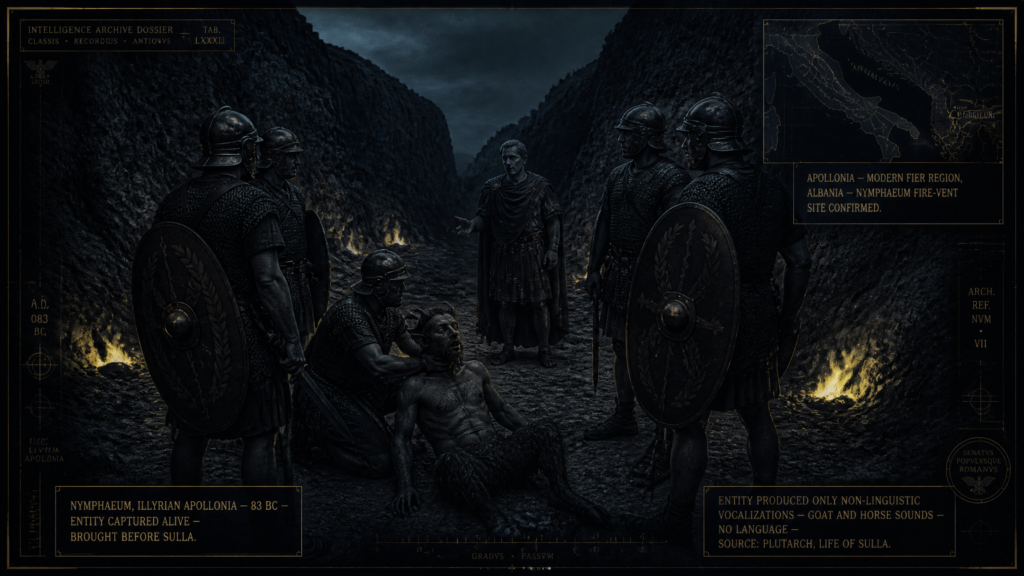
83 BC, Illyrian Apollonia: Sulla's soldiers captured it in the valley of fire-rivers. He questioned it directly. It produced only the sounds of a goat and a horse. Plutarch recorded it. The record holds it open.
THINK ABOUTIT UFO | UAP | ENTITY ENCOUNTER REPORT
83 BC: Roman General Syllas see’s a satyr near Illyrian Apollonia Greece
In 83 BC, the Roman general Lucius Cornelius Sulla was marching his army through Illyrian territory near Apollonia — a Greek colonial city on the Adriatic coast of what is now Albania — when his soldiers captured something in the sacred precinct of the Nymphaeum, a valley of fire-rivers and steep terrain near the city. They brought it to Sulla. He interrogated it. It could not speak in any language — it produced only sounds that the account compares to the cries of a goat and a horse. It looked like a satyr: the form from Greek mythology that was half-man, half-animal, depicted in every painting and statue of the period. What Sulla’s soldiers had captured did not match any known animal of the Mediterranean world. Plutarch recorded the event without apparent skepticism, placing it among the omens and prodigies that preceded Sulla’s march on Rome — and in the context of the Roman prodigy record, that placement is significant. The Nymphaeum at Apollonia was a known site of unusual geophysical activity, with natural gas vents producing fires from the ground. Whatever was encountered there, in that specific anomalous landscape, was considered remarkable enough for the most detailed biographer of the Roman Republic to include it by name.
Date: 83 BC
Sighting Time: Unspecified
Day/Night: Day
Location: Near Apollonia, Illyrian territory — modern Fier region, Albania
Urban or Rural: Rural — sacred precinct, geophysically anomalous terrain
No. of Entity(‘s): 1
Entity Type: Satyr — non-human entity, retained as high strangeness, possible unknown origin
Entity Description: Semi-humanoid classical satyr morphology; produced only non-linguistic vocalizations resembling goat and horse sounds when questioned; could not or would not communicate verbally
Hynek Classification: CE-III (Close Encounter III) — close observation of animate non-human being
Duration: Extended — capture, transport to camp, and direct interrogation by Sulla
No. of Object(s): None
Description of the Object(s): N/A
Shape of Object(s): N/A
Size of Object(s): Not specified
Color of Object(s): Not specified
Distance to Object(s): N/A — entity captured and brought directly before witness
Height & Speed: N/A
Number of Witnesses: Multiple — Sulla’s army; Sulla as primary interrogating witness
Special Features/Characteristics: Captured alive near Nymphaeum fire-vent terrain; non-verbal only; Sulla interpreted as omen
Case Status: Insufficient Data
Source: Plutarch, Life of Sulla
Related Cases: 163 BC — Formice, Italy, entity encounter with radiation effects (Sparks) | 216 BC — Cannae, Italy, figures in white robes at edges of aerial objects | 1914 — Farmersville, Texas, stationary non-reactive entity in fencerow | 1967 — Lake Worth, Texas, satyr-like creature at Mosque Point
DETAILED REPORT
The account comes from Plutarch’s Life of Sulla, written in the late 1st to early 2nd century AD but drawing on sources contemporary with Sulla’s campaigns. Plutarch was writing biography, not natural history, and he included this encounter as one of the prodigies and omens surrounding Sulla’s return from Greece to march on Rome — a politically explosive moment. In that narrative context, the satyr encounter functions as a sign of the extraordinary times. But Plutarch’s treatment is notable for what it does not do: it does not explain the entity away, does not identify it as a known animal, and does not mark it as mythological embellishment. It describes capture, transport, interrogation, and the sounds the creature made. These are the structural elements of a report, not a literary device.
The geographic context is specific and verifiable. Apollonia was a major Greek colonial city on the Illyrian coast, near the mouth of the Aous River in modern Albania. Sulla was at Apollonia in 87–86 BC during his Greek campaign against Mithridates, and the city was the site of his winter quarters and a center of Roman-Greek intellectual contact — Apollonia later became the city where the young Augustus studied. The Nymphaeum mentioned in the account is also a documented site: a sanctuary associated with the nymphs, characterized by natural hydrocarbon seeps producing flames from the ground — what ancient writers called rivers of fire. This is a real geophysical feature of the Albanian coastal terrain. The combination of anomalous natural phenomena and the capture of an unidentified entity at the same location is a pattern seen in other pre-modern encounter reports.
The entity’s inability to produce language is the most analytically significant detail. Sulla was one of the most powerful Romans of his generation, capable of commanding armies and terrifying subordinates. Whatever was brought before him produced only animal sounds when directly questioned. The account does not say it was afraid, or injured, or that it resisted — only that it could not or would not speak. In the context of the Roman prodigy record, where entities associated with aerial or anomalous phenomena are sometimes described as figures in white robes who appear and vanish, the Apollonia satyr occupies a different category: physically captured, physically present, physically examined, and physically anomalous. It is one of the very few pre-modern entity encounters in the record where the non-human being was held in Roman custody and directly interrogated by a named historical figure.
The classification on the existing page is CE-V, which requires voluntary bilateral contact initiated by the entities. That classification does not fit this account — the entity was captured, not cooperative. CE-III, which covers close observation of animate beings associated with anomalous phenomena, is the correct classification for a captured non-human entity brought before a witness. The absence of an associated craft means some researchers would classify this as a straight cryptid encounter rather than a UAP-associated entity event. Per archive standards, cryptids are retained as high strangeness with possible alien or unknown origin noted, and this case is held here on that basis — Plutarch placed it in the prodigy record, and the prodigy record is the ancient world’s closest equivalent to an anomaly report.
RESEARCHER’S NOTES
The Satyr at Apollonia — Illyrian Coast, 83 BC, and the Problem of the Named Witness
Plutarch’s account is brief, specific, and placed without apology in the biography of one of Rome’s most documented historical figures. The combination of a named primary witness, a verifiable location, a geophysically anomalous setting, and a physical examination of the entity gives this case a structural credibility rare in the pre-modern record — and a classification problem that has not been cleanly resolved.
- Source Chain Assessment: The primary source is Plutarch’s Life of Sulla, a text that has survived intact through multiple manuscript traditions and is among the best-preserved of the Parallel Lives. The original page source URL is dead, but the Plutarch citation is independently verifiable in any standard edition. Plutarch was writing approximately 150 years after the event, drawing on earlier biographies and Roman historical records. He names Sulla as the interrogating witness, names the location as the Nymphaeum near Apollonia, and names the vocalizations. This is more sourcing specificity than most ancient entity accounts carry. Source chain assessment: VERIFIED for Plutarch’s text; the gap is the 150-year transmission delay between event and author.
- Classification Issues and Corrections: The CE-V classification on the existing page is incorrect for this encounter. CE-V requires voluntary bilateral contact — the entity here did not initiate contact, communicate, or cooperate; it was captured by soldiers and brought to Sulla under duress. CE-III applies: close observation of an animate non-human being in an encounter context. The absence of a craft means this case sits at the boundary between entity encounter and cryptid report. Per archive standards, cryptids are retained as high strangeness with possible alien or unknown origin noted. Given Plutarch’s placement of the account within the prodigy tradition — the same literary and institutional framework that produced the clypeus shield-sighting records — the high strangeness classification is appropriate. Recommend correcting CE-V to CE-III on the live page.
- Geographic and Geophysical Context: The Nymphaeum at Apollonia is a documented site of natural hydrocarbon seepage producing ground-level flames — described in the ancient sources as rivers of fire. This is a real geological phenomenon of the Albanian Adriatic coast and has been confirmed in modern surveys. The association of anomalous entity encounters with geophysically active terrain is a recurring pattern in the pre-modern record: the 1913 Killary Harbor encounter occurred in an Atlantic fjord with unusual water conditions; the 1914 Farmersville entity stood motionless in flatland terrain with no visible shelter. Whether the Nymphaeum’s fire-terrain was causally associated with the entity’s presence cannot be determined, but its specificity in Plutarch’s account suggests the location was considered meaningful to the original reporters.
- Pattern Context — The Non-Communicating Entity: The entity’s failure to produce language under direct interrogation by Sulla is analytically notable. The Roman encounter record includes multiple accounts of figures in white robes associated with aerial structures who appear and vanish without communication. The Apollonia satyr is at the other end of that spectrum: physically captured, physically present, and physically examined — but equally unable or unwilling to communicate. The vocalization description — goat-like and horse-like sounds — is consistent with what modern entity encounter literature would categorize as non-linguistic communication or simply as the absence of any shared linguistic framework. That a Roman general in 83 BC experienced the same communicative barrier with a non-human entity that modern abduction researchers have documented in the 20th century is one of the more quietly remarkable consistencies in the long record.
The Apollonia satyr encounter is a case that sits exactly at the edge of what the archive can confidently hold. Plutarch’s source is real, the location is verifiable, the witness is one of the most documented figures in Roman history, and the entity was physically examined. What cannot be determined — and what the archive does not attempt to determine — is whether the creature Sulla’s soldiers brought out of the Nymphaeum was an unknown animal, a non-human intelligence of uncertain origin, or something the Roman world’s existing vocabulary for the anomalous simply lacked the framework to describe. What is recorded is this: near a valley of fire-rivers on the Illyrian coast, something was captured that looked like the creatures in the paintings and the statues, and when the most powerful Roman in Greece questioned it directly, it said nothing that could be understood. The record holds it there.