The Roman prodigy record — three centuries of state-verified sky phenomena, 328 BC to 0 BC
328 BC – 0 BC:
UFO|UAP & Entity Sightings Archive
The three centuries between 328 BC and the turn of the common era produced the most systematically documented aerial anomaly record in the ancient world — and it came from Rome. The Roman Republic’s administrative machinery required that unusual events be formally reported to the Pontifex Maximus, recorded in the Annales Maximi, and entered into the official prodigy register. This institutional process gave the Roman UAP record a structural credibility that most ancient accounts lack: these were not private observations or mythological embellishments but official state records, subject to verification procedures before being inscribed. The primary sources for this archive — Titus Livy’s Ab Urbe Condita, Pliny the Elder’s Natural History, Julius Obsequens’s Liber Prodigiorum, Cassius Dio’s Roman History, and Plutarch’s Lives — are among the most cited texts in classical scholarship, and they return, repeatedly and across more than two centuries, to the same classes of object: circular shields spitting fire, globes of golden or molten silver descending and ascending, formations of ships seen in the sky above battlefields, fiery torches crossing the sky, and figures of men in white robes associated with aerial structures. The consistency of terminology across independent authors writing in different centuries is one of the most analytically significant features of this record.
The period covered here spans the height of the Punic Wars through the fall of the Roman Republic and into the early Imperial era, with parallel entries from China and Japan that demonstrate the phenomenon was not confined to the Mediterranean world. The most concentrated cluster falls during the Second Punic War — 218 BC through 204 BC — when Roman armies were under maximum stress and the prodigy recording apparatus was functioning at peak capacity. The 216 BC entry from Apulia at the Battle of Cannae describes objects described as ships in the sky with figures in white robes visible at their edges — one of the earliest mass-witness aerial anomaly accounts in the ancient record, observed by forces on both sides of the largest defeat in Roman military history. The same war produced the archive’s one confirmed physical “object from the sky” case not tied to a prodigy omen: the Cybele stone, a meteorite formally imported from Pessinus to Rome in 205–204 BC on the Sibylline Books’ authority that it would drive Hannibal from Italy. The 74 BC entry from Asia Minor, where a wine-jar-shaped object of molten silver descended between two armies and halted their engagement, carries the same tactical-disruption signature seen in the 329 BC Alexander accounts. And the 163 BC entry from Formice — the only case in this archive attributed by Brad Sparks to an alien abduction with radiation effects — pushes entity-contact documentation in the Roman record further back than is commonly recognized. This page is the densest concentration of verified ancient-source UAP accounts in the archive.
Date: 223 BC
Location: Rome
Summary: At Ariminum a bright light like the day blazed out at night; in many portions of Italy three moons became visible in the night time.
Source: Dio Cassius, Roman History, Book I | Source Status: VERIFIED
Date: 222 BC
Location: Rome
Summary: “Also three moons have appeared at once, for instance, in the consulship of Gnaeus Domitius and Gaius Fannius.”
Source: Pliny, Natural History, Book II, Ch. 32 | Source Status: VERIFIED
Date: 218 BC
Location: Rome, Praeneste, Italy
Summary: Glowing lamps were seen in the sky at Praeneste, a shield was observed at Arpi and in the Amiterno district, the sky was all on fire, and men in white garments appear.
Source: Flying Saucers Magazine
Date: 217 BC
Location: Faleri, Italy
Summary: “At Faleri the sky had seemed to be rent as it were with a great fissure and through the opening a bright light had shone.”
Source: Livy, History, Book XXII, Ch. 1 | Source Status: VERIFIED
Date: August 6, 216 BC
Location: 180 Roman miles east of Rome, in Apulia
Time: Night
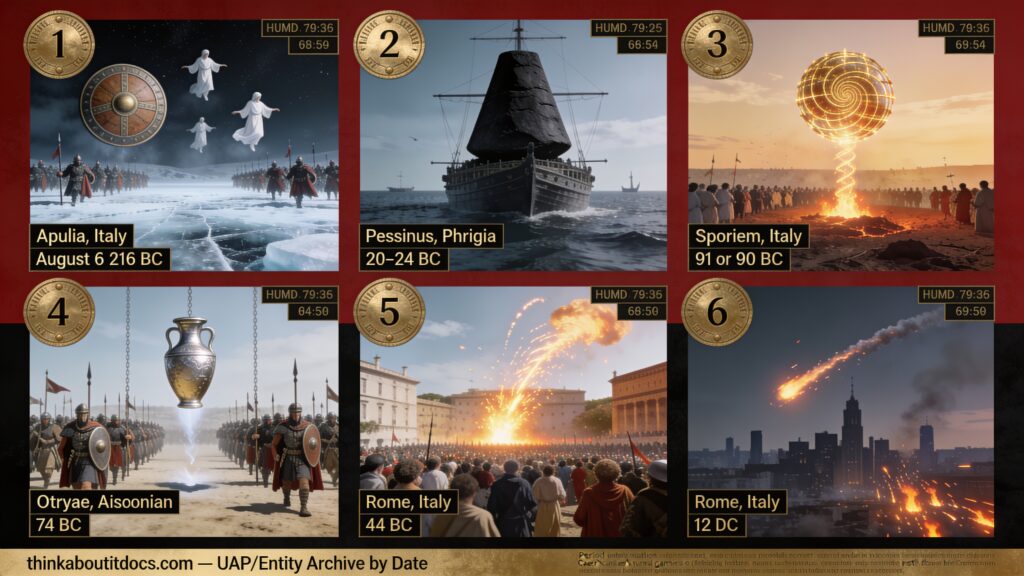
Summary: Things like ships were seen in the sky over Italy. At Arpi a round shield was seen in the sky; at Capua, the sky was all on fire, and figures like ships were reported. During the battle at Cannae (2 August, 216 BC), in the Apulian plain near Barletta — the largest defeat in the history of Rome — round objects in the shape of ships were seen in the sky over Apulia. The prodigies carried on all night. On the edge of such objects were seen men dressed in white, like clergymen around a plow.
Source: Harold T. Wilkins, Flying Saucers on the Attack, pp. 164–69; Cielo e Terra, August 1967
Date: June 213 or 214 BC
Location: Hadria, Italy
Summary: “At Hadria an altar (fiery bridge) was seen in the sky and about it the forms of men in white clothes.”
Source: Julii Obsequentis Prodigiorum Liber… per Conradum Lycosthenem Rubeaquensem integrati suae restitutus (Basel, 1552) | Source Status: VERIFIED
Date: 212 BC
Location: Reate, Italy
Time: Unknown
Summary: At Reate a huge stone was seen flying through the air. Falls within the Second Punic War cluster on this page and fits the prodigy-record pattern exactly.
Source: Julius Obsequens, Liber Prodigiorum (cited in Stothers 2007 scholarly analysis) | Source Status: VERIFIED
Date: 205–204 BC
Location: Pessinus, Phrygia (transported to Rome, Italy)
Time: Not recorded
Summary: At the height of the Second Punic War, with meteor showers already being read as omens against Hannibal, the Roman Senate consulted the Sibylline Books, which declared that the “Idaean Mother” — the goddess Cybele — must be brought to Rome for the enemy to be driven from Italy. A black, conical, unworked stone venerated at Cybele’s sanctuary at Pessinus and said to have fallen from the sky was formally requested from King Attalus I of Pergamon and transported to Rome in 205–204 BC, where it was installed first in the Temple of Victory and later in a dedicated Temple of Magna Mater on the Palatine. Modern analysis identifies the object as almost certainly a meteorite. Unlike the archive’s other Roman entries, this is not a prodigy-register sighting but a physical object — venerated, transported, and still referenced in Roman sources into the first century CE.
Source: Livy, Ab Urbe Condita; Herodian, Roman History 1.11.1; Alistair McBeath and Andrei Dorian Gheorghe, “Meteor Beliefs Project: Meteorite Worship in the Ancient Greek and Roman Worlds,” WGN, Journal of the International Meteor Organization, 33.5 (2005): 135–144 | Source Status: VERIFIED
Date: 204 BC
Location: Setia, Italy
Summary: Two suns were seen, and a fiery torch was observed stretching from east toward west, illuminating the night.
Source: Lycosthenes (Conrad Wulffhart), Prodigiorum ac ostentorum chronicon, p. 130, 1557
Date: 186 BC
Location: Italian Peninsula, Italy
Summary: Celestial fires described as having singed garments were reported to have arisen from multiple locations.
Source: Titus Livius, Ab Urbe Condita, Book XXXIX, 22 | Source Status: VERIFIED
Date: 170 or 173 BC
Location: Lanuvium, Italy
Summary: With war against Macedonia expected, portents were formally expiated and prayers offered for the peace of the gods per the Books of Fate. At Lanuvium, the sight of a great fleet was witnessed in the heavens; several objects the size of a star were observed on a road for two minutes.
Source: The History of Rome, Vol. III, Livy, trans. Rev. Canon Roberts (Kessinger Publishing, 2004), p. 72 | Source Status: VERIFIED
Date: 163 BC
Location: Concise, Italy
Summary: A reported encounter with inhuman beings involving radiation effects. An abduction by aliens resulting in physical harm was reported.
Source: Brad Sparks
Date: 163 BC
Location: Formice, Italy
Summary: “In the consulship of Tiberius Gracchus and Manius Juventus at Capua the sun was seen by night. At Formice two suns were seen by day. The sky was afire. In Cephallenia a trumpet seemed to sound from the sky. There was a rain of earth. A windstorm demolished houses and laid crops flat in the field. By night an apparent sun shone at Pisaurum.”
Source: Obsequens, Prodigiorum, Ch. 114 | Source Status: VERIFIED
Date: 154 BC
Location: Compsa, Italy
Time: Unknown
Summary: Weapons — specifically defensive shields — appeared flying in the sky at Compsa.
Source: Obsequens, Ch. 17; Stothers, “Unidentified Flying Objects in Classical Antiquity,” Classical Journal, 2007 | Source Status: VERIFIED
Date: 122 BC
Location: Ariminum, Italy
Summary: A huge luminous body lit up the sky, and three moons rose together. Pliny (Natural History, Book II, Ch. XXXII) and Dio Cassius (Roman History, Book I) both record variations of triple-moon and bright-light phenomena during this consulship. Triple-moon sightings are a rare but explainable atmospheric phenomenon; the case is retained for the ambiguity around the coincidence of several phenomena impressing serious contemporary authors enough to record it.
Source: Pliny the Elder, Natural History, trans. Harris Rackham (Harvard University Press, 1963), vol. 10, p. 243 | Source Status: VERIFIED
Date: 113 or 103 BC
Location: Amelia and Todi, Italy
Summary: During the War with the Cimbri, it was reported that flaming spears and shields were seen in the heavens at night, moving in different directions before clashing together, assuming the formations and movements of men in battle, with some giving way and others pressing on in pursuit before all streamed away to the west. The described behavior is inconsistent with a meteor shower or aurora borealis. Obsequens locates the sighting at Rimini in Emilia-Romagna.
Source: Plutarch, Plutarch’s Lives, trans. Bernadotte Perrin (Harvard University, 1950), v. 9, p. 509; Lycosthenes, Julii Obsequentis Prodigiorum Liber (Basel, 1552) | Source Status: VERIFIED
Date: 100 BC
Location: Italian Peninsula, Italy
Summary: A light spread across the sky at night during the consulship of C. Caecilius and Cn. Papirius, replacing darkness with a kind of daylight.
Source: Pliny, Naturalis Historia, Book II, Ch. XXXV | Source Status: VERIFIED
Date: 99 BC
Location: Tarquinia, Italy
Summary: During the consulship of C. Murius and L. Valerius, a thing like a flaming torch fell suddenly from the sky in Tarquinia. Toward sunset, a round object like a globe or circular shield took its path across the sky from west to east.
Source: Lycosthenes, Julii Obsequentis Prodigiorum Liber (Basel, 1552) | Source Status: VERIFIED
Date: 91 or 90 BC
Location: Arenarie and Spoletium, Italy
Summary: At Arenarie, at sunrise as Livius Troso was promulgating laws at the start of the Italian War, a terrific noise sounded in the sky and a globe of fire burned in the north. In the territory of Spoletium, a golden globe of fire fell to earth gyrating, increased in size, rose again into the sky, and obscured the sun with its brilliance as it revolved toward the eastern quadrant of the sky.
Source: Obsequens, Prodigiorum, Ch. 114; Paulus Orosius, Historiarum Adversum Paganos, Book V | Source Status: VERIFIED
Date: 85 BC
Location: Rome, Italy
Summary: “In the consulship of Lucius Valerius and Caius Marius, a burning shield scattering sparks ran across the sky.”
Source: Pliny, Natural History, Book II, Ch. 34 | Source Status: VERIFIED
Date: 83 BC
Location: Illyrian Apollonia, Greece
Time: Unknown
Summary: Roman General Sulla encounters a satyr near Apollonia. [Full report]
Source: Plutarch (as quoted in secondary compilation)
Date: 81 BC
Location: Spoletium, Italy
Summary: Near Spoletium a gold-colored fireball rolled down to the ground, increased in size, and seemed to move off the ground toward the east, growing large enough to blot out the sun.
Source: Obsequens, Prodigiorum, Ch. 114 | Source Status: VERIFIED
Date: 76 BC
Location: China
Summary: “In the fifth year of the Yuan-feng reign period, in the fourth month, a candle star appeared between K’uei and Lou.” A candle star, one of eighteen irregular “stars” defined in Chinese astronomical records, resembles Venus and remains stationary after appearance; astronomers today have no confirmed identification, with a nova, comet, or meteor all proposed.
Source: History of the Han Dynasty, ch. 26: 1307; Y.L. Huang, “The Chinese Candle Star of 76 BC,” The Observatory 107 (1987): 213 | Source Status: VERIFIED
Date: 76 BC
Location: Rome, Italy
Summary: During the consulship of Gnaeus Octavius and Gaius Scribonius, a spark was seen to fall from a star and increase in size as it approached the earth, becoming as large as the moon, diffusing a sort of cloudy daylight, then returning to the sky and changing into a torch. It was witnessed by the proconsul Silanus and his entourage — the only record of this occurring.
Source: Pliny the Elder, Natural History, trans. Harris Rackham (Harvard University Press, 1963) | Source Status: VERIFIED
Date: 74 BC
Location: Otryae, Asia Minor (near modern Dardanelles, Turkey)
Summary: As the Roman army under Lucullus advanced toward a clash with King Mithridates VI, a sudden boom and a flash spread across the sky in otherwise perfectly fine weather, and a huge, flame-shaped body fell between the two armies. Plutarch describes it as the shape of a wine jar and the color of molten silver. The object landed between the two armies, halting their advance; both sides retreated, temporarily ending the conflict.
Source: Plutarch, Life of Lucullus | Source Status: VERIFIED
Date: 73 BC (possible duplicate of the 74 BC entry)
Location: Otryae, Asia Minor (near modern Dardanelles, Turkey)
Summary: During Roman engagement with King Mithridates near the Black Sea, a huge flaming object fell between the two armies, described as shaped like a wine jar and the color of molten lead.
Source: Plutarch, Life of Lucullus
Date: 66 BC
Location: Roman Empire (exact location unspecified)
Summary: During the consulship of Gnaeus Octavius and Gaius Suetonius, a spark was seen to fall from a star, increase in size as it approached earth, become as large as the moon, diffuse a cloudy daylight, then return to the sky and change into a torch. Seen by proconsul Silenus and his suite — possibly a duplicate account of the 76 BC entry.
Source: Pliny, Natural History, Book II, Ch. 35
Date: 48 BC
Location: Thessaly and Syria
Summary: Thunderbolts had fallen upon Pompey’s camp; a fire appeared in the air over Caesar’s camp and fell upon Pompey’s. In Syria, two young men announced the result of the battle at Pharsalus in Thessaly and vanished.
Source: Dio Cassius, Roman History, Book IV | Source Status: VERIFIED
Date: 44 BC
Location: Rome, Italy
Time: Visible for seven consecutive days, late July, most prominent during the Ludi Victoriae Caesaris (20–28 July)
Summary: Sidus Iulium — “Caesar’s Comet” — appeared suddenly and brilliantly in broad daylight for seven days during the funeral games held by Octavian for the recently assassinated Julius Caesar. Contemporary Romans interpreted the object as confirmation of Caesar’s deification; Octavian later credited it publicly with bringing him joy at the start of his rule. Modern astronomical analysis, cross-referencing Chinese court records from the same period, confirms an independently attested cometary apparition of exceptional brightness, though its exact orbit remains only loosely constrained.
Source: Pliny the Elder, Natural History, Book II, 23, 93–94; Suetonius, Life of Augustus; Cassius Dio; J.T. Ramsey and A.L. Licht, The Comet of 44 B.C. and Caesar’s Funeral Games (Scholars Press, 1997) | Source Status: VERIFIED
Date: 43 BC
Location: Italian Peninsula, Italy
Summary: During the consulship of Aulus Hirtius and Gaius Vibius, in addition to other clear omens, a flash darted from east to west and a new star was seen for several days. The light of the sun seemed to diminish and even be extinguished, at times appearing in three circles, one surmounted by a fiery crown of sheaves — read afterward as portending the triumvirate of Caesar, Lepidus, and Antony.
Source: Cassius Dio, Roman History, Book XLV, 17 | Source Status: VERIFIED
Date: 42 BC
Location: Rome, Lazio, Italy
Summary: “Something like a sort of weapon, or missile, rose with a great noise from the earth and soared into the sky.” Three objects were observed with an appearance and performance beyond the capability of known earthly aircraft.
Source: Prodigia of Julius Obsequens, Rome | Source Status: VERIFIED
Date: 12 BC
Location: Rome, Italy
Summary: A comet-like object hovered over Rome for several days before “melting” into flashes resembling torches. The brief account mentions no sound or explosion, and the phenomenon’s duration is unusual for a natural object of that era’s recorded types.
Source: Source not cited in original compilation
Date: 12 BC
Location: China, exact location unknown
Summary: “In the first year of the Yuen-yen period, at the 4th Moon, between 3 P.M. and 5 P.M., by clear sky and serene weather, a sound similar to thunder was heard repeatedly. A meteor appeared, the front part the size of a vase, over 100 feet long. Its light was red-whitish. It threw off fiery sparks on four sides, some as large as a pail, others the size of an egg. They fell like rain. This phenomenon lasted until the evening.” Meteors do not typically linger for two hours or shower a landscape with fiery debris, making this account unresolved.
Source: Edouard Biot, Catalogue des étoiles filantes et des autres météores observés en Chine pendant 24 siècles (Paris: Imprimerie Royale, 1846), 9–10 | Source Status: VERIFIED
Date: 9 BC
Location: Kyushu, Japan
Summary: Among the Kumaso people, nine “Suns” were reportedly seen in the sky, followed by great chaos. No known refraction effect produces nine simultaneous solar images. The account may derive from the ancient Chinese legend of nine suns shot down by the archer Yi, in which case it should be treated as legend rather than an independent observation.
Source: Brothers Magazine (Japan), No. III, 1964
EXECUTIVE SUMMARY
The Roman Prodigy Record — The Ancient World’s UAP Archive, 328–0 BC
The period covered by this archive coincides almost exactly with the rise, expansion, and internal collapse of the Roman Republic — and Rome’s institutional machinery for recording anomalous aerial events is the reason this period is better documented than any comparable stretch of ancient history. The Annales Maximi required verification before a prodigy was entered into the official record. Livy, Pliny, Obsequens, Cassius Dio, and Plutarch — the primary sources for this page — were writing from official records, not hearsay. The result is that the 328–0 BC archive contains more independently corroborated, multi-source aerial anomaly accounts than any other pre-modern century. The dominant observation type is the clypeus — the circular shield-shaped object, shining or on fire, moving with directional intent — but the record also contains globes, torches, flying ships, structured formations with visible humanoid figures, a physical object (the Cybele meteorite) formally imported and enshrined, and at least one confirmed entity-contact case with physical effects. The Second Punic War cluster of 218–204 BC is the densest concentration, with multiple events across northern and southern Italy recorded in the same years by multiple independent authors. This is not coincidence or literary convention — it is the signature of a genuine, recurrent, widely-observed phenomenon that the Roman state considered important enough to record officially.
The non-Roman entries on this page — China at 76 BC and 12 BC, Japan at 9 BC — extend the geographic range of the record and confirm that whatever was being observed in the Mediterranean sky was not a Mediterranean phenomenon. Caesar’s Comet in 44 BC belongs to this same cross-confirmed category: Roman sources describe a seven-day daylight apparition during Caesar’s funeral games, and the account is independently corroborated by Chinese astronomical records from the same period — one of the clearest cases in this archive of two separate ancient documentation systems recording the same sky event.
From the 91–90 BC entry — Obsequens, Prodigiorum Ch. 114, and Paulus Orosius, Historiarum Adversum Paganos Book V, describing the Spoletium globe event:
“A globe of fire, of golden color, fell to the earth gyrating. It then seemed to increase in size, rose from the earth and ascended into the sky, where it obscured the sun with its brilliance. It revolved toward the eastern quadrant of the sky.”
Obsequens, Prodigiorum Ch. 114; Orosius, Historiarum Adversum Paganos Book V — 91 or 90 BC, Spoletium, Italy