The winged disc and the serpent — F.W. Holiday's Bronze Age sky-disc theory, 3rd millennium BCE
3RD MILLENNIUM BCE:
TARANIS, THE THUNDER-GOD & THE WINGED SUN WHEEL
UFO SIGHTINGS REPORT
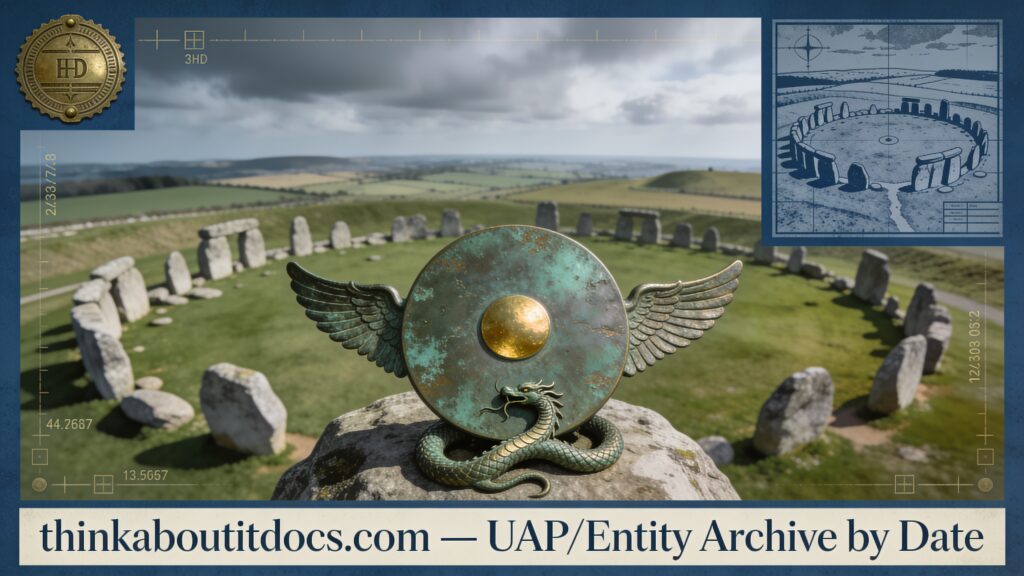
Across Bronze Age Britain and continental Europe, a recurring symbol shows up carved into stone, cast in bronze, and painted on tomb walls: a disc, often winged, often paired with — or set in opposition to — a serpent or dragon figure. Fringe researcher F.W. Holiday, best known for his Loch Ness investigations, argued in his 1973 book The Dragon and the Disc that this winged-disc motif was not solar symbolism but a technical, eyewitness-derived rendering of aerial craft, and that the same disc iconography connects the Celtic thunder-god Taranis, the layout of the Avebury stone circle, and the broader mythological shift historian Marija Gimbutas attributed to the arrival of sky-worshiping Kurgan peoples in Old Europe. This entry documents Holiday’s thesis and the artifacts he built it on, on the terms of his own claims — a fringe interpretive framework, not a verified sighting record.
Date: 3rd millennium BCE (Bronze Age)
Location: Worldwide iconographic pattern; primary case sites in Britain (Avebury, Wiltshire) and continental Europe (Austria; Trundholm, Denmark), with parallel motifs cited in China and Egypt
Time: Not applicable (iconographic and mythological record, not a discrete witnessed event)
Summary: F.W. Holiday’s research into Bronze Age disc symbols in Britain documents a winged or “sun wheel” disc motif that recurs in conjunction with serpent and dragon (“wyrm”) iconography. Holiday argued the wheel — later personified as the Celtic thunder-god Taranis, whose approach was traditionally described as a rumbling or booming sound — was a technological rather than purely solar symbol, and that the Avebury stone circle’s layout was designed to echo a winged disc when viewed from above. He connected this to comparable “eye” and disc iconography in China and Egypt and to Marija Gimbutas’s Kurgan hypothesis, which holds that sky-and-thunder-worshiping nomadic peoples from the Pontic steppe displaced or absorbed the earlier chthonic, serpent-associated religious traditions of Old Europe during the Bronze Age.
Source: F.W. Holiday, The Dragon and the Disc: An Investigation into the Totally Fantastic (1973); Marija Gimbutas, Kurgan hypothesis research; Trundholm Sun Chariot artifact, National Museum of Denmark
DETAILED REPORT
Holiday’s central claim rests on the recurrence of a winged or legged disc across Bronze Age British artifacts, often depicted in direct conflict with a serpent or dragon figure coiled at the base of a world-tree, with the disc descending from above to confront it. He read this as more than decorative symmetry: in his framework, the disc represents “sky” forces in conflict with “earth” or “underworld” forces, and the pairing recurs in mythological structures far outside Britain. He also noted that a number of cultures maintained a practice of hurling wooden discs through the air at night — by his reading, an act of imitative or ritual significance tied to the sky-disc symbolism rather than simple recreation.
Taranis, the Celtic thunder-god, is the figure Holiday most directly associates with the wheel motif — Taranis’s approach is traditionally described in mythological sources as accompanied by a rumbling or booming sound, which Holiday compares to modern reports of unexplained atmospheric “skyquakes.” He further argued that the addition of wings or legs to wheel iconography across Bronze Age artifacts — a documented feature of period metalwork, alongside genuine archaeological wheel-and-disc objects such as the Trundholm Sun Chariot from Denmark — implied a level of directed movement and landing capability beyond a simple celestial symbol for mainstream archaeologists, who read the same wheel imagery as solar-cycle representation.
On Avebury specifically, Holiday proposed that the monument’s layout was intentionally designed to replicate a winged disc when viewed from above — a claim mainstream archaeology does not support, as Avebury’s henge and stone-circle plan is documented as a ritual and ceremonial landscape feature built up over centuries, without an aerial-view winged-disc design intent in the archaeological record. Holiday extended his framework to “eye” iconography (the Eye of Horus in Egypt, the eye of Odin in Norse tradition), reading these as sky-borne surveillance symbolism, and to the broader mythological transition Marija Gimbutas documented in her Kurgan hypothesis — the archaeologically supported thesis that steppe-originating, sky-and-thunder-worshiping peoples spread into Old Europe during the Bronze Age and gradually supplanted or absorbed the region’s earlier goddess-centered, chthonic religious traditions. Gimbutas’s Kurgan hypothesis itself is a mainstream (if debated) archaeological framework; Holiday’s extension of it to a literal “two non-human intelligences in conflict” reading is his own interpretive layer, not part of Gimbutas’s own work.
RESEARCHER’S NOTES
Taranis and the Disc — Reading a Fringe Framework on Its Own Terms
- Source is genuine, claims are Holiday’s own: The Dragon and the Disc is a real 1973 book by F.W. Holiday, author of several Loch Ness and “high strangeness” titles. His disc-culture thesis is a minority, fringe interpretive framework within ufology and is not accepted by mainstream archaeology, which reads Bronze Age wheel and disc imagery as solar-cycle symbolism.
- Gimbutas’s Kurgan hypothesis is separable from Holiday’s extension of it: the archaeological Kurgan hypothesis concerning steppe-people migration into Old Europe is a genuine, debated mainstream framework. Holiday’s reading of that migration as a literal conflict between two non-human intelligence groups is his own overlay and is not part of Gimbutas’s published work.
- Avebury “aerial winged-disc layout” claim is unsupported: this specific claim originates with Holiday and is not supported by archaeological survey of the Avebury monument, which documents a ceremonial henge and stone-circle complex built in phases without evidence of an intentional aerial winged-disc design.
- Genuine artifact anchors the discussion: the Trundholm Sun Chariot (Denmark, c. 1400 BCE) is a real, well-documented Bronze Age bronze disc-and-chariot artifact housed at the National Museum of Denmark, and is a legitimate reference point for period wheel-and-disc iconography independent of Holiday’s ufological reading of it.
- Correction from prior version: this entry replaces a previous version of the page that contained broken self-referential links (every internal link pointed back to this same page rather than to genuine sources or related entries) and inconsistent capitalization introduced by an automated drafting error. Content has been rewritten and fact-checked against Holiday’s actual published thesis and Gimbutas’s actual published research.
Taken on its own terms, Holiday’s disc-culture framework is a genuine and long-standing piece of ufological literature connecting Bronze Age iconography to modern UFO reports — but it remains a minority interpretive lens applied after the fact to artifacts and myths that mainstream archaeology explains through solar symbolism and the documented Kurgan migration pattern. The archive preserves Holiday’s claims as claims, distinct from the archaeological record they’re built on.
“What many scholars have called a ‘sun wheel’ is, in fact, often depicted as a winged disc.”
F.W. Holiday, The Dragon and the Disc: An Investigation into the Totally Fantastic (1973)