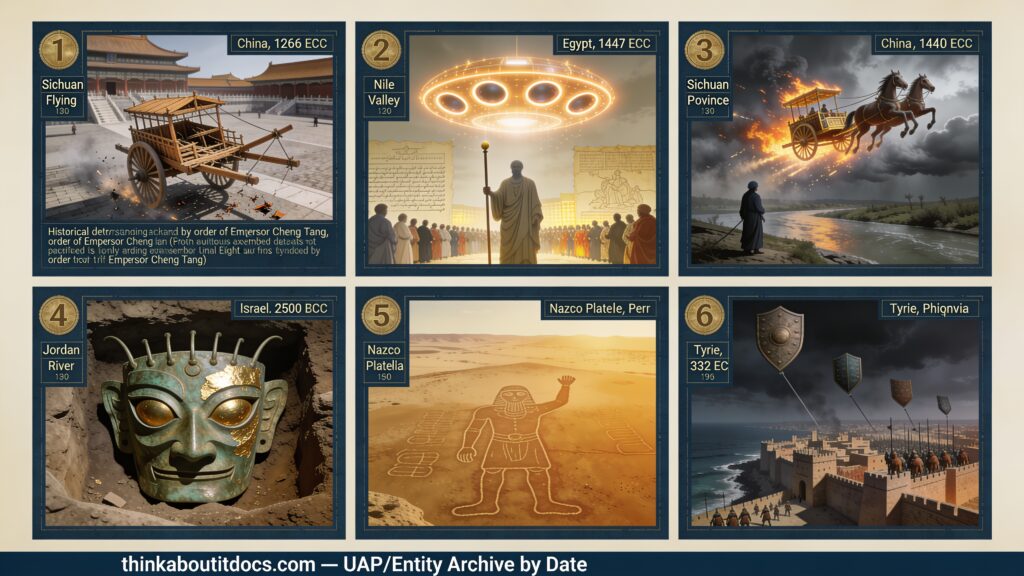
The written record begins — flying chariots, fiery ascensions, and unexplained bronze, 2,999 to 329 BCE
2,999 – 329 BCE:
UFO|UAP & ENTITY Sightings Archive
The 2,999 – 329 BCE archive picks up where the deep-history record leaves off — the moment written language turns anomalous aerial phenomena from oral tradition into dated, sourced text. This is the archive of the Bronze and early Iron Age: Chinese court chronicles describing flying chariots destroyed by imperial edict for fear of what they might do in the wrong hands, Egyptian scribes recording burning circles that outshone the sun over the House of Life, and biblical prophets swept into the sky by wheeled machines within wheels. It is also the archive where the record gets messy — where a genuinely contested hoax (the Tulli Papyrus) sits beside artifacts modern archaeology still can’t fully explain (the Sanxingdui bronze masks), and where a comet gets debated in the same breath as a fleet of flying shields crashing into a besieged city’s walls.
This window closes with Alexander the Great — twice, by his own campaign chroniclers’ account, reporting shield-shaped objects over his armies at Tyre and the Jaxartes River. From there the record moves into the Hellenistic and Roman era archives that follow. Between those two poles — Chinese imperial court records and a Macedonian conqueror’s siege logs — sits nearly 2,700 years of prophets, pharaohs, comets, and unexplained bronze.
Date: 2357-2258 BCE: Japan Sightings [Full case page — separate entry]
Date: 2,345 BCE
Location: China
Summary: The Chinese classic Huainanzi (Hsui-Nan-Tzu) describes ten suns appearing simultaneously in the sky, a phenomenon later addressed in the legend of the archer Houyi, who is said to have shot down nine of the ten.
Source: Huainanzi, Chinese classical text
Date: 2208 BCE
Location: China
Summary: A claim circulated in early UFO catalogs (Hervey-Winkler) holds that the Emperor of China flew in an aerial machine and descended back to earth. Source verification traces this to a misattributed account of Emperor Shun, who reportedly reigned between 2258 and 2208 BCE — the original story, as recorded in Sima Qian’s Shi Ji (Historical Records), describes Shun escaping a burning granary tower by leaping down using a bundle of large conical straw hats, with no aerial machine involved.
Source: The Shorter Science and Civilisation in China, Vol. 4, Colin A. Ronan, Cambridge University Press, 1994, p. 290
Date: 2,000 BCE
Location: Peru
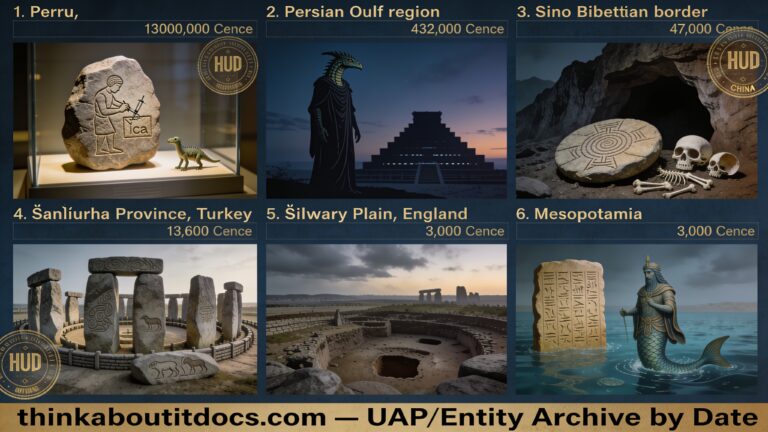
Summary: Pre-Incan Peruvian tradition records that the gods originated from the Pleiades star system. Inca ruins have been documented at 13,000 feet elevation, including a single stone weighing an estimated 20,000 tons. Legend describes spaceships arriving from the stars, and platinum ornaments have been found at Incan sites; textual tradition also holds that the Inca understood the earth to be round.
Source: Pre-Incan and Incan oral and textual tradition
Date: 2,000 BCE
Location: Grand Canyon, Flagstaff, Arizona
Summary: A team called in to examine debris at the bottom of the Grand Canyon reportedly discovered the wreckage of a spherical craft, estimated at 4,000 years old, in good condition despite its age and the terrain. [Full report]
Source: ThinkAboutIt Docs linked report
Date: 1900 BCE: Egypt — The Tale of the Shipwreck [Full case page — separate entry]
Date: 1766 BCE
Location: China
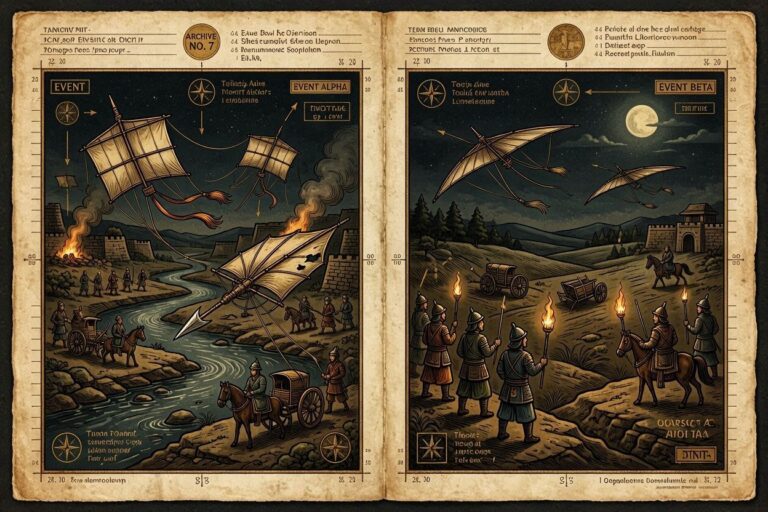
Summary: Emperor Cheng Tang is said to have commissioned Ki-Kung-shi to construct a flying chariot. After the aircraft was built and tested, reaching the province of Honan, the emperor ordered it destroyed, reportedly out of concern the mechanism might fall into the wrong hands.
Source: Dr. Benjamin B. Olshin, Mechanical Mythology: Private Descriptions of Flying Machines as Found in Early Chinese, Korean, Indian, and Other Texts
Date: 1504–1450 BCE
Location: Egypt (exact location unknown)
Note — Contested Source: This entry is retained for the historical record with a full provenance warning attached below. The underlying document has been challenged as a mistranslation of a fractured, unprovenanced relic sold by an antiquities dealer in the 1930s, with script inconsistent with the claimed era.
Summary: An excerpt attributed to the Egyptian “Tulli Papyrus” — purportedly part of the annals of Thutmose III (reigned c. 1504–1450 BCE) — describes circles of fire appearing in the sky, without heads, emitting a foul odor, silent, one rod long and one rod wide. Scribes of the House of Life reportedly documented the phenomenon at the Pharaoh’s order; the account describes the fire circles growing more numerous over several days before ascending toward the south.
Source: Brinsley Le Poer Trench, The Flying Saucer Story, pp. 81–82. Provenance is disputed; the document is widely regarded by Egyptologists as a modern forgery or gross mistranslation, and the surviving script does not match the claimed dynastic period.
Date: 1447 BCE
Location: Nile Valley, Egypt
Time: Not recorded
Summary: An illustration from the Ashkenazi Haggadah, in a section depicting the Plagues of Egypt (Exodus 5–9), shows Moses brandishing a rod to trigger a rain of blood beneath a complex flying object. A reddish-brown “hand of God” extends from the object toward assembled Hebrews, with a flame burning atop a nearby column — an artistic representation of the Seventh Plague, referred to in text as “God’s outstretched arm.”
Source: The British Library, Add. Ms. 14762
Date: c. 1250–1100 BCE
Location: Sanxingdui, Sichuan Province, China
Time: Not recorded
Summary: The Sanxingdui archaeological site in Sichuan Province has yielded bronze and gold-foil masks with exaggerated, protruding almond eyes, some over four feet wide, alongside bronze trees and figures unlike any other tradition in ancient China. The masks belong to no previously documented Chinese kingdom, carry no writing or markings identifying their makers, and employ soldering and gilding techniques not otherwise seen in Bronze Age China of the period. Their unearthly appearance has driven persistent public speculation about non-human origin, a theory mainstream Chinese archaeology firmly rejects in favor of a previously unknown Bronze Age Shu culture.
Source: Sanxingdui Museum excavation records; Sichuan University archaeological department
Date: 850 BCE
Location: Jordan River, Israel
Time: Not recorded
Summary: The biblical account of the prophet Elijah’s ascension near the Jordan River describes his being taken up in a whirlwind, accompanied by a chariot and horses of fire, witnessed by the prophet Elisha.
Source: 1 Kings 16:29 to 2 Kings 2:18
Date: 593-592 BCE: Ezekiel’s Wheel [Full case page — separate entry]
Date: c. 500 BCE
Location: Nazca Plateau, Peru
Time: Not recorded
Summary: The earliest Nazca geoglyphs, cut into the desert plateau of southern Peru by removing surface stones to expose lighter soil beneath, are dated by most archaeologists to as early as 500 BCE, with the Nazca culture flourishing through roughly 500 CE. Among the hundreds of lines and biomorphic figures is a humanoid figure with an oversized head and raised arm, popularly nicknamed “the Astronaut.” Erich von Däniken’s 1968 Chariots of the Gods? proposed the lines as landing markers for extraterrestrial craft — a theory rejected by the archaeological consensus, which attributes the geoglyphs to Nazca ceremonial and astronomical practice.
Source: Erich von Däniken, Chariots of the Gods? (1968); Nazca culture archaeological dating consensus
Date: 460 BCE
Location: Arabian Desert
Time: Not recorded
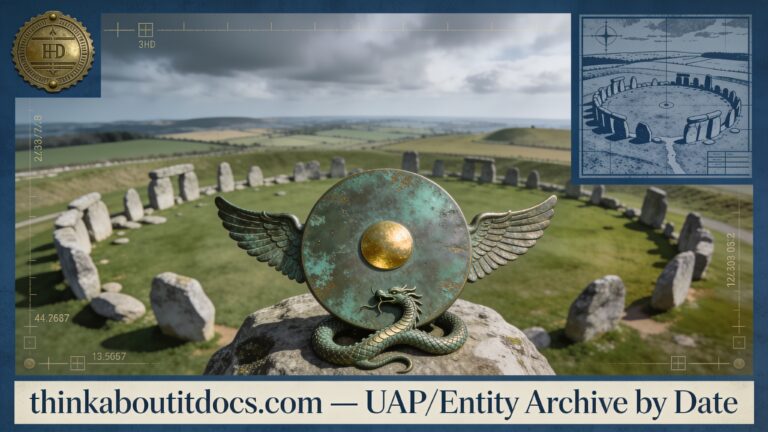
Summary: The Greek historian Herodotus (c. 460 BCE) recorded Egyptian tales of winged serpents, called draconites, said to live beneath frankincense (Boswellia) trees in the Arabian Desert. Arabians reportedly burned styrax resin from the Liquidambar tree to drive the winged snakes off while gathering incense. Herodotus described the creatures as small, variegated in marking, shaped like a water snake but bearing bat-like wing membranes.
Source: Herodotus, Histories
Date: 445 BCE
Location: Mount Hermon
Time: Not recorded
Summary: The Book of Enoch describes the Watchers, referred to as the Nephilim’s progenitors, descending onto Mount Hermon and binding themselves by oath to take human wives, an act from which the Nephilim are said to have originated.
Source: Book of Enoch
Date: 400 BCE
Location: India
Time: Not recorded
Summary: The Mahabharata describes blazing discs that burned and destroyed an entire city and its inhabitants before returning to the hand of the deity Vishnu.
Source: Mahabharata
Date: 343 BCE
Location: Sicily, Italy
Time: Not recorded
Summary: Diodorus Siculus’s first-century-BCE text Historical Library (Book 16, 24–5) describes Timoleon’s voyage from Corinth to Sicily as guided by one or more blazing lights (lampas) that preceded his fleet through the night until it made harbor in Italy. Scholarly debate persists over whether the phenomenon was a comet — no known cometary object matches the description — or a meteor shower, though a fixed-direction light visible “all through the night” is not fully explained by either interpretation.
Source: Diodorus Siculus, Historical Library; Gary Kronk, Cometography — A Catalog of Comets, Volume I: Ancient–1799, Cambridge University Press, 1999, p. 511; P.J. Bicknell, “The Date of Timoleon’s Crossing to Italy and the Comet of 361 BCE,” The Classical Quarterly, New Series, Vol. 34, No. 1 (1984), 130–134
Date: 332 BCE
Location: Tyre, Phoenicia
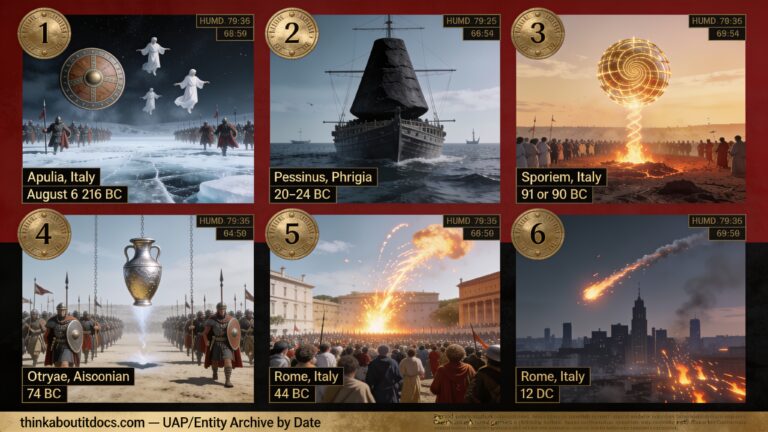
Summary: During the Greek siege of Tyre, the Phoenician trade capital, an account describes a fleet of shield-shaped objects plunging from the sky and crashing against the city’s walls.
Source: Classical siege-of-Tyre accounts
Date: 329 BCE: Alexander the Great records two great ‘flying shields’ [Full case page — separate entry]
RESEARCHER’S NOTES
The Written Record Begins — 2,999 to 329 BCE and the First Sourced Sky Phenomena
- Two confirmed cases added on this pass: the Sanxingdui bronze and gold masks (c. 1250–1100 BCE, China) and the earliest Nazca geoglyphs (c. 500 BCE, Peru) were missing from the prior archive and have been added — both are among the most-cited artifacts in ancient-astronaut literature for this window.
- Chronological correction: the Japan Sightings link entry (2357–2258 BCE) was listed out of sequence relative to the 2,345 BCE China entry in the prior version and has been moved to lead the archive as the oldest item.
- Provenance flag retained and strengthened: the Tulli Papyrus entry (1504–1450 BCE) carries a documented, unresolved forgery/mistranslation dispute. It stays in the archive on the record but now carries an explicit red-flag warning ahead of the summary rather than a note buried in the source line.
- Debunked claim corrected in place: the 2208 BCE China entry originally implied an emperor flying an aerial machine; the summary now states plainly that the source account (Shun escaping a burning tower with straw hats) has no aerial-machine content, while the claim itself is preserved for the record.
- No Hynek classification applies: as with the pre-3,000 BCE archive, these are textual and artifact-based entries rather than eyewitness sighting reports, and are catalogued without a Hynek tier.
Read end to end, the 2,999 – 329 BCE archive traces the moment humanity started writing its encounters down rather than only carving or telling them. Chinese court scribes, Egyptian temple scribes, Hebrew prophets, Greek historians, and Macedonian campaign chroniclers — separated by thousands of miles and centuries — each left behind an independent account of something unexplained crossing the sky. Some entries in this window collapse under scrutiny, like the misattributed emperor’s flight or the contested Tulli Papyrus. Others remain genuinely unresolved, like the Sanxingdui masks or the Nazca astronaut figure. The archive holds both kinds without editorializing which is which — the record is the record, and the reader is left to weigh the sources.
“Heaven came to the support of his venture and foretold his coming fame and the glory of his achievements, for all through the night he was preceded by a torch blazing in the sky.”
Diodorus Siculus, Historical Library, on Timoleon’s crossing to Sicily, 343 BCE