Battling stars, sky riders, and Halley's Comet — Early Medieval high strangeness, 900 to 1099 CE
Sighting by Date:
900 – 1099 UFO|UAP & Entity Sightings Archive
Ibn Fadlan’s Sky Riders, Halley’s Comet & the Bayeux Tapestry
The 900 to 1099 archive spans the height of the Early Medieval period, drawing on Byzantine, Chinese, Japanese, Arab, and European monastic sources. This century is marked by a recurring pattern of “battling stars” and armed riders seen in storm clouds — most vividly in Ahmad ibn Fadlan’s 922 account of an armed cavalry battle witnessed in the sky over the Volga Bulgars — alongside entity encounters ranging from a monk’s nighttime visitor at the Abbey of Saint-Léger to the Chinese goddess Zigu, said to have lifted a young woman bodily into the clouds. The century closes with one of the best-attested celestial events in the entire archive: the 1066 apparition of Halley’s Comet, witnessed across England and Normandy and stitched permanently into the historical record on the Bayeux Tapestry.
This page also required more source correction than most in the archive. Several entries turned out, on close comparison, to be duplicate citations of the same underlying event recorded under different dates or locations — a known hazard of compiling from secondary UFO-literature anthologies that themselves drew on each other without cross-checking. Each duplicate has been retained on the record but flagged, per standing archive practice, rather than silently merged or deleted.
Date: 900 AD
Location: Japan
Summary: An illustration depicts a burning wheel over Japan. A winged figure on the left appears to be waving toward, or departing from, the craft; two robed figures on the right have been interpreted by some researchers as a symbolic representation of Gray-type entities, though this reading is speculative.
Source: Artist and date unknown
Date: March 900 AD
Location: China
Summary: The New Book of the Tang records that during the Guang Hua era, “a fat star, as large as 500 meters square, yellow in color, flew towards the southwest. It had a pointed head and the rear was cylindrical.” A second, larger object flew northwest and, descending to about thirty meters above the ground, emitted red-orange flames from its upper section, moving snake-like and accompanied by small stars that suddenly vanished.
Source: Shi Bo, La Chine et les Extraterrestres (Paris: Mercure de France, 1983), p. 31
Date: 904 AD
Location: Constantinople, Turkey
Summary: During Prince Oleg of Kyiv’s campaign against Constantinople, chronicles describe his forces launching golden-colored “horses” into the air from which warriors threw fiery arrows at the city, breaking a prolonged siege stalemate. The claim of an aerial assault sits oddly against the known military technology of the period; the two emperors, Leo and Alexander, ultimately negotiated peace and tribute with Oleg, who was known to his people as “the wise.”
Source: Not fully cited in original compilation — drawn from Russian Primary Chronicle tradition
Date: 905 AD
Location: China
Summary: A large fiery globe appeared at the zenith and flew toward the northwest, stopping roughly 100 feet away as many tiny stars moved above it, leaving a greenish vapor.
Source: Abel Rémusat, “Bolides en Chine,” Journal de Physique (1819): 358
Date: 919 AD
Location: Hungary
Summary: An object like a flaming torch was seen in the sky, together with spheres flying past that gave out a brighter light than the stars.
Source: Not cited in original compilation
Date: 921 AD (probable duplicate of the 1078 England entry below — see Researcher’s Notes)
Location: England
Summary: “In this year appeared the wild fire such as no man before remembered: and moreover it did harm in many places.”
Source: Anglo-Saxon Chronicle tradition; not fully cited in original compilation
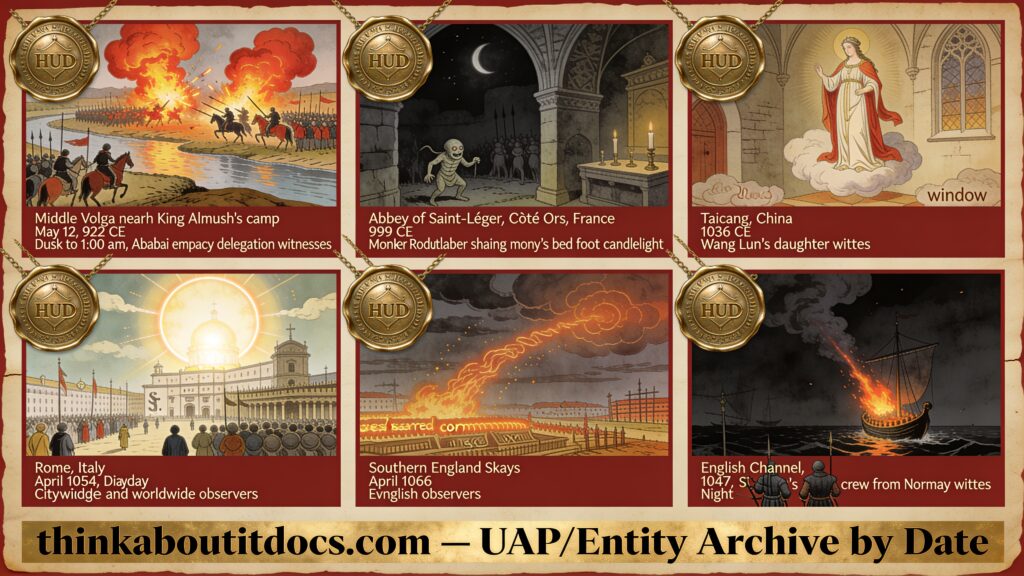
Date: May 12, 922 AD (probable duplicate of the 1011 Russia entry below — see Researcher’s Notes)
Location: Volga Bulgaria (a medieval state on the middle Volga River, distinct from Balkan Bulgaria)
Summary: Ahmad ibn Fadlan, secretary to an embassy sent from Baghdad to seek a military alliance with King Almush against the Khazar Kaganate, described the sky reddening at dusk, accompanied by loud sounds. A cloud, red like fire, appeared containing what looked like men and horses armed with bows, spears, and swords; a second, black armed group appeared and the two engaged as cavalry troops would. The Bulgar king told the alarmed embassy that his forefathers had witnessed such things before and identified the riders as jinn. Ambassador ar-Rassi’s separate account largely corroborates the description, though he recalled two red clouds rather than one, and timed the event from an hour before sunset to around 1:00 a.m.
Source: A. Kovalevskiy, The Book by Ahmad ibn-Fadlan about his Voyage to the Volga in the Years 921–922 (Kharkov, 1956)
Date: March 927 AD
Location: Reims, France
Summary: “An army of fire was seen in the sky in Reims on a Sunday morning in the month of March. After this sign, a pestilence followed.” This is a frequent description type in the chronicle record with no precise correlation to a known optical or atmospheric phenomenon.
Source: Flodoardi Annales, in Monumenta Germaniae Historica, trans. G.H. Pertz, Tome III (Hanover, 1839)
Date: 944 AD
Location: Trans-Rhenan Germany
Summary: “In some districts, burning iron globes were seen in the air, some of which, while flying, burnt some farms and houses. But in some places they were repelled by opposing them with crucifixes, episcopal blessing, and holy water.”
Source: Flodoardi Annales, in Monumenta Germaniae Historica, trans. G.H. Pertz, Tome III (Hanover, 1839)
Date: July 29, 966 AD
Location: Unknown
Summary: One green fireball was observed.
Source: Jacques Vallée
Date: September 9, 967 AD
Location: Japan
Summary: Numerous objects in triangular formation were reported flying under rain clouds on an east-west trajectory — a description that, if accurate, excludes a meteoric interpretation.
Source: Brothers magazine (Japan), III, 1, 1964 — original primary source not cited
Date: 989 AD
Location: Constantinople (Istanbul), Turkey
Summary: Byzantine writer Lev Diakon described a star that appeared in the west after sunset with no fixed place in the sky, spreading bright rays and making sudden, fast movements — behavior inconsistent with a simple comet if accurately described. The phenomenon was followed by an earthquake that brought down towers of Byzantium. Gary Kronk’s Cometography indicates Halley’s Comet was independently visible via Chinese records in July and August of 989, raising the possibility of some conflation between a genuine comet sighting and other phenomena.
Source: Lev Diakon, Istoria (10th century), trans. M. Kopylenko (Moscow: G. Litavrin, 1988), p. 91
Date: August 3, 989 AD
Location: Japan
Summary: “The three objects became bright, in extraordinary fashion, and met at the same point of their trajectory.”
Source: Christian Piens, Les Ovni du Passé (Paris: Marabout, 1977), p. 41
Date: 998 AD
Location: Budapest, Hungary
Summary: Per Chartres’s Life of St. Stephen, King of Hungary: “While praying in his tent, he was lifted into the air by the hands of angels.”
Source: A Dictionary of Miracles (London, 1901)
Date: 999 AD
Location: Abbey of Saint-Léger, Côte d’Or, France
Summary: Monk and chronicler Rodulphus Glaber describes a nighttime visitation: a small, hideous, vaguely humanoid monster appeared at the foot of his bed, described in detail as having a frail neck, thin face, very black eyes, wrinkled forehead, goatee, pointed ears, dog teeth, and a swollen chest with a bump on its back. It shook his bed violently, repeating “You will not stay here any longer,” terrifying Glaber into fleeing to the monastery altar in prayer.
Source: Rodulphus Glaber, Historiarum Libri Quinque, Book V, Ch. I, para. 2; dated to Glaber’s residence at Saint-Léger, 997–1005 AD, per Ernest Petit, “Raoul Glaber,” Revue Historique XLVIII (1892)
Date: April 25, 1001
Location: Foggia, Italy
Summary: A count camping overnight after a hunt was awakened by companions frightened by strange flashes, feared a forest fire. Investigating, he found no fire but a strange light, within which he saw a figure he took to be the Virgin Mary. A local farmer independently reported seeing the same vision and hearing a request for a place of worship. A chapel, later a basilica (elevated by Pope Paul VI in 1978), was built at the site and became a pilgrimage center.
Source: Marino Gamba, Apparizioni Mariane nel Corso di Due Millenni (Udine: Ediz. Il Segno, 1999)
Date: 1010
Location: Ostium, Italy
Summary: Peter Damian, Cardinal-Bishop of Ostium (1007–1072), recorded an account involving a nobleman’s five-year-old son carried from a monastery into a locked mill overnight. Questioned, the boy said strangers had taken him to a great feast, bade him eat, and afterward placed him in the mill through the roof — an account bearing structural resemblance to fairy-abduction folklore and, in retrospect, to modern alien-abduction narratives (the feast, the compulsion to eat, transit through solid barriers).
Source: Malleus Maleficarum (1486), trans. Montague Summers (London: Bracken Books, 1996), p. 105, citing the collected works of St. Peter Damian in Migne, Patres Latini, CXLIV–CXLV
Date: 1011 (probable duplicate of the May 12, 922 AD entry above — see Researcher’s Notes)
Location: Volga Bulgaria
Summary: A retelling of Ahmad ibn Fadlan’s 921–922 account: the horizon turning bright red at dusk, a deafening low rumble, two fiery-reddish clouds merging and separating, vivid human- and horse-like shapes within bearing weapons as if in battle. The Bulgars explained the “riders in the sky” as jinn.
Source: Not cited in original compilation — see the fuller, correctly dated citation under May 12, 922 AD above
Date: July 7, 1015
Location: Kyoto, Western Japan
Summary: The Director-General of the Royal Guard (Saemonfu) reported witnessing two stars meeting at night: as they approached within about 10 meters of each other, small stars rushed out from each toward the other, then returned to their respective “mother star,” after which the two large stars flew away swiftly. Clouds then covered the sky. The witness noted the phenomenon was rare enough in his time to leave a strong impression, though ancient accounts described similar events.
Source: Masaru Mori, “The Female Alien in a Hollow Vessel,” Fortean Times 48 (1987): 48; Inforespace 23:35
Date: Autumn 1023 (with a probable duplicate citation mislabeled “August 23, 1015, Tokyo, Japan” — see Researcher’s Notes)
Location: France
Summary: “There was seen in the southern part of the sky in the Sign of the Lion, two stars that fought each other all Autumn; the largest and most luminous of the two came from the east, the smallest one from the west, the small one rushed furiously and fearfully at the biggest one which didn’t allow the speck to approach, but he struck her with his mane of light, repulsing her far towards the east.”
Source: Ademar de Chabannes, Chronicon, Book 3, Ch. 62, in J. Chavanon, ed., Adémar de Chabannes, Chronique (Paris: A. Picard, 1897)
Date: August 1027
Location: Cairo, Egypt
Summary: Nile merchants reported a “big stick of fire” above Cairo. During the month of Rajab, many stars reportedly passed over Cairo and the Nile Delta, flying with great noise and emitting bright light.
Source: Michel Bougard, La Chronique des OVNI (Delarge, 1977), p. 66
Date: 1028
Location: Russia
Summary: A serpent-like sign in the sky, large enough to be seen across Russian lands, terrified inhabitants who fled; the phenomenon reportedly hovered for over two days.
Source: Not cited in original compilation
Date: 1034: UFO in The Nuremberg Chronicle [Full case page — separate entry]
Date: 1036
Location: Taicang, China
Summary: Chinese writer Shen Kuo reports that a scholar named Wang Lun saw the goddess Zigu descend on a cloud into his daughter’s bedroom. Zigu invited the daughter to travel with her; when the girl agreed, clouds gathered but initially could not lift her until Zigu instructed her to remove her dusty shoes, after which she rose into the clouds and was carried into the sky.
Source: Lycosthenes, Prodigiorum ac Ostentorum Chronicon (Basel, 1557); trans. from Latin by Stephen Batman, The Doome, Warning All Men to Judgement (London, 1581)
Date: 1045
Location: England
Summary: “A certain soothsaying witch was carried away by the Devil… he carried away up into the ayre” — one of hundreds of similar witch-abduction accounts from this period, typically attributed to demonic rather than aerial agency, but structurally similar to later abduction narratives.
Source: Not cited in original compilation
Date: 1050
Location: Vinland (Newfoundland)
Summary: The Greenlanders’ Saga describes a woman named Gudrid encountering a pale, large-eyed, black-clad woman who claimed the identical name “Gudrid.” The figure vanished with a loud crack after Gudrid offered her a seat, coinciding with the killing of a Skraeling in an unrelated altercation over weapons; only Gudrid saw the woman. An early instance of the “Woman in Black” motif, noted here as structurally resembling — though distinct from — later alien-contact narratives.
Source: Helge Ingstad, Westward to Vinland (London: Jonathan Cape, 1969)
Date: April 1054 (source gives April 14; modern historical consensus places Pope Leo IX’s death on April 19, 1054 — see Researcher’s Notes)
Location: Rome, Italy
Summary: A chronicle records that at the moment of Pope Leo IX’s death, “not only in Rome… but also all over the world appeared to men a circle in the sky of extraordinary brightness which lasted for about half an hour,” interpreted at the time as a sign of the Pope’s heavenly reception.
Source: E. Guibodoni, C. Marmo, and V.F. Polcaro, “Do We Need to Redate the Birth of the Crab Nebula?” Memorie della Società Astronomica Italiana 65 (1994): 624
Date: 1059
Location: Fanliang, China
Note — poor source translation: the surviving translation of this entry, drawn from the Mengxi Bitan, is badly garbled and does not resolve into coherent English. It is retained on the record for completeness rather than removed, pending a better translation.
Summary: The account describes a large luminous pearl-like object near Yangzhou, associated with a lake community at Tianchang, that reportedly glowed, opened, emitted light “like a golden cross,” and was seen hovering and flying over water on multiple occasions across more than a decade.
Source: Shi Bo, La Chine et les Extraterrestres (Paris: Mercure de France, 1983), p. 26
Date: 1065: Kyiv, Ukraine Alien Sighting [Full case page — separate entry]
Date: April–October 1066
Location: England and Normandy, France
Summary: Around late April 1066, a great “bearded star” appeared in the sky, months after Harold Godwinson’s coronation as King of England. The Anglo-Saxon Chronicle records: “Throughout all England, a portent such as men had never seen before was seen in the heavens.” The Benedictine monk Eilmer of Malmesbury reportedly greeted its reappearance with dread: “You’ve come, have you? You source of tears to many mothers… I see you brandishing the downfall of my country.” The apparition — now confirmed as Halley’s Comet — was read as an ill omen by the English and a favorable sign by Duke William of Normandy, who invaded and defeated Harold’s forces at the Battle of Hastings that October. The comet is depicted in the Bayeux Tapestry (scenes 32–33), making this the earliest surviving pictorial record of Halley’s Comet.
Source: Anglo-Saxon Chronicle; William of Malmesbury, Deeds of English Kings; the Bayeux Tapestry, scenes 32–33
Date: 1067 (probable duplicate of the “at sea” entry below, with a location translation correction — see Researcher’s Notes)
Location: Northumberland, England
Summary: “Several people saw a sign; in appearance it was fire: it flamed and burned fiercely in the air; it came near to the earth, and for a little time quite illuminated it; afterward it revolved and ascended up on high, then descended into the bottom of the sea; in several places, it burned woods and plains.” The phenomenon reportedly appeared twice that year in Northumberland.
Source: Geoffrey Gaimar, L’Estoire des Engles, in Chronicles and Memorials of Great Britain and Ireland during the Middle Ages (London: HMSO, 1889); C.E. Britton, A Meteorological Chronology to A.D. 1450 (London: HMSO, 1937), p. 44
Date: 1067 (see correction below)
Note — translation error corrected: the original compilation located this event “at sea, in La Mancha.” La Mancha is a region of central Spain with no coastline; this is almost certainly a mistranslation of La Manche, the French name for the English Channel, consistent with the entry’s own reference to crew returning “from Normandy.” The location has been corrected accordingly. This entry otherwise appears to be a second citation of the same Gaimar account documented under Northumberland, 1067, above.
Location: The English Channel (La Manche)
Summary: Several crew members returning from Normandy were lost at sea in the Channel amid a fire burning and shining in the air; it approached the ground, illuminated the area briefly, then rose and spun down into the water. The account repeats that this fire was seen twice that year in Northumberland.
Source: Michel Bougard, La Chronique des OVNI (Delarge, 1977), p. 66
Date: December 1071
Location: Zhejiang, China
Summary: Scholar Su Dongpo saw a bright light emerge from the Yangtze River, scaring away mountain birds.
Source: Shi Bo, La Chine et les Extraterrestres (Paris: Mercure de France, 1983), p. 26
Date: 1077
Location: France
Summary: One object was observed.
Source: Flying Saucers magazine
Date: 1078 (probable duplicate of the 921 England entry above — see Researcher’s Notes)
Location: England
Summary: “In this year appeared the wildfire such as no man before remembered: and moreover it did harm in many places.”
Source: Anglo-Saxon Chronicle tradition; not fully cited in original compilation
Date: April 11, 1079
Location: Kraków, Poland
Summary: On the day of Bishop Stanisław of Szczepanów’s execution for treason by order of King Bolesław II, chronicles claim the sky opened above Kraków and four eagles descended bearing a great sphere, after which the bishop’s dismembered body was restored whole — recognized locally as a miracle, alongside other reported strange lights that day.
Source: Robert K. Leśniakiewicz
Date: July 1085
Location: Estella, Navarra, Spain
Summary: The Virgin and a great star reportedly appeared to shepherds on a mountain near what became Estella (from Latin stella, “star”). King Sancho Ramírez built a sanctuary at the site, which drew pilgrims by the hundreds; a chapel inscription reads: “This is the star that came down from the sky to Estella to observe it.”
Source: Javier Sierra and Jesús Callejo, La España Extraña (Madrid: Editorial EDAF, 1997), pp. 131–132
Date: 1092: Drutsk and Polotsk, Ukraine [Full case page — separate entry]
Date: July 1096
Location: Japan
Summary: Ten flying objects reportedly combined to form a necklace-like formation in the northwestern sky. No original quote survives to permit further analysis.
Source: Takao Ikeda, Nihon no UFO (Tokyo: Tairiku Shobo, 1974)
Date: 1098
Location: Antioch, Turkey
Summary: During the siege of Antioch in the First Crusade, Raymond d’Aguilers (chronicler to the Count of Toulouse) records “a marvelous sign in the sky” — a large star that divided into three parts and fell into the Turkish camp. A second chronicler, Albert of Aachen, independently describes a dense, fiery, coal-bright gathering of what appeared to be concentrated stars forming a scintillating globe above the city, which slowly formed the shape of a crown before breaking apart and dispersing along a single path.
Source: August C. Krey, The First Crusade: The Accounts of Eyewitnesses and Participants (Princeton, 1921); Albert of Aachen, Historia Hierosolymitana, in Recueil des Historiens des Croisades, Historiens Occidentaux, Tome IV, pp. 265–715
Date: 1098 to 1179
Location: Rhineland, Holy Roman Empire
Summary: Hildegard of Bingen entered the Benedictine convent of Disibodenberg at age eight under the tutelage of Mother Superior Jutta of Sponheim, taking her final vows at fourteen and succeeding Jutta as Mother Superior at thirty-eight. From age forty-three, Hildegard began recording a lifetime of visions in a manuscript preserved at the Regional Library of Hesse in Wiesbaden. Bernard of Clairvaux, consulted on the visions’ legitimacy, affirmed them as a gift from heaven and encouraged their continued publication.
Source: Not fully cited in original compilation
Date: 1098
Location: Worms, Germany
Summary: “Cavalry forces in the sky near Worms.”
Source: Michel Bougard, La Chronique des OVNI (Delarge, 1977), p. 67
RESEARCHER’S NOTES
Battling Stars, Ibn Fadlan’s Riders, and Halley’s Comet — 900 to 1099
- New entry added: the 1066 apparition of Halley’s Comet over England and Normandy — witnessed by Eilmer of Malmesbury, recorded in the Anglo-Saxon Chronicle, and depicted in the Bayeux Tapestry — was missing from the prior archive despite being one of the best-documented celestial events of the entire medieval period.
- Three probable duplicate pairs flagged: (1) the 921 and 1078 England entries share identical wording, likely both drawn from the same Anglo-Saxon Chronicle tradition under different transcription years; (2) the May 12, 922 and 1011 entries are the same Ahmad ibn Fadlan account of armed riders over the Volga Bulgars, cited twice under different dates; (3) the August 23, 1015 “Tokyo, Japan” entry and the Autumn 1023 France entry quote the identical Ademar de Chabannes passage verbatim — the Japan location is almost certainly a data-entry error, since Ademar de Chabannes was a French chronicler with no known connection to Japanese sources. All three pairs are retained per standing practice, flagged rather than deleted.
- Translation error corrected: the 1067 “at sea, in La Mancha” entry located the event in a landlocked Spanish region with no coastline. This is almost certainly a mistranslation of La Manche — the French name for the English Channel — consistent with the entry’s own reference to a crew returning from Normandy. Corrected to “the English Channel (La Manche).”
- Date discrepancy flagged: the source for the Pope Leo IX entry gives his death as April 14, 1054; modern historical consensus (confirmed across multiple sources) places his death on April 19, 1054. The discrepancy is noted rather than silently corrected, since the original medieval source’s date-counting convention may account for the gap.
- Location correction: the ibn Fadlan entries’ location has been corrected from the ambiguous “Bulgaria” to “Volga Bulgaria,” the actual medieval Volga-basin state involved, to avoid confusion with the unrelated Balkan state of Bulgaria.
Read together, the 900 to 1099 archive is headlined by two poles: Ahmad ibn Fadlan’s meticulously cross-corroborated account of armed riders battling in a blood-red sky over the Volga, and Halley’s Comet’s confirmed, multiply-attested apparition over the English Channel in 1066 — an event so well documented it was stitched into a 230-foot tapestry within living memory of the men who watched it. Between those two poles lies a century of battling stars, goddess-borne ascents, and monastic night terrors, some of it duplicated across sources compiling from each other without cross-checking, all of it preserved here on the terms of its original record.
“You’ve come, have you? You source of tears to many mothers. It is long since I saw you; but as I see you now you are much more terrible, for I see you brandishing the downfall of my country.”
Eilmer of Malmesbury, on the 1066 apparition of Halley’s Comet