The Magonia sky-ships and Charlemagne's globe — Early Medieval high strangeness, 500 to 899 CE
Sighting by Date:
500 – 899 UFO|UAP & Entity Sightings Archive
Magonia Sky-Ships, Charlemagne’s Globe & the Celestial Dog of Japan
The 500 to 899 archive covers the Early Medieval period, when early historians, monks, and chroniclers recorded structured luminous objects through the lens of religious and celestial portent. This period is notable for its documentation of coordinated aerial phenomena — “battling armies” seen over France, immense pillars of fire recorded in Ireland, and flaming shields that reportedly routed a Saxon army outside Charlemagne’s castle. From the Magonia sky-ships of Lyon to the Celestial Dog of Japan, the archive traces the phenomenon’s continuity from ancient prodigy record into the structured, occupant-bearing craft accounts that come to dominate later centuries.
This era also documents some of the earliest recorded claims of physical contact and abduction: Archbishop Agobard of Lyon’s account of a mob attempting to stone four people who had allegedly fallen from a sky-ship, and an unnamed Indian woman said to have been taken by a “demigod” descending in an aerial vehicle. Sources here range from careful ecclesiastical historians writing from firsthand testimony to later compilers working from fragmentary or contested manuscripts — the archive preserves each on the terms of its original source.
Date: 507
Location: Poitiers, France
Summary: As French king Clovis pursued the defeated Visigoths after killing their king Alaric II and seizing Aquitaine, his nocturnal march was reportedly directed by a flaming meteor suspended above the cathedral of Poitiers — a signal likened by contemporary chroniclers to the column of fire that guided the Israelites through the desert. Clovis shortly thereafter moved the Frankish capital to Paris.
Source: Edward Gibbon, The History of the Decline and Fall of the Roman Empire (London: T. Cadell, 1837), p. 594
Date: 540
Location: Rome, Italy
Summary: “Often a little spark has seemed to come down from the sky to the Earth; then, having grown into a kind of orb like the Moon, it has been seen as disc-like. This very thing recently happened and foretold a danger of seditions and misfortunes beyond measure.”
Source: John Lydus, On Portents, 6, quoted in Richard B. Stothers, “The Roman Fireball of 76 BC,” The Observatory 107 (1987): 211
Date: 540: Monte Cassino, Italy Sighting [Full case page — separate entry]
Date: 541
Location: Gaul (France)
Summary: A comet so vast that the whole sky seemed on fire.
Source: Roger of Wendover, Flores Historiarum
Date: 553
Location: Clonfert, Ireland
Summary: “Brennain of Birra was seen ascending in a chariot into the sky this year” — an early instance of what would today be called abduction, referring to Saint Brendan (“Breanainn”) of Clonfert (c. 484–c. 578), an Irish monastic saint sometimes credited with sailing to America.
Source: The Annals of the Four Masters, compiled in the 17th century by four friars of the Abbey of Donegal
Date: 556
Location: Japan, exact location unknown
Summary: A strange visitor from the sky was encountered during the rule of Emperor Ame-Kuni-Osi-Hiroki-Niro-niha, warning that Japan’s earlier troubles with Korea stemmed from having stopped honoring a founding divine being, and that repentance and a new temple would restore the country’s fortunes.
Source: Mikhail Rosenshpitz, “Space Visitors in Ancient Japan,” Unbelievable World (Kiev, Ukraine), No. 8, August 2004
Date: 584
Location: France
Summary: Multiple witnesses. St. Gregory, Bishop of Tours, records in his Historia Francorum that in 584 CE “there appeared in the sky brilliant rays of light which seemed to cross and collide with one another.”
Source: Gregory of Tours, History of the Franks
Date: September 585
Location: France
Summary: “Certain people saw signs, that is to say rays or domes such as are customarily seen… to race across the sky.” Gregory of Tours elsewhere describes “golden globes” seen flashing at enormous speed across French skies on several occasions.
Source: Michel Bougard, Inforespace 22 (August 1975): 35, quoting Gregory of Tours, History of the Franks
Date: November 596
Location: Horyuji Temple, Japan
Summary: An object resembling a canopy or lotus flower descended and appeared suspended above the Horyuji temple, changing color and shape.
Source: Fusouriyatuki, Vol. 3 (Buddhist history), quoted in Takao Ikeda, Nihon no UFO (Tokyo: Tairiki Shobo, 1974) — original volume not independently verified
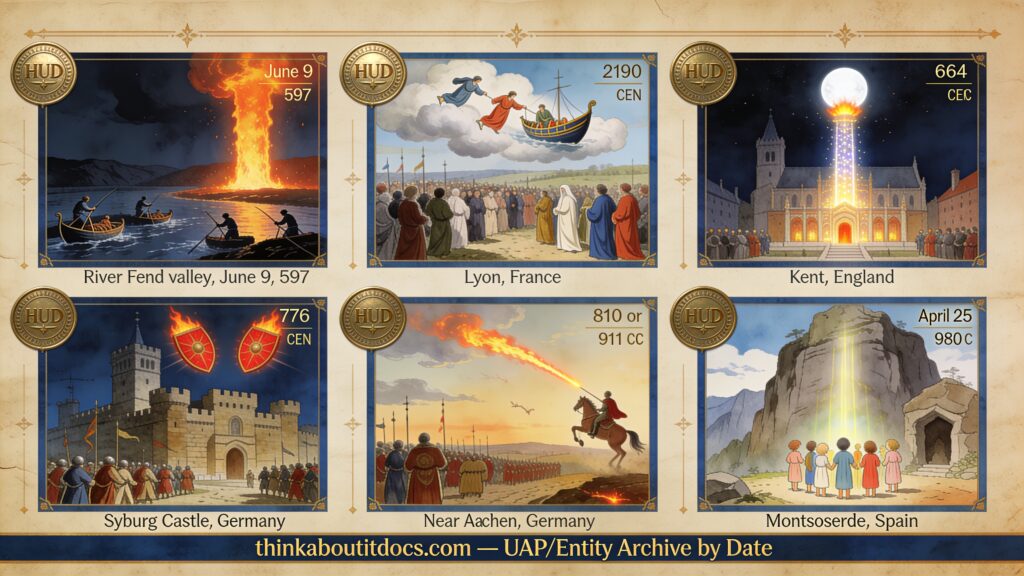
Date: June 9, 597
Location: Valley of the River Fend, Ireland
Summary: On the night St. Columba died, multiple fishermen at separate pools along the river independently reported the whole vault of heaven suddenly illuminated by what one witness, relaying the account to the monk Adomnán, described as “an immense pillar of fire,” ascending and illuminating the earth like the summer sun at noon before darkness followed as if the sun had set.
Source: William Reeves, ed., Life of Saint Columba, written by Adomnán, Ninth Abbot of Iona (Edinburgh: Edmonston & Douglas, 1874)
Date: January 14, 616
Location: China
Summary: “A large shooting star like a bushel fell onto the rebel Lu Ming-yueh’s camp. It destroyed his wall-attacking tower and crushed to death more than 10 people.”
Source: Not cited in original compilation
Date: After 618
Location: China
Summary: The Dong Tien Ji (“Peeping on the Sky”) records that in the Tang Dynasty a celestial ship over 50 feet long was found and placed in the Ling De Hall. The ship rang with a metallic sound when struck and was made of a very hard, rustproof material. Tang Prime Minister Li Deyu cut a slender stick from the vessel and carved it into a Taoist priest figurine that reportedly flew away and returned; in the years of Emperor Daming, both the figurine and the ship disappeared.
Source: Paul Dong, China’s Major Mysteries: Paranormal Phenomena and the Unexplained in the People’s Republic of China (China Books, 2000), pp. 68–69
Date: 619
Location: Gamo River, Central Japan
Summary: A bright object resembling a human figure was seen over the Gamo River.
Source: Not cited in original compilation
Date: 637
Location: Japan
Summary: A great star floated from east to west accompanied by thunder-like noise. Contemporary accounts disagreed on the cause — a falling star, or “earth thunder” — until the Buddhist priest Bin declared: “It is not the falling star but the Celestial Dog, the sound of whose barking is like thunder.”
Source: Nihongi, or Chronicles of Japan (London: George Allen & Unwin, 1956), quoted in W. Raymond Drake, Gods and Spacemen in the Ancient East (London: Sphere, 1973), p. 104
Date: 640
Location: Japan
Summary: On the 7th day of the second month of spring, a star entered the moon.
Source: The Nihongi, Book Two
Date: 640: Faremoutiers-en-Brie, France Sighting [Full case page — separate entry]
Date: 642
Location: Japan
Summary: On the 9th day of the 7th month, during the reign of Empress Toyo-Tokaro-Ikashi-hi-Tarahishi-Hime, a guest star entered the moon.
Source: The Nihongi, Book Two
Date: 643
Location: Japan
Summary: “Five colored banners and umbrellas shone in the sky, and descending, hung over the Temple to the sound of various music.”
Source: Not cited in original compilation
Date: 650
Location: India
Summary: One night in the hot season, while Hari Swami and his new wife slept on the roof of their summer house, the veil covering her face slipped as a demigod seated in his aerial car passed overhead. His gaze fell on her; he lowered the car, placed her asleep within it, and she was never seen again.
Source: As told by Hari Swami, translated from Hindi by J. Platts
Date: May 655
Location: Mt. Katsuragi, Japan
Summary: A man riding a dragon was seen in the sky, described as looking “like a Chinese man.” No corroborating detail has been located for this account.
Source: Takao Ikeda, Nihon no UFO (Tokyo: Tairiki Shobo, 1974), quoting Fusouriyatuki, Vol. 3
Date: 664
Location: Kent, England
Summary: A glittering pillar of light was reportedly seen shining over the hall of King Ecgbert I’s palace in the dead of night, arousing the household. On emerging, the king saw a globe of extraordinary splendor burning with a white flame, its origin apparently connected to the same source of light.
Source: Symeon of Durham, Opera et Collectanea, Vol. 1 (Durham: Andrews and Co., 1868)
Date: September 6, 670
Location: Nara Prefecture, Western Japan
Summary: A flaming object was seen flying north from many locations across Japan, one year before the Jinshin War, accompanied by an umbrella-shaped cloud and a strange sound over Nara. The account lacks sufficient detail for firm classification.
Source: Takao Ikeda, Nihon no UFO (Tokyo: Tairiku Shobo, 1974), quoting the Teiohennenki
Date: 675
Location: Berecingum (Barking) Convent, near London, England
Summary: After matins, nuns visiting the tombs of departed brothers were struck by a great sheet of light descending from heaven, brighter than midday sun, which caused them to stop singing in astonishment. The light then rose, moved to the south side of the monastery, rested there, and withdrew again to heaven — behavior the Venerable Bede’s account notes is inconsistent with a simple meteor.
Source: J.A. Giles, ed., The Venerable Bede’s Ecclesiastical History of England, Book IV, Ch. VII (London: Henry G. Bohn, 1867)
Date: 679
Location: Naniwa (Osaka), Japan
Summary: Cotton-like matter, 5 to 6 feet long, fell over Naniwa and drifted with the wind.
Source: Not cited in original compilation
Date: November 21, 684
Location: Japan
Summary: At dusk, seven stars reportedly “drifted together” toward the northeast before sinking below the horizon. Available detail is insufficient to draw a conclusion.
Source: W. Raymond Drake, Gods and Spacemen in the Ancient East (New York: Signet, 1968), p. 1
Date: May 698
Location: Ireland
Summary: A 17th-century transcription of an older, undated manuscript uses the term “shield” for an aerial phenomenon — as researcher Yannis Deliyannis notes, an unusual echo of the “clipei” (shields) reported by Roman-period authors. “Three shields were seen in the heavens, as it were warring from the east to the west, after the manner of undulating waves on a very calm night, being that of the Ascension of the Lord. The first was snowy, the second fiery, the third bloody” — read afterward as portending cattle plague across Ireland and the whole of Europe.
Source: Annals of Ireland, three fragments copied by Dubhaltach Mac Firbisigh, trans. John O’Donovan (Dublin: Irish Archaeological and Celtic Society, 1860)
Date: June 741 (with a related account dated 735)
Location: Constantinople (Istanbul), Turkey
Summary: During the reign of Constantine Copronymus, three columns of fire appeared in the sky in June, with a similar phenomenon in September. A separate 735 CE account describes “a thing… like a half-moon” in the northern sky that gradually passed south, returned north, and finally descended below the horizon.
Source: Jean-Baptiste Chabot, Chronique de Michel le Syrien, patriarche Jacobite d’Antioche (Paris, 1899–1910)
Date: 746
Location: England
Summary: “Dragons were seen in the heavens.”
Source: Not cited in original compilation
Date: 747
Location: China
Summary: Huge flame-breathing dragons were reported in the skies, accompanied by men in airships.
Source: Not cited in original compilation
Date: 748
Location: England
Summary: “Ships were seen in the air with their men.”
Source: Not cited in original compilation
Date: 749
Location: Cluain Moccu, Ulster, Ireland
Summary: “Ships were seen in the air with their crews.”
Source: The Annals of Ulster
Date: April 750
Location: Córdoba, Spain
Summary: “All the citizens of Córdoba saw three suns which shone and twinkled in a wonderful way, preceded by a sickle of fire and emerald” — read by the chronicle as a divine sign preceding a famine that struck Spain.
Source: Crónica Mozárabe of 754 (also known as Continuatio Hispana)
Date: 760
Location: France
Summary: During the reign of Pepin the Short (715–768), the air was reportedly filled with human figures, sailed ships, and battling armies, with several individuals claiming to have been abducted by aerial beings. Note — contested source: no contemporary primary source has ever been located, and the account is suspected to originate with the 1670 work Comte de Gabalis by Abbé N. de Montfaucon de Villars, retroactively dated to 760.
Source: Jules Garinet, Histoire de la Magie en France (Paris, 1818)
Date: 763
Location: Meath County, Ireland
Summary: While King Domnall Mac Murchada attended the fair at Teltown, ships were seen in the air.
Source: Not cited in original compilation
Date: 776
Location: Syburg Castle, Germany

Summary: During the Saxon rebellion against Charlemagne, attackers besieging Syburg Castle reportedly saw “the likeness of two shields red with flame wheeling over the church.” The Saxons were thrown into confused, panicked flight, with many injuring or killing one another in the chaos.
Source: Carolingian Chronicles: Royal Frankish Annals and Nithard’s Histories, trans. Bernhard Walter Scholz (Ann Arbor: University of Michigan Press, 1970), pp. 53, 55
Date: 793
Location: England
Summary: “Dragons were seen flying in the air” — an omen recorded in the same year as the Viking raid on Lindisfarne.
Source: Not cited in original compilation
Date: 796
Location: England
Summary: “In the same year small globes were seen about the Sun.”
Source: Not cited in original compilation
Date: 800
Location: Lyon, France
Summary: Agobard, later Archbishop of Lyon during the Carolingian Renaissance, wrote a denunciation of the belief, widespread among the local peasantry, in a “certain region called Magonia from whence come ships in the clouds.” The ships’ pilots, called “storm wizards,” were said to steal crops destroyed by storms in exchange for bribing human collaborators with produce. Agobard testified he personally witnessed a mob attempting to stone four people — three men and a woman — who were said to have fallen from one of these vessels; accounts differ on whether Agobard’s intervention actually saved them.
Source: Agobard of Lyon, Liber Contra Insulsam Vulgi Opinionem
Date: c. 500 BCE – 800 CE (site construction period; entry retained under 800s per prior archive placement)
Location: Nazca Plateau, Peru
Note — dating correction: the prior version of this entry dated the Nazca geoglyphs to “804?” — this is a chronological error. Archaeological consensus dates the Nazca Lines’ construction across the full span of the Nazca culture, roughly 500 BCE to 500–800 CE, not to a single discrete 804 CE event. The entry is retained here in its original archive position with the corrected dating noted.
Summary: The Nazca Lines — vast geoglyphs cut into the desert plateau of southern Peru — are cited in ufological literature (following Erich von Däniken’s 1968 Chariots of the Gods?) as possible landing markers for aerial craft, a claim rejected by the archaeological consensus, which attributes the lines to Nazca ceremonial and astronomical practice across many generations. See also the fuller entry for this site in the 2,999–329 BCE archive.
Source: Nazca culture archaeological dating consensus; Erich von Däniken, Chariots of the Gods? (1968)
Date: 810 or 811
Location: Near Aachen, on the Via Aquisgrana, Germany
Summary: As Charlemagne left camp before sunrise during his final campaign against the Danish king Godfred, a ball of fire fell suddenly from the heavens with great light, rushing across the clear sky from right to left. His horse plunged and threw him so heavily that his cloak buckle broke and sword belt shattered; he could not rise unassisted, and a javelin he had been holding was found some twenty feet away.
Source: Einhard, The Life of Charlemagne, trans. Samuel Epes Turner (New York: Harper & Brothers, 1880)
Date: 813
Location: Santiago de Compostela, Spain
Summary: A hermit named Pelayo heard music in a wood and saw a peculiar shining star above Mount Libredon, a former Celtic sacred site — giving the place its Latin name “Campus Stellae” (field of the star), later Compostela. Bishop Teodomiro’s subsequent investigation led to the discovery of what was identified as the tomb of the Apostle James, and the site became the endpoint of the Camino de Santiago pilgrimage.
Source: Concordia de Antealtares (dated 1077)
Date: 815: Lyons, France Sighting [Full case page — separate entry]
Date: 817
Location: China
Summary: A globe appeared at the zenith with a tail, flying slowly west beneath the moon while witnesses reported hearing something like the sound of birds — an unusual detail, since meteors do not typically fly “slowly.”
Source: Abel Rémusat, “Bolides en Chine,” Journal de Physique (1819): 358
Date: 827
Location: Barcelona, Spain
Summary: “Terrible things in the sky” were reported at night while Pepin I was at war in Spain, emitting pale or red light — a description inconsistent with typical meteor coloration.
Source: Michel Bougard, Inforespace 22 (August 1975): 36, citing Astronomus, Vita Hludowici Pii (835 CE)
Date: 840 (a second, separately transmitted account of the same underlying Magonia tradition documented under 800 CE above)
Location: Lyon, Rhône-Alpes, France
Summary: Agobard’s writings on peasant “superstitions” describe air-elemental beings (“sylphs”) traveling in sky-sailing ships that stole crops and abducted people; villagers claimed anchors from these ships had become lodged in rooftops. Agobard reports hearing that four captured sylphs, claiming to be from “Magonia,” were stoned to death by an angry mob — a rumor he personally dismissed as contradicting scripture.
Source: Agobard of Lyon
Date: 842
Location: France
Summary: Multicolored armies were seen marching in the sky at night — sightings of “infernal armies” that reportedly accompanied the siege of Jerusalem on several occasions.
Source: Not cited in original compilation
Date: November 879
Location: China
Summary: Two “suns” fought energetically in the sky; on another day of the same month, two suns fought and then merged together.
Source: Shi Bo, La Chine et les Extraterrestres (Paris: Mercure de France, 1983), p. 47
Date: April 25, 880
Location: Montserrat–Santa Cova, Spain
Summary: Seven children from Monistrol saw a strange light descend from the sky toward a grotto on Montserrat, accompanied by a soft melody. The light reappeared on four consecutive Saturdays before a group led to the site by seven men discovered an image of a black virgin in the cave, surrounded by a magical light and pleasant aroma. Attempts to move the sculpture caused it to grow inexplicably heavier, and a hermitage was built on the spot where it was finally set down — still standing today.
Source: Josep Guijarro, Guia de la Catalunya Màgica (Barcelona: Ediciones Martínez Roca, 1999), pp. 42–43
RESEARCHER’S NOTES
The Magonia Sky-Ships and Charlemagne’s Globe — 500 to 899
- Dating error corrected: the prior “804?” Nazca Lines entry has been corrected — archaeological consensus dates Nazca geoglyph construction across roughly 500 BCE to 500–800 CE, not to a single 804 CE event. The entry is retained in its original archive position with the correction noted, and cross-referenced to the fuller Nazca entry in the 2,999–329 BCE archive.
- Two Agobard accounts, flagged as related: the 800 CE and 840 CE entries both derive from Archbishop Agobard of Lyon’s writing on the Magonia belief but differ in framing and detail (three versus four persons stoned; “storm wizards” versus “sylphs”). Both are retained as separate citations per standing archive practice, now explicitly cross-referenced to each other.
- Contested source flagged: the 760 CE France entry (aerial armies under Pepin the Short) carries no located contemporary source and is suspected to derive from a 1670 work retroactively applied to the 8th century. It is retained with an explicit provenance warning.
- Strongest multi-source cluster: the June 9, 597 Ireland account is independently corroborated by multiple fishermen at separate locations along the same river, relayed to Adomnán by a direct eyewitness — one of the more strongly attested entries in this archive.
Read together, the 500 to 899 archive is headlined by the Magonia sky-ship accounts from Lyon and Charlemagne’s flaming globe near Aachen — both cases carrying the same core signature seen throughout this era: aerial objects and occupants intersecting directly with named historical figures and documented events, recorded by chroniclers who, in Agobard’s case, testify to having witnessed the aftermath themselves. The archive holds contested and well-corroborated accounts side by side, on the terms of their original sources.
“I saw several exhibiting in a certain concourse of people four persons in bonds — three men and a woman — who they said had fallen from those same sky-ships.”
Archbishop Agobard of Lyon, c. 800 CE