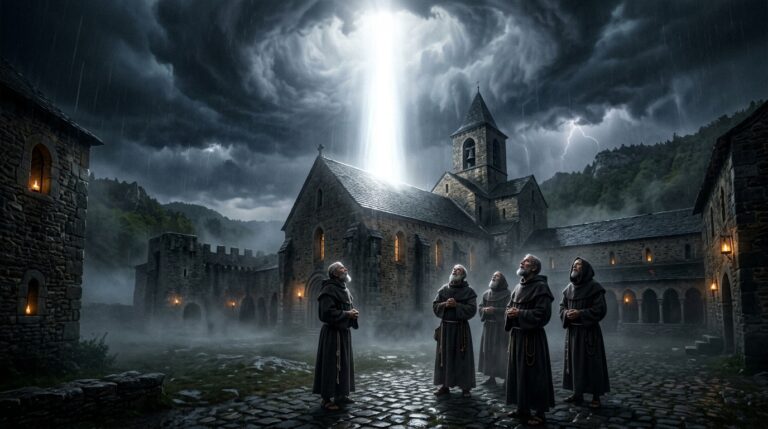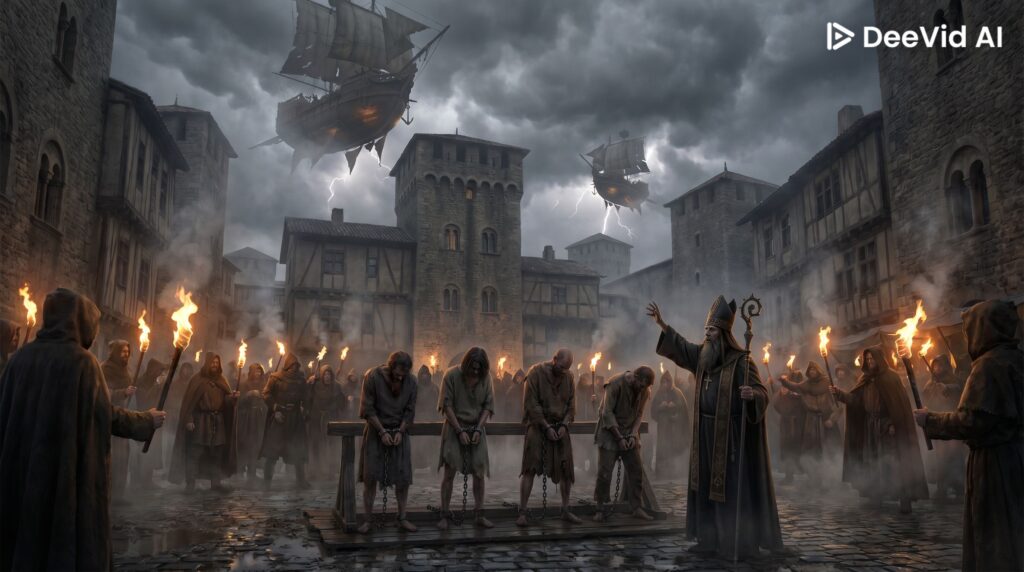
815 CE — Lyons, France. Archbishop Agobard of Lyons personally intervened to save four individuals from execution after a crowd accused them of arriving aboard cloud-sailing ships from the region of Magonia.
THINK ABOUTIT UFO|UAP|ENTITY SIGHTING REPORT
0815 CE: Lyons, France Sighting
In 815 CE, the Archbishop of Lyons saved four people from being stoned to death by a mob — not for witchcraft, not for heresy, but for allegedly arriving in the region aboard a ship that sailed through the clouds. The Archbishop, Agobard of Lyons, was one of the most rational and respected minds of the Carolingian era, a man who spent his career dismantling superstition. Yet what he recorded in his treatise De Grandine et Tonitruis — About Hail and Thunder — stands today as one of the most credible medieval accounts of aerial craft, entity contact, and the abduction of human beings by non-human intelligences operating from a place the locals called Magonia.
Date: 815 CE
Sighting Time: Unknown
Day/Night: Unknown
Location: Lyons France
Urban or Rural: Urban — city of Lyons, public assembly
No. of Entity(‘s): Multiple — at minimum 4 confirmed; aerial navigators described as a class of beings
Entity Type: Humanoid — described as men and a woman; aerial navigators from Magonia
Entity Description: Three men and one woman reportedly descended from cloud-sailing ships; described as human in appearance; held in chains by the crowd and nearly executed
Hynek Classification: CE-IV (Close Encounter IV) Abduction and direct contact between humans and aerial navigators
Duration: Multiple days — the four individuals were held captive for several days before being brought before the Archbishop
No. of Object(s): Multiple — a fleet of cloud-sailing ships described as coming from the region of Magonia
Height & Speed: Aerial — cloud level; speed not recorded
Size of Object(s):Large enough to carry crew and cargo
Distance to Object(s): Low altitude — witnesses described individuals as having descended or fallen from the craft
Shape of Object(s): Ship-like — referred to consistently as vessels or ships
Color/Description of Object(s): Ships that sailed upon the clouds, transporting aerial navigators who traded in agricultural goods destroyed by storms; described in Latin as “naves veniant in nubibus”
Number of Witnesses: Multiple — a large assembled crowd witnessed the four captives; Archbishop Agobard personally witnessed and intervened
Special Features / Characteristics: The craft were associated with atmospheric disturbances — hailstorms and thunder; aerial navigators described as trading in agricultural goods destroyed by storms; the region of origin named as Magonia — a separate and distinct realm; Archbishop Agobard documented the account as a skeptic yet vouched for its authenticity as a firsthand report
Case Status: Unexplained
Source: Agobard of Lyons, De Grandine et Tonitruis (About Hail and Thunder), 815 CE; translated and referenced in Jacques Vallée, Passport to Magonia, 1969
Summary/Description: In 815 CE, Archbishop Agobard of Lyons documented a remarkable incident in which four individuals — three men and one woman — were nearly executed by a mob after being accused of arriving from cloud-sailing ships from a region called Magonia. The Archbishop intervened, freed the four captives, and recorded the entire episode in his treatise on weather superstitions. The account represents one of the earliest and most credibly sourced medieval references to aerial craft, organized non-human aerial activity, and direct human-entity contact in Western European history.
Related Cases: 640 CE Faremoutiers-en-Brie France Entity Sighting | 1034 CE Nuremberg Chronicle Sighting | BCE Aerial Ship Records
DETAILED REPORT:
The year is 815 CE. In the city of Lyons, in what is now southeastern France, a crowd has gathered. At its center, bound in chains, stand four people — three men and one woman. The charge against them is extraordinary: they have been accused of arriving in the region aboard ships that sail through the clouds, departing from a mysterious realm called Magonia.
The crowd wants them dead.
What saves their lives is the intervention of one of the most respected intellectuals of the Carolingian era — Agobard, Archbishop of Lyons. Born around 769 CE in Languedoc, Agobard had risen through the church hierarchy to become one of the great rationalist thinkers of his age. He had written 22 books. He fought superstition systematically and on principle. He was precisely the last man in ninth-century France who could be expected to take aerial ships seriously.
And yet what Agobard recorded in his treatise De Grandine et Tonitruis — About Hail and Thunder — is not a dismissal of the event. It is a firsthand account of it.
Agobard describes a widely held popular belief in his era: that a separate region called Magonia existed, from which ships regularly sailed through the clouds. These aerial navigators, as he describes them, were believed to conduct trade with earthbound individuals known as Tempestaries — men accused of summoning storms in order to sell destroyed agricultural goods to the Magonians at a profit. The ships would descend, collect the ruined crops and dead animals, and return to Magonia.
The Archbishop describes this belief not as rare or fringe but as common — held by many, publicly. He writes in Latin that he himself “saw and heard” people of this persuasion. His purpose in De Grandine et Tonitruis is to argue against these beliefs on theological grounds — that attributing God’s weather to the commerce of aerial men diminishes divine authority.
But in doing so he preserves something priceless: a firsthand account of four individuals who were displayed before an assembled crowd, accused of having descended from one of these ships, held captive for days, and brought before Agobard himself for judgment. He freed them. He argued successfully against the mob. And he wrote it all down.
Jacques Vallée, in his landmark 1969 work Passport to Magonia, identified this case as one of the most significant medieval UAP records ever documented — not despite Agobard’s skepticism, but because of it. A rationalist skeptic vouching for the authenticity of a firsthand account, while arguing against its supernatural interpretation, is precisely the kind of credible witness that UAP research depends upon across every era.
The Magonia account raises questions that remain unanswered twelve centuries later. What were the cloud ships? Who were the four captives and where did they actually come from? What did the crowd witness that convinced them so completely that execution was warranted? And what was the region called Magonia — a name specific enough, consistent enough across accounts, that it appears to describe a real place of origin rather than a metaphor?
RESEARCHER’S NOTES: The Magonia Incident — Aerial Craft, Entity Contact, and the Archbishop Who Saved Four Lives
- Source Authority: Archbishop Agobard of Lyons is one of the most credible witnesses in the entire medieval UAP record. A trained rationalist, prolific author, and active skeptic of superstition, his documentation of the Magonia incident is all the more significant because he was arguing against the crowd’s interpretation — yet still vouched for the authenticity of the events he personally witnessed.
- The Magonia Designation: The name Magonia appears consistently in ninth-century accounts as a specific place of origin for aerial navigators — not a metaphor, not a mythological realm, but a named location from which craft regularly departed and returned. Jacques Vallée used it as the title of his landmark 1969 study of pre-modern UAP encounters precisely because of its specificity and recurrence across independent sources.
- Trade and Interaction Pattern: The Magonian aerial navigators were not described as raiders or invaders — they were described as traders, conducting organized commerce with earthbound intermediaries. This purposeful, transactional interaction pattern is distinct from most folklore creature accounts and aligns closely with the structured contact behavior documented in modern CE-IV cases.
- The Four Captives: The most remarkable element of this case is the physical evidence — four actual human beings, held in chains, presented before the Archbishop, accused of having arrived from aerial craft. Whether they were genuinely from the ships, confused locals caught in the wrong place, or something else entirely, their existence as physical witnesses to the event elevates this far beyond a secondhand rumor into a documented incident with real human consequences.
The Lyons Magonia incident of 815 CE is not mythology — it is documented history, preserved by a skeptic who had every reason to dismiss it and chose instead to record it faithfully. Archbishop Agobard saved four lives and left behind one of the most detailed medieval accounts of organized aerial activity, entity contact, and the complex relationship between human populations and whoever was operating those cloud ships. Twelve centuries later the questions he raised remain open. The ships have different names now. The pattern has not changed.