THINK ABOUTIT CLOSE ENCOUNTER REPORT
1608: Strange Sightings in Baie des Anges, Nice, France
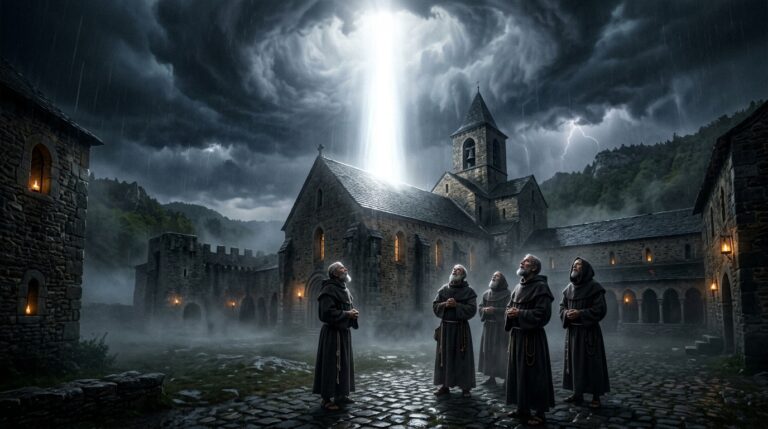
On the evening of August 5, 1608, the citizens of Nice, France watched three luminous craft race erratically across the sky over the Baie des Anges — the Bay of Angels — before stopping abruptly and hovering a few feet above the water. The craft were long, oval, flattened along their lengths, each with what witnesses described as a strange mast on top. The bay water beneath them began to froth. A dense orange vapor rose from the surface. A loud unpleasant noise accompanied both phenomena. Then two beings emerged from one of the craft. They were vaguely human in outline, dressed in red clothing covered in silvery scales, with huge heads and luminous eyes. Each held a cable or tube attached to the craft above them. They entered the water and worked in and around their vessel for over two hours — in full view of the terrified residents of Nice — before returning inside. All three craft then departed at high speed. The same day, similar craft and entities were reported at Genoa, 100 miles up the coast. The 1608 Mediterranean event cluster is one of the most technically specific and geographically coordinated USO encounters in the pre-modern record.
Date: August 5, 1608
Sighting Time: Evening — exact time not recorded
Day/Night: Evening
Location: Baie des Anges, Nice, France
Urban or Rural: Urban coastal — Nice was a significant coastal city; the bay fronted the populated waterfront
No. of Entity(s): 2 — observed exiting craft and working in the water
Entity Type: Humanoid — vaguely human in overall outline
Entity Description: Two beings described as vaguely human looking. Dressed in red clothing covered with silvery scales. Huge heads disproportionate to body. Luminous eyes. Each held a cable or tube physically connected to the craft above them. They entered the water and moved in and around the vessel for over two hours before returning inside.
Hynek Classification: CE-III — Close Encounter of the Third Kind; close observation of animate beings directly associated with the landed/hovering craft; the beings were observed conducting extended operations in the water
Duration: Over two hours — from the craft stopping above the water through the entities’ work period and departure
No. of Object(s): 3 Description of Object(s): Three luminous craft, long and oval in shape, flattened along their lengths, each with a strange mast sitting on top. Initially racing erratically across the sky before stopping and hovering a few feet above the bay surface.
Shape of Object(s): Oval — flattened along the length; with a structural mast on top of each craft Size of Object(s): Not recorded — large enough for entities to emerge from and for cables/tubes to reach the water surface Color of Object(s): Luminous
Distance to Object(s): A few feet above the water surface during the hover phase — visible from the Nice waterfront at close coastal range
Height & Speed: Hovered at water surface level during operations; departed at high rate of speed
Number of Witnesses: Multiple — citizens of Nice observed the event from the waterfront
Special Features/Characteristics: Physical environmental effects — bay water frothing beneath the hovering craft; dense orange vapor rising from the water surface; loud unpleasant noise accompanying both phenomena; entities connected to craft by cables or tubes during water operations suggesting either life support, power supply, or tethering for underwater work; the scaly red appearance of the entities is consistent with modern interpretations of specialized environmental or pressure suits rather than biological characteristics; same-day concurrent events at Genoa Italy 100 miles up the Mediterranean coast; part of a documented summer 1608 Mediterranean coastal event cluster that also included Marseilles; the event is one of the most technically specific pre-modern USO cases in the European historical record
Case Status: Unexplained
Source: www.subversiveelement.com/UfoNiceFrance.html
Summary/Description: On August 5, 1608, three luminous oval craft with structural masts hovered over the Baie des Anges at Nice, France. Two scaly red-suited entities with huge heads and luminous eyes emerged from one craft connected by cables or tubes and conducted operations in the bay water for over two hours while the water frothed and emitted dense orange vapor with loud noise. All three craft then departed at high speed. The event occurred on the same day as similar craft and entity reports at Genoa, Italy, 100 miles up the Mediterranean coast, suggesting a coordinated operational presence across the northwestern Mediterranean coast in August 1608.
Related Cases: August 1, 1608 CE Genoa Italy USO Entity Battle | August 15, 1608 CE Genoa Italy Three Fire Coaches | 1608 Marseilles France Sightings
DETAILED REPORT:
August 1608. Nice is part of the Duchy of Savoy — a prosperous coastal trading city on the northwestern Mediterranean shore. The Baie des Anges — the Bay of Angels — is its harbor, its waterfront, its daily backdrop. The citizens of Nice are not strangers to ships. They know what a vessel looks like, what a crew looks like, what normal maritime activity sounds and smells like.
What appeared over their bay on the evening of August 5th was none of those things.
Three luminous craft entered the sky over the Baie des Anges and began racing erratically — not in the smooth arc of celestial bodies or the predictable trajectory of conventional flight, but erratically, changing direction, accelerating, moving in ways that had nothing to do with wind or tide or any propulsion system the people watching had a name for. Nice watched. Then the craft stopped.
They stopped simultaneously and hovered a few feet above the surface of the bay.
The structural details that the witnesses preserved are worth examining carefully. The craft were long — elongated, not spherical. Oval in shape. Flattened along their lengths — describing a disc or lens morphology rather than a spherical or cylindrical one. And on top of each craft, a strange mast. Not a conventional ship’s mast — the witnesses were maritime people who knew what those looked like. Something structurally different, something that required the qualifier strange, mounted on top of each of the three hovering oval craft.
The bay responded to their presence.
The water beneath the hovering craft began to froth — a physical disturbance of the bay surface consistent with some form of energy emission or propulsion effect interacting with the water. From the frothing water rose a dense orange vapor. Not steam. Not smoke. Orange vapor — a specific color that witnesses preserved because it was unlike any vapor their experience had produced before. Accompanying both the frothing and the vapor was a loud, unpleasant noise that carried across the waterfront.
Then the beings appeared.
Two entities emerged from one of the three craft. The witnesses described them as vaguely human looking — not fully human, but humanoid in overall structure. Their clothing was red and covered in silvery scales — an appearance that modern researchers consistently interpret as specialized environmental or pressure equipment rather than biological characteristics. Their heads were huge — disproportionately large relative to their bodies. Their eyes were luminous.
Each entity held a cable or tube that was physically connected to the craft hovering above them.
They entered the water.
For over two hours, these two beings — connected by cables to their hovering craft, in red scaly suits, with luminous eyes and oversized heads — worked in and around their vessel in the Baie des Anges while the citizens of Nice watched from the shore. What they were doing is not recorded in the account. The account preserves what was visible from the waterfront — the beings, the cables, the movement around the craft — but not the purpose of the operation. Whether they were conducting repairs, collecting samples, deploying equipment, or performing some function entirely outside any 17th century framework, the witnesses could not determine and did not speculate.
After more than two hours the two entities returned inside the craft.
All three departed at high speed.
The same day — August 5, 1608 — similar craft and entities were reported at Genoa, Italy, approximately 100 miles up the Mediterranean coast. The Genoa accounts describe humanoid entities fighting above the sea while cannon fire failed to drive them away, and later three fire-coach objects conducting multiple circuits of the harbor. Marseilles reported related activity in the same period. The 1608 summer Mediterranean event cluster spans at least three locations across the northwestern coast of the sea over a period of weeks — the most geographically coordinated USO event cluster in the pre-modern European record.
RESEARCHER’S NOTES:
The Baie des Anges — Cables, Orange Vapor, and the 1608 Mediterranean Fleet
- The Cable/Tube Connection as Technical Evidence: The two entities’ use of cables or tubes physically connecting them to the hovering craft is one of the most analytically significant details in the account. This is not a detail that 17th century witnesses would have invented from available cultural frameworks — demons and angels do not use cables. The cables suggest either a life support system, a power supply tether, or a safety line for underwater operations — all consistent with modern technical approaches to marine operations in an atmospheric or pressure suit. The witnesses preserved this detail because it was visible and unusual, not because it fit any existing explanatory framework.
- The Orange Vapor as Physical Evidence: The dense orange vapor rising from the frothing bay water beneath the hovering craft is a specific physical phenomenon whose color and behavior were unusual enough to be preserved as a defining characteristic of the event. Orange vapor produced by interaction between an unknown propulsion or energy system and seawater is consistent with various energy-water interaction processes — none of which were available to 17th century Nice as an explanatory resource. The witnesses reported it because it was there and it was orange and they had no other word for it.
- Environmental Suit Interpretation: The red clothing covered in silvery scales, huge heads, and luminous eyes — described by witnesses as vaguely human — is one of the most consistently cited pre-modern descriptions of what modern researchers interpret as specialized environmental equipment. Pressure suits, dive suits, or atmospheric isolation equipment would present exactly the appearance described: a scaled or textured outer surface, an enlarged head section containing a helmet or breathing apparatus, and luminous optical elements within the helmet. The 17th century witnesses had no framework for this interpretation and described precisely what they saw.
- The 1608 Mediterranean Cluster: The Nice event’s occurrence on the same day as the Genoa accounts — with similar craft and similar entities conducting different but clearly related operations at different points along the same coastline — argues for a coordinated operational presence rather than independent anomalous events. Three or more separate coastal locations reporting similar craft and entity types across a period of weeks in the same body of water is not a coincidence pattern. It is an operational pattern. Whatever was working the Mediterranean coast in the summer of 1608 was doing it systematically.
Two beings in red scaly suits connected by cables to their oval craft worked in the Baie des Anges for over two hours on August 5, 1608, while the citizens of Nice watched from the shore and the water frothed orange beneath the three hovering vessels. They did not acknowledge the people watching. They did not address them, warn them, or explain their presence. They completed their work, returned to their craft, and the three vehicles departed at high speed. The same day, the same craft type appeared at Genoa 100 miles up the coast. The Mediterranean had something operating in it in the summer of 1608, and it was working a specific stretch of coastline with specific equipment for specific purposes that no one on shore in 1608 could identify. Four centuries later the archive holds the description and the question remains the same: what were they doing in the water?