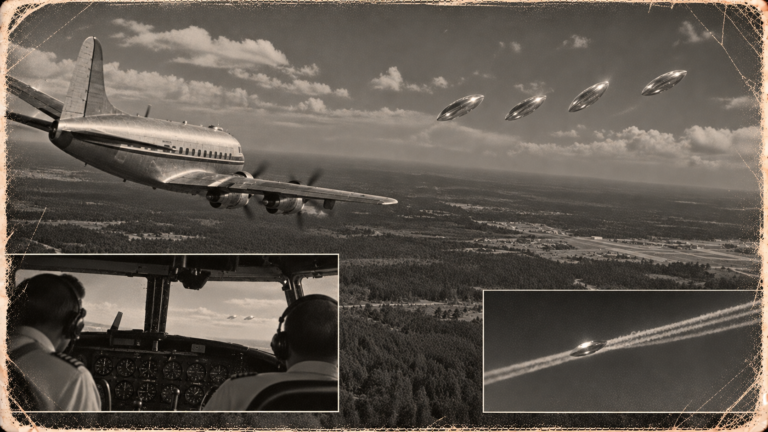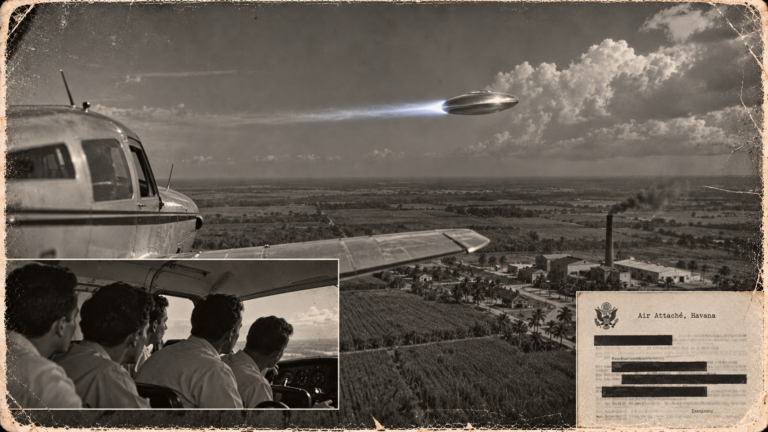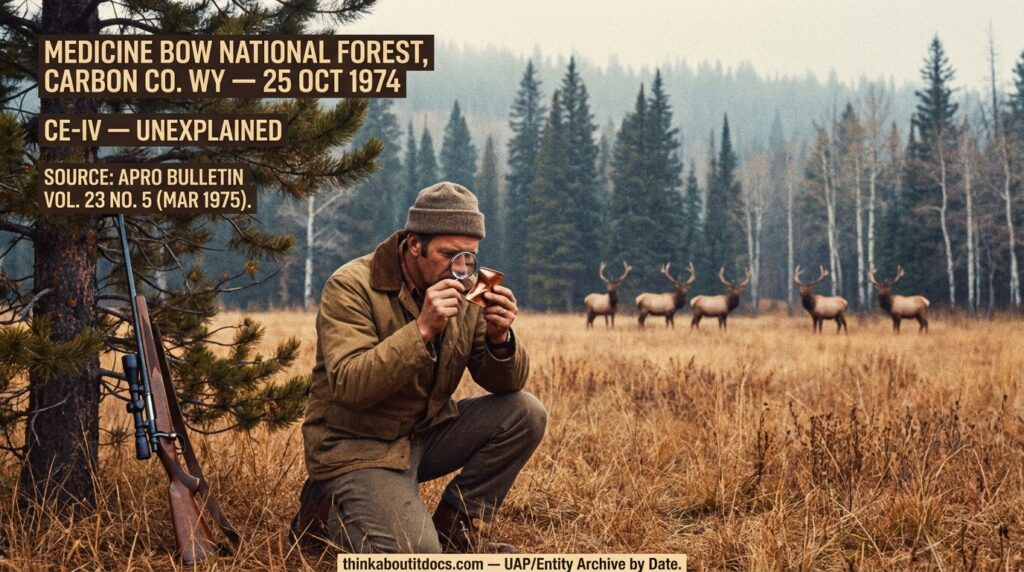
Medicine Bow National Forest, Carbon County, Wyoming, October 25, 1974 — Carl Higdon examines the mangled 7mm copper bullet jacket that appeared to strike an invisible barrier fifty feet from his rifle, the first physical anomaly in what would become one of APRO's most thoroughly investigated abduction cases. Source: APRO Bulletin, Vol. 23 No. 5 (March 1975).
THINK ABOUTIT ABDUCTION REPORT
1974: Carl Higdon’s Humanoid/UFO encounter
On October 25, 1974, oil field worker Carl Higdon raised his rifle at a bull elk in Wyoming’s Medicine Bow National Forest and watched the bullet travel fifty feet before stopping in midair and dropping to the ground. What followed — an encounter with a bowlegged entity who called himself “Ausso,” a journey inside a transparent cubicle to an unknown destination reportedly 163,000 “light miles” away, and a return that left Higdon dazed, amnesiac, and stranded with his pickup truck in a location it could not have reached by road — remains one of the most physically evidenced and professionally investigated abduction cases in the APRO archives.
The case is distinguished by convergent lines of corroboration rarely found in single-witness encounters: a mangled 7mm bullet jacket whose lead core was entirely missing, forensically examined by APRO metallurgist Dr. Walter Walker; a two-wheel-drive pickup truck found in terrain inaccessible by conventional driving; severe physiological aftereffects including extreme bloodshot eyes and appetite disruption; and extensive hypnotic regression conducted by Dr. R. Leo Sprinkle of the University of Wyoming, who concluded that Higdon was reporting the events sincerely despite their high strangeness.
Date: October 25, 1974
Sighting Time: Approximately 4:00 P.M.
Day/Night: Day
Location: Medicine Bow National Forest, south of Rawlins, Carbon County, Wyoming, United States
Urban or Rural: Rural — remote elk-hunting area on the north boundary of the national forest
No. of Entity(‘s): 2 (primary entity “Ausso” plus one unnamed second occupant who disappeared upon landing)
Entity Type: Humanoid
Entity Description: Approximately 6’2″, 180 lbs. Black suit, black shoes, belt with a star in the center and yellow emblem below. Distinctly bowlegged, slanted head with no discernible chin, thin hair standing straight up. Appendage extending from sleeve used for pointing/directing. Six teeth total — three upper, three lower. Claimed inability to tolerate sunlight.
Hynek Classification: CE-IV (Close Encounter IV) Abduction of the witness or other direct contact
Duration: Approximately 7 hours total elapsed time (4:15 P.M. to approximately 11:30 P.M. when located by search party); subjective duration unclear due to amnesia and time compression
No. of Object(s): 1
Description of the Object(s): Transparent cubicle approximately 7 × 7 feet containing a high-backed bucket seat with restraining bands, a helmet apparatus with four wires (two top, two side leading to back), a control console with three labeled levers of different sizes, and a mirror in the upper right showing the interior/cargo area behind the seat
Shape of Object(s): Cubic (travel vehicle); tower structure at destination approximately 90 feet tall with rotating light
Size of Object(s): Cubicle approximately 7 × 7 feet; destination tower approximately 90 feet tall
Color of Object(s): Transparent (cubicle); brilliant rotating white light at destination tower
Distance to Object(s): Direct contact — witness was inside the craft
Height & Speed: Higdon reported seeing a basketball-shaped object (interpreted as Earth) receding below the cubicle during transit; entity claimed a distance of 163,000 “light miles” was traversed
Number of Witnesses: 1 (Carl Higdon); corroborating observations of unidentified lights near the area reported by search party members prior to vehicle arrival
Special Features/Characteristics: Mangled 7mm copper bullet jacket (lead slug missing) recovered at site and forensically examined; pickup truck found in inaccessible terrain requiring tow extraction; five elk frozen motionless visible in mirror reflection behind the witness; four “hunger pills” in transparent cellophane-type container offered by entity; five human-appearing individuals observed at destination; “glassy shield” scanning apparatus at destination tower; entity’s pointing appendage used to move objects and individuals effortlessly
Case Status: Unexplained
Source: APRO Bulletin, Vol. 23 No. 5 (March 1975); Rick Kenyon; Robert Nantkes; Dr. R. Leo Sprinkle; Frank Bourke; Rawlins Daily Times (October 29, 1974)
Summary/Description: Carl Higdon, while hunting elk in the Medicine Bow National Forest, fired his rifle at a bull elk but the bullet traveled only fifty feet before dropping to the ground. He encountered a humanoid entity called “Ausso” who transported him in a transparent cubicle to an unknown destination. Higdon was subjected to a scanning procedure, told he was “not what they needed,” and returned. He was found seven hours later, dazed and amnesiac, with his truck in an inaccessible location. Physical evidence included the mangled bullet jacket and vehicle displacement. Dr. Leo Sprinkle conducted hypnotic regression and concluded Higdon was reporting sincerely.
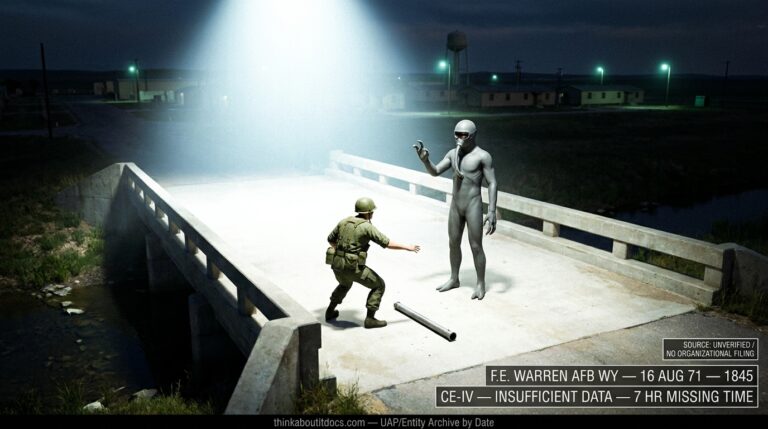
Related Cases: 1971 Cheyenne Wyoming Abduction (F.E. Warren AFB CE-IV) | 1976 Kentucky Abductions (Stanford — also investigated by Dr. Leo Sprinkle)
Full Report
On the afternoon of October 25, 1974, Carl Higdon was hunting elk south of Rawlins, Wyoming, on the north boundary of the Medicine Bow National Forest. At approximately 4:00 P.M., he crested a hill and spotted five elk. He raised his 7mm rifle and fired. The bullet traveled approximately fifty to sixty feet, appeared to strike an invisible barrier, and fell to the ground. Higdon walked over, retrieved the bullet — now a badly mangled copper jacket with the lead slug entirely absent — and tucked it into a fold in his canteen pouch.
He then heard a twig-snapping sound and turned to see a figure standing in the shadow of the trees. The entity stood approximately six feet two inches tall and weighed an estimated 180 pounds. He wore a black suit, black shoes, and a belt featuring a star in the center with a yellow emblem below it. His legs were distinctly bowlegged, his head slanted with no discernible chin, and thin hair stood straight up from his scalp. The entity identified himself as “Ausso.”
Ausso asked Higdon if he was hungry. When Higdon said yes, Ausso tossed him a package of four pills in a transparent cellophane-type container, telling him they were “four-day” pills. Higdon swallowed one — something he later found inexplicable, as he ordinarily refused even aspirin. Ausso then asked if Higdon would like to come with him. Higdon agreed. Ausso extended an appendage from his sleeve, pointed, and Higdon found himself seated in a transparent cubicle approximately seven by seven feet in size, restrained in a high-backed bucket-type seat with bands around his arms and a helmet-like apparatus on his head — similar to a football helmet but fitted with two wires on top and two on the sides leading to the back. A control console opposite his chair held three levers of different sizes bearing lettered markings, which Ausso manipulated.
A mirror in the upper right portion of the cubicle reflected the five elk behind him, motionless in what appeared to be a cage or corral — frozen in the same positions as when Higdon first spotted them. A second entity was present in the cubicle but disappeared when they landed. When Ausso pointed his appendage at the largest lever and it moved downward, the cubicle began moving. During transit, Higdon observed a basketball-shaped object below the craft that he took to be Earth receding beneath them. Ausso stated they had traveled 163,000 “light miles.”
At the destination, Higdon observed a massive tower approximately ninety feet tall topped with a brilliant rotating light that caused significant eye pain. He heard a sound like an electric razor. Standing outside the tower were five human-appearing individuals — a gray-haired man of forty to fifty years, a brown-haired girl of ten or eleven, a blonde girl of thirteen or fourteen, a brown-haired young man of seventeen or eighteen, and a blonde young woman of similar age — dressed in ordinary clothing and apparently conversing among themselves.
Ausso pointed his appendage and they entered the tower, ascending via an elevator to a room where Higdon stood on a small platform. A glassy shield extended from the wall, remained in front of him for approximately three to four minutes, then retracted. Ausso then told Higdon that he was “not what they needed” and they would return him. They descended to the main floor and re-entered the cubicle. Ausso held Higdon’s rifle, called it “primitive,” and asked to keep it, but was not permitted to and returned it. He pointed at the longest lever, and Higdon found himself standing on a slope. His foot struck a loose rock and he fell, injuring his neck, head, and shoulder.
Disoriented and unable to remember who he was, Higdon stumbled past his pickup truck — now parked in a heavily wooded area on a road with deep ruts — walked approximately a mile beyond it, then returned and heard a woman’s voice on the citizen’s band radio. He called for help, telling the woman he did not know who or where he was. Authorities were notified and Higdon was located at approximately 11:30 P.M. He was dazed, confused, and initially had difficulty recognizing his wife. His two-wheel-drive truck had to be towed out, as it could not have navigated the rough terrain where it was found by conventional means. He was admitted to Carbon County Memorial Hospital in Rawlins at 2:30 A.M. on October 26, presenting with extreme bloodshot eyes that teared constantly, sore head, neck, and shoulder, and complete loss of appetite. By the following morning, he was ravenous and complained about the size of hospital meals.
Search party members independently confirmed that Higdon’s vehicle could not have driven into or out of the area where it was found. Unidentified lights were also observed near the area before the search vehicles arrived, ruling out vehicle headlights as an explanation.
Dr. R. Leo Sprinkle, APRO’s psychology consultant from the University of Wyoming, conducted extensive interviews and hypnotic regression sessions on November 2 and November 17, 1974. Under hypnosis, Higdon recalled additional details: before he was returned, Ausso pointed at the pocket containing the remaining pills and they floated out and hung suspended in the air. The entity had only six teeth — three above and three below. Ausso stated that his planet had no fish, that he could not tolerate the sun’s rays as they burned him, and that he was exploring and searching for food, taking animals back for breeding purposes. When the cubicle first departed, Ausso pointed at Higdon’s truck and it “just disappeared.”
The mangled bullet jacket was examined by Dr. Walter Walker, APRO’s metallurgy consultant, who confirmed it had struck something extremely hard with immense force. Higdon noted that a 7mm bullet is powerful enough to completely transit a standard telephone pole. Plans were made to search for the missing lead slug after snowmelt.
In his preliminary report, Dr. Sprinkle stated that although single-witness sightings are inherently difficult to evaluate, the indirect evidence supported the tentative conclusion that Carl Higdon was reporting sincerely the events he experienced.
Researcher’s Notes
The Mangled Bullet and the Invisible Wall — Medicine Bow 1974 and Physical Evidence in Abduction Cases
- Physical Evidence Convergence: The Higdon case presents an unusually strong cluster of physical anomalies for a single-witness encounter. The mangled 7mm copper bullet jacket — with its lead core entirely missing — was forensically examined by APRO metallurgist Dr. Walter Walker, who confirmed it had struck an object of extreme hardness with tremendous force. The anomalous vehicle displacement, in which Higdon’s two-wheel-drive pickup was found in terrain that search party members confirmed was inaccessible by conventional driving, represents a second independent physical anomaly. These two pieces of evidence, combined with the documented physiological aftereffects — severe bloodshot eyes, appetite disruption, and confusion — create convergent lines that are difficult to dismiss as fabrication, since each would require separate and unrelated falsification.
- Classification Correction — CE-III to CE-IV: The original page classified this case as CE-III (close observation with animate beings associated with the object). This is incorrect. Carl Higdon was not a passive observer of an entity near a craft; he was transported inside a vehicle, taken to an unknown destination, subjected to what appears to be a scanning or evaluation procedure (the “glassy shield”), told he was “not what they needed,” and returned. This is a textbook Close Encounter of the Fourth Kind — abduction with direct physical contact and transport. The CE-III classification likely reflects the original APRO-era reporting convention, as Hynek’s CE-IV category was not yet widely adopted in 1975. The reclassification here corrects the taxonomy without altering the underlying evidence.
- Investigative Rigor — Sprinkle’s Methodology: Dr. R. Leo Sprinkle’s involvement elevates this case above the typical single-witness encounter report. Sprinkle conducted multiple hypnotic regression sessions over two dates (November 2 and 17, 1974), was unsatisfied with his initial results and returned for a second session, and explicitly stated his conclusions in measured, preliminary language rather than advocacy. His assessment — that Higdon was “reporting sincerely the events which he experienced” — represents one of the more careful professional evaluations in the APRO archive. Sprinkle’s long-term involvement with abduction cases at the University of Wyoming, and his parallel role in the 1976 Kentucky abductions (Stanford case), establishes him as a recurring and credentialed investigative figure across multiple high-profile CE-IV cases of this era.
- Contextual Pattern — Entity Food-Gathering Claims: Ausso’s stated purpose — that he was searching for food, could not tolerate sunlight, and took animals back for breeding — places this case within a recurring but often overlooked thread in the contact literature: entities who describe resource acquisition as their primary motivation. This contrasts with the more common “observation” or “study” framings reported in other abduction cases. The detail that the five elk were visible in the cubicle mirror, frozen and motionless, corroborates the food-gathering claim within the internal logic of the account. Whether this represents genuine information or confabulation under hypnosis, it is internally consistent — a quality that distinguishes it from cases where hypnotic recall produces contradictory or escalating narrative embellishments.
The Carl Higdon case endures in the archival record because it presents something rare in single-witness abduction reports — physical evidence that can be held, weighed, and examined under a microscope. The mangled bullet, the displaced truck, the bloodshot eyes, and the measured professional assessment by Dr. Leo Sprinkle form a chain of corroboration that resists easy dismissal. Higdon did not seek publicity; the Rawlins Daily Times reported the story four days after the event, and the investigation was driven by APRO’s field team, not by the witness. Whatever happened in the Medicine Bow National Forest on October 25, 1974, the documented record shows a man who went elk hunting and came back changed — physically, psychologically, and in ways that left marks the investigators could measure.
Media