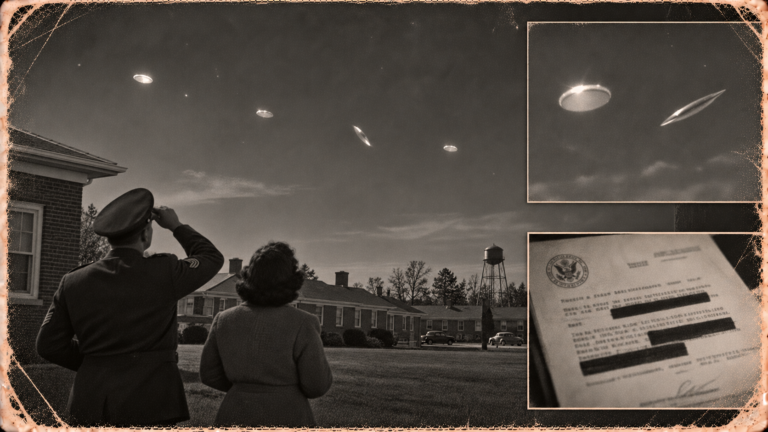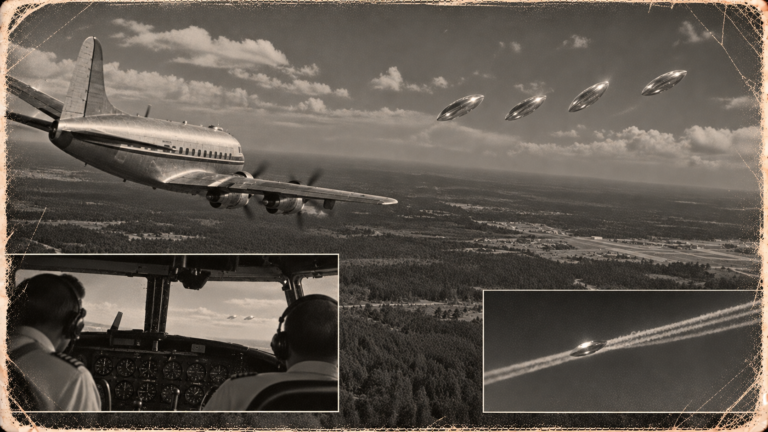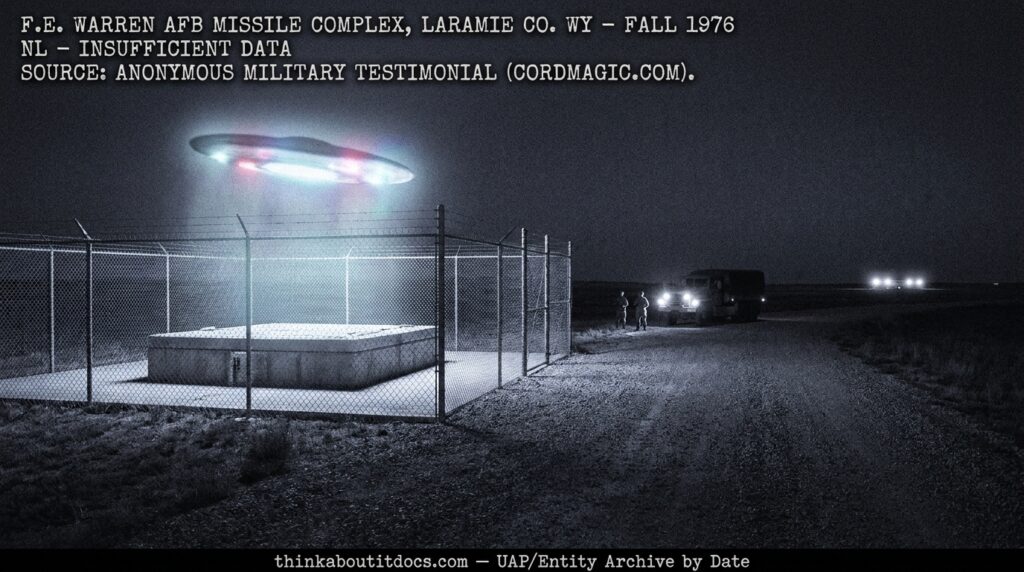
F.E. Warren AFB missile complex, Laramie County, Wyoming, fall 1976 — A pulsating cigar-shaped object hovers above a Minuteman III Launch Facility while a Security Alert Team truck sits stationary on the access road, the crew having refused to approach any site where the object was present. Anonymous military testimonial via cordmagic.com. Case status: Insufficient Data.
THINK ABOUTIT UFO|UAP SIGHTING REPORT
1976: UFO near Cheyenne, Wyoming, F E Warren
In the fall of 1976, a Minuteman III combat crew commander identified only as “Bruce” watched from his underground launch control capsule as a pulsating white light with red and blue strobes systematically visited multiple missile silos in his squadron’s area south of F.E. Warren Air Force Base near Cheyenne, Wyoming. Over the course of two and a half hours, the object — described by the topside NCOIC as a “fat cigar” approximately fifty to sixty feet long — hovered above the launch control facility itself, then moved from site to site, departing each location before Security Alert Teams could reach it, before accelerating to a white dot and vanishing at approximately 4:30 A.M.
⚠ ANONYMOUS UNVERIFIED REPORT:
This account was self-submitted to a UFO website (cordmagic.com) under a first name only (“Bruce”) with no independent investigation, FOIA confirmation, or organizational case file on record. The operational details — Minuteman III terminology, LCF/LF designations, SAT procedures, SAC reporting chain — demonstrate genuine familiarity with the missile alert system, and the account references a second capsule commander who independently confirmed similar lights over his sites. However, no investigative body (APRO, MUFON, NICAP, CUFOS) is known to have examined this case, and the witness’s identity has not been verified. The report is preserved here for its consistency with the broader pattern of ICBM-site UAP incidents but should be weighted accordingly.
Date: Fall of 1976 (exact date not recorded)
Sighting Time: Approximately 2:00 A.M. to approximately 4:30 A.M.
Day/Night: Night
Location: F.E. Warren Air Force Base and associated Minuteman III missile sites, south of Cheyenne, Laramie County, Wyoming, United States
Urban or Rural: Military — Air Force base and dispersed rural missile silo complex
No. of Entity(‘s): None reported
Entity Type: Not Applicable
Entity Description: Not Applicable
Hynek Classification: NL (Nocturnal Light) Point or extended luminous source observed at night
Duration: Approximately 2.5 hours
No. of Object(s): 1
Description of the Object(s): Pulsating white light with red and blue lights visible between pulsations; described by topside observer as a “fat cigar” shape; departed at high speed, shrinking to a white dot before disappearing entirely
Shape of Object(s): “Fat cigar”
Size of Object(s): Estimated 50 to 60 feet in length
Color of Object(s): White pulsating light with red and blue lights visible between pulsations
Distance to Object(s): Approximately 100 feet above the Launch Control Facility (per Sgt Jones’s topside observation); observed at distances of several miles when positioned over dispersed missile sites
Height & Speed: Hovered approximately 100 feet above the LCF; moved between missile sites several miles apart; final departure described as accelerating to a white dot within seconds before vanishing
Number of Witnesses: Multiple — Combat Crew Commander “Bruce” and deputy “Sam” (underground, monitoring radio communications); Sgt Jones (topside NCOIC, direct visual observer); Security Alert Team of two (direct visual observers from patrol vehicle); at least one additional combat crew commander from another capsule in the squadron confirmed similar lights over his sites earlier that night
Special Features/Characteristics: Object systematically visited multiple missile silos across the squadron’s area over 2.5 hours; departed each site before Security Alert Teams could reach it; SAT reported repeated vehicle and equipment malfunctions (later admitted to be pretextual — the team refused to approach sites where the object was present); a second capsule commander independently confirmed similar activity over his sites but declined to report it for fear of ridicule; SAC and Warren Control Center initially dismissed the reports; post-event crew departure briefings stated the event “never officially happened”
Case Status: Insufficient Data
Source: Self-submitted anonymous military testimonial via cordmagic.com (http://ufo.cordmagic.com/); no independent investigation on file
Summary/Description: A Minuteman III combat crew commander and his deputy monitored radio communications as a pulsating cigar-shaped light systematically visited multiple missile silos in their squadron’s area south of F.E. Warren AFB over approximately 2.5 hours. The topside NCOIC observed the object directly at approximately 100 feet above the launch control facility. Security teams refused to approach sites where the object was present. A second capsule commander independently confirmed similar activity. SAC dismissed the reports, and post-event briefings instructed crews the event never officially happened.
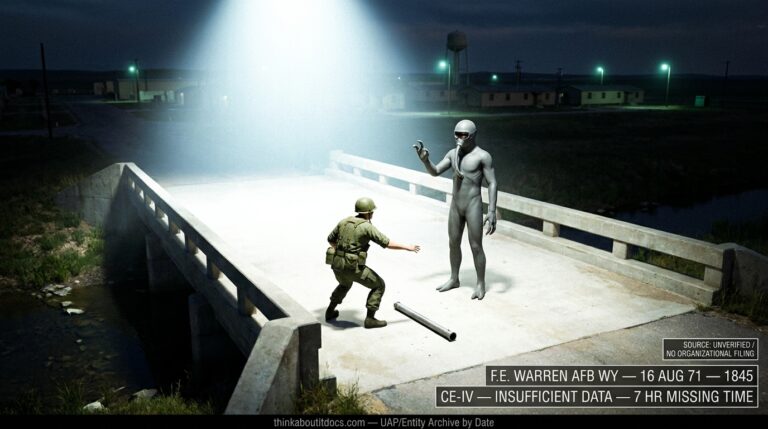
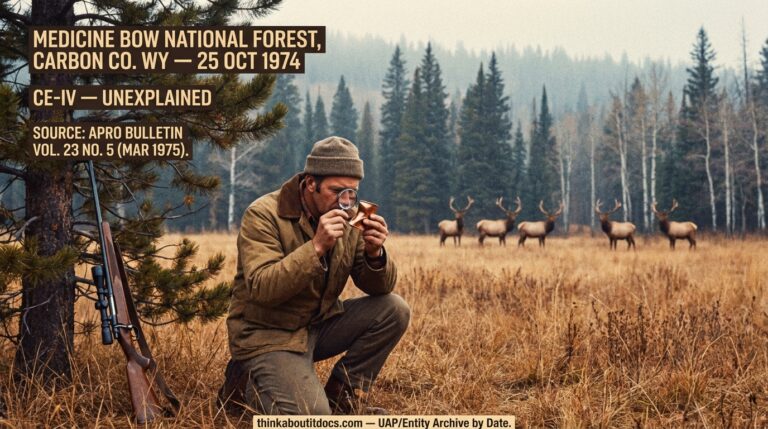
Related Cases: 1971 Cheyenne Wyoming Abduction (F.E. Warren AFB CE-IV) | 1974 Carl Higdon Medicine Bow CE-IV | Malmstrom AFB Echo Flight 1967 (Montana — Minuteman I missile shutdowns during UFO presence) | Robert Salas testimony (referenced by witness as parallel account)
Full Report
In the fall of 1976, a 20-year Air Force veteran identified only as “Bruce” was serving as a Minuteman III Combat Crew Commander on alert duty at a Launch Control Facility south of Cheyenne, Wyoming, within the F.E. Warren AFB missile complex. His deputy, referred to as “Sam,” was a lieutenant with prior enlisted service in Tactical Air Command units. Bruce described himself as initially “very skeptical about all the ‘UFO nonsense.'”
To stay awake during the overnight alert, Bruce and Sam monitored radio communications between the topside Non-Commissioned Officer in Charge, Sgt Jones, and the Security Alert Team — two armed patrolmen responsible for checking the squadron’s ten missile sites, located approximately nine to ten miles south of the Launch Control Facility.
At approximately 2:00 A.M., Bruce and Sam heard Sgt Jones ask the SAT to stop their vehicle, look around, and report anything unusual. Jones gave no hints about where to look or what to look for. After an initial response that they saw nothing, the SAT reported in an excited voice that they could see a pulsating white object in the sky with red and blue lights visible between the pulsations. They estimated it was approximately ten miles to the north, very close to the main capsule — the Launch Control Facility itself.
Bruce called Jones on the direct hotline between the underground capsule and the topside facility. Jones reported that the object was hovering approximately one hundred feet directly above the LCF. He described it as a “fat cigar” shape, approximately fifty to sixty feet long, with a white pulsating light and red and blue lights visible between pulsations. He was observing it in real time as they spoke. Jones then reported that it moved away.
Within minutes, Jones called back to report that the object appeared to have stopped a few miles away, very close to one of the Launch Facilities — a missile silo. Bruce and Sam ordered the SAT to that site, but the team had to return to the capsule for batteries and other equipment. By the time they headed toward the silo, the pulsating light had moved away before they could reach it.
Over the next two hours, the object made stops very close to several more missile sites in succession. Each time, Bruce and Sam attempted to dispatch the SAT to the site in question. Each time, the team reported vehicle problems or equipment malfunctions and failed to reach any of the sites. According to Jones, at approximately 4:30 A.M. the object accelerated dramatically — it “whooshed away” and shrank to a white dot within seconds. The dot remained visible briefly, then disappeared entirely.
During a routine communications check with all other launch control capsule commanders in the squadron, Bruce mentioned the object and received chuckles and ridicule. Within a minute, however, one of the other commanders contacted Bruce’s capsule privately and reported that his own topside crew had observed the same type of lights over their missile sites earlier that night but had not mentioned it during the communications check for fear of ridicule. This commander stated that he had not and would not report the incident to headquarters.
Bruce and Sam reported the activity to SAC and the Warren Control Center. They were laughed at and told to call back if the object “ate the cops.” Despite the ridicule, they made three or four additional calls to the Control Center insisting the observations be officially logged. On their final call, they threatened to wake the base commander if the reports were not entered into the log.
The following morning, after their alert shift was relieved by a new crew, Bruce and Sam went topside and found Sgt Jones curled up in a chair, wide awake and visibly shaken. They spent time talking to him and trying to calm him down. Under promise of confidentiality about the SAT’s actions, Jones revealed that the Security Alert Team had been frightened and had made a deliberate decision not to drive to any missile site where “that thing” was present, regardless of orders. The reported vehicle and equipment problems had been pretextual.
At subsequent crew departure briefings, all outgoing crews were told by an unrecognized individual that the event “never officially happened” and that they were not to discuss it with anyone. Bruce noted that he did not encounter Sgt Jones on any subsequent alert duty.
Bruce stated that he remained convinced Sgt Jones had seen something genuinely unusual and was sincere in his description. He maintained silence for decades in accordance with military orders, but came forward after seeing similar accounts — particularly those of former missile commander Robert Salas — challenged publicly by skeptics. He concluded that it was time for those who had been silent to speak about what they observed.
Researcher’s Notes
The Silent Squadron — F.E. Warren 1976 and the Pattern of ICBM-Site UAP Activity
- Source Chain Assessment: This account exists as an anonymous first-person testimonial self-submitted to cordmagic.com, a small UFO website, under a first name only. No investigative organization — APRO, MUFON, NICAP, or CUFOS — is known to have examined the case. No FOIA request results, base logs, or SAC incident reports have been located to corroborate the events described. The witness’s identity has not been independently verified. However, the operational vocabulary throughout the account — Minuteman III, Launch Control Facility, Launch Facility, Security Alert Team, NCOIC, SAC reporting chain, crew departure briefings, communications checks between capsule commanders — demonstrates specific and accurate familiarity with the Strategic Air Command missile alert system at a level inconsistent with casual fabrication. The case status is assessed as Insufficient Data rather than Unexplained, reflecting the anonymous sourcing and absence of independent investigation.
- ICBM-Site UAP Pattern: The F.E. Warren 1976 account aligns with a well-documented pattern of UAP activity at American ICBM installations spanning at least a decade. The most prominent precedent is the March 1967 Malmstrom AFB Echo Flight incident in Montana, in which ten Minuteman I missiles simultaneously went to “No-Go” status while security personnel reported a UFO at the perimeter fence. Robert Salas — whom Bruce specifically references as a motivating figure — has publicly described similar events at Malmstrom’s Oscar Flight. The behavioral characteristics described in the F.E. Warren account — systematic movement between dispersed silo sites, sustained presence over individual Launch Facilities, departure before security teams could close distance — are consistent with the surveillance-pattern behavior reported across multiple ICBM-site incidents. This does not confirm the account, but it places it within a coherent pattern rather than as an isolated anomaly.
- Institutional Suppression Dynamics: The account describes a multi-layered institutional response to the observations: initial ridicule from SAC and Warren Control Center; a second capsule commander’s decision not to report similar activity for fear of ridicule; post-event briefings by an unrecognized individual instructing all crews that the event “never officially happened”; and Bruce’s own decades of silence in accordance with military orders. These elements are consistent with the institutional dynamics described by other military UAP witnesses from the Cold War era, including the suppression mechanisms documented in the Malmstrom cases. The detail that the briefing was conducted by someone Bruce did not recognize — rather than the squadron commander or a known officer — suggests the suppression directive may have originated from outside the local chain of command.
- Security Team Refusal — Behavioral Evidence: One of the most telling details in the account is the SAT’s deliberate refusal to approach any missile site where the object was present, masked behind fabricated vehicle and equipment malfunctions. This behavioral response — trained military security personnel choosing to disobey orders rather than close with an unknown — parallels the reported reactions at other ICBM-site incidents and carries a specific evidentiary weight. Sgt Jones’s condition the following morning — still awake, visibly upset, curled in a chair hours after the event — corroborates the intensity of what the topside personnel experienced. The SAT’s deception and Jones’s psychological state are the kinds of behavioral details that resist fabrication because they undercut the heroic narrative that hoaxers typically construct; the witnesses in this account were frightened, disobedient, and ashamed of their actions.
The F.E. Warren 1976 account occupies an uncomfortable position in the archival record — operationally detailed, behaviorally credible, and entirely unverified. No investigator examined the witnesses, no FOIA request has surfaced the logs that Bruce insisted be kept, and the witness himself remains anonymous beyond a first name. What the account provides is not proof but pattern: another data point in the recurring thread of UAP activity at American nuclear missile installations, told by a self-described skeptic who kept silent for decades and came forward only after watching other military witnesses face public challenge for describing the same kind of events. The record preserves it here as reported, weighted accordingly, and open to the corroboration that has not yet arrived.