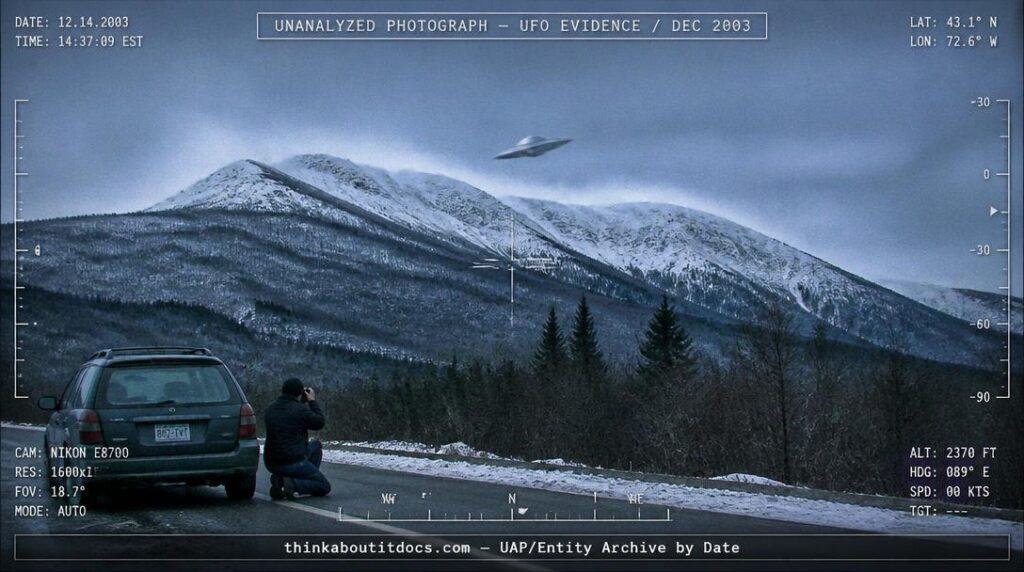
December 2003 — A metallic disc photographed gliding across a Vermont mountain range in 20-mph winds before departing at extreme speed. Anonymous photographer, unanalyzed image.
THINK ABOUTIT UFO|UAP SIGHTING REPORT
2003: Disc-shaped object photographed in Vermont
In December 2003, an amateur photographer from Connecticut was setting up his camera on the side of a road in the mountains of southeast Vermont when something caught his peripheral vision — a metallic or whitish disc-shaped object gliding slowly across the mountain range, appearing to struggle slightly against 20-mph winds. He recovered from his surprise fast enough to take one photograph before the object paused momentarily and then “jolted” out of view at extreme speed. The resulting image shows a small disc-shaped object against a backdrop of snow-covered peaks with visible wind-blown snow. The photograph was submitted to UFO Evidence and has received no formal forensic analysis.
Date: December 2003 (exact date not specified)
Sighting Time: 2:00–3:00 p.m.
Day/Night: Day
Location: Mountains of southeast Vermont (specific location not provided)
Urban or Rural: Rural (mountain road)
No. of Entity(‘s): 0
Entity Type: N/A
Entity Description: N/A
Hynek Classification: DD (Daylight Disc) — Metallic or whitish disc-shaped object observed and photographed during daylight hours.
Duration: Approximately 30 seconds (from initial peripheral sighting through photograph to high-speed departure)
No. of Object(s): 1
Description of the Object(s): Disc-shaped, metallic or whitish. Appeared to be gliding across the mountain range at moderate speed, showing signs of interaction with 20-mph winds (described as “having a little bit of trouble flying into the wind”). After the photograph was taken, the object appeared to hover momentarily, then departed to the right at extreme speed in a sudden “jolting” acceleration.
Shape of Object(s): Disc
Size of Object(s): Unknown — appeared as a disc at distance against the mountain backdrop
Color of Object(s): Metallic or whitish
Distance to Object(s): In front of the mountain range (distance not estimated)
Height & Speed: Mountain-level altitude. Initially gliding at moderate speed (appeared to interact with wind); departed at extreme speed in a non-inertial “jolting” maneuver
Number of Witnesses: 1
Special Features/Characteristics: Photographic evidence — one photograph taken during the observation. Apparent wind interaction (the object appeared to have difficulty in 20-mph winds, unlike a conventional aircraft). Non-inertial departure — the object went from stationary or near-stationary to extreme lateral speed instantaneously (a “jolt”), which is inconsistent with conventional aerodynamics. Real-time visual observation preceded the photograph (the object was seen first, not discovered later in the image).
Case Status: Insufficient Data (anonymous witness, no forensic analysis of photograph, no investigation)
Source: UFO Evidence (ufoevidence.org)
Summary/Description: An anonymous student photographer from Connecticut photographed a metallic disc-shaped object gliding across a snow-covered Vermont mountain range in December 2003. The object appeared to interact with high winds before departing at extreme speed in a non-inertial acceleration. One photograph exists. No forensic analysis conducted. Anonymous single-witness report submitted to UFO Evidence.
Related Cases: 1985: Ascutney, VT — Oblong craft observed by three women | 2003: Weyauwega, WI — UFO photographs with analysis (contemporary photographic case with forensic review for comparison)
Detailed Report
The witness, self-identified only as a student from Connecticut, drove to Vermont on a December weekend in 2003 seeking landscape photography opportunities. Recent snowfall in the mountains promised good shots. Driving aimlessly through southeast Vermont in the early-to-mid afternoon (2:00–3:00 p.m.), he found a composition he liked: a mountain with snow blowing dramatically off its peak in approximately 20-mph winds with higher gusts. He parked on the roadside, knelt down, and began setting up his camera.
While setting up, something caught his peripheral vision. Moving from left to right across the mountain range was an object unlike anything he had seen before. It was disc-shaped, metallic or whitish. It moved with a gliding quality, but not quite — the witness struggled to find a comparison. Notably, the object appeared to interact with the wind conditions, showing what the witness interpreted as “a little bit of trouble flying into the wind.” After recovering from his initial surprise, the witness took one photograph.
Immediately after the photograph was taken, the object appeared to hover momentarily in place, then jolted abruptly to the right and out of view at extreme speed. The transition from stationary to departure was instantaneous — a non-inertial acceleration inconsistent with any conventional aircraft’s ability to overcome momentum. The total observation lasted approximately thirty seconds.
The witness did not report the sighting to any authority or investigating organization. He submitted the account and photograph to UFO Evidence (ufoevidence.org). No forensic analysis of the photograph has been published. The witness declined to identify his school or provide his full name.
Researcher’s Notes
The Mountain Disc — Southeast Vermont 2003 and the Wind Interaction Detail
- The Wind Interaction Anomaly: The most analytically interesting detail in this report is the witness’s observation that the disc appeared to have difficulty with the 20-mph winds. Conventional aircraft of any size capable of sustained flight in mountain environments are not visibly affected by 20-mph surface winds at altitude. Balloons and lighter-than-air craft would be affected but would move with the wind, not against it. The description of an object appearing to struggle against the wind while maintaining a deliberate trajectory is unusual and does not fit standard mundane candidates. If accurately observed, it suggests a propulsion mechanism with a specific relationship to atmospheric conditions — one that does not simply overpower wind resistance but shows interaction effects at low-speed operation. The subsequent instantaneous high-speed departure contrasts sharply with this apparent low-speed vulnerability, implying two operational modes.
- The Non-Inertial Departure: The “jolting” departure — from stationary or near-stationary to extreme lateral speed with no apparent acceleration curve — is a recurring feature in UAP observation reports classified as instantaneous or non-inertial acceleration. This behavior violates classical Newtonian mechanics for any object with mass operating through aerodynamic means. The witness described it as abrupt and total — not a gradual acceleration but an instant transition. If the photograph were subjected to forensic analysis confirming a genuine airborne object, and if additional witnesses could corroborate the departure behavior, this detail would place the case among the stronger evidence points for anomalous flight performance. Without that corroboration, it remains a compelling but unverifiable testimony.
- Photographic Evidence — Unanalyzed: The photograph exists but has never been subjected to forensic analysis. Without examination of the original file’s EXIF metadata, compression artifacts, pixel-level consistency, and atmospheric optical properties, the image cannot be evaluated for authenticity. The Weyauwega, Wisconsin photographs from the same year (February 2003) provide a useful comparison — those images underwent a competent published analysis that found no manipulation. The Vermont photograph deserves the same treatment but has not received it. Until it does, the image’s evidentiary value remains potential rather than demonstrated.
- Source and Anonymity: The witness is anonymous beyond a self-description as a student from Connecticut. The sighting was submitted to a user-contribution website with no editorial vetting process. No follow-up investigation was conducted. The case is included because the photograph exists, the real-time observation narrative (peripheral detection, wind interaction, non-inertial departure) is internally consistent and specific, and the detail level exceeds what is typically found in fabricated anonymous submissions. But the anonymity, the absence of forensic analysis, and the lack of any investigation place the case firmly in the Insufficient Data category.
The 2003 Vermont mountain disc is a single-photograph, single-witness, uninvestigated case that contains two analytically interesting details — wind interaction at low speed and non-inertial departure at high speed — embedded in an otherwise minimal evidentiary package. The photograph could tell us something, but no one has examined it. The witness could have been located and interviewed, but no one tried. The case sits in the archive as unrealized potential: evidence that exists but has not been tested, testimony that is specific but has not been verified, and a flight performance description that is consistent with the best UAP reports but rests entirely on one anonymous student’s word. If the original image file is recoverable and a competent analyst examines it, the case could be upgraded or dismissed. Until then, it is a shape on a mountain, caught by a camera, explained by nothing.
Source & Media

I’m a amateur photographer from Connecticut. One weekend I decided to drive up to Vermont for a day of picture taking. I was very excited because I heard that snow had just recently fell up in the mountains so I was hoping to get some good shots.
I finally got up to Vermont and just started to drive around aimlessly, hoping to find some good photo ops. Mid-afternoon(about 2-3 pm) I saw this great shot of some mountain with snow blowing all over the place on top of it. That day had about 20 mph winds with higher gusts, as you can see in the picture. I parked the car on the side of the road, and stepped out, knelled down and started to set up my camera to take the picture.
As I was setting up my camera, something caught my attention out of the corner of my eye. It moved rather slowly, sort of like gliding, but not. It’s very hard to explain because I have nothing to compare it to, it wasn’t like anything I’ve seen before. It moved from the left to right in the picture(sorry, but I have no idea what the cardinal directions for that would be). The object looked as if it was having a little bit of trouble flying into the wind. After recovering from the awe in seeing this, I quickly took a picture. Right after I took the picture it looked like the object stayed in the same sport for a second, and then it QUICKLY jolted all the way to right out of my view.
I have no idea what this object could have been, and now after viewing this site, I believe it may in fact have been a UFO. I hope this picture interests you as much as it interests me.
Personal Background: Student(I rather not say which school)
Reported Sighting? No
Location: Connecticut, US