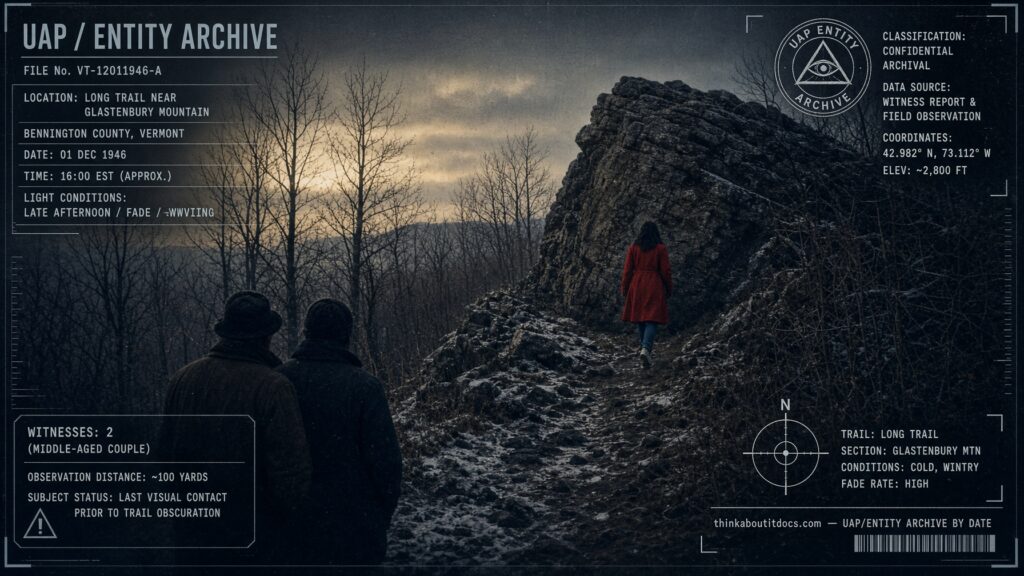
December 1, 1946 — Long Trail, Bennington, Vermont. Bennington College sophomore Paula Welden rounded a bend on a well-traveled trail in full view of witnesses 100 yards behind her — and was never seen again.
THINK ABOUTIT UFO SIGHTINGS REPORT
1946: The Disappearance of Paula Welden — Bennington Triangle
A college sophomore told her roommate she needed a break from studying and went for a walk. An hour and a half later, a couple strolling a hundred yards behind her watched her round a bend in the trail — and when they reached the same bend themselves, she was simply gone. No struggle. No trace. No red coat found anywhere in the woods. Paula Welden‘s disappearance triggered the largest search in Vermont history, led directly to the founding of the state’s first police force, and turned a one-year-old missing hunter into the opening chapter of one of America’s most enduring unsolved mysteries.
Date: December 1, 1946
Sighting Time: Last confirmed sighting approximately 16:00
Day/Night: Late afternoon, fading light
Location: The Long Trail, near where it crosses Vermont Route 9, close to Glastenbury Mountain, Bennington County, Vermont
Urban or Rural: Rural wilderness trail
No. of Entity(s): Not Applicable
Entity Type: Not Applicable — no entity or paranormal element directly witnessed; included in this archive for its status within the Bennington Triangle high-strangeness cluster (see Researcher’s Notes)
Entity Description: Not Applicable
Hynek Classification: Not Applicable — missing-person case, not a UFO or aerial sighting
Duration: Not Applicable
No. of Object(s): Not Applicable
Description of the Object(s): Not Applicable
Number of Witnesses: Multiple people saw Welden alive along her route that afternoon, including a motorist who gave her a ride, hikers who gave her directions and cautioned her about the fading light, and a middle-aged couple who were the last to see her, watching her disappear around a rocky outcropping roughly 100 yards ahead of them
Special Features/Characteristics: No physical trace of Welden — not a thread of her distinctive red coat, not a footprint — was ever recovered despite an extensive, sustained search involving hundreds of volunteers, Bennington and Williams College students, local residents, aircraft conducting grid searches, and eventually the FBI; the case’s second most significant legacy, after the mystery itself, is institutional: public criticism of the disorganized initial search response (Vermont had no state police force in 1946) led directly to the Vermont legislature establishing the Vermont State Police in 1947; the case inspired Shirley Jackson’s 1951 novel Hangsaman and remains a subject of ongoing books, documentaries, and academic interest; Welden was declared dead in absentia, but her case remains officially open and unsolved.
Case Status: Unexplained
Source: Contemporary 1946-47 press coverage (Bennington Banner and national wire services); Vermont State Police official cold case file; Michael C. Dooling, Clueless in New England: The Unsolved Disappearances of Paula Welden; The Charley Project; New England Historical Society; corroborating detail across multiple independent historical and true-crime sources
Related Cases: 1946: December UFO & Entity Sightings Archive | 1945: Glastenbury Mountain — The Disappearance of Middie Rivers (first case in the same cluster, thirteen months earlier)
Detailed Report
Paula Jean Welden was born October 19, 1928, in Stamford, Connecticut, the eldest of four daughters of industrial designer William Archibald Welden and his wife Jean. A 1945 graduate of Stamford High School, she was in her sophomore year at Bennington College, studying fine arts with a developing interest in botany.
On Sunday, December 1, 1946, Welden worked her usual breakfast and lunch shifts at the college dining hall, then returned to her dormitory, Dewey House, where she spoke with her roommate, Elizabeth Johnson. Welden told Johnson she was finished with studying for the day and wanted to take a long walk. She left campus around 2:45 PM, wearing a distinctive bright red coat with a fur collar, blue jeans, and lightweight sneakers — clothing poorly suited to the cold December weather setting in that afternoon. She carried little or no money and left behind an uncashed check her parents had sent her, suggesting she expected to return within a few hours.
Welden hitchhiked from near campus and was picked up by a motorist around 2:45-3:00 PM, who dropped her off on Route 9 near the entrance to the Long Trail, roughly three miles from where she intended to hike. Multiple witnesses saw her over the following hour: she spoke with a group of hikers, including Ernie Knapp and companions, who were returning from a camping trip; they gave her directions and specifically cautioned her that she was not well dressed for the conditions and that daylight would soon fade. She was also seen by a lumberjack named Fred Gadette, who was arguing with his girlfriend on Harbour Road at the time, and by others along the trail.
The last confirmed sighting came from a middle-aged couple walking the trail roughly 100 yards behind Welden. They watched her round a bend near a rocky outcropping ahead of them. When they reached the same point moments later, she was nowhere in sight, and the trail beyond offered no indication of which direction she might have gone. She was never seen or heard from again.
Welden’s absence was not noticed until the next morning, when her roommate realized she had never returned; Bennington College required students to sign out for absences past 11 PM, and Welden had done neither that nor checked in. College officials notified her parents, and her father rushed from Connecticut to organize a search, eventually raising a $5,000 reward. The search grew to include hundreds of volunteers, Bennington and Williams College students (with classes suspended to allow participation), local residents, the Boy Scouts, aerial searches conducted by grid pattern, and eventually the FBI. A bulldozer was brought in to dig out a gravel pit where she had reportedly been seen. Despite all of this, absolutely no physical trace of Welden was ever recovered — no clothing, no footprint, nothing.
In the weeks following the disappearance, numerous reported sightings of Welden emerged from around the country — a waitress in Fall River, Massachusetts who believed she had served her the following day; a train conductor who thought he saw her in South Carolina — but every lead was investigated and none held up. A private investigator hired by a Stamford newspaper, Raymond Schindler, came to believe Welden had likely been the victim of foul play, though no evidence was ever found to support this or any other specific theory. One alternate theory holds that Welden, dropped off near a road sign that could have directed her to either of two trails both called “Long Trail,” may have mistakenly headed onto the unfamiliar second trail rather than the one she intended — though heavy snow that winter prevented investigators from thoroughly searching that area.
The public outcry over the initial search’s disorganization — Vermont had no dedicated state police force in 1946, relying instead on county sheriffs — became a significant factor in the Vermont legislature’s decision to establish the Vermont State Police in 1947, directly attributable to this case. Welden’s story also inspired author Shirley Jackson’s second novel, Hangsaman (1951), and remains a frequently cited case in true-crime literature, cold-case journalism, and regional Vermont history to this day. She was eventually declared dead in absentia, though her case remains officially open.
RESEARCHER’S NOTES
The Second Stone in the Bennington Triangle
- On why this case belongs alongside Middie Rivers’s: Exactly one year and nineteen days after 74-year-old hunting guide Middie Rivers vanished near the same general area of Glastenbury Mountain, Paula Welden disappeared under strikingly similar circumstances: an experienced-enough walker, familiar terrain by local standards, broad daylight, witnesses in close proximity moments before vanishing, and a total absence of any physical trace despite an intensive search. Rivers’s case alone might read as an isolated tragedy involving an elderly man in demanding wilderness terrain. Welden’s case — a young, capable college student, on a well-traveled recreational trail, seen continuously by multiple witnesses right up until the final moment — is much harder to explain by the same “got lost, succumbed to exposure” theory that investigators initially favored for Rivers. Together, these two cases are what transformed a single strange disappearance into a recognized pattern, three more instances of which would follow by 1950.
- On why this case, specifically, is treated as belonging on a UFO/high-strangeness archive: As with the Rivers case, this report is direct that no primary source establishes any UFO, aerial phenomenon, or paranormal element in Welden’s actual disappearance. Its inclusion here reflects the same reasoning applied to Rivers: Glastenbury Mountain and the surrounding region carry an independently documented reputation for UFO sightings, unexplained lights, and cryptid folklore (the “Bennington Monster”) that predates and postdates both disappearances, and the broader “Bennington Triangle” concept — which explicitly groups this case with four others as a single unexplained regional phenomenon — is itself a significant piece of American paranormal folklore regardless of whether any individual case within it has a mundane explanation.
- On the strength of the mundane explanation, weighed honestly: Unlike some entries in this archive, Welden’s case has a genuinely plausible conventional explanation on the table: exposure death in rugged winter terrain, in inadequate clothing, is a real and common cause of hiker fatalities, and Vermont’s mountain wilderness is large enough that a body could plausibly go unrecovered, especially given the heavy snowfall that winter limited search efforts in at least one area investigators later flagged as under-searched. What makes the case remain genuinely puzzling rather than simply tragic is the total absence of any trace whatsoever — not clothing, not equipment, nothing — combined with witnesses situated so close behind her at the moment she vanished.
- On the case’s unusually strong documentation: Compared to Middie Rivers’s case, which survives primarily through regional folklore compilation, Welden’s disappearance was a major contemporaneous national news story, generating an extensive paper trail: press coverage, an official Vermont State Police case file still maintained today, a dedicated modern investigative book (Dooling’s Clueless in New England), and ongoing academic and journalistic interest. This is one of the best-documented individual missing-person cases in this entire archive’s chronological span, whatever ultimately happened to her.
Paula Welden went for a walk on a Sunday afternoon and became a case that changed how an entire state polices itself, inspired a major American novelist, and anchored one of the country’s most durable unsolved mysteries — all without a single trace of her ever being found. Thirteen months after Middie Rivers walked into the same stretch of Vermont wilderness and never walked out, the pattern had a name people would still be using eighty years later.