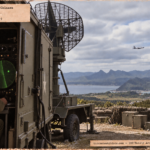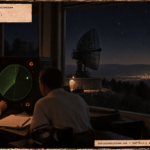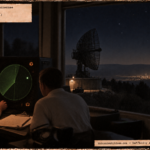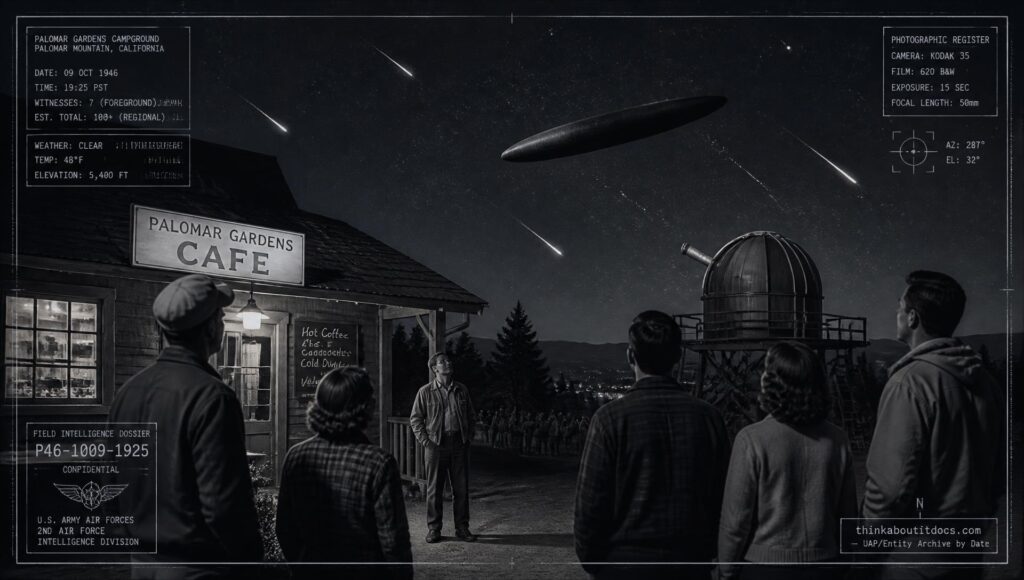
October 9, 1946 — Palomar Gardens, California. Hundreds of San Diego-area witnesses saw a dark, cigar-shaped object during a meteor shower — the night that started George Adamski on the path to becoming America's first famous UFO contactee.
THINK ABOUTIT UFO SIGHTINGS REPORT
1946: Palomar Gardens — The Night the Contactee Movement Began
On a single October night during a meteor shower, hundreds of people across San Diego watched something large and dark maneuver in the sky for over an hour. Local radio stations took calls about it in real time. A trance medium tried to talk to it telepathically. And a struggling philosophy teacher running a small mountain campground stood outside his cafe and watched with everyone else — not knowing that this one night would eventually make him the most famous, and most controversial, UFO contactee in American history.
Date: October 9, 1946
Sighting Time: 19:25, during an annual meteor shower
Day/Night: Night
Location: Palomar Gardens campground, at the base of Palomar Mountain, California, with additional witnesses across the broader San Diego area
Urban or Rural: Rural (Palomar Gardens) and urban (San Diego proper, where medium Mark Probert reported his own sighting)
No. of Entity(s): Not Applicable — no occupants observed during this specific sighting
Entity Type: Not Applicable
Entity Description: Not Applicable
Hynek Classification: NL — Nocturnal Light, bordering on DD (Daylight Disc equivalent given the object’s structural visibility). A large, dark object was observed maneuvering at night with some structural detail resolved (cigar/dirigible-like shape), but no landing, physical trace, or entity was reported during this specific event.
Duration: Approximately 95 minutes
No. of Object(s): 1 primary object reported by the majority of witnesses; Mark Probert’s separate account in San Diego proper described a “winged flying machine with red lights,” which may represent either the same object viewed differently or a distinct sighting during the same general event window
Description of the Object(s): Described by Adamski as “a large black object, similar in shape to a gigantic dirigible, and apparently motionless.” Other period accounts describe it as bat-like or cigar-shaped, hovering and maneuvering rather than moving in a fixed trajectory.
Shape of Object(s): Cigar/dirigible-shaped, per the most common description
Size of Object(s): Not precisely recorded; described as “large” and “gigantic” by witnesses, though these terms were not translated into any specific measurement
Color of Object(s): Black/dark
Distance to Object(s): Not precisely recorded across the various witness accounts
Height & Speed: Described as hovering and maneuvering rather than following a fixed high-speed trajectory, distinguishing it in witnesses’ minds from the meteors that were simultaneously visible that same night
Number of Witnesses: Hundreds across the San Diego area, including callers to local radio stations reporting the object in real time; specifically named witnesses include George Adamski (at Palomar Gardens) and trance medium Mark Probert (in San Diego proper)
Special Features/Characteristics: This sighting is widely credited within ufological history as the founding event of the American UFO “contactee” movement — the San Diego area, and Palomar Gardens specifically, are frequently described by historians of the movement as its literal birthplace; the event was reported the same night on local radio and in period press including the Los Angeles Daily News, according to some accounts; the sighting coincided with a natural meteor shower, raising the standing possibility that at least some portion of what was reported by the wider public that night was misidentified meteor activity, even if the core object described by multiple witnesses as hovering and maneuvering does not fit a meteor’s fixed ballistic behavior; George Adamski did not publicly capitalize on this sighting for years — his first UFO photograph was not taken until early 1947, and his famous personal contact claims did not begin until November 1952.
Case Status: Disputed
Source: Borderland Sciences Research Association (BSRA), founded by Meade Layne in San Diego, 1946, and its Round Robin journal; George Adamski, Flying Saucers Have Landed (with Desmond Leslie, 1953); Håkan Blomqvist, historical research drawing on BSRA archives; multiple period and retrospective ufological histories
Related Cases: 1946: October UFO & Entity Sightings Archive
Detailed Report
On the evening of October 9, 1946, during an annual meteor shower, hundreds of residents across the San Diego, California area reported an unusual object in the night sky — large, dark, and behaving in a manner distinct from the meteors also visible that night. Local radio stations reportedly took calls from the public in real time as the sightings unfolded, and the event was covered in period press.
Among the witnesses was George Adamski, at the time an obscure teacher of Eastern philosophy and mysticism who, with his wife, ran a small campground and diner called Palomar Gardens at the base of Palomar Mountain — not affiliated with, but often mistaken by tourists for being connected to, the famous Palomar Observatory near the mountain’s peak. Adamski later described the object in his 1953 book Flying Saucers Have Landed as “a large black object, similar in shape to a gigantic dirigible, and apparently motionless,” and wrote that the sighting marked the first time the idea of interplanetary travel by “man-made ships” had seriously entered his thinking.
Separately, in San Diego proper, trance medium Mark Probert reported his own sighting that same night — a “strange winged flying machine with red lights.” Probert was closely associated with Meade Layne, founder of the Borderland Sciences Research Association (BSRA), a San Diego-based organization blending Fortean research with spiritualist and mediumship practices. On Layne’s advice, delivered by telephone, Probert attempted telepathic communication with the object. This event, along with Adamski’s, is documented in BSRA’s own journal, Round Robin, which historians researching the earliest years of American ufology have identified as a key primary source for understanding how the contactee movement took shape.
Adamski did not immediately capitalize on the October 1946 sighting. His first claimed UFO photograph — of what he said was the same “mother ship” passing in front of the Moon — was not taken until early 1947. His famous personal contact narrative, describing a face-to-face meeting with a Venusian named Orthon in the California desert, did not begin until November 20, 1952, more than six years after this initial sighting. By the time that later story became internationally famous, published in Flying Saucers Have Landed, Adamski had become both a celebrity within the emerging UFO contactee subculture and a subject of serious skepticism from mainstream ufological investigators.
Air Force Captain Edward J. Ruppelt, who ran Project Blue Book, personally investigated Adamski’s later claims and reportedly compared him to the showman P.T. Barnum, concluding Adamski was a skilled con artist. Former associates of Adamski, including Jerrold Baker, who had worked with him at Palomar Gardens, later told investigators that Adamski’s famous 1952 desert meeting had been a planned, staged operation rather than a genuine encounter, and that photographic “evidence” from the era had been produced using ordinary props found around the property.
RESEARCHER’S NOTES
Separating the Sighting from the Mythology It Produced
On why this case demands unusually careful handling: Few cases in this archive present as sharp a split between the strength of the underlying event and the credibility of what one witness later built on top of it. The October 9, 1946 sighting itself — hundreds of independent witnesses, same-night radio coverage, corroboration from a completely separate witness (Probert) in a different part of the city, and a real, well-documented meteor shower providing independent astronomical context for the date — is a genuinely well-attested mass sighting event by the standards of 1940s ufology. George Adamski’s subsequent six-year journey from bystander at that event to internationally famous, and later widely discredited, contactee is a separate historical development that should not be allowed to retroactively delegitimize the 1946 sighting itself, nor should the 1946 sighting’s relative credibility be used to launder Adamski’s later, far more thoroughly debunked claims.
On the meteor shower coincidence: A genuine, documented meteor shower occurring the same night is a legitimate and important piece of context. It’s entirely plausible that some portion of the “hundreds of witnesses” that night were, at least in part, observing ordinary meteor activity, especially those who saw only brief lights rather than the sustained, maneuvering, dark object described by Adamski, Probert, and other more detailed accounts. This archive doesn’t resolve that ambiguity, but flags it as the most obvious mundane candidate explanation for at least part of the night’s reports.
On why the BSRA connection matters historically, independent of the sighting’s truth value: Whatever actually appeared in the sky that October night, the fact that it was witnessed and processed through the specific lens of Meade Layne’s Borderland Sciences Research Association — an organization already primed by its spiritualist and Fortean interests to interpret aerial phenomena through a contact/communication framework — is directly relevant to understanding why the American UFO movement developed a contactee culture as early and as fully as it did. The infrastructure for interpreting a strange light as an attempt at communication already existed in San Diego before the “flying saucer” term was even coined the following June.
On weighing Adamski’s later exposure against this earlier case: The specific, named testimony of former associates like Jerrold Baker — describing planned operations and prop-based photography — represents some of the more direct debunking evidence available anywhere in the contactee literature, and it should be taken seriously precisely because it comes from people who worked closely with Adamski rather than outside skeptics. That evidence bears directly on Adamski’s 1952 and later claims. It does not, on its own, prove that Adamski or anyone else fabricated what they described seeing on October 9, 1946, a night when he was one witness among a much larger, independently corroborated group.
A meteor shower, a dark shape in the sky, hundreds of ordinary people calling their local radio station to ask what they’d just seen — and one man at a small mountain cafe who would spend the rest of his life turning that single night into a career, a mythology, and eventually a cautionary tale. Whatever hovered over San Diego that October evening in 1946, it set something in motion that outlived the truth of any single account of it.