November 12, 1945 — Bickford Hollow, Glastenbury Mountain, Vermont. Veteran guide Middie Rivers walked ahead of his hunting party into trees he'd known for decades — and was never seen again.
THINK ABOUTIT UFO SIGHTINGS REPORT
1945: Glastenbury Mountain — The Disappearance of Middie Rivers
A 74-year-old woodsman who knew a Vermont mountain better than anyone alive walked a few hundred yards ahead of his own hunting party on a mild November afternoon — and was never seen again. No body. No struggle. No animal kill. Just one unfired cartridge on a creek bank, and a legend that would grow to swallow four more people over the next five years. This is the case that started the Bennington Triangle.
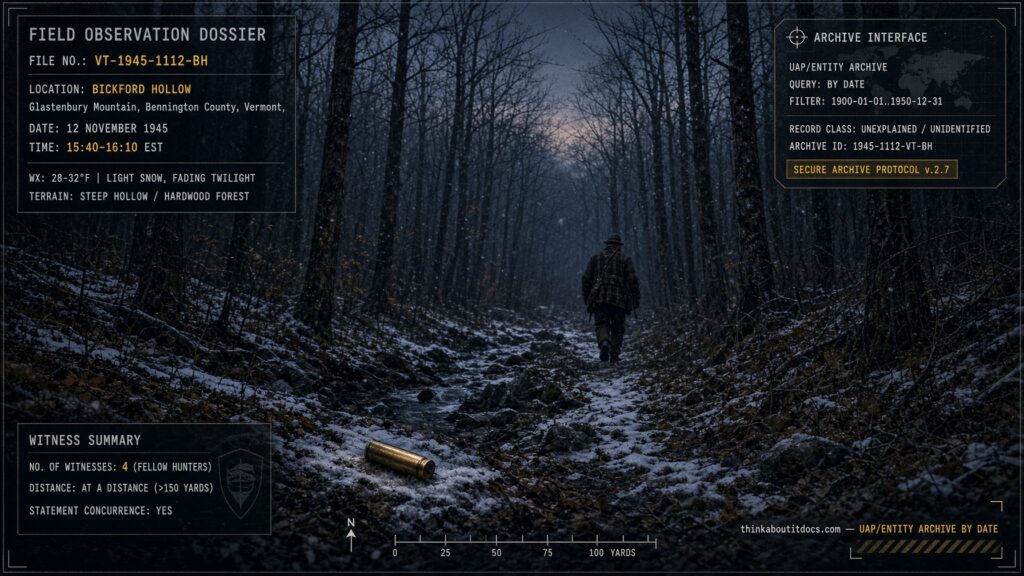
Date: November 12, 1945
Sighting Time: Approximately mid-to-late afternoon
Day/Night: Day
Location: Glastenbury Mountain, Bennington County, Vermont, near Bickford Hollow (also referred to in some accounts as Hell Hollow), roughly four miles west of Bennington proper
Urban or Rural: Rural/wilderness — remote, sparsely populated forest, largely unincorporated since 1937
No. of Entity(s): Not confirmed — see Special Features
Entity Type: Not Applicable — no entity was directly witnessed; some secondary accounts report Rivers said he “saw something” moments before disappearing, but no description survives
Entity Description: Not Applicable
Hynek Classification: Not applicable — this is a missing-person case with no direct aerial or entity observation confirmed by primary sources; included in this archive for its status as the founding case of the Bennington Triangle and Glastenbury Mountain’s independently documented association with UFO and high-strangeness activity.
Duration: Rivers separated from his party during the return to camp; the exact interval before his absence was noticed is not precisely recorded, but appears to have been well under an hour, given he was expected for lunch
No. of Object(s): Not Applicable
Description of the Object(s): Not Applicable
Number of Witnesses: 4 — the other hunters in Rivers’s party, none of whom directly witnessed his disappearance; one companion reportedly spotted him at a distance on a nearby trail walking in the opposite direction from camp shortly before he vanished
Special Features/Characteristics: Rivers was an exceptionally experienced local guide, in confirmed good health, walking terrain he had covered for decades — ruling out the most common mundane explanations (disorientation, medical emergency in unfamiliar terrain) that typically apply to missing-hiker cases; the search, involving roughly 300 volunteers and U.S. Army personnel dispatched from Fort Devens, Massachusetts, found no trace of Rivers, no signs of struggle, and no evidence of animal predation, over eight days of searching; the single unexpended cartridge found on a creek bank, matching Rivers’s own ammunition, is the only physical trace ever recovered; Rivers’s case became, retroactively, the first of five disappearances in the same general area over the following five years (Paula Jean Welden, 1946; James E. Tetford, 1949; Paul Jepson, 1950; Frieda Langer, 1950 — the only one of the five whose remains were eventually recovered), collectively named the “Bennington Triangle” by Vermont folklorist Joseph A. Citro; Glastenbury Mountain independently carries a long-documented local reputation, predating 1945, for unexplained lights, aerial phenomena, and a Bigfoot-type cryptid known as the “Bennington Monster,” reportedly described as far back as the early 1800s.
Case Status: Unexplained
Source: Regional press coverage, Bennington Banner and other Vermont newspapers, November-December 1945; Joseph A. Citro, Green Mountains, Dark Tales (1994) and Shadow Child; Legends of America; corroborating detail from multiple independent Vermont folklore, true-crime, and paranormal-research compilations
Related Cases: 1945: November UFO & Entity Sightings Archive
Detailed Report
By November 1945, Glastenbury and its neighboring township of Somerset had been unincorporated ghost towns for eight years, their populations long since dispersed after the local logging industry collapsed. What remained was dense, remote Vermont wilderness — exactly the kind of terrain that draws experienced hunters and guides, including Middie Rivers, a 74-year-old lifelong resident of the area who had spent decades leading hunting and fishing parties through its trails.
On November 12, with unseasonably mild weather that made it hard to believe Thanksgiving was only two weeks away, Rivers led a party of four hunters into the woods near Bickford Hollow. Rivers’s own recent physical examination had confirmed him to be in excellent health for his age, and by every account he was as capable a woodsman as the region had. As the group made its way back toward camp for lunch, Rivers, moving faster or more directly than the others, got ahead of the party. At least one companion reported spotting him at a distance on a nearby trail — walking, notably, in the opposite direction from camp. He was never seen again.
The disappearance triggered one of the larger search efforts the region had seen, ultimately involving roughly 300 volunteers alongside U.S. Army personnel dispatched from Fort Devens, Massachusetts. For eight days, searchers combed the wilderness around Bickford Hollow and the broader Glastenbury area. They found nothing — no body, no clothing, no signs of a struggle, no indication of animal predation. The single piece of physical evidence recovered in the entire search was one unexpended rifle cartridge, found on the bank of a nearby creek, believed by investigators to have come from Rivers’s own bullet belt based on the ammunition type. After more than a month of effort, the search was called off. As the final search party made its way home in the fading light, the season’s first snowfall began.
Rivers’s case did not initially attract the kind of legendary status it would eventually acquire. That came later, as four more disappearances followed in the same general area over the next five years — most notably Bennington College student Paula Jean Welden in December 1946, whose case drew far larger search efforts and FBI involvement — leading Vermont folklorist and author Joseph A. Citro to formally name the pattern the “Bennington Triangle” in his 1990s writing. Citro’s research also documented the area’s older reputation, predating any of the 1945-1950 disappearances: local Abenaki tradition reportedly regarded Glastenbury Mountain as cursed ground where “the four winds met,” and 19th-century settlers reported a large, hairy, aggressive creature — the “Bennington Monster” — along with recurring accounts of strange lights and aerial phenomena that continue to be reported in the area to the present day.
RESEARCHER’S NOTES
A Disappearance With No UFO in It — And Why It’s Here Anyway
- On why this case appears on a UFO archive at all: Stated plainly, there is no primary source establishing that Middie Rivers’s disappearance itself involved a UFO, an aerial phenomenon, or any entity encounter. What this archive can honestly say is that his case is the founding event of a location — Glastenbury Mountain — with an independently and separately documented reputation for exactly those phenomena, going back well before 1945. The connection between Rivers’s disappearance and the area’s UFO/cryptid folklore is associative, made by later writers connecting the disappearances to the location’s broader strangeness, not evidentiary. This report treats that distinction carefully rather than implying the disappearance was itself paranormal in nature.
- On the “saw something and ran after it” detail: This detail appears in some later secondary retellings but not in the earliest press coverage of the case, which raises the standard concern about details accumulating in a story over decades of retelling. This report includes it as a noted secondary claim, not as an established fact of the original 1945 case.
- On why the case is still genuinely puzzling, UFOs aside: Set the paranormal framing aside entirely, and Rivers’s disappearance remains a legitimately hard case to explain through ordinary means. He was not a novice hiker who could plausibly have gotten lost — he was, by every account, the single most experienced woodsman in the immediate area, walking terrain he’d covered for decades, in good health, in mild weather, in daylight, only a short distance from his own party. An eight-day search by hundreds of people, including soldiers, found no trace of him at all. Cases involving experienced local guides vanishing without any explanatory evidence are genuinely unusual, independent of any UFO connection.
- On the pattern that followed: Whatever happened to Rivers, the fact that four more people vanished from roughly the same small area over the following five years — with only one body ever recovered — is itself the more statistically striking part of the story. A single disappearance, however unexplained, could plausibly be an isolated tragedy. A cluster of five, concentrated in one small wilderness area over five years, is the kind of pattern that invites exactly the folklore it received.
Middie Rivers walked into trees he’d known his whole life and did not walk back out. No body was ever found. No explanation was ever confirmed. Whatever the true cause — misadventure, foul play, or something this archive cannot verify — his disappearance opened a five-year chapter of unexplained loss on Glastenbury Mountain that has never been closed.