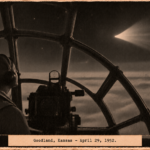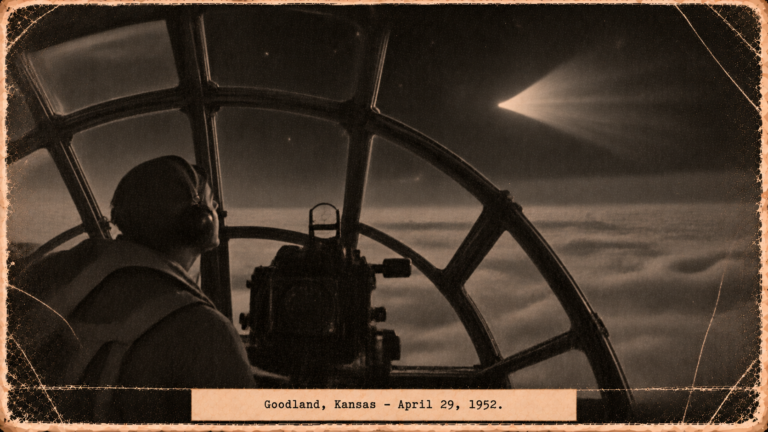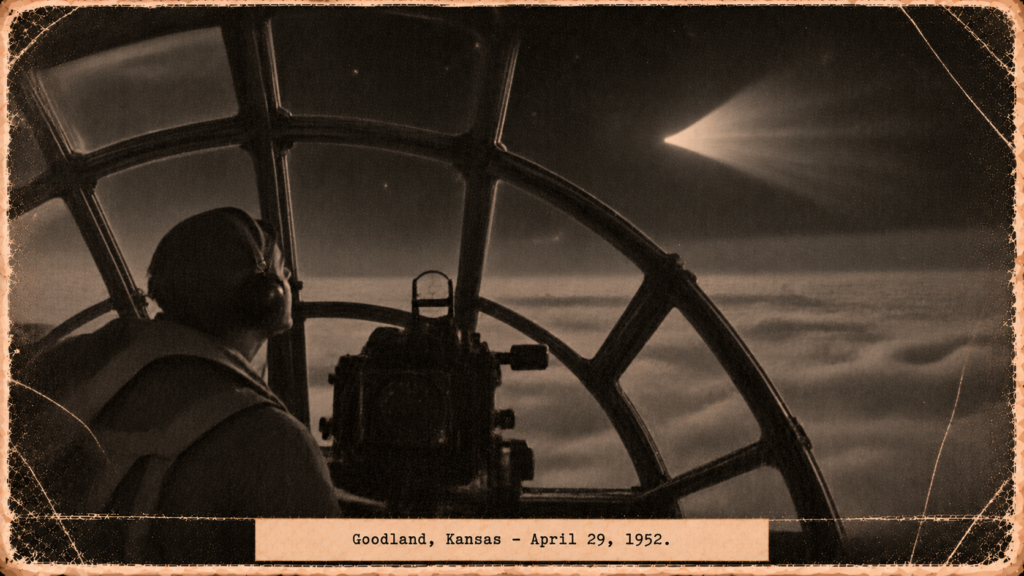
A B-29 bombardier sees a fan-shaped light north of Goodland, April 29, 1952.
THINK ABOUTIT UFO|UAP SIGHTINGS REPORT
1952: A B-29 Bombardier at 30,000 Feet Watches a Pulsing, Fan-Shaped White Light Cross Overhead in Two Seconds North of Goodland, Kansas
At 10:00 p.m. CST on April 29, 1952, a lieutenant serving as bombardier in the nose of a B-29 of the 321st Bombardment Squadron, 90th Bomb Wing, was cruising east at 30,000 feet about 15 miles north of Goodland, Kansas, above a solid 10/10 undercast. The sky above was clear except for slight haze, and the stars and moon were plainly visible.
Directly ahead and at 45 degrees elevation he saw a soft white, fan-shaped light about 5,000 feet above, traveling very rapidly west toward the aircraft and pulsing three to four times a second. It passed overhead in about two seconds and was blocked from view by the airframe. No other crew member saw it, no sound was heard, and Kansas City Air Traffic Control had no other aircraft in the area. Blue Book lists this Goodland, Kansas UFO case as Unidentified.
Date: April 29, 1952
Sighting Time: 10:00 p.m. CST (2200 hours)
Day/Night: Night; moon and stars visible
Location: 15 miles north of Goodland, Kansas (about 39°36’N, 101°40’W), in flight
Urban or Rural: Airborne above an undercast
No. of Entity’s: Not Applicable
Entity Type: Not Applicable
Entity Description: Not Applicable
Hynek Classification: NL (Nocturnal Light)
Duration: About 2 seconds
No. of Object(s): 1
Description of the Object(s): A soft white, fan-shaped light that pulsed at an estimated 3 to 4 times per second; the base and sides of the fan were sharply defined and the trailing edge indefinite
Shape/Size/Color of Object(s): Fan shape; the base appeared about 50 feet across, widening to 100–150 feet at the trailing edge; soft white
Distance to Object(s): About 5,000 feet above the aircraft at 45 degrees elevation
Height & Speed: Object about 5,000 feet above the B-29, which was cruising at 30,000 feet pressure altitude on an easterly heading; the light traveled very rapidly westward and passed overhead in about 2 seconds (no speed figure given)
Number of Witnesses: 1 (a bombardier in the nose compartment; no other crew member saw it)
Special Features/Characteristics: Light only, no visible fuselage; pulsing 3 to 4 times a second; no audible sound or radio interference; no interphone check made at the time
Case Status: Blue Book: Unidentified
Source: Air Intelligence Information Report (Director of Intelligence, 90th Bomb Wing, Forbes AFB, May 9, 1952); Project Blue Book record card; Blue Book April list; Berliner; Project 1947
Summary/Description: A B-29 bombardier at 30,000 feet saw a pulsing white fan-shaped light cross from his front to overhead in two seconds. ATC records showed no other traffic and a university astronomy check found nothing natural.
Related Cases: Great Blue Hill wobbling objects (April 24, 1952); Bellevue Hill C-124 crew (April 24, 1952); April 1952 archive
Detailed Report
The Air Intelligence Information Report, from the Director of Intelligence of the 90th Bombardment Wing at Forbes AFB, Topeka, was prepared on May 9, 1952 by Lt. Col. George A. Hanseiman (as read from the scan) and covers an observation of April 29, 1952. It states that the sighting was reported to the Director of Intelligence on May 5, 1952 by a 1st Lieutenant of the 321st Bombardment Squadron, a B-29 bombardier. The evaluation is B-2. Three enclosures are listed: two sketches and an annotated map of the area.
The report says the sighting took place at 2200 CST on April 29, 1952, at a position 15 miles north of Goodland, Kansas. The bombardier states that he was in the bombardier’s nose compartment and that the aircraft was cruising at 30,000 feet pressure altitude on an easterly heading just above a 10/10 undercast. The sky above was clear except for a slight haze through which the stars and moon were clearly visible.
He then noted directly ahead and at a 45-degree elevation a soft white fan-shaped light approximately 5,000 feet above, traveling very rapidly in a westerly direction toward the aircraft. The light pulsed at an estimated 3 to 4 times per second and passed overhead with great speed in about 2 seconds, after which observation was blocked by the B-29 airframe. The light only was seen, with no visible fuselage. The base and sides of the fan were sharply defined and the trailing edge was indefinite. The base appeared approximately 50 feet across, extending to 100–150 feet at the trailing edge.
No audible sound was heard, nor any radio interference noted. No interphone check was made at the time, but subsequent questioning of the crew by the observer indicates that no other crew member saw the object.
Investigation of possible meteoric or other natural phenomena with the Department of Astronomy at Washburn University in Topeka produced negative results, and no unusual activity was reported by that source. The Kansas City Air Traffic Control Center reported that no other air traffic other than the observer’s B-29 was in the area at the time according to its records.
The Project Blue Book record card marks it air-visual, source AF bombardier, 2 seconds, 1 object, white, fan shape, straight and level, with the conclusion Unknown. Its comments repeat that the bombardier saw a fan-shaped light that pulsed 3 to 4 times a second, passed the B-29, and that no other air traffic was in the air.
RESEARCHER’S NOTES
A Two-Second Pass, One Witness and an Empty Sky
- One Witness in a Crew. The report says no other crew member saw it, but also that no interphone check was made at the time; the other crew were asked afterward. A two-second pass from a nose position may not have been visible from other stations.
- No Speed Figure. The report gives a heading (westward) and a time (about 2 seconds) but no speed. The 5,000-foot height is the bombardier’s own estimate.
- Checks Made. The astronomy department at Washburn University found nothing natural, and Kansas City ATC had no other aircraft. Those are the two explanations the report rules out; it does not mention balloons, a flare or a meteor beyond the astronomy check.
- Time Zone. The record card says 2200 PST while the report says CST; the card’s GMT entry (0400 on April 30) matches 2200 CST.
Goodland is a short, well-documented incident: a trained observer in a position to see forward and up, a specific description of a shape and a pulse rate, a ground check with ATC and an astronomy department, and no explanation. That is why it sits among April’s Unidentified cases.
«a soft white fan-shaped light approximately 5,000 feet above, traveling very rapidly in a westerly direction toward the aircraft.»
— Air Intelligence Information Report, 90th Bomb Wing, Forbes AFB, May 9, 1952