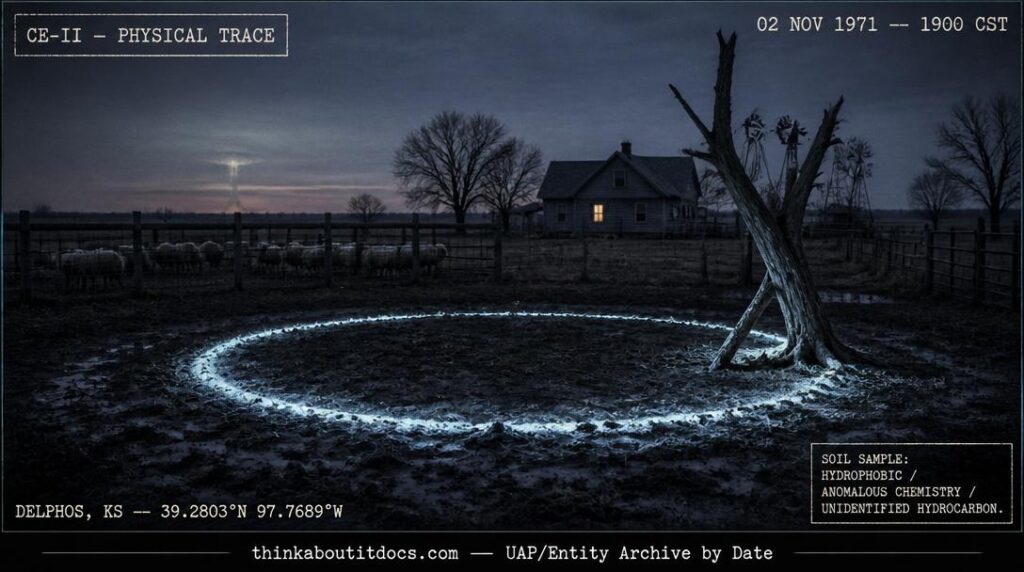
The Delphos Ring — a pale, crusted band of chemically altered soil that remained dry under snow for over a month — is one of the most documented physical traces in UFO history.
THINK ABOUTIT UFO|UAP SIGHTINGS REPORT
1971: Delphos, Kansas Landing Ring
When sixteen-year-old Ronald Johnson touched his parents on the arm and told them something was hovering in the tree grove behind their Kansas farmhouse, he set in motion one of the most thoroughly investigated physical trace cases in UFO history. What the Johnson family found at the site — a glowing ring burned into the earth, luminescent material on the surrounding trees, and soil so profoundly altered that it remained bone-dry under a foot of snow thirty-two days later — would survive multiple independent laboratory analyses, law enforcement investigation, and decades of scientific scrutiny without yielding a satisfactory conventional explanation. The Delphos Ring case is not famous because of what Ronald Johnson saw in the sky. It is famous because of what was left behind on the ground.
Date: November 2, 1971
Sighting Time: Approximately 7:00 PM CST
Day/Night: Night
Location: Johnson family farm, near Delphos, Ottawa County, Kansas, United States
Urban or Rural: Rural
No. of Entity(‘s): None reported
Entity Type: N/A
Entity Description: N/A
Hynek Classification: CE-II (Close Encounter II) — object observed at close range with physical traces left at the site
Duration: Several minutes (observation); physical traces persisted for months
No. of Object(s): 1
Description of the Object(s): Mushroom-shaped craft with a short stem, approximately nine feet in diameter and ten feet tall. Entire surface covered with multicolored lights. Object hovered approximately two feet above ground, became extremely bright at the base upon departure, and emitted a vibrating mechanical sound.
Shape of Object(s): Mushroom (domed top with short stem)
Size of Object(s): Approximately 9 feet diameter, 10 feet tall
Color of Object(s): Multicolored (surface covered in lights of varying colors)
Distance to Object(s): Approximately 25 yards (75 feet) from the witness
Height & Speed: Hovering approximately 2 feet above ground; departed at an angle at high speed
Number of Witnesses: 3 primary (Ronald Johnson, Durel Johnson, Erma Johnson) plus 1 corroborating (Lester Ensbarger, 11 miles away in Minneapolis, KS)
Special Features/Characteristics: Glowing ring left on ground approximately 8 feet in diameter. Ring soil was bone-dry to at least 12 inches depth while surrounding ground was muddy. Luminescent material found on nearby trees. Physical contact with ring soil caused numbness in Mrs. Johnson’s fingers lasting approximately two weeks. Soil resistant to water absorption. Soil contained unidentified hydrocarbons, elevated calcium, increased acidity, and white crystal-like organic fibers. Ring visible 32+ days post-event. Broken tree limbs and a downed dead Chinese elm at site. Dog was unusually quiet; sheep bleated nervously.
Case Status: Unexplained
Source: Ted Phillips, MUFON Journal #209 (Sept 1985); Phyllis Budinger, MUFON Journal #427 (Nov 2003); Loy Lawhon, About.com; Mike Dash, Borderlands; Jacques Vallée, Dimensions; Ottawa County Sheriff’s Office report; Thaddia Smith, The Delphos Republican
Summary/Description: On the evening of November 2, 1971, sixteen-year-old Ronald Johnson observed a mushroom-shaped, multicolored-light-covered object hovering two feet off the ground in a tree grove on his family’s farm near Delphos, Kansas. The object departed with a blinding flash from its base. Ronald and his parents subsequently discovered a glowing ring on the ground and luminescent material on nearby trees. The ring soil was profoundly altered — dry, crusted, water-resistant, chemically anomalous — and physical contact caused numbness. Multiple independent investigations, including soil analysis, confirmed the anomalous physical traces. A corroborating witness eleven miles away observed a bright descending light at the same time.
Related Cases: 1964: Socorro, New Mexico (Zamora) | 1967: Falcon Lake, Manitoba (Michalak) | 1981: Trans-en-Provence, France
Detailed Report
On the evening of November 2, 1971, sixteen-year-old Ronald Johnson was tending sheep on his family’s farm near the small town of Delphos in Ottawa County, Kansas. At approximately 7:00 PM, Ronald and his dog Snowball were startled by an object hovering roughly two feet off the ground in a grove of trees about twenty-five yards from where he stood. The object was mushroom-shaped — a domed upper structure with a short stem — approximately nine feet in diameter and ten feet tall. Its entire surface was covered in multicolored lights. Ronald described the sound it produced as resembling “an old washing machine which vibrates.”
As Ronald watched, the object suddenly became extremely bright at its base and ascended at an angle, temporarily blinding the boy. He noted that his dog remained unusually quiet during the encounter, while the sheep in the nearby pen were bleating nervously. After several minutes, as his vision recovered, Ronald went into the house and told his parents, Durel and Erma Johnson, what he had seen. The family went outside and were able to observe the object, now reduced to approximately half the apparent size of a full moon, before it vanished into the sky to the south.
The Johnsons then walked to the spot where Ronald had first observed the object hovering. What they found stunned them: a glowing ring on the ground, approximately eight feet in diameter, with a crusted, light-colored surface. Luminescent material was also visible on nearby trees. When Erma Johnson bent down and touched the glowing ring, her fingers went numb. She wiped the substance onto her leg, and that area also went numb. The numbness in her fingers persisted for approximately two weeks. Durel Johnson photographed the ring approximately ten minutes after the sighting.
The next day, Durel and Ronald drove into Delphos and spoke with Thaddia Smith, a reporter for the local newspaper, The Delphos Republican. Smith, her husband, and her son-in-law accompanied the Johnsons back to the farm, where Smith documented the ring in detail. She noted that while surrounding ground was muddy from recent rains, the ring itself was completely dry and light-colored, approximately one foot wide. A dead tree had been crushed to the ground, and a living tree had a broken limb that snapped as though it were long dead, despite being green under the bark with green leaves still attached to its upper portion. The lower portion appeared blistered with a whitish cast.
That afternoon, Ottawa County Sheriff Ralph Enlow, Undersheriff Harlan Enlow, and Kansas Highway Patrolman Kenneth Yager investigated the site. Harlan Enlow’s report confirmed the ring’s characteristics and noted the dry soil sample and tree damage. The Sheriff’s office also documented a corroborating report: on November 3, Lester Ensbarger of Minneapolis, Kansas — approximately eleven miles from Delphos — advised Deputy Sheriff Leonard Simpson that he had observed a bright light descending in the sky in the direction of Delphos at approximately 7:30 PM on November 2.
Physical-trace specialist Ted Phillips arrived thirty-two days after the event to conduct a detailed investigation. Even at that late date, the ring was still clearly visible. The soil within the ring remained dry to a depth of at least twelve inches, despite being covered by snow, while soil outside the ring was wet and black. Phillips collected soil samples from both the ring and the surrounding area and photographed the site extensively. Sheriff Enlow provided Phillips with a written statement vouching for the Johnson family’s character and his belief that the incident was not a hoax.
Multiple independent laboratory analyses of the ring soil revealed significant anomalies compared to control samples from outside the ring. The ring soil was resistant to water absorption, contained elevated calcium and soluble salts, and was more acidic than surrounding soil. It contained an unidentified hydrocarbon and an organic material composed of white, crystal-like fibers. Analytical chemist Phyllis Budinger conducted additional analysis of preserved soil samples in 2003 — samples that had been stored in sealed film canisters by CUFOS researcher John Timmerman since the 1970s — and confirmed the anomalous chemical composition.
A French biologist, who requested anonymity, identified the white fibers as a fungus-like organism of the order Actinomycetales and noted that this organism is sometimes found with Basidiomycetes fungi that can fluoresce under certain conditions. Jacques Vallée reported this finding in his book Dimensions. However, the fungal hypothesis accounts for only the ring pattern and possible luminescence — it does not explain the extreme soil desiccation to twelve-inch depth, the chemical anomalies, the physiological numbness effect, the tree damage, the crushed dead elm, or the corroborated aerial observation itself.
Researcher’s Notes
The Glowing Ring — Delphos 1971 and the Evidentiary Standard for Physical Trace Cases
- Classification and Canonical Status: The Delphos case is properly classified CE-II under the Hynek system — an observation at close range accompanied by physical effects left at the site. It stands as one of the most frequently cited CE-II cases in the literature, alongside the 1964 Socorro case (Lonnie Zamora), the 1967 Falcon Lake case (Stefan Michalak), and the 1981 Trans-en-Provence case. What distinguishes Delphos is the breadth of its physical evidence portfolio: ground traces, soil chemistry anomalies, physiological effects on a witness, tree damage, luminescent residue, and photographic documentation all from a single event. Few cases in the CE-II catalog present this many independent evidentiary channels.
- Source Chain and Investigative Integrity: The source chain on this case is exceptionally strong for a civilian UFO investigation. First responders included a newspaper reporter (Smith, within 24 hours), law enforcement (Sheriff Enlow and Kansas Highway Patrol, same day as press visit), and a specialist physical-trace investigator (Ted Phillips, 32 days post-event). Soil samples were collected by both law enforcement and Phillips independently. Long-term sample preservation by CUFOS allowed for re-analysis decades later by Budinger. Sheriff Enlow provided a written character endorsement of the Johnson family. The corroborating witness (Ensbarger) reported independently to a different law enforcement officer. This multi-layered, independently verified documentation chain elevates Delphos well above the typical single-witness, single-source case.
- The Fungal Hypothesis — Partial Explanation, Not Resolution: The Actinomycetales identification by Vallée’s anonymous French biologist is frequently cited as a potential explanation. It is worth noting precisely what it explains and what it does not. Actinomycetales can produce ring-shaped growth patterns in soil and some associated Basidiomycetes can fluoresce. However, fairy-ring fungi do not render soil hydrophobic to twelve-inch depth, do not alter soil calcium content and acidity, do not produce unidentified hydrocarbons, do not cause contact numbness in human tissue, do not snap living tree branches, and do not flatten dead elms. The fungal finding is a data point within the case, not a resolution of it. Treating it as a complete explanation requires ignoring the majority of the physical evidence.
- Physiological Effects and Physical Evidence Convergence: The numbness experienced by Erma Johnson upon touching the ring material represents a physiological effect claim that is unusual in the CE-II literature. She did not seek medical attention, which limits the evidentiary weight, but her account was consistent across multiple retellings and was reported within hours of the event. The convergence of physiological effects, persistent soil alteration, tree damage, luminescent residue, and an independent corroborating witness creates a case where dismissal requires rejecting multiple independent evidence channels simultaneously — a standard that most proposed conventional explanations have not met.
- Archival Significance: Ted Phillips, who investigated over 600 physical-trace cases during his career, consistently ranked Delphos among the most significant. The case was featured in MUFON Journal issues #209 (1985) and #427 (2003), in Jacques Vallée’s Dimensions, and in multiple other major UFO research compilations. The preservation and re-analysis of soil samples over a span of thirty-plus years represents a rare instance of longitudinal physical evidence management in UFO research — a standard the field has struggled to maintain consistently.
The Delphos Ring endures in the record not because of what was seen in the sky — a brief observation by a teenage boy — but because of what was left in the earth. The physical traces were documented by journalists, law enforcement, and specialist investigators, analyzed in multiple laboratories over decades, and have resisted complete conventional explanation. Whatever hovered in that Kansas tree grove on November 2, 1971, it left a mark that science has not fully accounted for.
Media

Witness Ronald Johnson.
MUFON sketch showing side view of the encounter. (credit: MUFON / Connelly)

Photograph of the landing ring left by the object.