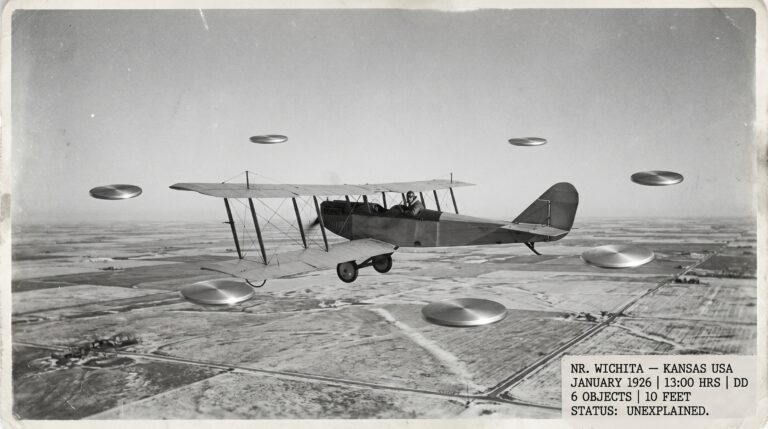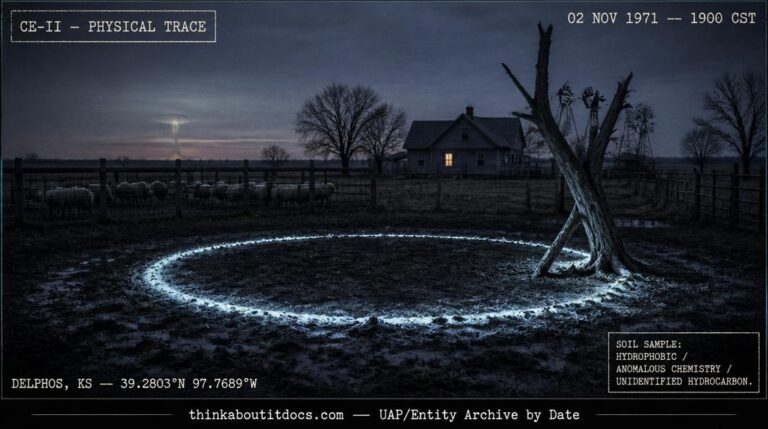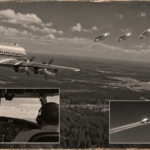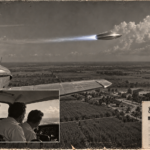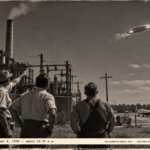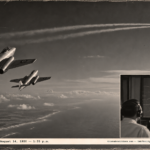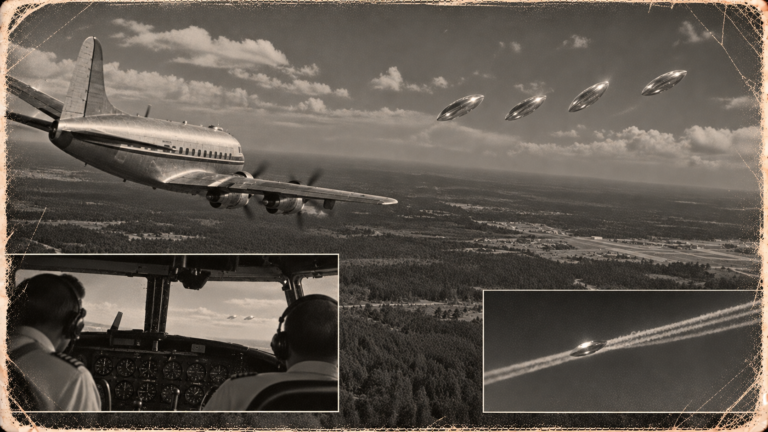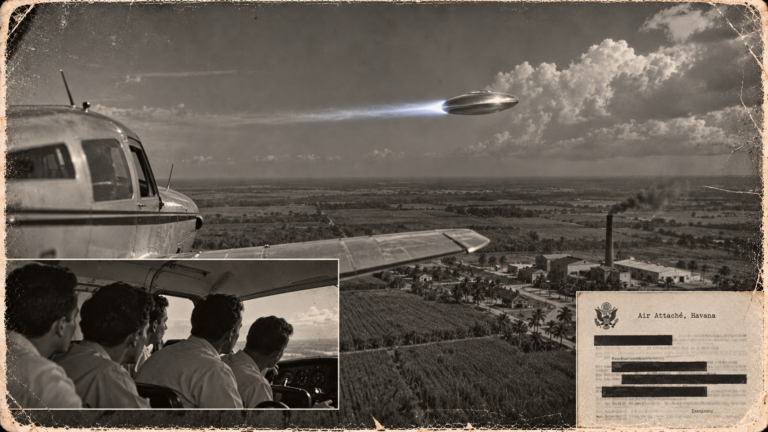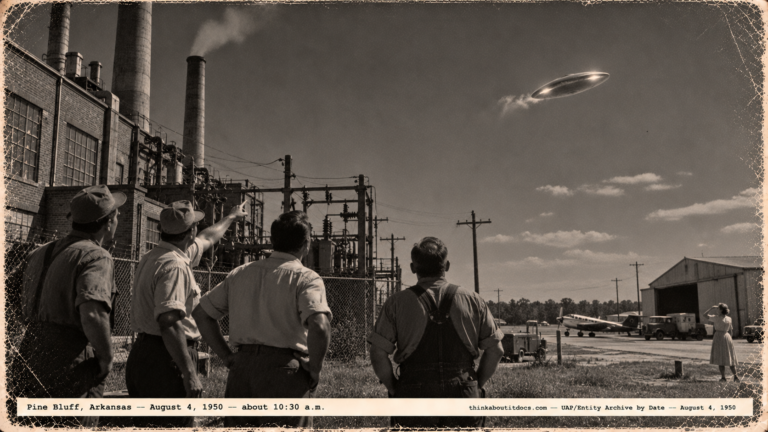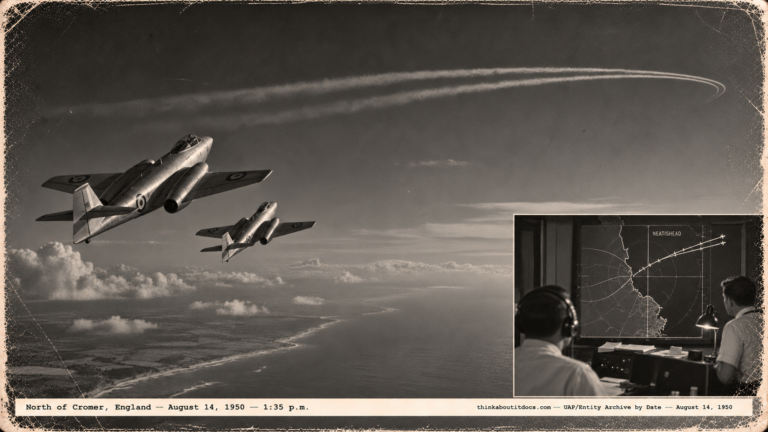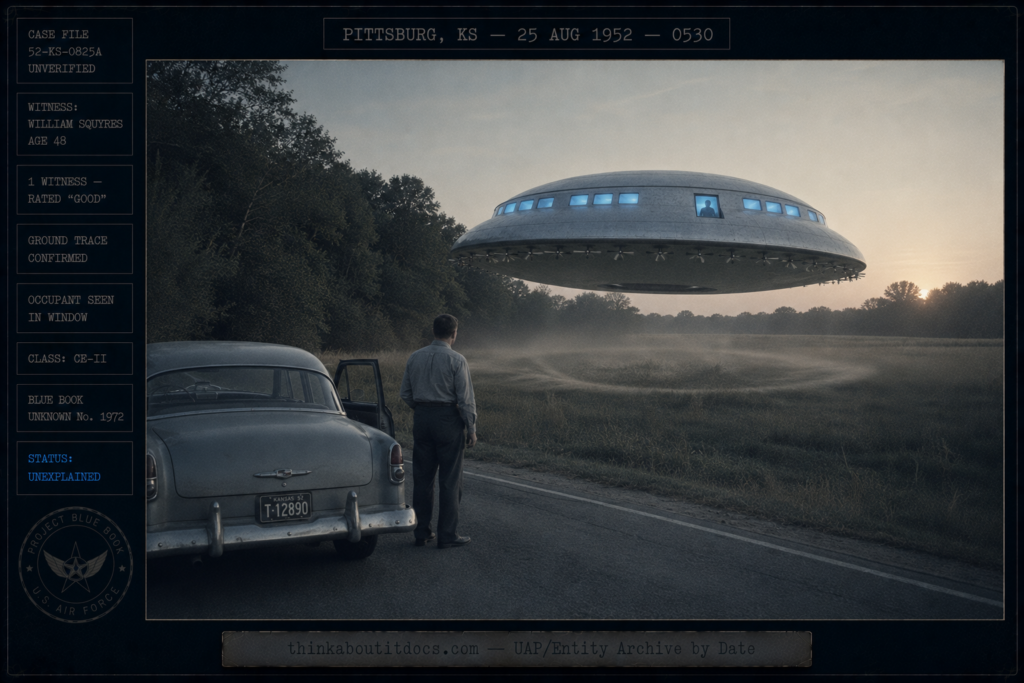
The August 25, 1952 William Squyres sighting near Pittsburg, Kansas — a 75-foot oval craft with a man visible at the window and a confirmed ground trace, filed as Blue Book Unknown No. 1972. Unexplained. (thinkaboutitdocs.com — UAP/Entity Archive by Date)
THINK ABOUTIT UFO|UAP|ENTITY SIGHTINGS REPORT
1952: Figures Seen in the Windows of an Oval Object (William Squyres, Pittsburg, Kansas)
It is the case J. Allen Hynek admitted he had “puzzled long and hard over” — one of the earliest to reach Project Blue Book, and one of the few occupant reports the Air Force could not explain away. At dawn on August 25, 1952, radio-station musician William Squyres was driving to work near Pittsburg, Kansas, when he came upon a dull-aluminum object the shape of two meat platters set edge to edge, about seventy-five feet long, hovering ten feet above a field. A row of windows glowed with a fluctuating blue light; behind them he saw movement, and through a clear forward window the head and shoulders of a motionless man. Small propellers spun around the rim. When Squyres stopped and got out, the thing rose straight up with a sound like a hundred quail flushing at once, flattening the grass beneath it. He reported it to police within the hour; investigators later confirmed the disturbed vegetation and rated him a reliable witness. The Air Force filed it as Unknown No. 1972. With a daylight observation, a credible witness, a confirmed ground trace, and an unresolved official verdict, this is among the strongest early occupant cases — and the archive’s job is to fix the page’s errors and let its real strength show.
Date: August 25, 1952 (Project Blue Book Unknown No. 1972)
Sighting Time: About 5:30 a.m. (reported to police at 6:43 a.m.)
Day/Night: Day (dawn / first light)
Location: About 7 miles northeast of Pittsburg, Kansas, near the Yale Road north of US-160 (witness driving from Frontenac)
Urban or Rural: Rural (field beside a wooded area near the highway)
No. of Entity(‘s): At least 1 clearly seen (a seated man, head and shoulders visible through a forward window), with additional movement behind other windows
Entity Type: Human-appearing (the witness believed the craft was “piloted by humans, not men from Mars”)
Entity Description: The head and shoulders of a single man, sitting motionless and facing forward, seen plainly through a clear window; behind other, shaded windows, indistinct figures and “regular movement”
Hynek Classification: CE-II (Close Encounter II) — object at close range with a confirmed physical trace (vegetation flattened beneath it); the prior CE-I understated the case, which includes a ground trace and an apparent occupant
Duration: Several minutes (the witness stopped, exited the car, and watched before the object departed)
No. of Object(s): 1
Description of the Object(s): A dull-aluminum object shaped like two turtle shells or two oval meat platters placed edge to edge, with a row of rectangular windows along the upper body glowing with a blue light that fluctuated dark to light; a clear forward window showing a seated man; a series of small propellers (about 6 to 12 inches across) spaced closely along the rim, revolving at high speed; the object rocked gently while hovering and emitted a steady throbbing sound, then rose vertically with a noise like a large covey of quail taking off, flattening the vegetation below
Shape of Object(s): Oval / lens (two platters edge to edge)
Size of Object(s): About 75 feet long, 45 feet wide, and 15 feet thick at the mid-section
Color of Object(s): Dull aluminum, with a weathered look
Distance to Object(s): About 100 feet (the witness approached on foot to roughly that distance; the object hovered ~10 feet above the field, about 100 yards off the road)
Height & Speed: Hovering about 10 feet above the ground, rocking; departed vertically at high speed
Number of Witnesses: 1 (William Squyres; radio-station officials and Air Force investigators later corroborated the ground trace, not the object itself)
Special Features/Characteristics: Apparent occupant visible through a window; rim propellers; throbbing sound and quail-like departure noise; flattened vegetation confirmed by later witnesses and Air Force investigators; reported to police at 6:43 a.m.; witness reliability rated “good” in the official report; the witness had an artificial leg, which is why he remained near the road rather than crossing the rough field
Case Status: Unexplained
Source: NICAP / Richard Hall, “The UFO Evidence” (1964); USAF Project Blue Book Special Report No. 14 (Unknown No. 1972); contemporaneous Pittsburg, Kansas press; Brad Sparks, “Catalog of Project Blue Book Unknowns”
Summary/Description: At about 5:30 a.m. on August 25, 1952, KOAM radio musician William Squyres saw a dull-aluminum, oval object about 75 feet long hovering ten feet above a field northeast of Pittsburg, Kansas. It had a row of blue-glowing windows with movement behind them, a clear forward window through which he saw a seated man, and small propellers spinning around its rim. When he stopped and got out, the object rose straight up with a sound like a covey of quail, flattening the vegetation below. He reported it to police within the hour; investigators confirmed the ground trace and rated him reliable. The Air Force classified it as Unknown No. 1972, and it remains unexplained.
Related Cases: 1952: Suzanne Knight sighting, Maryland (a near-contemporary occupant-through-a-window report) | 1947: Disc Zooms Down Snake River Canyon, Idaho | 1971: Delphos, Kansas Landing Ring
DETAILED REPORT
William Squyres was a musician and staff member at radio station KOAM in Pittsburg, Kansas. At about 5:30 on the morning of August 25, 1952, driving to work from his home near Frontenac along the Yale Road, north of US-160 and some seven miles northeast of Pittsburg, he came upon an object hovering perhaps ten feet above a field of grass about a hundred yards off the road. It was just dawn — light enough to see color and detail, which is central to the case and which the prior page got wrong by marking the time as “night.”
As Squyres later told investigators, the hair rose on the back of his neck. The object resembled two turtle shells, or two oval meat platters, placed edge to edge — about seventy-five feet long, forty-five wide, and fifteen thick through the middle, of a dull, weathered aluminum color. Along the rim where the halves met, a series of small propellers, six to twelve inches across, were spaced closely and spinning at high speed. Across the upper body ran a row of rectangular windows glowing with a blue light that pulsed from dark to bright; behind them he could see movement, indistinct, as if behind a drawn shade. Forward of those was a clear window, and through it he saw plainly the head and shoulders of a single man, sitting motionless and facing the front of the craft. The object rocked gently as it hovered and gave off a steady throbbing sound.
Squyres stopped his car and got out. Here a small, telling detail from the Blue Book file belongs in the record: he had an artificial leg, and the ground was rough, so he stayed near the road rather than crossing the field — he approached only to within about a hundred feet. As he watched, the object rose straight up and out of sight, with a sound he likened to a large covey of quail flushing all at once, and the vegetation beneath it was visibly blown about. Struck by the human figure he had seen, Squyres came away convinced the craft was “piloted by humans, and not some men from Mars.”
What makes this more than a startling story is what followed. Squyres drove into Pittsburg and reported the sighting to police; the report was logged at 6:43 a.m. He returned to the field with officials from the radio station, who saw that the vegetation was disturbed in a roughly circular area, like the backwash of something that had lifted off. Air Force investigators subsequently confirmed the disturbed ground and, in the official report, rated the witness’s reliability as “good.” That combination — a physical trace independently observed, and a witness the Air Force itself judged credible — is why the case carries weight despite resting on a single primary observer.
The Air Force could not explain it, and filed it among the statistical Unknowns of Project Blue Book Special Report No. 14, where it is catalogued as Unknown No. 1972. J. Allen Hynek’s relationship to the case is itself part of the record. It was one of the earliest reports to reach Blue Book, and Hynek’s first instinct was to dismiss it as a hallucination. Writing about it twenty-five years later, he admitted he had “puzzled long and hard over this case,” and conceded that his early, casual dismissal had not been a scientifically sound way to treat it. The astronomer who consulted on the original report fixed on the propellers, noting correctly that propellers six to twelve inches across could not possibly lift a seventy-five-foot craft — a sound objection that cuts against a conventional-aircraft reading as much as anything, since no known machine of 1952 matched the description either.
That is the honest shape of the case: a detailed, daylight, close-range observation of a structured object with an apparent human occupant and a confirmed physical trace, made by a witness the investigators rated reliable, which the Air Force left unexplained. Its single weakness, repeatedly noted by researchers including Hynek, is that there was only one witness to the object itself. The flattened vegetation, the police report, and the official reliability rating offset that weakness without erasing it.
RESEARCHER’S NOTES
The Radio Man on the Highway — Kansas 1952 and the Case Hynek Couldn’t Shake
- Classification correction (CE-I to CE-II): The prior page filed this CE-I, a close encounter with no physical effects. But the object left a trace — vegetation flattened in a circular pattern beneath the hover point, observed afterward by radio-station officials and confirmed by Air Force investigators. A close-range object with an associated physical trace is the definition of CE-II, and that is the corrected class. The apparent occupant seen through the window adds an entity element, but because he was glimpsed inside the craft rather than encountered animate and external, CE-II with the occupant noted is more accurate than pushing to CE-III.
- The day/night error, and why it matters: The single clearest factual fix is the time of day. The prior template marked this “Night,” yet the sighting was at 5:30 a.m. at dawn in late August, and the page’s own narrative says “about dawn.” The distinction is not cosmetic: it was the growing daylight that let Squyres resolve the dull-aluminum color, the rectangular windows, the pulsing blue light, and — decisively — the head and shoulders of a man inside. A night sighting could not have yielded that detail, and mislabeling it undercuts the very observations that make the case notable.
- Source-chain assessment and restored detail: This is a well-documented case — NICAP’s “The UFO Evidence,” the Blue Book Special Report 14 unknowns (No. 1972), contemporaneous Pittsburg press, and the Sparks catalog. The prior page reproduced the NICAP narrative faithfully but dropped specifics that strengthen it: the 6:43 a.m. police report, the official “good” reliability rating, the consultant astronomer’s point that the rim propellers were far too small to provide lift, the corrected 15-foot (not 25-foot) thickness, and the witness’s artificial leg — the concrete reason he stayed by the road. That last detail matters precisely because it is the kind of specific, unglamorous fact that tends to accompany genuine testimony rather than invention.
- Hynek’s arc and the single-witness limit: The case’s analytical value is doubled by Hynek’s documented change of heart. He first wrote it off as hallucination, then admitted decades later that he had wrestled with it and that the easy dismissal was not scientifically defensible — a rare on-the-record example of the Air Force’s own consultant conceding he had judged too quickly. Set against that is the honest weakness every serious commentator notes: a single witness to the object itself. The archive holds both in view — a reliable witness, a confirmed trace, and an unresolved official verdict on one side; the absence of a second observer on the other — which is exactly why the status is Unexplained rather than proven.
The Squyres sighting is one of the early occupant reports that the era’s debunking machinery could not digest: a sober radio musician, at dawn, at close range, describing a structured craft with a man at a window and propellers around its rim, who reported it to police within the hour and left behind a patch of flattened grass the Air Force itself went out and confirmed. Told straight — at dawn, not night; a CE-II with a real ground trace, not a bare CE-I; thickness fifteen feet, not twenty-five; with the police log, the reliability rating, and Hynek’s reluctant second thoughts restored — it stands where Blue Book left it: Unknown No. 1972, unexplained, with its one honest weakness, the lone witness, named rather than hidden.