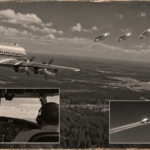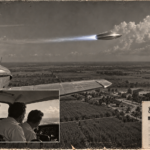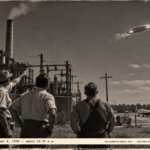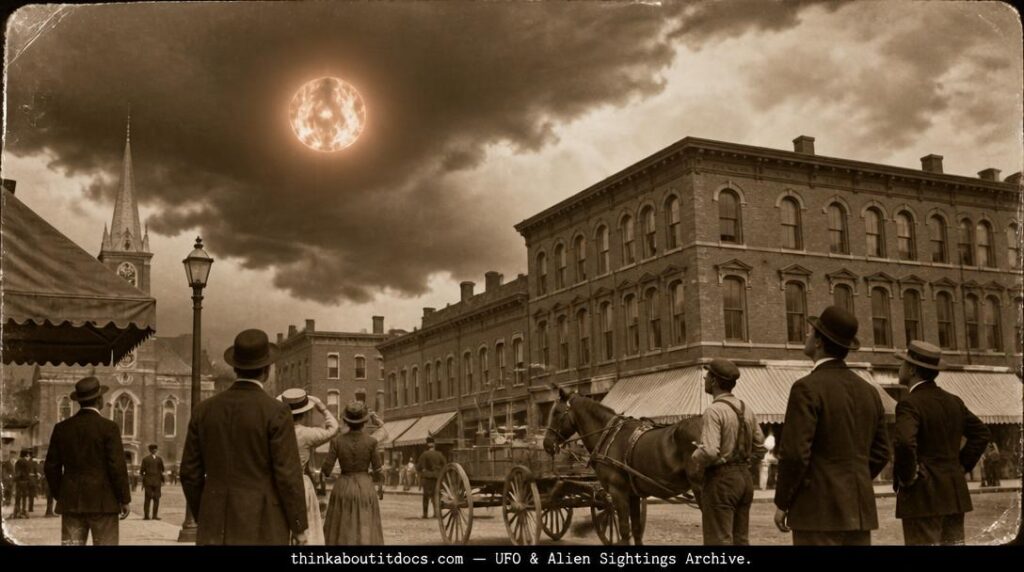
The July 2, 1907 Burlington, Vermont incident — Bishop John Stephen Michaud's famous "torpedo-shaped" object, later identified by the U.S. Weather Bureau as ball lightning.
THINK ABOUTIT UFO SIGHTINGS REPORT
The 1907 Burlington, Vermont “Torpedo”
Corrected and Explained as Ball Lightning
Shortly before noon on July 2, 1907, an ordinary Tuesday, a bright ball of light descended over downtown Burlington, Vermont and exploded about 15 feet above College Street with a boom loud enough to draw people out of shops and offices across the block. A horse was found lying in the road near the blast; it got back up moments later. The next day’s Burlington Free Press chalked it up to an early-summer thunderstorm. A month later, the story took on a life of its own when Bishop John Stephen Michaud gave the U.S. Weather Bureau’s local forecaster an extraordinarily detailed description of a torpedo-shaped, copper-colored object hovering nearby — a description that has made this one of the most-cited “unexplained” American sightings of the pre-aviation era ever since. It has an explanation. This page corrects three factual errors from this site’s earlier coverage and restores it.
Date: July 2, 1907
Sighting Time: Shortly before noon
Day/Night: Day
Location: Corner of Church and College Streets, Burlington, Vermont
Urban or Rural: Urban (downtown)
No. of Entity(s): 0
Entity Type: N/A
Entity Description: N/A
Hynek Classification: N/A — atmospheric electrical phenomenon (ball lightning), not a standard aerial-craft category
Duration: Undocumented; witness accounts suggest a sustained appearance rather than an instantaneous flash
No. of Object(s): 1
Description of the Object(s): A torpedo-shaped body with a dark, rupturing shell and tongues of fire issuing from its surface
Shape of Object(s): Torpedo-shaped
Size of Object(s): Approximately six feet long by eight inches in diameter, per Michaud’s description
Color of Object(s): Dark surface resembling red-hot burnished copper, with red flames and a dim halo
Distance to Object(s): Approximately 300 feet away (horizontal) and 50 feet above rooftop level (height), per Michaud
Height & Speed: Stationary in appearance before exploding roughly 15 feet above College Street
Number of Witnesses: At least six named individuals, plus at least one further unnamed witness
Special Features/Characteristics: Loud explosion audible across the block; a horse found lying in the road nearby, which stood up shortly after; surface described as “rupturing” with fire issuing from spots on it
Case Status: Explained (Probable) — ball lightning, per the U.S. Weather Bureau’s contemporaneous investigation and an independent 1985 analysis by a Vermont weather historian
Source: Alexander, William H., Monthly Weather Review, August 1907; Burlington Free Press, July 3, 1907; Ludlum, David, The Vermont Weather Book, 1985
Summary/Description: A bright ball of light descended over downtown Burlington and exploded about 15 feet above College Street. Witnesses included Bishop John Stephen Michaud, former Governor Urban A. Woodbury, grocer Alvaro Adsit, insurance worker W. P. Dodds, and others. A month later, Michaud gave the U.S. Weather Bureau an elaborate description of a torpedo-shaped, copper-colored object, which made the case famous — but both the Weather Bureau in 1907 and an independent historian in 1985 identified the cause as ball lightning.
Witnesses: Bishop John Stephen Michaud; former Vermont Governor Urban A. Woodbury; an unnamed Burlington businessman; grocer Alvaro Adsit; insurance office worker W. P. Dodds; a young man employed at the Strong Theater; and at least one further unnamed witness whose account the original newspaper reporter treated skeptically
Related Cases: Corrected from this site’s earlier draft, which contained three factual errors — see Researcher’s Notes below
DETAILED REPORT
The event itself is not in serious dispute. Multiple named Burlington residents, in different locations around the same downtown block, independently reported a bright falling ball of light around midday on July 2, 1907, followed by a loud explosion roughly 15 feet above College Street. Insurance worker W. P. Dodds saw it first, descending from the northwest. Grocer Alvaro Adsit, watching from his store window, saw the “fire ball” drop in front of a nearby furniture store before it detonated. People rushed outside afterward and found a horse lying in the road in front of the Standard Coal and Ice Company; it stood back up shortly after. A young man at the Strong Theater a block away also reported seeing the fireball. One further witness claimed to see the ball bounce along College Street before striking the horse and shooting back into the sky — an account the Free Press reporter who wrote up the story the next day openly attributed to “a man with a vivid imagination.”
That next-day Free Press report — published July 3, 1907, not June 3 as this site previously listed — framed the event in entirely mundane terms: a loud clap of thunder, a “forerunner” to the summer’s frequent violent storms, followed twenty minutes to two hours later (accounts vary slightly) by heavy rain. Former Governor Woodbury, interviewed for that story, said his first thought was that a nearby explosion had occurred and he expected to see debris in the air. No torpedo shape, no copper coloring, and no hovering object appear anywhere in the original next-day account.
The elaborate description that made this case famous did not surface until a month later, when Burlington’s U.S. Weather Bureau forecaster, William H. Alexander, wrote up the incident for the national Monthly Weather Review and interviewed witnesses directly. It was in that interview that Bishop Michaud gave his now-famous description:
“Raising my eyes and looking eastward along College Street, I observed a torpedo-shaped body some 300 feet away, stationary in appearance and suspended in the air about 50 feet above the tops of the buildings. In size it was about six feet long by eight inches in diameter, the shell cover having a dark appearance, with here and there tongues of fire issuing from spots on the surface resembling red-hot burnished copper.”
Michaud described the object beginning to move over a nearby store, its covering appearing to “rupture” in places as red flames issued out, encircled by a dim 20-foot halo. He told Alexander that an “angry-looking cumulonimbus cloud” was approaching from the northwest at the time, and that a downpour followed roughly 20 minutes later — a somewhat different timeline than the Free Press’s own account, and, notably, still describing an actual thunderstorm in progress. Michaud himself remained shaken a month on: “Four weeks have passed since the occurrence of this event, but the picture of that scene and the terrific concussion caused by it, are vividly before me, while the crashing sound still rings in my ears. I hope I may never hear or see a similar phenomenon, at least at such ‘close range.'”
Alexander, the meteorologist who collected this testimony, did not treat it as evidence of anything exotic. His own conclusion, printed alongside Michaud’s account in the same Monthly Weather Review article, identified the Burlington incident as “a single peal of thunder or explosion attended by what is believed to have been a case of ‘ball’ or ‘globe’ lightning” — one unusually violent example among “a large number of violent, and in many cases destructive, thunderstorms” across Vermont that season. Nearly eight decades later, Vermont weather historian David Ludlum reached the same conclusion independently in his 1985 book The Vermont Weather Book, describing ball lightning as “a relatively rare form of lightning, consisting of a reddish, luminous ball… which may move rapidly along solid objects or remain floating in mid-air” — a description that fits Michaud’s account of a stationary, glowing, fire-issuing object considerably better than it fits any known aircraft of 1907, powered or otherwise.
RESEARCHER’S NOTES
The Bishop’s Torpedo — Three Errors Corrected and an Explanation Restored
- The governor’s name was wrong: This site’s earlier draft named the former governor “Alexander Woodbury.” Every primary and secondary source consulted — the original Free Press coverage, VTDigger’s 2018 retrospective, and Seven Days’ 2025 coverage — gives his name as Urban A. Woodbury. Corrected here.
- The newspaper date was impossible: The earlier draft cited “Burlington Free Press, June 3, 1907″ for an event dated July 2, 1907 — a citation that would require the paper to have reported the story a month before it happened. The actual Free Press report ran the next day, July 3, 1907.
- The case was never actually unexplained: This is the most significant correction. The earlier draft states flatly, “No explanation was given for the event… No explanation has been offered since.” This is not accurate. The Free Press offered a thunderstorm explanation the day after the event. The U.S. Weather Bureau’s own investigator, writing a month later in a national scientific journal and quoting Michaud’s account in full, concluded the cause was ball lightning. A Vermont weather historian reached the identical conclusion independently, seventy-eight years later, in a dedicated book on the state’s weather history. Two professional meteorological assessments, separated by nearly a century, agree on the same natural explanation. Presenting this case as unexplained required omitting both of them.
- The object’s position was garbled in translation: Michaud’s own words distinguish two separate measurements — the object was “300 feet away” (horizontal distance from him) and “50 feet above the tops of the buildings” (height). The earlier draft compressed these into “hover 300 feet above downtown Burlington,” which is not what the primary account says.
- Why the case still belongs in the archive: Ball lightning remains, in Ludlum’s own words, poorly understood even today, and Michaud’s description — an object with a defined shape, dimensions, and a rupturing, fire-issuing surface, observed for what he describes as a sustained period rather than an instantaneous flash — is unusually elaborate for a ball lightning account. The case is genuinely interesting precisely because it sits at the edge of a recognized, if strange, natural phenomenon rather than because it defies explanation altogether. That is a more honest — and, frankly, more interesting — way to present it than a false claim that science has never weighed in.
The Burlington case is one of the best-documented “UFO” reports of the pre-aviation era — three credentialed witnesses, a same-day newspaper account, and a follow-up scientific investigation published in a national journal within weeks. What it is not is unexplained. Two independent meteorological analyses, separated by seventy-eight years, both point to ball lightning — a real, if still poorly understood, atmospheric phenomenon whose documented behavior matches Michaud’s description better than any competing explanation on offer. The bishop saw something genuinely strange. Science had an answer for it before this site ever did.
“Raising my eyes and looking eastward along College Street, I observed a torpedo-shaped body some 300 feet away, stationary in appearance and suspended in the air about 50 feet above the tops of the buildings… the shell cover having a dark appearance, with here and there tongues of fire issuing from spots on the surface resembling red-hot burnished copper.”
— Bishop John Stephen Michaud, quoted in William H. Alexander’s report, Monthly Weather Review, August 1907