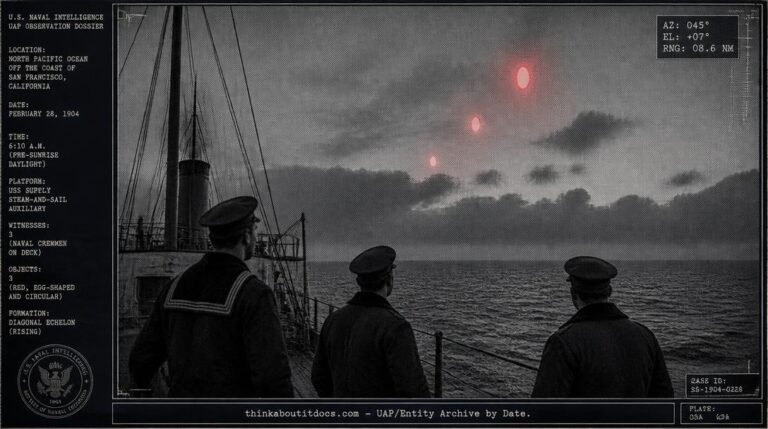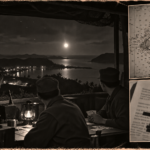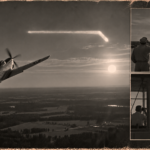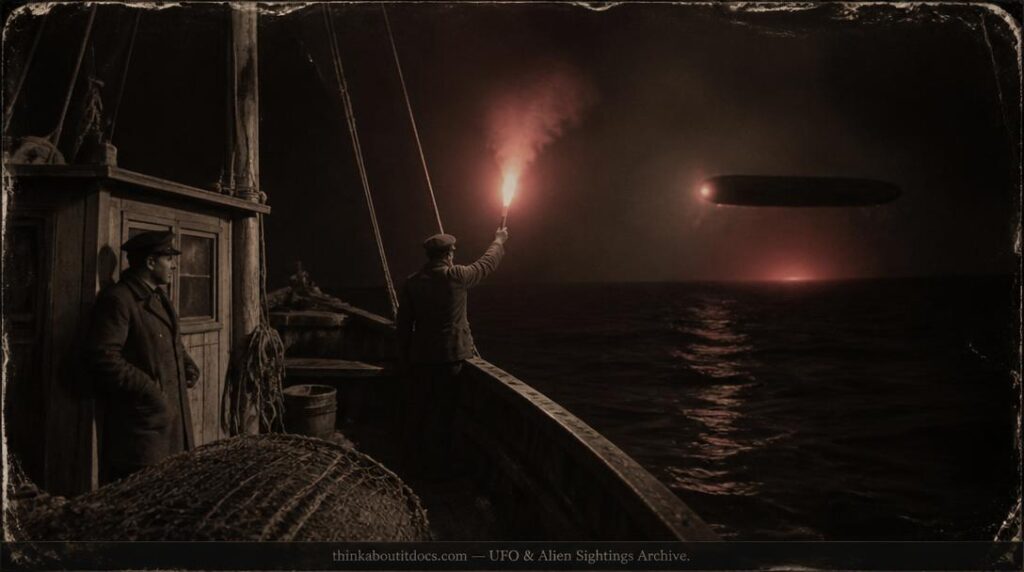
October 1908, North Sea — Captain J. H. Stockman of the fishing smack Superb signals with a red flare and reports receiving a matching red flare in return from a sausage-shaped object above his ship.
THINK ABOUTIT UFO SIGHTINGS REPORT
1908: The Superb Flare Exchange — North Sea
Thirty to forty miles off Lowestoft, in the dark of an October night in 1908, Captain J. H. Stockman of the fishing smack Superb watched what he first took for a star rising out of the sea. It came closer. He raised a red flare — and something above him answered with red. He tried white. It answered with blue. For a few minutes, a Suffolk fishing captain and something he never identified spoke to each other in color, out over open water, a year before the British phantom airship wave would properly begin.
Date: October 1908
Sighting Time: Undocumented (night)
Day/Night: Night
Location: North Sea, 30–40 miles off Lowestoft, England
Urban or Rural: N/A (open sea)
No. of Entity(s): 0
Entity Type: N/A
Entity Description: N/A
Hynek Classification: NL
Duration: Undocumented; described as lingering “for some time” after the exchange
No. of Object(s): 1
Description of the Object(s): A sausage-shaped object carrying a single light, first mistaken for a rising star
Shape of Object(s): Sausage-shaped
Size of Object(s): Undocumented
Color of Object(s): Exchanged red, white, and blue flares/lights during the signaling sequence
Distance to Object(s): Undocumented; approached from a distance to directly above the ship
Height & Speed: Undocumented
Number of Witnesses: 2 (Captain J. H. Stockman and at least one crew member)
Special Features/Characteristics: Responded to Stockman’s red flare with a red flare, then to a white flare with a blue flare — an apparent color-coded exchange
Case Status: Insufficient Data
Source: Delaire, J. Bernard, first published 1909, reflecting on the October 1908 event
Summary/Description: Captain J. H. Stockman of the fishing smack Superb signaled a red flare toward an approaching object and reported receiving a red flare in response; he then showed white and reported receiving blue. The object, sausage-shaped and carrying a single light, eventually withdrew out to sea.
Witnesses: Captain J. H. Stockman and at least one crew member of the fishing smack Superb, out of Suffolk
Related Cases: Predates the main 1909 British phantom airship wave documented elsewhere on this site
DETAILED REPORT
The account, first published in 1909 by researcher J. Bernard Delaire reflecting on the previous October’s event, describes Captain Stockman fishing well offshore when his attention was caught by what he initially took for “a large star rising out of the water.” Unlike a star, it began approaching his vessel.
Stockman called a crew member to witness what he was seeing, then made a decision that sets this case apart from most maritime light sightings of the era: rather than simply watching, he tried to communicate. He raised a red flare toward the object. According to the account, he was immediately answered — a red flare shone back at him from above the ship. He then raised a white flare. The response, this time, was blue.
The object itself was described as sausage-shaped, carrying a single light. After the exchange, it lingered for some time before withdrawing out to sea and disappearing.
That is the entirety of the documented account. No further detail survives about the object’s size, altitude, sound, or the exact sequence and timing of the flare exchanges beyond the two described pairs — red-to-red, white-to-blue. The source, Delaire, is a credentialed early UFO researcher whose work is independently cited elsewhere in this archive’s British pre-war material, and the case has been corroborated in general outline by other secondary compilations of the pre-war British scareship record.
RESEARCHER’S NOTES
The Superb Case — A Deliberate Signal, or a Coincidence Dressed as One?
- The strongest reading of this case is also the most cautious one: Stockman initiated contact with a specific color, and received back not the same color reflected passively, but a specific — and on the second attempt, different — color in response. If the account is accurate and complete, that pattern (matching red, then differing white-to-blue) is harder to explain as coincidence than a single color-match would be.
- But simpler explanations exist and deserve equal weight: a nearby vessel or a shore signal station equipped with colored flares or lights could produce exactly this kind of exchange, especially if its operators were themselves reacting to Stockman’s flares rather than initiating contact. Flare and running-light colors available to period vessels and coastal stations were limited in palette; a coincidental match on the first exchange is not implausible, particularly if “red” was a common distress or acknowledgment signal of the era.
- The account is thin where it matters most for evaluation: no altitude estimate, no duration, no description of how quickly the responding lights appeared relative to Stockman’s own signals, and only a single-source citation. A case this analytically interesting would benefit enormously from a primary newspaper account, which has not yet been located.
- Context matters: this sighting predates the main 1909 British phantom airship wave by several months, placing it early in a period when “sausage-shaped” aerial objects with lights were beginning to be reported with increasing frequency across Britain — genuine airships (German and otherwise) were also becoming more common in this period, and a lit, cigar-shaped object at night is exactly what a period airship, seen at a distance and misjudged in scale, could produce.
The Superb case earns its place in this archive not because it proves communication with something unknown, but because it is one of the few pre-war accounts where a witness didn’t just watch — he tried to talk back, and something, by his account, answered in kind. Whether that was deliberate signaling, a nearby human vessel, or coincidence dressed up by retelling, the account as it survives doesn’t settle the question. It’s presented here as exactly what it is: a genuinely striking, thinly-sourced story that deserves more research before anyone draws a firm conclusion from it.
“He decided to signal to the ‘airship’ with a red flare, and to his surprise he was immediately answered by a red flare from above his ship. He then showed a white flare, and received a blue flare in response.”
— Account of Captain J. H. Stockman, fishing smack Superb, North Sea, October 1908, as documented by J. Bernard Delaire