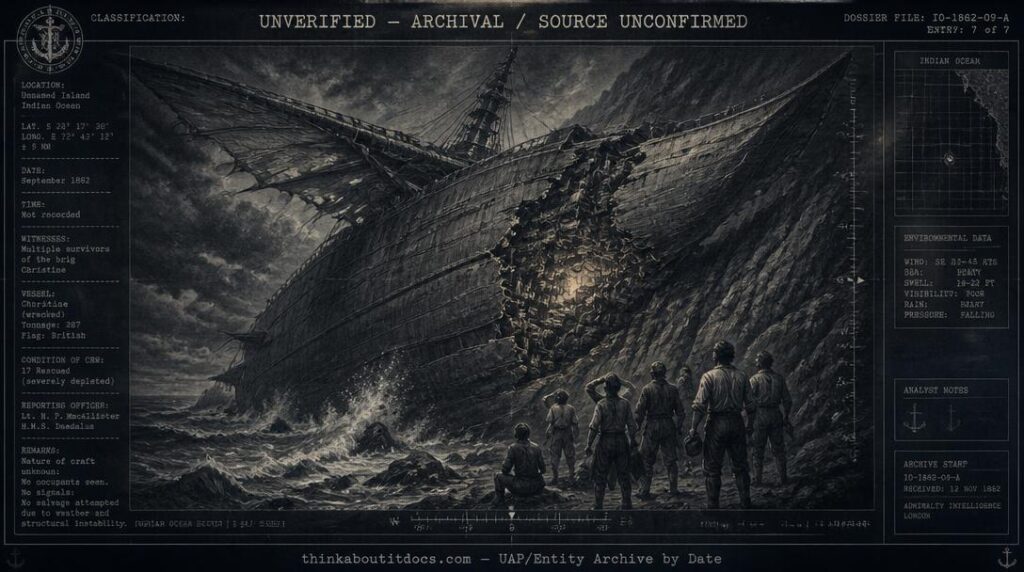
The September 1862 Christine wreck — shipwrecked survivors reportedly discovered a crashed aerial vessel the size of a battleship, containing unidentifiable machinery, unknown food, and the bodies of more than a dozen twelve-foot bronze-skinned men. Sourcing for this case could not be independently verified beyond a 1990 magazine article.
THINK ABOUTIT UFO|UAP|ENTITY SIGHTINGS REPORT
1862: Indian Ocean — The Christine Wreck and the Twelve-Foot Crew
Survivors of the wrecked Danish brig Christine, huddled at the base of a cliff on a desert island somewhere in the Indian Ocean in September 1862, watched an immense shape fall out of the storm above them — an aerial vessel, driven and uncontrolled, bearing straight for the terrified sailors before a sudden gust threw it against the cliff face instead. What they found in the wreckage, according to the account, was stranger than the crash itself: crushed machinery no one could identify, furniture jumbled beyond recognition, metal boxes of unfamiliar food marked with unknown characters, and the bodies of more than a dozen men — dark bronze in color, long-haired and bearded, and estimated at over twelve feet tall. One survivor, unable to bear the sight, threw himself from the cliff. The others, starving, eventually ate the strange food, dragged the giant bodies over the edge, and built a raft to escape.
Sourcing Note: This is one of the most dramatic craft-and-occupant accounts in this archive’s 19th-century record, and also one of its least independently verifiable. The only traceable source is a 1990 Fate magazine article by researcher Jerome Clark. No period (1862–63) newspaper account, ship’s log, admiralty record, or earlier Fortean compilation — including the exhaustively researched catalogs of Charles Fort, Jacques Vallée, and Chris Aubeck, all of which cover this era in detail — has been located referencing a wrecked Danish brig named Christine or this event. This does not prove the account false; Fate published both carefully sourced historical pieces and undocumented folklore over its long run, and it is possible an original source exists that has not yet surfaced. But as it stands, this case cannot be traced back further than a 20th-century magazine retelling, and it is presented here with that limitation stated plainly, consistent with archive policy for similarly unverified cases.
Date: September 1862
Sighting Time: Not recorded
Day/Night: Not recorded
Location: A desert rock or small island in the Indian Ocean, exact location not specified in the source account
Urban or Rural: Not Applicable — uninhabited island
No. of Entity(‘s): “More than a dozen” — deceased, found within the wreckage
Entity Type: Humanoid — giant, dark bronze-skinned, long-haired and bearded
Entity Description: Bodies estimated at over twelve feet in height, dark bronze in color, with long hair and beards, dressed in garments of unfamiliar fashion and texture; found deceased within the wrecked vessel, apparently killed in the crash
Hynek Classification: Not Applicable — wreckage/crash discovery rather than a live sighting; closest to a CE-II/III profile if the underlying account were verified, but the Hynek scale is not meaningfully applicable to an unverified retrospective account
Duration: Not recorded — survivors reportedly remained on the island long enough to build a raft before departing
No. of Object(s): One
Description of the Object(s): An aerial vessel described as large as a modern battleship, driven uncontrolled in a storm before crashing against a cliff face; equipped with “immense wings or sails” and machinery too crushed on impact to be identifiable; interior contained furniture, tools too large to be practically used, and metal boxes of food marked with unknown characters
Shape of Object(s): Ship-like, battleship-scale, with wing- or sail-like structures
Size of Object(s): Comparable in scale to a contemporary battleship
Color of Object(s): Not recorded
Distance to Object(s): Crashed a few hundred yards from the survivors’ position at the base of the cliff
Height & Speed: Descended from high in the air, uncontrolled, before a sudden change in wind diverted its course into the cliff face rather than directly into the survivors
Number of Witnesses: Multiple, unenumerated — survivors of the Christine’s wreck, including a named “Mr. Oleson”
Special Features/Characteristics: Unidentifiable crushed propulsion machinery; furniture and tools of unfamiliar design, some too large for practical human use; preserved food in inscribed metal containers that proved edible and sustained the survivors; psychological trauma severe enough that one survivor took his own life at the site
Case Status: Insufficient Data.
Source: Jerome Clark, Fate magazine, September 1990 — no independent period corroboration located
Summary/Description: According to the account, the Danish brig Christine wrecked on a small, uninhabited Indian Ocean island in September 1862. Survivors, gathered at the base of a cliff amid a storm, watched an enormous aerial vessel descend uncontrolled toward them before a wind gust diverted it into the cliff face instead. Investigating the wreckage, they found crushed, unidentifiable machinery, jumbled furniture, tools too large for ordinary use, and metal boxes of unfamiliar but edible food marked with unknown characters. They also found the bodies of more than a dozen men, dark bronze in color, over twelve feet tall, long-haired and bearded, wearing garments of unfamiliar material. One survivor, overwhelmed, jumped to his death from the cliff. The remaining survivors eventually ate the preserved food, disposed of the bodies, and built a raft to leave the island. The earliest identified source for this account is a 1990 article by researcher Jerome Clark in Fate magazine; no period document corroborating the event has been located.
Related Cases: 1860–1865: UFO|UAP & Entity Sightings Archive
Detailed Report
According to the account as it survives in modern sources, the Danish brig Christine wrecked in September 1862 on a small, uninhabited rock or island in the Indian Ocean, “several miles in size.” Survivors, including a man identified only as Mr. Oleson, gathered at the base of a cliff as waves and wind battered the rocks, apparently expecting the wreck of the Christine itself to be their end. It was at this moment, according to the account, that they saw an enormous shape descending from high in the air — an aerial vessel, uncontrolled, seemingly driven by the same storm that had wrecked their own ship. The vessel appeared to be heading directly for the survivors, who cried out in despair, before a sudden shift in wind diverted its course and it crashed into the cliff face a few hundred yards from where they stood.
Approaching the wreck cautiously, the survivors found a vessel they estimated to be as large as a contemporary battleship. The machinery that had powered it — described as working through “immense wings or sails” — was too crushed by the impact for them to form any idea of how it had actually functioned. The interior held strange implements and furniture in a jumbled, near-unrecognizable mass. Among the wreckage they found metal boxes covered in unfamiliar characters, which turned out to contain food that proved wholesome and palatable — food that, combined with water found among the rocks, kept the survivors alive in the following days.
Their situation grew more disturbing when they discovered the bodies of more than a dozen men within the vessel, dressed in garments of unfamiliar fashion and texture. The bodies were described as dark bronze in color, but their most striking feature was their scale — the men were estimated at more than twelve feet in height, with long hair and beards. Tools of many kinds were found aboard as well, but these too were oversized, apparently unusable by the human survivors. One man among the survivors, unable to cope with what he had seen, went insane and threw himself from the cliff into the sea. The rest fled the site in horror, only returning once hunger forced them back. After eating from the strange food stores, the survivors found the resolve to drag the giant bodies to the cliff edge and dispose of them, eventually building a raft from the wreckage and leaving the island.
The earliest identified appearance of this account in print is a September 1990 article by researcher Jerome Clark in Fate magazine, a long-running American publication that mixed investigative Fortean journalism with reader-submitted folklore across its decades of operation. No period document — a ship’s log, an insurance record, a newspaper account from 1862 or 1863, or a listing in any Lloyd’s-type shipping register — has been located to independently confirm the existence of a Danish brig named Christine lost under these circumstances. The event also does not appear in the major 20th- and 21st-century compilations of historical aerial anomaly cases (Fort’s Book of the Damned, Vallée and Aubeck’s Wonders in the Sky, Aubeck and Shough’s Return to Magonia), which draw heavily on period newspapers and would be a natural place for a case this dramatic to surface if a contemporaneous source existed and had been located by other researchers.
RESEARCHER’S NOTES
The Christine Wreck — Indian Ocean 1862 and the Case That Can’t Be Traced Back
- Classification Issues: Filed without a Hynek tier, since the account describes a post-crash discovery rather than an observed encounter, and — more fundamentally — because the case’s evidentiary status does not support confident classification of any kind. If the underlying events were verified, the crashed-vessel-with-deceased-occupants structure would resemble a CE-II/III profile; as it stands, that classification would overstate what can actually be established.
- Source Chain Assessment: This is the weakest source chain of any standalone case built out in this archive. A single 1990 magazine article, 128 years after the claimed event, with no named original source document, no period ship record, and no earlier researcher’s citation. Compare this to the archive’s better-sourced 19th-century wreck and crash cases, which typically trace to a contemporaneous newspaper, a ship’s log excerpt, or a scientific society’s report — none of which exists here as far as can be determined.
- Pattern Context: The story’s structure — giant humanoid crew, unidentifiable advanced machinery, unfamiliar preserved food, a psychologically shattered survivor — closely tracks familiar tropes of 20th-century UFO crash-retrieval literature rather than the more restrained, matter-of-fact tone typical of genuinely period-sourced 19th-century aerial anomaly reports elsewhere in this archive. That stylistic mismatch is not proof of fabrication, but it is a legitimate reason for caution, and it is the same kind of pattern-based flag applied to other weakly sourced cases in this archive.
- Geographic and Historical Context: The Indian Ocean in 1862 was a heavily used commercial shipping route, and 19th-century wrecks in this region were generally well documented through insurance registers, colonial administrative records, and shipping newspapers of the period — the kind of paper trail that exists for the vast majority of period wrecks with any commercial or diplomatic significance. The complete absence of such a trail for a wreck involving a crashed vessel of “battleship” scale and giant occupants, an event that would have been extraordinarily newsworthy if reported at the time, is itself a notable gap.
The Christine wreck is, on its own narrative terms, one of the most extraordinary accounts in this entire archive — a crashed aerial vessel, giant humanoid occupants, unknown technology and food, and survivors who lived to build a raft and sail away. It is also, on close examination, a story this archive cannot currently trace back further than a single 1990 magazine article. That gap does not settle the question of what did or didn’t happen on an unnamed island in the Indian Ocean in 1862. It only means this case, unlike most of what surrounds it in this decade’s record, is being carried here as a story worth flagging rather than a documented event.
“They found in metal boxes covered with strange characters what they afterward discovered to be very wholesome and palatable food… Their horror was intensified when they found the bodies of more than a dozen men… estimated to have been more than 12 ft high.”