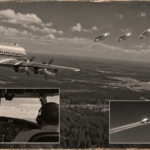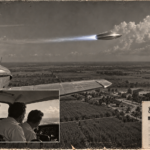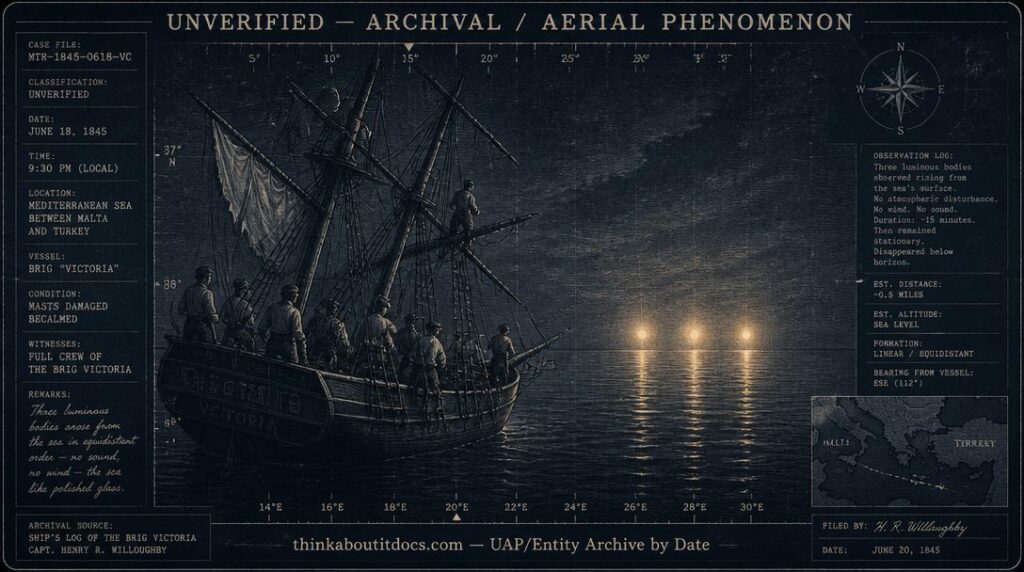
The June 18, 1845 brig Victoria sighting — a becalmed Mediterranean crew, having just lost their upper masts and endured two hours of unexplained wind, watched three luminous bodies rise from the sea amid an overpowering heat and sulphur stench.
THINK ABOUTIT UFO|UAP SIGHTINGS REPORT
1845: Mediterranean Sea — The Brig Victoria’s Three Luminous Bodies
On the night of June 18, 1845, the brig Victoria was becalmed in the Mediterranean, midway between Malta and Turkey, when her top-gallant and royal masts suddenly went over the side, as though torn away by a squall that wasn’t there. For two hours an easterly wind blew hard while the crew fought to reef topsails aloft — and then, all at once, the wind died. In the sudden calm, the crew felt an overpowering heat and the stench of sulphur close in around them. That was the moment three luminous bodies rose out of the sea, half a mile off the ship’s side, and hung visible for ten full minutes before the wind returned and carried the Victoria on.
The report reached print through the Malta Mail, was picked up by the London Times two months later, and was still being cited by the British Association for the Advancement of Science sixteen years afterward, in a formal scientific survey of luminous meteor phenomena. Few 19th-century maritime sightings carry that kind of institutional afterlife — reprinted, catalogued, and still being referenced by professional scientists a generation after the sailors who saw it had likely left the sea.
Date: June 18, 1845
Sighting Time: 9:30 PM
Day/Night: Night
Location: Mediterranean Sea, between Malta and Turkey, at approximately 36°40’56” N, 13°44’36” E (aboard the brig Victoria, en route from Newcastle to Malta)
Urban or Rural: Not Applicable — open sea
No. of Entity(‘s): Not Applicable
Entity Type: Not Applicable
Entity Description: Not Applicable
Hynek Classification: NL
Duration: Approximately 10 minutes for the luminous bodies themselves; the wider weather anomaly (mast damage, wind reversal, calm, sulphur stench) spanned roughly two hours or more
No. of Object(s): Three
Description of the Object(s): Three luminous bodies that issued from the sea itself, coinciding with a sudden calm, an overpowering heat, and a strong smell of sulphur
Shape of Object(s): Not specified beyond “luminous bodies”
Size of Object(s): Not recorded
Color of Object(s): Not specified beyond “luminous”
Distance to Object(s): Approximately half a mile from the vessel
Height & Speed: The three bodies “issued from the sea” — rising from the water’s surface rather than approaching from altitude
Number of Witnesses: Not individually enumerated — the full crew of the brig Victoria, described as “all hands” aloft reefing topsails at the time of the associated wind event
Special Features/Characteristics: Sudden, unexplained loss of the top-gallant and royal masts as if in a squall, despite no bad weather; two hours of hard easterly wind followed by sudden calm; overpowering heat and stench of sulphur coinciding precisely with the appearance of the luminous bodies; return of hard wind and a current of cold fresh air shortly after the lights vanished
Case Status: Unexplained.
Source: Malta Mail, cited by the London Times, August 18, 1845; James Glaisher et al., “Report on Observations of Luminous Meteors, 1860–1861,” Annual Report of the British Association for the Advancement of Science (1861): 1–44, at 30
Summary/Description: At 9:30 PM on June 18, 1845, the brig Victoria, sailing from Newcastle to Malta, was becalmed in the Mediterranean between Malta and Turkey when her top-gallant and royal masts suddenly went over the side as if carried away by a squall, despite no sign of bad weather. A hard easterly wind blew for two hours while the crew worked aloft reefing topsails. The wind then dropped suddenly, and the crew felt an overpowering heat and a stench of sulphur. At that moment, three luminous bodies rose from the sea roughly half a mile from the ship and remained visible for ten minutes. Shortly afterward, hard wind returned and the vessel entered a current of cold fresh air. The report was first published in the Malta Mail, reprinted by the London Times two months later, and cited again sixteen years later in a formal British Association survey of luminous meteor phenomena.
Related Cases: 1845–1849: UFO|UAP & Entity Sightings Archive
Detailed Report
The brig Victoria was making passage from Newcastle to Malta when, at 9:30 PM on June 18, 1845, she found herself becalmed in the Mediterranean, at a position recorded as latitude 36°40’56” north, longitude 13°44’36” east — roughly midway between Malta and the Turkish coast. Despite no visible sign of approaching bad weather, her top-gallant and royal masts (the uppermost sail-bearing spars of the rig) suddenly went over the side, as though torn away by a sudden squall.
What followed was two hours of hard wind blowing from the east, during which the entire crew — “all hands” — worked aloft, reefing topsails against the sudden blow. Then, as abruptly as it had begun, the wind fell calm again. In that new stillness, the crew reported feeling an overpowering heat and a strong stench of sulphur settle over the ship. It was at this precise moment — heat, sulphur smell, and dead calm arriving together — that three luminous bodies rose up out of the sea itself, appearing roughly half a mile from the vessel. They remained visible for a full ten minutes.
Shortly after the lights disappeared, the wind returned to hard blowing, and the Victoria found herself in a current of cold fresh air — a notable contrast to the overpowering heat that had accompanied the sighting only minutes before. The account, evidently drawn from a report or log kept aboard the Victoria, was first published in the Malta Mail. It was picked up by the London Times, which reprinted it on August 18, 1845, roughly two months after the event. The case resurfaced again in 1861, when James Glaisher and colleagues cited it in a formal British Association for the Advancement of Science report on luminous meteor observations — a sixteen-year afterlife of scientific citation that few maritime sightings of this era can match.
RESEARCHER’S NOTES
The Victoria’s Three Lights — Mediterranean 1845 and a Weather Event With No Clean Explanation
- Classification Issues: Filed as NL (Nocturnal Light) — no structural detail beyond “luminous bodies,” no occupant or entity component, and no close approach to the vessel. The case’s real analytical weight sits not in the objects themselves but in the tightly sequenced weather anomaly that bracketed them, which is unusual enough to warrant inclusion regardless of how the lights alone would be classified.
- Source Chain Assessment: This is an unusually well-attested maritime account for its era: original publication in a regional newspaper close to the events (Malta Mail), national republication within weeks (London Times), and formal scientific citation sixteen years later by a credentialed British Association survey team compiling luminous meteor data. That the case was still considered worth citing by working scientists in 1861 — long after any novelty value had worn off — suggests it was taken as a serious data point rather than a curiosity.
- Physical Evidence and Evidentiary Weight: The mast damage is the case’s most concrete physical detail — sails and spars do not go over the side “as if carried away by a squall” without a genuine mechanical force acting on the rigging, whatever that force was. Combined with the reported heat and sulphur smell — both physiologically specific, sensory details unlikely to be embellishments of a purely visual light phenomenon — this reads as a multi-sensory event rather than a simple account of lights on the water. No conventional single explanation (waterspout, ball lightning, bioluminescence, volcanic gas venting) cleanly accounts for the mast damage, the sulphur smell, the heat, and the three discrete luminous bodies occurring in that specific sequence.
- Geographic and Historical Context: The Mediterranean shipping lanes between Malta and the Ottoman-controlled eastern approaches were heavily trafficked in the 1840s, meaning a merchant brig’s log-based report reaching a regional Maltese paper and then London within weeks reflects a well-established, credible news pipeline for the period — this was not an isolated account struggling to find print, but one that moved through normal channels quickly.
A merchant crew lost their upper masts to a squall that wasn’t there, worked two hours against a wind that had no weather behind it, and then stood in sudden stillness, breathing sulphur, and watched three lights rise out of the sea beside them. The Malta Mail printed it, the London Times reprinted it, and sixteen years later a British scientific association was still citing it in a formal survey of things seen burning in the sky. Nobody in that chain explained it. Nobody has since.
“At this moment three luminous bodies issued from the sea, about half a mile from the vessel, and remained visible for ten minutes.”