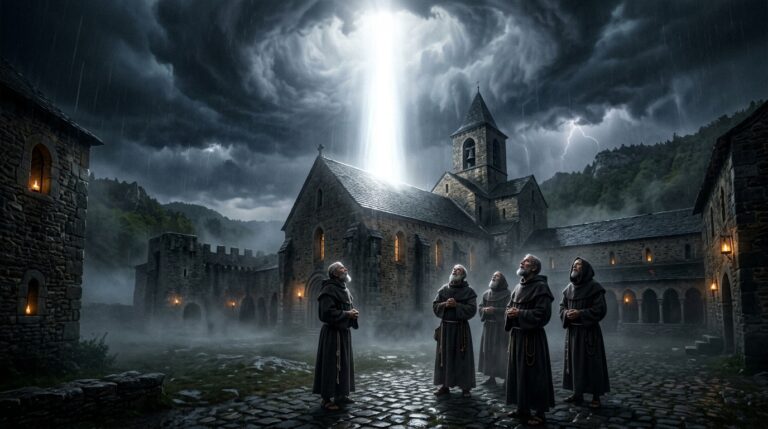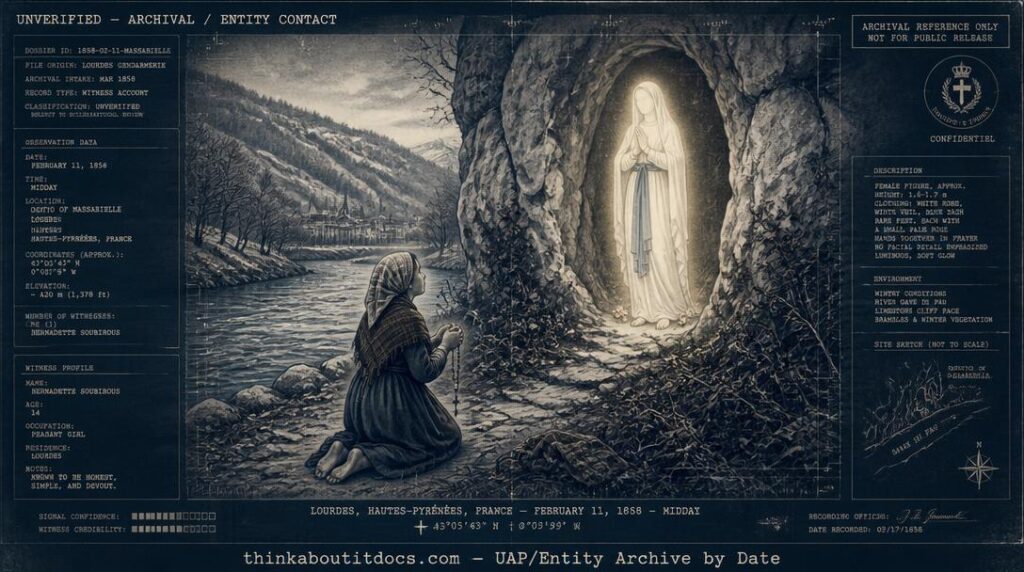
The February 11, 1858 Lourdes encounter — fourteen-year-old Bernadette Soubirous's first meeting with a white-robed figure at the grotto of Massabielle, the opening event of the most thoroughly investigated apparition sequence in 19th-century Church history.
THINK ABOUTIT ENTITY ENCOUNTER REPORT
1858: Lourdes, France — Bernadette Soubirous’s First Grotto Encounter
On the cold midday of February 11, 1858, a sickly fourteen-year-old miller’s daughter named Bernadette Soubirous was gathering firewood and scavenging animal bones along a stream on the outskirts of Lourdes, in the French Pyrenees, when her two companions crossed to the far bank ahead of her. Bernadette stopped at a small grotto in the cliff face to remove her shoes and stockings — and heard, by her own later account, a sound like a gust of wind. Turning toward the grotto, she saw a white figure in the shape of a young woman standing in a niche in the rock. What followed over the coming five months would become the most exhaustively investigated apparition sequence in the history of the Catholic Church — eighteen separate encounters, a formal canonical inquiry, physical effects at the site still reported by pilgrims today, and eventual sainthood for the girl who saw it first.
The scale of institutional scrutiny this case has undergone is without real parallel elsewhere in this archive. Bernadette was questioned repeatedly — by her own family, by skeptical priests, by civil authorities, and eventually by a formal Church commission — over years, not days. Her account never changed in its essential details across that questioning. The Bishop of Tarbes did not issue his ruling recognizing the apparitions as worthy of belief until January 1862, nearly four years after the first encounter.
Date: February 11, 1858 (first of eighteen apparitions occurring between February 11 and July 16, 1858)
Sighting Time: Midday
Day/Night: Day
Location: Grotto of Massabielle, on the banks of the Gave de Pau, just outside Lourdes, Hautes-Pyrénées, France
Urban or Rural: Rural — riverbank grotto on the outskirts of a small Pyrenean town
No. of Entity(‘s): One
Entity Type: Humanoid — young woman figure, later identified by the entity itself as “the Immaculate Conception”
Entity Description: A white figure in the shape of a young woman or girl, standing in a niche in the grotto’s rock face; dressed in a white robe girded at the waist with a blue ribbon, a white veil over her head, bare feet each marked with a yellow rose, holding a rosary of white beads on a gold chain
Hynek Classification: Not Applicable — non-craft entity contact, outside the standard Hynek close encounter scale
Duration: Not precisely timed for this first encounter; later apparitions in the series were reported to last from several minutes up to roughly 45 minutes
No. of Object(s): Not Applicable
Description of the Object(s): Not Applicable
Shape of Object(s): Not Applicable
Size of Object(s): Not Applicable
Color of Object(s): Not Applicable
Distance to Object(s): Not Applicable
Height & Speed: Not Applicable — the figure remained stationary within the grotto niche throughout the encounter
Number of Witnesses: One direct witness (Bernadette Soubirous); her two companions present at the scene did not see the figure themselves
Special Features/Characteristics: Preceded by an unexplained gust-of-wind sound with no other observed physical cause; witness entered a state described as ecstasy, becoming unresponsive to freezing water while crossing the stream afterward; witness’s hand reportedly shook and became unable to complete the sign of the cross until the figure itself performed the gesture first; the encounter was the first of an eighteen-apparition sequence extending to July 16, 1858
Case Status: Unexplained.
Source: Bernadette Soubirous’s own later written account, “Les Écrits de Sainte Bernadette et sa voie spirituelle”; canonical investigation records of the Diocese of Tarbes; Mike Dash, Borderlands
Summary/Description: On February 11, 1858, fourteen-year-old Bernadette Soubirous was gathering firewood and scavenging bones along a stream near Lourdes, France. While her two companions crossed to the opposite bank, Bernadette stopped at the grotto of Massabielle to remove her shoes and stockings, and heard a sound like a gust of wind. Looking toward the grotto, she saw a white-robed young female figure standing in a niche in the rock, wearing a blue-girded white robe, a white veil, and a yellow rose on each bare foot, holding a rosary. Bernadette, apparently entering a state of ecstasy, crossed the freezing stream without apparent discomfort. She attempted to make the sign of the cross but could not raise her hand until the figure made the gesture first. After Bernadette finished praying the rosary, the figure vanished. This was the first of eighteen apparitions Bernadette reported at the same location through July 16, 1858, in which the figure eventually identified itself as “the Immaculate Conception.” A formal Church canonical investigation followed, and the Bishop of Tarbes declared the apparitions worthy of belief on January 18, 1862. Bernadette was canonized a saint by Pope Pius XI in 1933.
Related Cases: 1850–1859: UFO|UAP & Entity Sightings Archive | 1846 La Salette, France — The Weeping Lady of Mont Planeau | 1830 Paris, France — Catherine Labouré Rue du Bac Contact
Detailed Report
Bernadette Soubirous was born in 1844 to a poor milling family in Lourdes, a small town in the French Pyrenees. By 1858 the family had fallen into severe poverty, and Bernadette, then fourteen and in frail health from chronic asthma, was sent out with her younger sister Toinette and a friend, Jeanne Abadie, to gather firewood and scavenge bones near the Gave de Pau river on February 11, 1858.
As her companions crossed the stream ahead of her, Bernadette paused at a small grotto known locally as Massabielle to remove her shoes and stockings before following. She heard what she later described as a sound resembling a gust of wind, though nothing around her appeared to move. Turning toward the grotto, she saw, in a niche in the rock face, a white figure in the shape of a young woman or girl. Bernadette described the figure as wearing a white robe girded at the waist with a blue ribbon, a white veil that gave only a glimpse of her hair, bare feet each marked with a yellow rose, and a rosary of white beads on a gold chain held on her right arm.
Apparently entering a state her later chroniclers describe as ecstasy, Bernadette crossed the freezing stream to rejoin her companions without any apparent discomfort from the cold water. Uncertain at first whether she was imagining the figure, she reached for her rosary and attempted to make the sign of the cross, but found she could not raise her hand to her forehead. According to her account, the figure itself then made the sign of the cross, after which Bernadette’s hand was freed and she was able to do the same. She prayed the rosary while the figure remained present; when she finished, the figure disappeared.
This was the first of eighteen apparitions Bernadette would report at the same grotto between February 11 and July 16, 1858, a sequence extensively documented at the time by family members, clergy, and civil authorities who questioned her repeatedly, both skeptically and supportively, without ever recording a substantive change in her account. During the ninth apparition on February 25, the figure asked Bernadette to drink from and wash in a spring at the site — a spring that had not previously been visible, and which began flowing that day and has continued since. On March 25, during the sixteenth apparition, the figure gave its name for the only time, stating, according to Bernadette, “I am the Immaculate Conception” — a title formally defined as Catholic dogma only four years earlier, in 1854, a detail later investigators noted as unlikely to have been known or invented by an uneducated peasant girl of the period. The final apparition took place on July 16, 1858.
A formal canonical investigation followed, extending over several years and examining Bernadette’s testimony, the reported physical effects at the site (including subsequent claims of healing associated with the spring), and the broader social response. On January 18, 1862, the Bishop of Tarbes issued a formal declaration: “The Virgin Mary did appear indeed to Bernadette Soubirous.” Bernadette herself entered religious life, joining the Sisters of Charity of Nevers, and died in 1879. She was canonized a saint by Pope Pius XI in 1933. The site of the grotto has since become one of the most visited Catholic pilgrimage destinations in the world, drawing several million visitors annually.
RESEARCHER’S NOTES
The Grotto Encounter — Lourdes 1858 and the Longest Investigation in This Archive
- Classification Issues: Filed as an entity encounter with no craft component, consistent with this archive’s treatment of visionary/contact cases (compare Catherine Labouré’s 1830 Rue du Bac contact and the 1846 La Salette encounter elsewhere in this archive). Catalogued here as a documented, repeatedly witnessed anomalous contact sequence with independently verifiable physical after-effects (the spring), not as a matter of religious doctrine, which is outside this archive’s scope.
- Source Chain Assessment: This case has, by a wide margin, the most extensive and sustained institutional documentation of any entity contact case in this archive. Unlike single-encounter cases resolved by a single investigation, Lourdes involved eighteen separate, repeatedly witnessed encounters over five months, near-continuous public and clerical scrutiny throughout that period, and a formal canonical ruling that took nearly four years to issue. The consistency of Bernadette’s account under that volume of contemporaneous questioning — rather than a single retrospective interview — is the strongest evidentiary feature of the case.
- Physical Evidence and Evidentiary Weight: The spring that began flowing at the site during the ninth apparition is this case’s most concrete physical trace element, still flowing and still central to the site’s pilgrimage activity today. Independent of any question of healing claims associated with it, the emergence of a previously non-existent water source at the exact time and place of a witnessed contact event is a verifiable physical anomaly worth weighing on its own terms.
- Pattern Context: Lourdes shares a close structural signature with both the 1830 Catherine Labouré Paris contact and the 1846 La Salette encounter elsewhere in this archive: a luminous or white-robed adult or youthful female figure, a young and socially marginal witness, a repeated-contact sequence rather than a single encounter, and eventual formal institutional validation following sustained scrutiny. The March 25 self-identification as “the Immaculate Conception” — a doctrinal term formally defined only four years prior and not obviously known to a barely-literate fourteen-year-old — is the detail investigators at the time and since have treated as the case’s single hardest point to explain through ordinary means.
A sickly fourteen-year-old girl gathering firewood on a February afternoon saw something in a riverside grotto that repeated itself seventeen more times over five months, survived years of hostile and sympathetic questioning alike without changing shape, and left behind a spring that still flows. Whatever happened at Massabielle, it is the most thoroughly investigated entity contact case in this entire archive — and after nearly four years of formal Church scrutiny, the investigating body’s own conclusion was that it could find no reason not to believe her.
“I am the Immaculate Conception.”