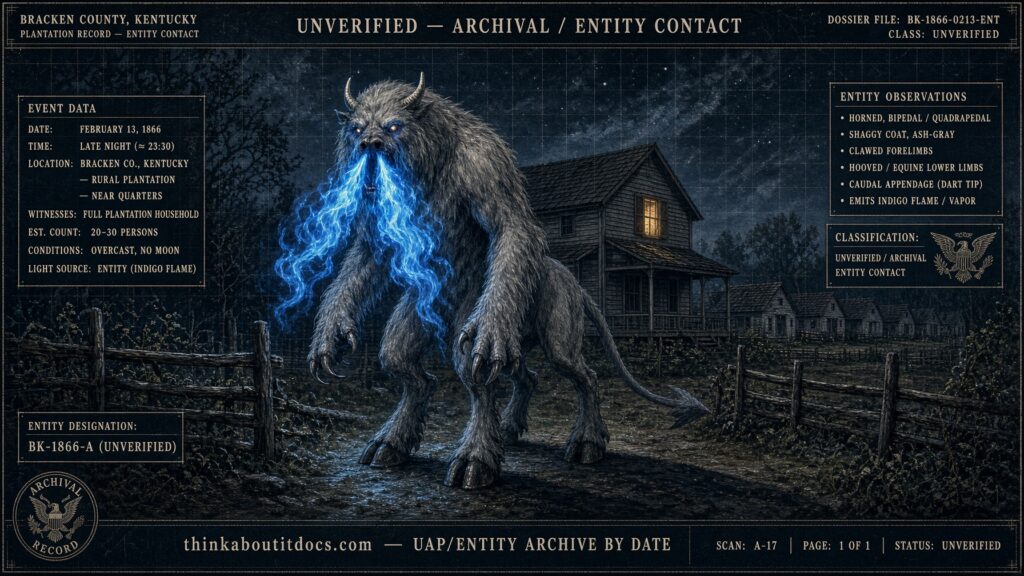
The February 13, 1866 Bracken County, Kentucky encounter — a plantation household watched a horned, sulfur-breathing entity standing near their fence, an encounter that reportedly drove two witnesses to permanent insanity and was followed by two further entity encounters in the same county within three years.
THINK ABOUTIT ENTITY ENCOUNTER REPORT
1866: Bracken County, Kentucky — The Blue Fire Monster
On a Monday night in February 1866, a plantation owner in Bracken County, Kentucky and his wife were startled awake in their bed by screaming coming from the quarters behind their house — men, women, and children, in what the account describes as utter pandemonium. Their bedroom was already lit up bright as day, but with a bluish cast to the light. Thinking the cabins were on fire, they rushed to the window with their daughters, hysterical, close behind. What they saw standing near the garden fence was, by the account’s own description, nearly as tall as the cabin itself: a horned, shaggy-armed, horse-legged creature with claws like a cat’s, a dart-tipped tail, eyes like burning coals, and a mouth and nostrils breathing sheets of blue flame with a hiss “a thousand fold louder” than a serpent’s. The air reeked of burning sulfur. Two of the people in the quarters — an elderly woman and a boy — were, according to the account, driven permanently insane by what they had witnessed. Then the creature wrapped itself in a spiral column of fire that reached the tops of the nearby locust trees, and when the flame died out an instant later, it was gone.
The account survives through Fortean researcher Jerome Clark’s Anomalistic List, which credits the original writing to a named individual, Nathaniel G. Squires. It is one of the most morphologically detailed entity descriptions in the 19th-century American record — and it is not, by the report’s own closing line, an isolated event: “the same or similar creature appeared on several nights at neighboring plantations.” Two more encounters, distinct in shape but sharing the same county, the same fire, and the same sulfur, would follow in Bracken County within the next three years.
Date: February 13, 1866 (a Monday)
Sighting Time: Late night
Day/Night: Night
Location: A plantation in Bracken County, Kentucky (exact plantation not specified in the surviving account)
Urban or Rural: Rural
No. of Entity(‘s): One
Entity Type: Non-human, humanoid-adjacent monstrous form
Entity Description: Gigantic stature, nearly as tall as a cabin; head not shaped like an ape’s, with two short white horns above each eye; long arms covered in shaggy ash-colored hair ending in cat-like paws with hooked claws; breast as broad as a large ox; horse-like front legs with cloven hoofs; long tail ending in a dart-shaped horn, continuously in motion; eyes glowing like coals of fire; nostrils and mouth emitting sheets of blue flame with a loud hissing sound; overall body color dull dingy brown except for the arms
Hynek Classification: Not Applicable — non-craft entity contact, outside the standard Hynek close encounter scale
Duration: Not precisely recorded — encompassed the initial outcry, the family’s arrival at the window, the observation of the standing creature, and its departure via self-immolation in a column of flame
No. of Object(s): Not Applicable
Description of the Object(s): Not Applicable
Shape of Object(s): Not Applicable
Size of Object(s): Not Applicable
Color of Object(s): Not Applicable
Distance to Object(s): Not Applicable
Height & Speed: Stationary throughout the observed encounter aside from its tail’s continuous motion; departed by enveloping itself in a rising column of flame that reached the height of nearby locust trees before extinguishing instantly
Number of Witnesses: Multiple — the plantation owner, his wife, their daughters, and the residents of the adjacent quarters, described collectively as an entire household
Special Features/Characteristics: Room illuminated with bluish light preceding visual sighting; strong sulfur odor accompanying the entity; two witnesses reportedly driven to permanent insanity; entity reported to have appeared on multiple nights at neighboring plantations; self-immolating departure via a rising, instantly-extinguishing column of flame
Case Status: Unexplained.
Source: Jerome Clark, Anomalistic List, quoting Nathaniel G. Squires
Summary/Description: On the night of Monday, February 13, 1866, a plantation owner and his family in Bracken County, Kentucky were woken by screaming from the household quarters behind their home. Their bedroom was already illuminated with an unnatural bluish light. Looking out, the family saw a gigantic, horned creature standing near the garden fence — horse-legged, shaggy-armed, coal-eyed, breathing sheets of blue flame from its nostrils and mouth with a loud hissing sound, and surrounded by the smell of burning sulfur. Two of the people in the quarters, an elderly woman and a boy, were reportedly driven to permanent insanity by the encounter. The creature then enveloped itself in a rising column of fire that reached the height of nearby locust trees before extinguishing instantly, at which point it was gone. The account notes the same or a similar creature was reported at neighboring plantations on other nights. This is the first of three distinct entity encounters documented in Bracken County within the following three years.
Related Cases: 1866–1869: UFO|UAP & Entity Sightings Archive (see also the October 10, 1868 Willow Creek, Bracken County entity and the December 1868 Independent Hill, Virginia entity, both catalogued on the same archive page)
Detailed Report
The account survives in Fortean researcher Jerome Clark’s Anomalistic List, a compilation of historical anomaly reports, which attributes the original description to a named individual, Nathaniel G. Squires. According to the account, the owner of a plantation in Bracken County, Kentucky and his family had retired for the night when they were roused by a sudden outcry from the quarters immediately behind the house — described as men, women, and children screaming in what amounted to a scene of utter pandemonium.
The owner and his wife sprang from bed to find their room already lit as brightly as by full daylight, though with a distinctly bluish cast to the light. Their first assumption was that the quarters were on fire. Rushing to the windows, joined by their shrieking, hysterical daughters, the family saw standing near the fence separating the quarters’ garden from the house yard a creature of, in the account’s words, gigantic stature and the most horrifying appearance — nearly as tall as the cabin beside it.
The description that follows is unusually specific for a 19th-century entity account: a head unlike an ape’s, bearing two short white horns above each eye; long arms covered in shaggy, ash-colored hair terminating in cat-like paws armed with large hooked claws; a breast as broad as a large ox’s; front legs resembling a horse’s, with only the hoofs cloven; a long tail tipped with a dart-shaped horn, in constant motion; eyes glowing like burning coals; and a mouth and nostrils continuously emitting sheets of blue-colored flame accompanied by a hissing sound described as a thousand times louder than a serpent’s. The creature’s overall coloring was a dull, dingy brown, except for the arms. The surrounding air was, according to the account, powerfully saturated with the smell of burning sulfur.
Among the people in the quarters, two — an elderly woman and a boy — were reported to have been driven to permanent insanity by the terror of the encounter, described as not having recovered their reason “up to this writing.” The creature’s departure was as abrupt as its appearance: it enveloped itself in a spiral column of flame that rose nearly to the height of the adjacent locust trees, obscuring its form completely, and the flame extinguished instantly — with its extinction, the creature was simply gone. The account closes by noting that the same or a similar creature had reportedly appeared on several other nights at neighboring plantations, suggesting this was not an isolated single-witness event even within its immediate period.
RESEARCHER’S NOTES
The Bracken County Monster — Kentucky 1866 and the First of a Three-Case Cluster
- Classification Issues: Filed as an entity encounter outside the standard Hynek scale, consistent with archive treatment of non-craft entity cases. The creature’s described anatomy — horns, cloven hoofs, sulfur, self-generated flame — draws heavily on demonic iconography familiar to a mid-19th-century rural Kentucky audience, and that cultural vocabulary should be weighed alongside the physical description rather than read as neutral, camera-like reporting.
- Source Chain Assessment: Unlike the Willow Creek and Independent Hill entries in the same Bracken County cluster — both of which cite specific named period newspapers (the Atlanta Daily Constitution and the Petersburg Daily Index, respectively) — this account’s chain runs through Jerome Clark’s modern compilation citing a named individual, Nathaniel G. Squires, without an identified original period publication in the version of the record consulted here. Clark is a credentialed, serious Fortean researcher whose compilations generally draw on genuine period sources, but this specific entry’s original newspaper or document has not been independently located, and that gap is worth noting even though it does not rise to the level of the sourcing problems flagged elsewhere in this archive (compare the Saratov, Russia and Indian Ocean Christine cases).
- Pattern Context: This is the first of three distinct entity encounters documented in Bracken County within roughly 24 months — followed by the October 1868 Willow Creek figure (man-faced, horse-legged, sword-carrying) and the December 1868 Independent Hill, Virginia entity (massive-armed, color-shifting, brimstone-emitting) in neighboring Virginia. All three share fire, sulfur or brimstone, and a broadly demonic visual vocabulary, while differing substantially in specific anatomy — worth treating as a genuine cluster rather than three unrelated reports, whatever the underlying explanation.
- Geographic and Historical Context: February 1866 was less than a year after the end of the Civil War, in a border-state county whose plantation households had been directly reorganized by emancipation the previous year. The account’s framing — a plantation owner’s household roused by screaming from the workers’ quarters — sits within that immediate post-Emancipation social context, and the psychological and social stresses of that period are worth considering as part of any full assessment of the case, independent of the question of what was physically witnessed.
A Kentucky plantation household was woken in the middle of the night by screaming, and looked out to see something the surviving account describes with unusual, almost clinical specificity — horns, hoofs, claws, a tail, coal-bright eyes, and a mouth that breathed fire loud enough to be heard as a monstrous hiss. Two witnesses reportedly never recovered from what they saw. It was, by its own account, not the only night this happened, and not the only plantation it happened at. Whatever moved through Bracken County that February, it returned — twice more, in two different shapes, within the next three years.
“Its nostrils and mouth were emitting sheets of blue colored flame, with a hissing sound, like the hissing of a serpent only a thousand fold louder… Two of them, an old woman and a lad, were actually driven to insanity by their fears and have not recovered their reason up to this writing.”