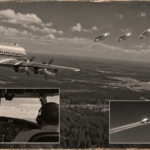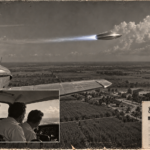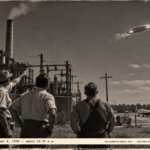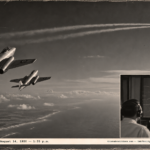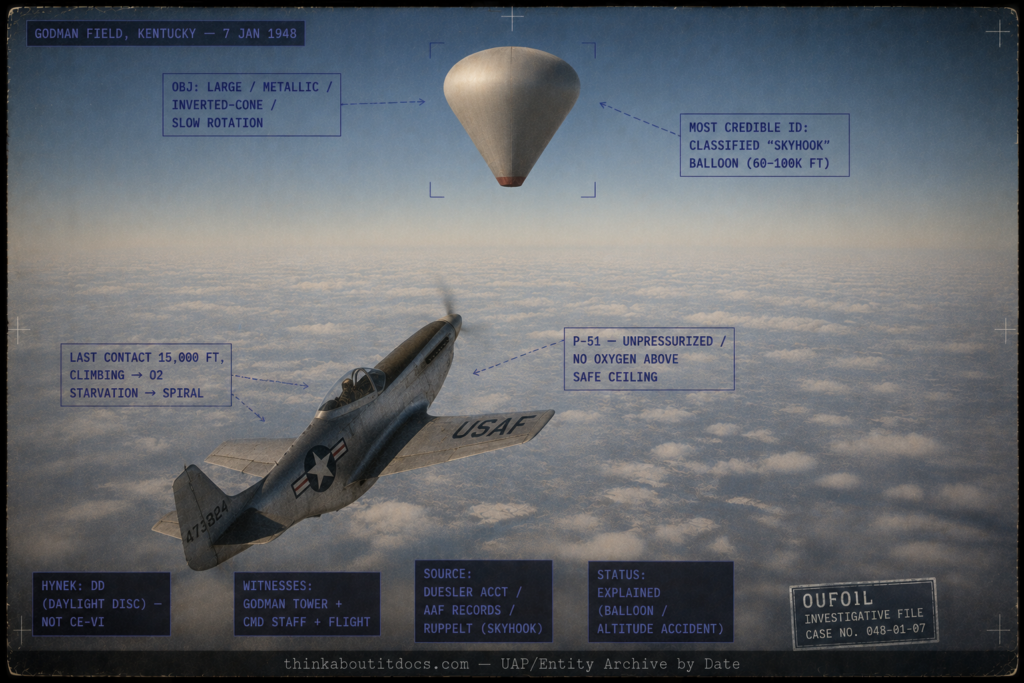
Captain Thomas Mantell climbs his P-51 after a huge high object over Godman Field, January 7, 1948 — a fatal pursuit of what is most credibly a classified Skyhook balloon.
THINK ABOUTIT UFO | UAP SIGHTING REPORT
1948: The Thomas Mantell Incident
At 1:20 on the afternoon of January 7, 1948, the control tower at Godman Field, Kentucky reported a huge, slowly rotating object hanging in the southern sky — an “inverted ice cream cone,” white shading to red, that senior officers crowded the tower to watch and could not name. A flight of National Guard P-51 Mustangs happened to be passing, and their commander, 25-year-old Captain Thomas F. Mantell, was asked to take a look. One by one the other pilots peeled off — low fuel, no oxygen, growing unease — until Mantell alone bored upward after the thing, radioing that it was “metallic and tremendous in size.” Then his transmissions stopped. His Mustang spiraled out of the high cold air and disintegrated near Franklin, Kentucky, the canopy still locked, the pilot dead. It was the first death the public ever tied to the chase of a flying saucer, and for years the object had no name. The name, when it came, was mundane and secret at once: a classified Navy balloon, drifting at the edge of space where an unpressurized fighter could not safely follow.
Date: January 7, 1948
Sighting Time: ~1:20 PM (first tower sighting); Mantell’s pursuit ~2:45–3:18 PM
Day/Night: Day
Location: Godman Field (Fort Knox), Kentucky; crash near Franklin, Kentucky (~city of Franklin / Simpson County), roughly 90–130 miles down range
Urban or Rural: Rural
No. of Entity(‘s): None reported
Entity Type: Not applicable — no occupants or entities
Entity Description: Not applicable
Hynek Classification: DD (Daylight Disc) — a structured daytime object pursued by aircraft. (The death was an aircraft accident, not a direct UFO action; the live page’s CE-VI is not applicable, as the Air Force board found the object was not responsible for the crash.)
Duration: Object observed from Godman tower for roughly 90 minutes to 2+ hours; Mantell’s pursuit ~30 minutes
No. of Object(s): 1
Description of the Object(s): A large object described from Godman tower as round/cone-shaped — an “inverted ice cream cone,” white to grey, the wide bottom showing red, with a dark vertical line giving the appearance of slow rotation. Mantell described it as metallic and tremendous in size. Consistent with a high-altitude Skyhook research balloon.
Shape of Object(s): Round / inverted-cone
Size of Object(s): “Tremendous” per Mantell; not precisely measured
Color of Object(s): White/grey shading to red at the base
Distance to Object(s): High and distant; Mantell pursued to above 20,000+ ft without reaching it
Height & Speed: Object very high (Skyhook balloons operated to ~60,000–100,000 ft); apparently near-stationary/slowly drifting. Mantell’s last report was at 15,000 ft, still climbing; he continued well above 20,000 ft without oxygen.
Number of Witnesses: Many — Godman tower and command staff (incl. base operations officer Capt. Warren Carter and deputy commander Capt. James Duesler), Mantell and his flight, and numerous ground/tower observers across Kentucky and Ohio that evening
Special Features/Characteristics: First publicized fatality tied to a UFO pursuit; experienced combat pilot (Mantell flew in WWII, awarded the Distinguished Flying Cross); aircraft unequipped/unpressurized for the altitude reached; canopy lock intact (no bailout attempted), indicating unconsciousness; object unidentifiable at the time because the Navy “Skyhook” high-altitude balloon program was classified; widespread same-evening sightings of a separate luminous object across Ohio (Lockbourne, Clinton County) reflected in the reproduced documents below
Case Status: Explained (the fatal crash was due to oxygen starvation / loss of consciousness during a high-altitude climb; the object is most credibly identified as a classified Skyhook balloon)
Source: Tony Dodd, “Flight to Destruction: The Strange Death of Pilot Thomas Mantell” (incl. interview with Capt. James F. Duesler, Godman deputy commander); U.S. Air Force / Project Sign records; reproduced contemporaneous military documents (Lockbourne AAB and Clinton County AAB tower-operator affidavits; Air Materiel Command intelligence request, Col. H.M. McCoy). Skyhook identification per Edward J. Ruppelt and subsequent Project Blue Book analysis.
Summary/Description: On January 7, 1948, Godman Field’s tower reported a large, slowly rotating “inverted ice cream cone” object in the sky over Kentucky. Captain Thomas Mantell, leading a flight of four P-51s, was asked to investigate; his wingmen dropped away for fuel, navigation, and lack of oxygen, leaving Mantell to climb alone after the object, which he described as metallic and enormous. His last transmission came at 15,000 feet as he continued to climb; he lost consciousness from oxygen starvation in the unpressurized fighter, and the trimmed aircraft climbed, leveled, spiraled, and disintegrated in the descent, crashing near Franklin, Kentucky. The Air Force found the object was not responsible for the crash. The object itself, unidentifiable at the time, is most credibly explained as a classified Navy Skyhook high-altitude balloon — huge, metallic-looking, and operating far above a P-51’s safe ceiling.
Related Cases: 1947 Kenneth Arnold sighting (wave context); 1948 Chiles-Whitted (Eastern Air Lines, later in 1948); 1949 Gorman dogfight (Fargo, ND — pursuit of a luminous object, also later tied to a balloon/illusion); Project Sign/Grudge/Blue Book Skyhook-balloon misidentifications
DETAILED REPORT
The Mantell incident is among the most historically important early cases not because it was anomalous in the end, but because of what it represented at the time: the first death the American public connected to the pursuit of a “flying saucer,” occurring barely six months into the modern phenomenon. The events are unusually well attested, and the account preserved here draws substantially on a firsthand source — Captain James F. Duesler, Godman Field’s deputy commander, a pilot and crash investigator who was present in the control tower and later served on the accident board, recorded in interview by researcher Tony Dodd.
By Duesler’s account, on the afternoon of January 7, 1948 he was called to the Godman tower, where staff had marked a direction on the window with a slip of paper. In that direction hung a strange grey object he and others described as an inverted ice cream cone — wide part down, narrow part up — appearing to rotate because of a dark vertical line that moved around it, its wide base reddish. A flight of four Air National Guard P-51 Mustangs under Captain Thomas Mantell was approaching, and Mantell was asked to investigate. The flight attrited quickly: one pilot broke off low on fuel, a second grew unsure of his position and was escorted back by a third, leaving Mantell alone in pursuit. His last transmission came at 15,000 feet, reporting the object in sight and that he was closing for a better look. Then nothing. The object was lost to cloud, and the tower’s attention faded — until word came in the small hours that Mantell’s aircraft had gone down roughly 130 miles away.
Mantell was no novice. He was a decorated WWII combat pilot, a Distinguished Flying Cross recipient who had flown through the Normandy invasion — which is part of why his death so unsettled the public and the press. But experience could not substitute for equipment. The P-51 he flew was unpressurized and, critically, his pursuit carried him to an altitude where the thin air could not sustain consciousness without supplemental oxygen, which he lacked or did not use. The Air Technical Intelligence assessment of the crash concluded that Mantell lost consciousness from oxygen starvation; the trimmed aircraft continued to climb until power loss leveled it, then torque rolled the left wing down, the nose dropped, and the Mustang fell into a tightening spiral, the uncontrolled high-speed descent tearing it apart. The intact canopy lock confirmed no bailout was attempted — Mantell, the board judged, never regained consciousness — and the report explicitly stated the object was in no way responsible for the crash.
The reproduced documents retained with this report broaden the picture and are part of why the case kept its grip: contemporaneous military affidavits from tower operators at Lockbourne Army Air Base and Clinton County Army Air Base in Ohio that same evening describe a brilliant, cone- or oval-shaped luminous object, ruddy red shifting to amber, hovering and changing altitude over Ohio hours after Mantell’s death — and an Air Materiel Command intelligence request from Col. H.M. McCoy seeking the crash report for the investigation of “so-called flying discs.” These show both the genuine official interest the case generated and the broader cluster of luminous-object reports that night (some of which may relate to the same or similar high-altitude objects, others to misperceived astronomical or atmospheric phenomena).
The resolution came from within the Air Force’s own UFO project. The object that drew Mantell upward could not be identified in January 1948 because the most likely culprit was itself secret: the Navy’s Skyhook program of enormous polyethylene high-altitude research balloons, then classified, which could rise to 60,000–100,000 feet, present a huge, shiny, metallic-looking, slowly-shifting profile, and appear to hover or drift slowly. Edward J. Ruppelt, who would head Project Blue Book, concluded that a Skyhook balloon was the probable object, and that identification has remained the consensus explanation. Early speculation that Mantell had chased the planet Venus was effectively abandoned in favor of the balloon, which far better fits the size, daytime visibility, and behavior the witnesses described. The tragedy, then, was real and the initial mystery genuine — a credible officer pursuing a genuinely unidentifiable object — but the object had an earthly, if secret, identity, and the death was an altitude accident, not an act of the unknown.
RESEARCHER’S NOTES
Flight to Destruction — Mantell 1948 and the Death That a Secret Balloon Explains
- Classification Basis: The case is best logged as DD (Daylight Disc) — a structured daytime object pursued by aircraft — rather than as a “death” close-encounter category. The CE-VI label on the live page implies the object caused the death; the Air Force accident board explicitly found the opposite, attributing the crash to oxygen starvation during an over-altitude climb. The death is a genuine and tragic fact, but it was an aviation accident incidental to the pursuit, not a direct effect of the object. Case Status: Explained.
- Source Assessment: The sourcing is a mix of strong and characterizing material. The Duesler firsthand account (via Tony Dodd) is valuable testimony from a present, credentialed witness and crash-board member, and it usefully flags discrepancies in how official statements were later attributed. The reproduced contemporaneous military documents (Lockbourne/Clinton County affidavits, the McCoy request) are genuine primary-source material and the backbone of the entry. Against these, the Dodd framing leans toward a cover-up reading (“self-destruct mechanism,” “disinformation programme”) that the evidence does not require; the record reads more straightforwardly as a real accident plus a then-classified balloon. Duesler’s striking detail — that the body was unpunctured but with all bones “crushed and pulverised” — is consistent with a high-speed in-air disintegration and extreme deceleration, not with anything exotic.
- The Skyhook Identification: The decisive context is that the Skyhook balloon program was classified in January 1948, which is precisely why competent observers — including a base command staff — could not identify the object. Skyhook balloons match the reported profile remarkably well: very large, metallic/shiny in sunlight, appearing as a rounded or inverted-cone shape, effectively stationary or slowly drifting, and floating far above a P-51’s safe operating ceiling. Edward Ruppelt’s conclusion in favor of a Skyhook, reached inside the Air Force’s own UFO investigation, is the strongest available explanation and accounts for the case’s facts without recourse to the exotic. The earlier “Venus” hypothesis is weaker and largely superseded.
- Pattern Context: Mantell sits at the hinge of the early phenomenon. It hardened public belief that UFOs were dangerous and that the government knew more than it said — both ideas amplified by the genuine classification of the balloon program, which created real (if mundane) official secrecy that later cover-up narratives mistook for concealment of the extraterrestrial. It belongs to a recognizable 1947–49 cluster of pilots pursuing high, bright, slow objects later attributed to balloons or astronomical bodies (the 1949 Gorman “dogfight” is a cousin). Its enduring lesson is about the danger of the chase itself and the way legitimate secrecy can manufacture an apparent mystery.
- Physical Evidence and Evidentiary Weight: The physical evidence is the crash itself, thoroughly investigated and consistent with an over-altitude blackout and high-speed disintegration. There is no physical evidence pointing to an anomalous object, and the most economical explanation — a classified Skyhook balloon — accounts for every reported feature of the thing Mantell chased. The weight of evidence supports Explained: a real death by aviation accident, and an object with a secret but terrestrial identity.
The death of Thomas Mantell is a genuine tragedy wrapped in a genuine mystery that time has resolved. A decorated combat pilot, asked to investigate a huge, slowly rotating object that his own base command could not identify, climbed his unpressurized Mustang past the altitude a man can survive without oxygen, lost consciousness, and died when his aircraft spiraled out of the sky — the canopy still locked, the object, the Air Force found, blameless for the crash. The thing he chased was unidentifiable in January 1948 for a mundane reason: the Navy’s giant Skyhook research balloons were classified, and one of them, drifting metallic and enormous at the edge of the stratosphere, fits the witnesses’ descriptions and Edward Ruppelt’s own conclusion. The archive logs the case as DD (Daylight Disc), Case Status Explained — a high-altitude balloon and a fatal altitude accident — while preserving it, and the contemporaneous documents below, as one of the most consequential and instructive episodes of the early era: the case that taught the public to fear the saucers, and that shows how real secrecy can wear the mask of the unknown.
Full Report

An artist’s impression of Capt. Thomas Mantell’s fatal encounter with a UFO above the Godman Air Force Base in Kentucky in 1948. (credit: Peter Brookesmith)
Many stories have been written about the untimely death of Captain Thomas Mantell whose USAF P-51 Mustang aircraft crashed on the 7th. January 1948, shortly after having observed an Unidentified Flying Object seen hovering in the air close to the United States Army Air Force Base at Godman Field, Kentucky. Like so many incidents at the time, the official Mantell files remain classified, and the truth within them gathers dust in some vault, probably housed at Wright Patterson AFB Dayton, Ohio.
Over the years such UFO related stories have been debated by researchers throughout the World, but the final proof about such incidents has never been forthcoming. The self-destruct mechanism, which seems to be an inherent part of UFO investigation emerges with uncanny regularity and this coupled with a clever disinformation programme, has stifled the startling truth to the present day.
The Thomas Mantell case is no exception to this rule. The tragic death of this brave pilot has officially been put down to pilot error, but who could say otherwise. Mantell could not defend his actions or tell the true story of what confronted him that fatal day. The official Army Air Force verdict, and that shared by many UFO investigators, is that Mantell’s aircraft crashed after he blacked out owing to lack of oxygen while attempting to fly too high an altitude in what was later described as a high altitude weather balloon. ( It seems that I have heard this weather balloon story before at Roswell)
The case was officially closed and the true circumstances of what had occurred entered the files of Project Saucer, The secret investigation group operating out of Wright Patterson Army Air Field in 1948.
The Official Version Of Events
The Thomas Mantell incident began at 1.20pm. On the 7th. January, 1948. when the control tower operators at Godman Field Army Air Force Base, Kentucky sighted a strange unidentified airborne object hovering in the sky close to the base. Several senior officers were summoned, and the base Operations and Intelligence Officer were soon joined by the Commanding Officer, but none were able to identify the slowly rotating object.
At the time a flight of four P-51 fighters were on a routine training flight under the supervision of Flight Commander Captain Thomas Mantell. They were flying towards Godman Field when at approximately 2.45pm, the control tower officer in charge ordered them to investigate the strange object. Captain Mantell acknowledged, but a short time later one of the pilots requested permission to brake away as he was running low on fuel, leaving the three remaining aircraft to head in the direction of the strange object.
The next message came from one of the three remaining pilots, who said he was losing his bearings and was becoming fearful of becoming lost. He too was granted permission to break away and return, but he would be accompanied by one of the two remaining pilots, who was instructed to accompany his colleague to guide him safely back to base. The only aircraft now in pursuit of the object was that piloted by Captain Thomas Mantell.
At 15,000 feet Mantell contacted the control tower and stated that he had the object in sight and was climbing to investigate. A short time later Mantell reported that he was closing on the object but that was the last message broadcast. Mantell’s aircraft crashed approximately 130 miles down range from Godman Field.
The official Air Technical Information Command report on the crash stated that they were of the opinion that Captain Mantell lost consciousness due to oxygen starvation. The trimmed aircraft had continued to climb until increasing altitude caused a sufficient loss of power for it to level out. The aircraft then began to turn left due to torque and as the wing drooped, so did the nose, until it was in a tight turning spiral. The uncontrolled descent resulted in excessive speed causing the aircraft to disintegrate. It is believed that Captain Mantell never regained consciousness. This was born out by the fact that the canopy lock was still in place after the crash, discounting any attempt to abandon the aircraft. They also stated that the UFO was in no way responsible for the crash.
A SUDDEN BREAKTHROUGH IN INFORMATION
Captain James F Duesler was the deputy commander at Godman Field on the date of the incident. He was also a pilot and crash investigator. Some years later he married an English girl and emigrated to England where he lived in retirement with his wife until she died. He then lived alone until his death.
I was contacted by Jim Duesler after he heard me giving an interview on the radio about the UFO subject and we became good friends and were in constant contact for about three years prior to his untimely death from natural causes. I found Jim to be a very warm and likable man who was easy to befriend- an elderly gentleman of high integrity. He had nothing to gain by recounting his version of the Thomas Mantell incident, which highlights numerous flaws in the official report which contained an official statement issued by the Department Of Defence which they claimed was made by Captain Duesler at the time.
Captain Duesler personally told me that he never made a statement to any authority relating to the incident, and that the DoD statement issued was a fake. He also told me that the fake statement included the words: Certified A True Copy-James F Duesler, Jr, Captain. USAF. He said that this was obviously a fake because he did not serve in the United States Air Force- he served in the US Army Air Corps before the inception of the USAF.
From this point I will only refer to Captain Duesler as Jim as he was obviously a civilian by this time and I will relate his story with the help of a recorded interview.
“On the afternoon of 7th. January, 1948, I was standing on the parking apron of Godman Field talking to Captain Warren Carter, who was the base operations officer, when one of the clerks from the operations centre came up to us and told Captain Carter that he was required in the control tower. He duly went to the tower and a short time later contacted me and requested that I join him as there was something important happening. I went to the control tower and told to look in certain direction into the sky. A small piece of paper had been put on the control room window to give an indication of direction. I looked out and saw a strange grey looking object which was hovering some distance away.
Because of its shape we described it as an inverted ice cream cone. The widest part pointed towards the ground and the narrow part pointing towards the sky. We also noted that the object appeared to be rotating because it had a black line running from top to bottom which moved around, giving the appearance of rotation. The wide bottom of the object was a red colour.
At this time a flight of four Air National Guard P-51 Mustangs were approaching our position at Godman. The flight was under the command of Captain Thomas Mantell.
Mantell was told of the object and requested to investigate. He responded to the request and told us he would investigate. One of the aircraft reported that the running low on fuel and requested that he break off and return to base. Permission was given leaving three aircraft to continue the investigation. A second aircraft then came over the intercom saying that he was unsure of his location and was afraid of getting lost and requested to break away and return to base. He was given permission and one of the two remaining aircraft was instructed to join him and guide him back to base.
This left Captain Mantell’s aircraft alone moving towards the distant object. The last transmission received from Mantell was when he was at 15000 feet, at which time he said that he had the object in sight and was closing for a better look. Nothing more was heard from him. The object then became obscured by cloud and was lost from view. At this our interest in the object was lost and I returned to my quarters.
At about 1am. In the morning, I was awoken from my bed by control room staff who informed me that they were watching strange in the sky. I got up and went to the control tower where they pointed out an object which was circling in a wide arc in the distance. It was agreed by all present that it resembled a cigar shape and was glowing a dull orange colour. During this time control tower operators at St.Louis and Wright Patterson had received reports of the same cigar shaped object. The object had also been reported by a flight of B-25 Mitchell Bombers to the St. Louis tower. I eventually went back to bed only to be awoken again at 3.30a. and informed that Thomas Mantell’s aircraft had crashed approximately 130 miles away. As I was a member of the accident investigation board I was required to attend the scene.
In company with two other men I attended the scene and on arrival found that the aircraft had crashed not far from the road and had strangely come down in the centre of a small clearing surrounded by tall trees. At this time I was told that the body of the pilot had been removed from the aircraft and taken away. Military personnel at the scene also told me that nowhere on the body had the skin been punctured or penetrated; yet all the bones in the body had been crushed and pulverised.
Reports

IMMEDIATE RELEASE
WILMINGTON, Ohio, Jan. 8– A sky phenomena, described by observers at the Clinton County air Base as having the appearance of a flaming red cone trailing a gaseous green mist, appeared in the southwest skies of Wilmington last night between 7:20 and 7:55 P.M.
S/Sgt. Gale F. Walter and Cpl. James Hudson, control tower operators at the airfield, first saw the phenomena at 7:20 P.M. and observed its maneuvers in the sky until 7:55 P.M. when it reported disappeared over the horizon. The sky phenomena hung suspended in the air at intervals and then gained and lost altitude at what appeared to be terrific bursts of speed. The intense brightness of the sky phenomena pierced through a heavy layer of clouds passing intermittently over the area and obscuring other celestial phenomena.
MSgt. Irvin H. Lewis, S/Sgt John P. Haag, Sg. Harold E. Olvis and T/Sgt. Leroy Ziegler, four members of the alert crew, joined the control tower operators in observing the sky phenomena for approximately 35 minutes. XX *30* XX

DET 103rd AACS
LOCKOURNE A. B.
COLUMBUS, OHIO
13 JANUARY 1947
SUBJECT: Report on Unusual Circumstance
TO: CO 332nd FIGHTER WING LOCKBOURNE A B
At approximately 1940 hrs Jan. 7th the Control Tower operator advised he observed an extremely strange bright light in the south west. However by the time I reached the operation steps at the entrance the light faded out. About two minutes later the Tower advised that the phenomenon was visible again. This time I saw the object at about 15 degrees above the horizon to the west south west of Lockbourne. The object was extremely bright, more so than any star. I would say about as large as and as bright as one of the runway lights at full intensity as viewed from the Control Tower. It appeared to have a tapering tail about 6 diameters long and predominantly was of a ruddy red color changing to A amber-yellow at different intervals.
The position of the object in the sky and the fact that we were reporting A high overcast at the time added to the mystery. UP until approximately 1950 hrs the object appeared to be motionless, at this time, however, it descended to the horizon in an interval of about 3 or 4 seconds, hovering there for 3 or 4 seconds and the ascended to its’ original position in an interval of about 3 seconds. It then rapidly began to fade and lower in the sky and disappeared at 1955 hrs.
AF9944 xmtd a position report to me at 1953 hrs over Columbus at 5,000 ft on round robin flight out of Wright Field to Washington and return , and reported a mysterious bright light to the west south west of his position, appearing like an oversized beacon.
Further information on reports from other stations observing the phenomenon can be obtained from flight services at Patterson.
//signed//
Frank M. Eisle
//signed//
*******, E.M.
25238

Below is typed transcription of document.
DETACHMENT 733RD AF BASE UNIT
103rd AACS SQUADRON
LOCKBOURNE ARMY AIR BASE
COLUMBUS 17, OHIO
14 JANUARY 1947
SUBJECT: Report of Unusual Circumstance
TO: Commanding Officer, 332nd Fighter Wing, Lockbourne Army Air Base, Columbus 17, Ohio.
On Wednesday January 7th between the hours of 1915 and 1939, there appeared in the sky a bright glowing object which I could not identify. At first I assumed it to be a star but the sky being overcast, I knew definitely that it was not a star nor an aircraft because the only air- craft flying in the local area was landing at the time. It was not an aircraft flare nor a balloon because it appeared to be enormous in size. I then observed it through the binoculars.
It appeared to be cone- shaped, blunt on top and tapering off toward the bottom. I could not distinguish the attitude in which the object appeared to be. It was glowd from a bright white to an amber color with a small streak trail- ing. It was at a distance between 5 and 7 miles from the control tower at an altitude of approximately 2000 to 3000 feet bobbing up and down and moving in a south-southwesterly direction at a speed exceeding 500 miles per hour.
Also the wind at the time was blowing from east to west and if it had been a balloon or lighter-than-aircraft it would have drifted in the direction the wind was blowing. There was no sound or unusual noise. Its performance was very unusual and the light emitting from it seemed to fade out at times. Just before it disappeared beyond the horizon the light changed to a sort of red color. The same object was later sighted in the vicinity of Clinton County Air Field by operators on duty in the control tower.
I have been actually engaged in aviation as an Air Traffic Control Tower Operator and a Private Pilot for a period of 5 years and thus far in all my experience, I have never encountered an optical illusion or any physical defect that would disqualify my possessions of such ratings.
//signed//
ALEX A. BOUDREAUX
Air Traffic Controller
CAF-6
 Mante
Mante
Below is typed transcription of document.
DETACHMENT 733RD AF BASE UNIT
103RD AACE SQUADRON
LOCKBOURNE ARMY AIR BASE
COLUMBUS 17, OHIO
14 JANUARY 1948
SUBJECT: Report oF Unusual Circumstance
TO : Commanding Officer
332nd Fighter Wing
Lockbourne Army Air Base
Columbus 17, Ohio.
On Wednesday January 7, 1948 at about 1925 Eastern time I observed in the sky an object which I could not identify. It appeared to hover in one position for quite some time, moving very little. It disappeared once for about one minute and I assumed it entered the overcast, which was at about 10,000 feet. After descending again below the overcast it circled one place for the duration of three 360 degree turns, then moved to another position to circle some more. Turns required approximately 30 to 40 seconds each, diameter estimated about two miles.
In moving from one place to another a tail was visible of approximately five times the length of the object. Not knowing how close or how far the object was from me at the time, I could not estimate the size very accurately, but it appeared as large or larger than one of our C 47 planes, and of a different shape. Either round or oval shaped. Just before leaving it came to very near the ground, staying down for about ten seconds, then climbed at a very fast rate back to its original altitude, 10,000 feet, leveling off and disappearing into the overcast heading 120 degrees. Its speed was greater than 500 mph in level flight.
It was visible to me for a period of twenty minutes. No noise or sound could be detected. The color was amber light but not sufficiently bright to cover or obscure the out- line of the configuration was was approximately round. During up and down movement no maneuvering took place. Motions was same as an elevator, climbing and descending vertically. Exhaust trail was noticeable only during forward speed. It appeared as a thin mist approximately same color (amber) as the object. Length about 5 times length of object.
During descent it appeared to touch the ground or was very close to touching it. It was approximately 3 to 5 miles away from Lockbourne Air Base in immediate vicinity of COMMERCIAL POINT. It positively was not a star, comet or any astronomical body to the best of my knowledge of such thing. I also rule out the possibility of it being a balloon, flare, dirigible, military or private aircraft. Ltr, Subj: Report of Unusual Circumstance, 14 Jan 48 (Cont’d) I am 26 years old and in good health and have excellent vision. I have been actively engaged in aviation 6 years. I have a private pilot license and spent 3 years 10 months in the U. S. Army Air Corps as a Sergeant link trainer instructor, instrument flight observer. The statements made herein are true and accurate to the best of my knowledge and may be used for any official purpose as deemed necessary.
//signed//
ALBERT R. PICKERING
VHF/DF Operator
CAF 7
 Below is typed transcription of document.
UNCLASSIFIED
MCIA/ACL/amb
JAN 14, 1947
Request for Report on Crashed P-51 National Guard Aircraft
Commanding Officer
315th AAFBU (Reserve Training)
Godman Field, Kentucky
1. It has been brought to the attention of this office that an official report has been made regarding the National Guard P-51 air- craft that crashed as a result of chasing an unidentified object on 7 January 1948. Information contained in this report may contribute greatly in the accomplishment of intelligence investigations of un- identified flying objects, or so-called “flying discs”.
2. It is requested, therefore, that a copy of this report be made available to this Command as soon as possible.
FOR THE COMMANDING GENERAL: H. M. McCOY
Colonel, USAF
Chief of Intelligence

Below is typed transcription of document.
PAGE II
(State of Ohio)
COUNTY OF CLINTON)
Before me, the undersigned Authority for administering oaths of this kind, personally appeared one James H. Hudson, Cpl, ASN 13220873 who, being first duly sworn by me, deposes and says;
The following information came over Plan 62: This observation was made in Kentucky at the scene of the P-51 crash with an 8″ telescope:
1. Height, 4 miles.
2. Width, 43 feet.
3. Height of object, 100 feet.
4. Speed at time, 10 mph
5. Shape, Cone.
6. Color, red with green tail.
This observation was taken at Godman Field, Kentucky, with a theolite:
1854 CST.
Elevation, 2.4 Azimuth 254.6
1856 CST
Elevation, 2.0 Azimuth 253.9
1902 CST
Elevation, 1.2 Azimuth 253.0
1906 CST
Disappeared.
The following is my opinion:
The object is not a comet or star, but was man made. It was not a balloon, comet, star, aircraft of known type. The light did not come from an aircraft’s running lights. The whole object appeared to be surrounded with a burning gas or something that gave a light.
Further the deponent sayeth not,
//signed//
JAMES H. HUDSON, Cpl
13220873
Sworn to and subscribed before me this 20th day of January , 1948
//signed//
GEORGE W. HOHANNESS
Captain, USAF

Below is typed transcription of document.
Before me, the undersigned authority for administering oaths of this kind, personally appeared one John P. Haag,
S/Sgt, AF 17003481
who, being first duly sworn by me, disposes and says:
The unidentified flying object was sighted in a South-West position at Clinton County Army Air Base at a heading of approximately 210 degrees on 7 January 1948, first being visible to this person at 19:35 o’clock when it was pointed out to me. The weather at the time was clear over the base, with a South-West wind which was moderate.
There seemed to be an overcast in the South-West which was a layer approximately 1000 feet thick. The height of this overcast was approximately 5000 feet. The one and only object which was seen with the naked eye seemed to be about five miles from the field at an estimated altitude of 15,000 to 20,000 feet.
The object seemed to remain stationary as first seen, with a light which resembled a complete wing of an airplane on fire. There was no beam of light projected. Then, for a period of five minutes I just took occasional glances at it as I went up the the Control Tower and observed the object through field glasses, which I then decided was not a comet or falling star, to my knowledge of astronomy. With the aid of field glasses, the object appeared to go from an altitude of 15,000 feet to 10,000 feet without any noticed forward or backward motion and then back up to its original altitude very rapidly, about three or four times. It seemed that when the object moved, a red light would dominate and change to a green light and then back to it’s original color.
It then began moving at a heading of 210 degrees and went behind the overcast and the light was seen through the overcast. The object moved very fast away; it stopped momentarily for three or four minutes and disappeared over the horizon at 15:55. No sound was heard from this object or no photographs taken.
Further the deponent sayeth not,
//signed//
JOHN P. HAAG S/Sgt,
AF 17003481
Sworn to and subscribed before me this 21 day of January , 1948
//signed//
ROBERT O. PETRANEKS Caots in, USAFR