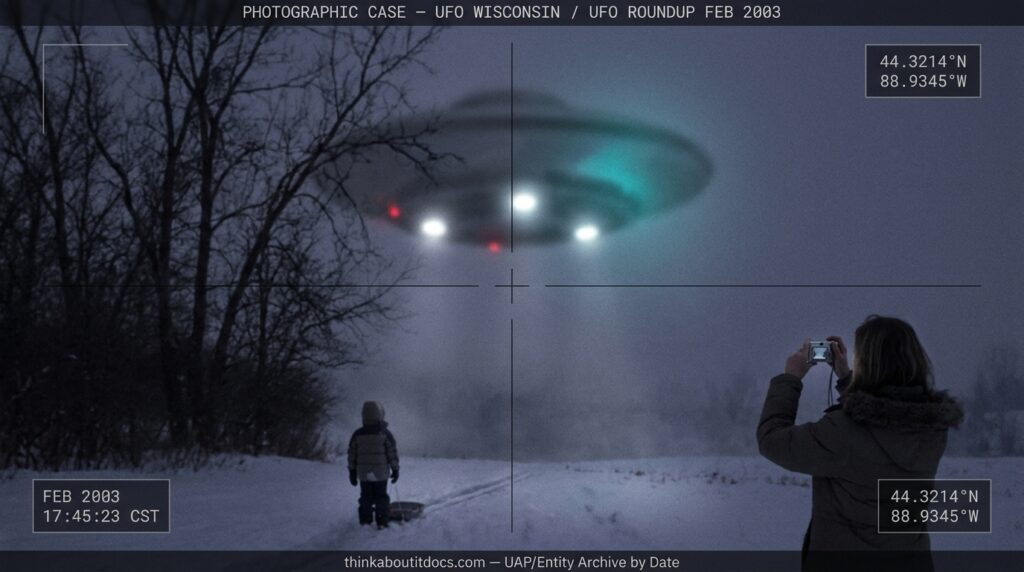
February 2003 — A disc with cycling white, red, and aqua lights photographed over Weyauwega, Wisconsin. Independent analysis found no evidence of digital manipulation.
THINK ABOUTIT UFO|UAP SIGHTING REPORT
2003: Weyauwega, Wisconsin UFO Photographs
In February 2003, a woman photographing her son sledding in a Weyauwega, Wisconsin neighborhood pointed her digital camera skyward and captured two of the clearest UFO images to come out of early-2000s Wisconsin. The photographs show a disc-shaped object with three bright white lights and a small red light in the first frame, and four lights with an aqua cast in the second — the lights apparently cycling through different patterns as the object moved from the southwest toward the railroad tracks. Independent photographic analysis published on ufowisconsin.com found no evidence of digital manipulation, confirmed proper occlusion by foreground tree branches, and noted atmospheric wash-out consistent with a genuine object at significant altitude. The witness subsequently declined all further contact.
The Weyauwega photographs represent a rare intersection in UAP case work: clear images, a competent technical review, multiple witnesses, and a straightforward account — weakened only by the witness’s withdrawal, which leaves the case permanently incomplete but does not invalidate the photographic evidence that survives it.
Date: February 2003 (exact date not specified)
Sighting Time: Evening, transitioning to dark
Day/Night: Dusk to night
Location: Weyauwega, Waupaca County, Wisconsin (north of Main Street, east side of Highway 110, south of the railroad tracks)
Urban or Rural: Rural (small town, population approximately 1,900)
No. of Entity(‘s): 0
Entity Type: N/A
Entity Description: N/A
Hynek Classification: NL (Nocturnal Light) — Luminous source observed during evening darkness. Although photographic analysis revealed disc-shaped structure, the sighting occurred during the transition from dusk to dark, and the object was perceived primarily as a pattern of cycling lights. See Researcher’s Notes for classification discussion.
Duration: Several minutes (sufficient for the object to transit from the southwest, pass nearly overhead, and continue south toward the railroad tracks; two photographs taken during transit)
No. of Object(s): 1
Description of the Object(s): Disc-shaped object displaying dynamic lighting. First photograph: three bright white lights and one small red light in a circular arrangement, with a clearly resolved disc outline. Second photograph: four lights with an aqua color cast in a lower sky position, with a less distinct but still circular outline visible through tree branches. Lights appeared to cycle through different patterns during transit. Object was washed out in the images, consistent with atmospheric haze at altitude. Initial impression was balloon-like; disc shape became apparent as the object moved further south and presented a different viewing angle.
Shape of Object(s): Disc / circular
Size of Object(s): Not estimated; appeared significant in photographs relative to foreground tree branches
Color of Object(s): Three bright white lights and one small red light (photo 1); four lights with aqua cast (photo 2); disc outline visible in both frames
Distance to Object(s): Not precisely estimated; passed nearly directly overhead, then receded southward
Height & Speed: Appeared to be at considerable altitude (atmospheric wash-out in images consistent with high-altitude object through haze); moved steadily from southwest to south at moderate apparent speed
Number of Witnesses: 2 (the reporting witness and her son)
Special Features/Characteristics: Photographic evidence — two digital photographs survived and underwent independent technical analysis. Dynamic light-cycling behavior observed in real time and documented across the two frames (white/red configuration shifting to aqua quad configuration). Object appeared behind foreground tree branches in both images, supporting genuine distance. No JPEG compression anomalies or digital manipulation artifacts detected. Atmospheric wash-out consistent with altitude. Witness declined further contact after initial report.
Case Status: Unexplained
Source: UFO Wisconsin Report (ufowisconsin.com) | Photographic analysis published on ufowisconsin.com | UFO Roundup, February 26, 2003 issue
Summary/Description: A woman and her young son observed a luminous object with cycling light patterns pass nearly overhead from the southwest while visiting a friend in Weyauwega, Wisconsin during February 2003. She captured two digital photographs showing a disc-shaped object with white, red, and aqua lights. Independent photographic analysis found no evidence of digital manipulation and confirmed characteristics consistent with a genuine airborne object at altitude. The witness declined further contact after the initial submission.
Related Cases: 2004: Oval object photographed over Wisconsin lake (photographic evidence, anonymous witness) | 1985: Eau Claire cross-shaped CE-I (Wisconsin, cycling lights/energy effects)
Detailed Report
On a February evening in 2003, the reporting witness was visiting a friend at a residential address in Weyauwega, a small town of roughly 1,900 people in Waupaca County, central Wisconsin. The location was north of Main Street, east of Highway 110, and south of the railroad tracks — a quiet neighborhood at the edge of open Wisconsin farmland. Her son was sledding in the snow, and she was taking photographs of him in the last light of the day. The digital camera was already in her hands when the sky offered something unexpected.
As darkness began to set in, her son pointed upward. Both of them noticed lights approaching from what the witness believed was the southwest. The lights were clearly structured — not random or scattered — and moved steadily across the sky. The witness did the most useful thing a civilian observer can do in the moment: she pointed her camera up and took photographs. She captured two images of the object as it transited the sky above the neighborhood.
In the first photograph, taken as the object passed nearly directly overhead, the camera resolved a circular shape with three bright white lights and a single smaller red light arranged in a structured pattern. A disc outline was clearly visible. In the second photograph, taken as the object moved south toward the railroad tracks and dropped lower relative to the observer, the object displayed four lights with a distinct aqua color cast, and the circular outline was less sharp but still discernible through the bare winter tree branches. The witness noted that the lights appeared to cycle through different patterns during the transit — the configuration was dynamic, not static.
Her initial impression was that the lights belonged to a balloon — a reasonable first hypothesis for an illuminated moving object in the sky. But as the object receded southward, she perceived a disc shape rather than the spherical or oblong profile of a balloon or blimp. Her son asked repeatedly what it was. She did not know.
The witness submitted the photographs and a brief account to UFO Wisconsin (ufowisconsin.com). The sighting was also reported in the February 26, 2003 issue of UFO Roundup. An independent photographic evaluation was published on ufowisconsin.com. After the initial submission, the witness declined to provide further details, answer follow-up questions, or identify herself publicly. She has not been heard from since.
The Photographic Analysis
The technical review published on ufowisconsin.com examined both images for signs of digital manipulation, optical artifacts, and physical consistency with an airborne object at altitude. The first photograph showed JPEG compression artifacts consistent with standard consumer digital camera output of the early 2000s — the boxy appearance of the sky and granularity around branch edges were characteristic of JPEG encoding, not post-processing manipulation. The object appeared positioned behind the foreground tree branches, with one notable exception: the bright lower-left light washed out a thin branch in front of it. The analyst noted this was consistent with a very bright light source overpowering a thin foreground element rather than evidence of compositing. A small branch was clearly visible in front of the dimmer red light, confirming the object’s position behind the tree canopy.
The second photograph showed a less distinct but still circular outline with four lights exhibiting an aqua cast. The disc shape was visible through the branches. The analyst found no evidence of digital paintbrush smearing, masking artifacts, or pixel-level inconsistencies that would indicate compositing. Both images displayed a washed-out quality on the object itself, consistent with how a physical object would appear at significant altitude during a cloudy evening — atmospheric haze softening detail and reducing contrast. This characteristic argued against a close-range hoax, which would have rendered with sharper edges and higher contrast.
Researcher’s Notes
The Weyauwega Photographs — Waupaca County 2003 and the Photographic Evidence Standard
- Photographic Evidence Quality: The Weyauwega photographs occupy a relatively strong position in the spectrum of UAP photographic evidence for their era. They were taken with a consumer digital camera of early-2000s vintage, which limits resolution but also limits the sophistication of any potential manipulation available to a casual hoaxer. The images show characteristics consistent with a real object at genuine distance: proper occlusion by foreground branches, atmospheric wash-out at altitude, standard JPEG compression artifacts, and no detectable compositing seams or digital alteration signatures. They are not conclusive — no single photograph or pair of photographs can be — but they passed a competent technical review without raising red flags. The case would benefit enormously from the original uncompressed image files, which would allow a more granular pixel-level and EXIF metadata analysis, but the witness’s withdrawal from contact makes this unlikely.
- The Light-Cycling Behavior: The witness described the object’s lights as cycling through different patterns — not a fixed configuration but a dynamic display that shifted between the two photographs. This detail is analytically significant because it narrows the field of mundane candidates. Hot-air balloons carry fixed burner illumination. Conventional aircraft maintain standard navigation light positions (red port, green starboard, white aft). Advertising blimps display static or scrolling text patterns. The shift from a white-and-red configuration in the first photo to an aqua-cast quad arrangement in the second does not match any conventional lighting system operating within FAA regulations. If the cycling was genuinely observed (rather than a misperception of viewing-angle changes), it constitutes one of the case’s strongest anomalous indicators.
- The Witness Withdrawal Problem: The reporting witness’s decision to stop communicating after the initial submission is the case’s most significant weakness. It can be read as privacy protection — a reasonable impulse for someone in a small town who did not seek attention and may have regretted the submission once it attracted interest. It can also be read as reluctance to face deeper scrutiny. Without further contact, neither interpretation can be confirmed or eliminated. What can be said is that the photographs themselves have not been debunked by the analysis that was conducted, the witness’s initial account is internally consistent and free of embellishment, and her withdrawal does not retroactively invalidate the physical evidence in the images.
- Geographic and Seasonal Context: Weyauwega sits in rural Waupaca County, central Wisconsin, well away from major military installations or restricted airspace. The nearest significant airport is Appleton International (ATW), approximately 30 miles to the southeast. The area has no documented history of concentrated UAP activity, making this a geographically isolated report rather than part of a regional flap. The February timing means cold, clear winter air with good visibility once darkness falls — conditions favorable for both genuine observation and for sharp photographic resolution at distance. The ground-level context (snow, sledding, residential neighborhood, a child present) is entirely ordinary, which is typical of credible spontaneous sightings.
The Weyauwega photographs from February 2003 represent a genuinely interesting case: two images of an apparent disc-shaped object with dynamic cycling lights, taken by a civilian witness during a mundane family outing, showing no detectable signs of digital manipulation and displaying optical characteristics consistent with a real object at altitude. The case is weakened by the witness’s refusal to engage further and by the absence of corroborating reports from other observers in the area. It is strengthened by the photographic analysis, the internal consistency of the account, and the light-cycling detail that does not match conventional aircraft lighting. The photographs remain among the clearer UFO images from early-2000s Wisconsin and earn their place in the archive as evidence that warrants continued scrutiny rather than either promotion or dismissal.
Media